

Michael Jordan and the Psychology of Ruthless Competitiveness
Reviewed by a Psychology Postgraduate (MA)
Michael Jordan psychology starts with a simple question: what makes one person want to win more than everyone else in the room — and keep wanting it for twenty years? The short answer is that Jordan combined an unusually fierce competitive drive with obsessive preparation, a memory for every slight, and an ability to treat pressure as fuel rather than threat. Research on competitiveness, deliberate practice, and performing under pressure helps explain how those pieces fit together — and why the same traits that built six championships also made him famously hard to be around. This is an educational look at Jordan’s public behaviour and the research around it, not an assessment of the man himself.
Jordan was born on 17 February 1963 in Brooklyn, New York, and raised in Wilmington, North Carolina. He was drafted third overall by the Chicago Bulls in 1984, won six NBA championships with them in the 1990s, was named the league’s Most Valuable Player five times, and retired — for the final time — in 2003 after two seasons with the Washington Wizards. He was inducted into the Basketball Hall of Fame in 2009. Along the way he became the most famous athlete on the planet, the face of Nike’s Air Jordan line, and, decades after his last game, still the standard every great player is measured against. The story is well known. The psychology underneath it is the interesting part.
Story
Jordan grew up in a competitive household. His father, James Jordan, was a maintenance supervisor and his mother, Deloris, worked in banking; the family moved to Wilmington when Michael was a toddler. He played against his older brother Larry in the backyard — Larry, shorter and older, usually won, and Michael hated losing to him with an intensity his family still talks about. That backyard rivalry is where the pattern started: losing was not information, it was an insult, and the response was to practise until the result changed.
At Laney High School in Wilmington, Jordan tried out for the varsity basketball team as a 15-year-old sophomore in 1978 — and was cut. The coach, Clifton “Pop” Herring, kept him on junior varsity instead, judging him too short at 5 ft 10 in and too raw. Jordan has told the story himself, many times, and the details matter less than what he did with it: he went home, cried, and then spent the next year working relentlessly. He grew roughly four inches that summer, made varsity as a junior, and by his senior year was averaging a triple-double and being recruited by every major college programme in America.
He chose the University of North Carolina, coached by Dean Smith, and as a freshman in 1982 he hit the game-winning jump shot in the NCAA championship final against Georgetown. It was the first time a national audience saw what would become Jordan’s signature quality: in the biggest moment, he wanted the ball. He stayed at UNC for three years, won college player of the year honours, and left for the NBA in 1984.
The Chicago Bulls team he joined was a losing franchise. Jordan changed that almost immediately — Rookie of the Year in 1985, scoring champion, All-Star — but team success took longer. The Bulls lost to the Detroit Pistons in the playoffs three years running, in 1988, 1989 and 1990. Detroit’s “Jordan Rules” defence was designed to hit him hard every time he drove to the basket. Jordan’s response was not to complain but to rebuild his body, adding muscle in the summers so he could take the punishment and keep coming. In 1991 the Bulls swept Detroit in the conference finals and then beat the Los Angeles Lakers for the franchise’s first championship. They won three in a row from 1991 to 1993.
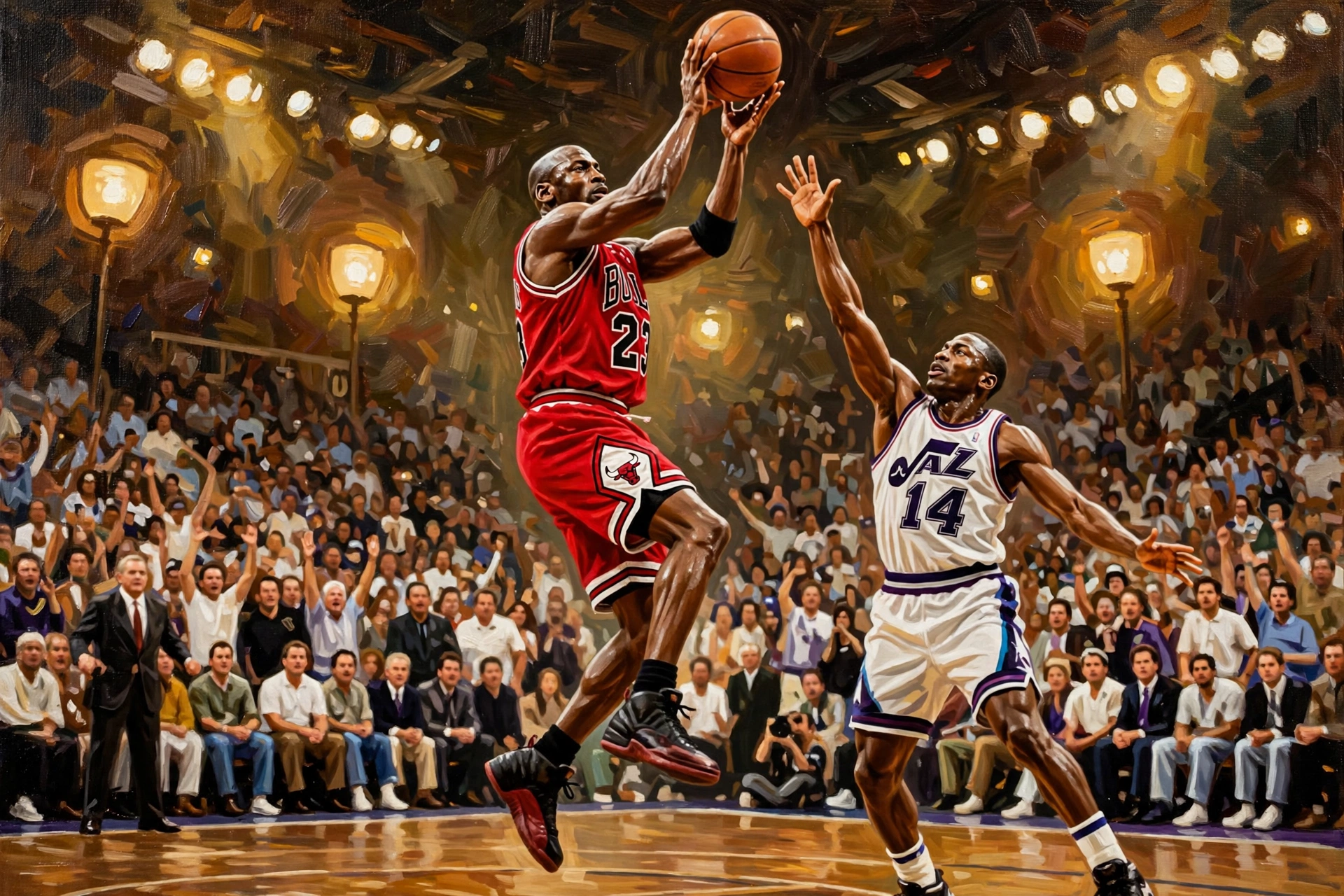
Then came the rupture. In July 1993, Jordan’s father was murdered at a highway rest stop in North Carolina, a killing that shocked America and devastated Jordan. He had been extraordinarily close to his father, who had been a constant presence at his games. In October 1993, at 30 years old and at the peak of his sport, Jordan announced his retirement from basketball, saying he had lost the desire to play. He spent 1994 playing minor-league baseball for the Birmingham Barons, hitting .202 — respectable for a beginner, nowhere near professional standard. In March 1995 he returned to basketball with a two-word fax: “I’m back.” The Bulls won a record 72 games in the 1995–96 season and three more championships from 1996 to 1998, the last sealed by Jordan’s final shot over Bryon Russell in Game 6 of the 1998 Finals against Utah. He retired again in January 1999, returned with the Washington Wizards in 2001 at 38, and retired for good in April 2003.
After basketball came the second career: part-owner and then majority owner of the Charlotte Hornets from 2010 until selling his majority stake in 2023, co-owner of the NASCAR team 23XI Racing, and the Jordan Brand, which grew from a shoe deal into a business worth billions. In 2020, the documentary series The Last Dance — filmed during the 1997–98 season and released during the pandemic — introduced Jordan’s story to a new generation and became one of the most-watched sports documentaries ever made.
Turning Point
Which moment made Michael Jordan? There are two strong candidates, and together they explain more than either does alone.
The first is being cut from the varsity team in 1978. It is the story Jordan himself returns to most often, and it is also the story most people misunderstand. The cut did not create his competitiveness — the backyard games with Larry show it was already there. What the cut did was give that competitiveness a clear, personal target: a named coach, a specific rejection, a date he could remember. Psychologists call this kind of experience a formative setback — a failure that gets woven into a person’s identity and becomes a reference point for everything after. Jordan spent the rest of his career collecting such reference points: coaches who doubted him, opponents who trash-talked him, reporters who questioned him. He kept a mental ledger of slights and used it as fuel.
The second turning point is the summer of 1993. His father’s murder removed the person whose approval mattered most, and his retirement that autumn was, by his own account, about grief and exhaustion as much as anything else. The eighteen months away — the baseball experiment, the time out of the spotlight — changed the terms of his return. When he came back in 1995, the hunger was different: less about proving himself to others, more about proving something to himself after loss. The second three-peat, the 72-win season, the Flu Game — all of it happened after the turning point, not before. The lesson is not that suffering makes people great. It is that Jordan’s response to loss was to return to the one structure he trusted — relentless preparation — and let the work carry him while the grief settled.
Mindset
What was going on in Jordan’s head? He has described his own approach in interviews over decades, and three habits show up again and again.
First, he treated every game as personal. Opponents, reporters, even teammates discovered that Jordan remembered things. A throwaway comment in a newspaper could become motivation for months. The most famous example came during The Last Dance, when Jordan admitted he had invented a slight — claiming a Seattle player had insulted him — simply to give himself something to play against. That is not a recommendation; it is a window into how his motivation worked. He manufactured urgency when none existed, because urgency was the state in which he performed best.
Second, he trusted preparation over inspiration. Jordan’s practice habits were legendary: first in the gym, last to leave, shooting hundreds of free throws after everyone else had gone home. He famously said that he had missed more than 9,000 shots in his career, lost almost 300 games, and failed to make the winning shot 26 times — and that this was precisely why he succeeded. The framing matters: he did not deny failure, he collected it and used it as evidence that he kept showing up.
Third, he separated the moment from the stakes. Teammates and coaches describe Jordan in big games as calm, almost detached — as if the roar of the arena had been turned down. That is not the absence of nerves. It is what happens when preparation has been so thorough that the body knows what to do without the mind having to supervise. Psychologists call this automaticity: skills practised to the point where they run without conscious effort, freeing attention for the decisions that actually matter in the moment.
Decisions
Jordan’s career is a series of decisions that looked risky at the time and obvious in hindsight — and a few that still divide opinion.
Choosing North Carolina over other offers. Dean Smith’s system was famously team-first, and some scouts worried it would hold Jordan back. Instead it taught him the discipline of playing within a structure — passing, defending, waiting for his moment — that later made the Bulls’ triangle offence work.
Signing with Nike in 1984. Jordan preferred Adidas, the brand he had worn in college. Nike, then a running-shoe company trying to break into basketball, offered him his own shoe line and a share of the revenue. The Air Jordan 1 was banned by the NBA for violating uniform rules — the league fined Nike $5,000 per game, which Nike happily paid — and the controversy made the shoe a cultural phenomenon. It was a business decision that became a second fortune, and it showed Jordan’s willingness to bet on himself rather than take the safer, more established option.
Retiring in 1993. At 30, coming off a third straight championship, Jordan walked away. The public explanation was lost desire; the private context was his father’s murder and the exhaustion of constant scrutiny. Whatever the mix of reasons, it was a decision almost no athlete at his peak had ever made — and it is the decision that makes his story more than a highlight reel.
Coming back in 1995, and again in 2001. Both returns invited the same question: why risk the legacy? The 1995 return produced the greatest season in NBA history. The 2001 return, with the Washington Wizards at 38, produced two solid seasons and no playoffs. Together they say something useful about Jordan: he was never protecting a statue. He wanted to play, so he played, and the outcome — glorious or ordinary — was secondary to the act itself.
Buying the Hornets. In 2010 Jordan became the first former player to become majority owner of an NBA franchise. The team struggled on the court for most of his tenure, and he sold his majority stake in 2023 at a valuation reported around $3 billion — a substantial financial success and a mixed basketball one. It is a reminder that the skills that make someone great at one thing do not automatically transfer to another, however competitive the person is.
Method
Jordan’s method was not a secret. It was visible to anyone who watched him practise, and it had four parts.
1. Deliberate repetition. Jordan did not just practise a lot; he practised the specific things that failed. After the Pistons beat the Bulls in 1990, he spent the summer in the weight room, not on the court — he had identified the physical weakness the losses exposed and fixed that first. This is close to what the psychologist Anders Ericsson called deliberate practice: focused work on weaknesses, with feedback, at the edge of current ability, rather than comfortable repetition of strengths.
2. Competitive practice. Jordan turned training into a contest. Teammates have described practice sessions that felt like finals, with Jordan trash-talking, raising the stakes, and refusing to lose even a shooting drill. The point was to make the real games feel easier than practice — to train under pressure so that pressure itself became familiar.
3. Film and memory. Jordan studied opponents obsessively and remembered their tendencies, their tells, their weaknesses. He also remembered his own failures in detail — the missed shots, the lost series — and used them as a checklist of what to fix. Memory, for him, was a tool, not a burden.
4. Rest as part of the method. This is the part people forget. Jordan was known for golf, for naps, for protecting his sleep and his downtime during the season. The intensity was real, but it was not constant; it was switched on for work and switched off elsewhere. That rhythm — full effort, then real recovery — is exactly what modern research on performance recommends, and it is one reason his body held up through fifteen seasons.

What If?
Counterfactuals are fun with Jordan because his career nearly went several different ways.
What if the Portland Trail Blazers had drafted him second in 1984? Portland, needing a centre, took Sam Bowie instead; Jordan went third to Chicago. In Portland, Jordan would have played alongside Clyde Drexler — another great shooting guard — in a smaller market, without the Bulls’ stage. The dynasty almost certainly never happens, and the global Jordan brand probably never reaches the same scale. Draft position, that most arbitrary of things, shaped a life.
What if he had never left basketball in 1993? The Bulls might have won a fourth straight title in 1994 — or they might have burned out. The eighteen months away cost him a season and a half of his prime, but they also gave him rest, distance, and a reason to return. Without the break, the second three-peat — the 72-win season, the Flu Game, the final shot — might not exist at all.
What if his father had lived? This is the one Jordan himself has addressed. James Jordan was his closest adviser and his loudest cheerleader. The 1993 retirement is inseparable from the loss. A Jordan who never lost his father at 30 might have played straight through the 1990s — and might never have discovered what the break taught him about why he played at all.
The point of asking is not to rewrite history. It is to notice how much of a life turns on timing, luck, and decisions made with incomplete information — and how little of it was inevitable, even for Michael Jordan.
What Most People Lack
Jordan’s story tempts people to copy the visible parts: the trash talk, the killer instinct, the refusal to lose. The parts most people actually lack are quieter, and they are the parts that made the visible ones work.
The first is tolerance for boring work. Jordan’s greatness was built on thousands of hours of unglamorous repetition — free throws, footwork drills, weight sessions, film study. Most people want the competitiveness without the calendar. Jordan’s edge was that he treated the boring work as the real work, and the games as the reward for it.
The second is a long memory for failure. Most of us protect ourselves by forgetting our failures, or by explaining them away. Jordan did the opposite: he kept them, studied them, and returned to them. The 1986 playoff loss to Boston, the three straight defeats to Detroit, the missed shots — he carried them openly, even listed them in his famous “failure” speech. That willingness to look directly at what went wrong is rare, and it is learnable.
The third is the ability to want something badly without needing it to be easy. Jordan’s career is a record of choosing the harder path — the tougher defender, the bigger moment, the team that had beaten him before. Most people, faced with the same choice, pick the easier one and then wonder why nothing changes. The difference is not talent. It is the habit of choosing the hard thing on purpose.
What Successful People Do Differently
Watch Jordan’s career next to other great athletes and a few patterns stand out — patterns that show up in research on high performers in every field, not just sport.
They practise the weak spots, not the strengths. After the Pistons beat him, Jordan lifted weights. After the 1995 playoff loss to Orlando, he came back with a fadeaway jump shot that no one could defend. The pattern is always the same: find the gap, close the gap, move on to the next one. Most people practise what they are already good at because it feels rewarding. Successful people practise what they are bad at because that is where the growth is.
They make pressure familiar. Jordan’s practices were harder than most people’s games. By the time the real pressure arrived, it felt routine. This is the logic behind stress inoculation: expose yourself to manageable doses of pressure in training, and the real thing stops feeling like an emergency.
They keep score honestly. Jordan knew his numbers — his shooting percentages, his record against each opponent, his failures. He did not inflate them or hide from them. Honest scorekeeping is what turns effort into progress, because you cannot improve what you refuse to measure.
They protect their recovery. Jordan slept, played golf, and switched off between games. The stereotype of the relentless competitor who never rests is a myth; the real pattern is intensity followed by genuine recovery, repeated for years. Burnout ends careers. Rhythm sustains them.
Success Mindset
Jordan’s own words are the best summary of his mindset, and they are worth reading carefully because they are less about talent than people assume.
“I’ve missed more than 9,000 shots in my career. I’ve lost almost 300 games. Twenty-six times I’ve been trusted to take the game-winning shot and missed. I’ve failed over and over and over again in my life. And that is why I succeed.”
The quote works because it reverses the usual story. Failure is not the opposite of success in Jordan’s account — it is the mechanism. Each miss is evidence of another attempt, and attempts are what produce skill. This is close to what the psychologist Carol Dweck calls a growth mindset: the belief that ability can be developed through effort, rather than being a fixed trait you either have or don’t. Jordan embodied the growth mindset in practice long before the term was popular — not by talking about it, but by treating every failure as a data point.
There is a second idea underneath the quote, and it is about self-efficacy — the psychologist Albert Bandura’s term for the belief that you can handle what comes next. Self-efficacy is not built by easy wins. It is built by surviving hard things and noticing that you survived them. Jordan’s career is a long list of hard things survived: the cut, the Pistons, the retirement, the return, the final shot with the season on the line. Each one added to the belief. By the end, the belief itself was part of the skill.
Failures
A profile that only lists Jordan’s wins would be dishonest. The failures matter — and he has always talked about them more openly than most stars do.
Baseball. The 1994 season with the Birmingham Barons is the most visible failure: a .202 batting average, 114 strikeouts, and the clear verdict that a year of professional baseball was not enough to make a professional baseball player. Jordan has said he does not regret it. The experiment cost him a year of basketball, but it also showed him — and everyone watching — that his greatness was specific, not general. He was not good at everything. He was extraordinary at one thing, and the baseball year proved it by contrast.
The Washington years. Jordan’s comeback with the Wizards in 2001–03 produced two seasons without a playoff appearance and, at times, visible friction with younger teammates. It dented the perfect ending of 1998. It also showed something admirable: he did not need the ending to be perfect. He wanted to play, and he accepted the ordinary results that came with it.
The Hornets. As majority owner from 2010 to 2023, Jordan’s Charlotte teams made the playoffs twice in thirteen seasons and never won a series. The business outcome was excellent — he sold at a large profit — but the basketball outcome was poor, and he has been candid that the team did not achieve what he hoped. It is a useful corrective to the idea that competitiveness alone guarantees results: the skills of playing and the skills of running a franchise are different skills.
The gambling scrutiny. In 1993, Jordan’s gambling became a public story — an Atlantic City casino visit the night before a playoff game, large bets, questions from reporters. The NBA investigated and found no evidence of wrongdoing, and Jordan has said he gambled for fun and competition, not out of compulsion. But the episode damaged his image at the time and remains part of the record. It is a reminder that the same appetite for risk that made him great on the court could look reckless off it.
Relationships
Jordan’s relationships were central to his career, and complicated in ways his teammates have described honestly.
His closest bond was with his father, James, who attended nearly every home game, travelled with the team, and was, by Jordan’s own account, his best friend. His father’s murder in 1993 is the single most important event in Jordan’s personal life, and it reshaped everything that followed.
With teammates, Jordan was demanding to a degree that some found inspiring and others found brutal. He pushed Scottie Pippen, his co-star through all six championships, relentlessly — and Pippen has said the pushing made him better. He clashed with others: he punched teammate Steve Kerr in practice in 1995 (the two later reconciled and became friends), and his treatment of younger players was often harsh. The honest version is that Jordan’s leadership style worked for some people and not for others, and that the championships do not erase the cost for the ones it did not work for.
His most important professional relationship may have been with coach Phil Jackson, who arrived in 1989 and built the triangle offence around Jordan’s gifts while teaching him to trust his teammates. Jackson’s calm, philosophical style was the counterweight to Jordan’s intensity, and Jordan has credited him repeatedly. It is a useful lesson about leadership: even the most driven person in the room benefits from someone who can see the whole picture.
Jordan married Juanita Vanoy in 1989; they divorced in 2006. He married Yvette Prieto in 2013, and they have twin daughters. He has three children from his first marriage. His family life has been kept largely private, which is itself a choice — and one the public record respects.
Dark Side
No honest profile of Jordan can skip the hard parts, and the hard parts are well documented in the public record — including by Jordan himself in The Last Dance.
The competitiveness that built his career had a shadow. Teammates describe a man who could be cruel in practice, who mocked weaker players, who held grudges for years over small things. The documentary shows Jordan weeping as he defends his methods — “winning has a price,” he says, “and leadership has a price” — and then, after a long pause, asking the camera to be turned off. It is one of the most human moments in the series, and it is worth sitting with: a man who knows what his drive cost other people, and is not sure the price was always worth it.
There is also the question of what happens when competitiveness has nowhere to go. Jordan’s gambling, his intensity in golf and cards, the stories of bets on almost anything — these are the same drive applied to situations where it could not produce anything useful. Research on competitiveness distinguishes between healthy rivalry, which pushes people to improve, and a win-at-all-costs orientation, which can damage relationships and judgement. Jordan’s career contains both. The public record shows a man who learned, slowly, to aim the drive at the right targets — and who sometimes missed.
None of this diminishes the achievements. It completes them. A profile that pretends Jordan was only the highlight reel would be a poster, not a portrait.
Second Act
Jordan’s second act began before his playing career ended. The Nike deal of 1984 became the Jordan Brand, which by the 2020s was generating billions of dollars a year in revenue — a business built on a shoe and a silhouette, still selling decades after he last played. It is one of the most successful athlete-business partnerships in history, and it happened because Jordan bet on a small company and his own name when the safe choice was the established brand.
As an owner, he became the first former player to hold a majority stake in an NBA team, buying the Charlotte Bobcats (later Hornets) in 2010 and selling his majority share in 2023. He co-founded the NASCAR team 23XI Racing in 2020 with driver Denny Hamlin, bringing his competitive instincts to a new sport. He has also been a significant philanthropist, including a $100 million commitment in 2020 to organisations working for racial equality and social justice, and the funding of health clinics in underserved communities in North Carolina.
The second act matters because it answers the question every great athlete faces: what do you do when the thing that defined you is over? Jordan’s answer was to build, to own, and to give — and to accept that the second act would not feel like the first. The trophies stopped. The work did not.
Fun Facts
- Jordan was cut from his high school varsity team at 15 — and later said the list of everyone who doubted him was something he kept in his head for years.
- He scored 63 points against the Boston Celtics in the 1986 playoffs, a record that still stands. Larry Bird’s verdict: “God disguised as Michael Jordan.”
- His number 23 was retired by the Miami Heat in 2003 — even though he never played a game for them. Coach Pat Riley said no one would ever wear it again in Miami, out of respect.
- The “Flu Game” of June 1997 — 38 points against Utah while visibly ill — was later revealed to have been food poisoning from a late-night pizza, according to his trainer.
- Jordan’s shoes from that Flu Game sold at auction in 2023 for $1.38 million.
- He starred in Space Jam in 1996, one of the highest-grossing basketball films ever made, and voiced himself in the animated world of Looney Tunes.
- At 6 ft 6 in, Jordan could not touch the top of the backboard — a myth he has laughed about. What he could do was hang in the air longer than anyone else, which is why the nickname “Air Jordan” stuck.
- He was the first athlete to become a billionaire, according to Forbes, thanks largely to the Jordan Brand rather than his playing salary.
What the Research Says
Jordan’s career is a useful case study for several well-established ideas in psychology — and the research also sets limits on what his story can teach us.
Deliberate practice works, but it is not the whole story. Anders Ericsson’s research showed that expert performance comes from years of focused, feedback-driven practice rather than talent alone. Jordan fits the pattern: thousands of hours of targeted work on specific weaknesses. But Ericsson himself warned that practice is necessary, not sufficient — genetics, opportunity, coaching, and luck all matter too. Jordan had the practice and the physical gifts and the right coaches at the right time. Copying the practice without the rest will not make you Jordan, and that is fine: the practice still makes you better than you were.
A growth mindset helps, but it is not magic. Carol Dweck’s research shows that believing ability can grow leads people to persist longer and learn more from failure. Jordan’s “I’ve failed over and over” framing is a textbook example. But mindset research also shows the effect is modest on its own — it works best combined with good strategies, good teaching, and real feedback. Jordan had all three.
Flow explains the calm in big moments. Mihaly Csikszentmihalyi’s concept of flow — a state of total absorption where skill meets challenge — describes what teammates saw in Jordan during big games: the sense that time slowed down and the game became simple. Flow cannot be forced, but it is more likely when preparation is deep and the challenge is matched to skill. Jordan’s practices were designed, deliberately or not, to make flow more likely when it counted.
Competitiveness has two faces. Research distinguishes between mastery orientation (competing to improve) and ego orientation (competing to prove superiority). Jordan showed both, sometimes in the same game. Mastery orientation is linked to persistence and enjoyment; ego orientation can produce great results but also anxiety, burnout, and damaged relationships. Jordan’s story shows the upside of both and the cost of the second — which is why it is worth studying honestly rather than imitating blindly.
Self-efficacy is built, not born. Albert Bandura’s research found that the strongest source of self-belief is mastery experience — surviving hard things and noticing you survived. Jordan’s career is a long chain of mastery experiences, each one making the next challenge feel more survivable. That chain is available to anyone: you do not need to win championships. You need to do hard things, notice that you did them, and let the evidence accumulate.
Activity
Quiz: How competitive are you — and is it helping you?
Answer honestly. There are no wrong answers — only patterns worth noticing.
1. When you lose at something that matters to you, what happens first?
a) I replay it and look for what I could have done differently.
b) I feel angry, mostly at myself.
c) I shrug it off and move on quickly.
d) I avoid thinking about it at all.
2. Before a big challenge, you usually…
a) Prepare obsessively — the work calms me down.
b) Feel nervous and try not to think about it.
c) Wing it and trust my instincts.
d) Talk myself out of doing it.
3. A colleague or friend beats you at something. You…
a) Congratulate them and ask how they did it.
b) Feel a sting, then use it as motivation.
c) Feel resentful for days.
d) Decide the thing never mattered anyway.
4. What does “practise” mean to you?
a) Working on the parts I am worst at.
b) Doing the whole thing over and over.
c) Doing the parts I enjoy most.
d) Something I avoid unless I have to.
Mostly A: You compete like Jordan at his best — mastery first, failure as data, preparation as the foundation. Keep it up, and watch that the drive stays aimed at growth, not at other people.
Mostly B: Your competitiveness is real and it fuels you, but it costs you. Try Jordan’s trick: after a loss, write down one specific thing to fix before you let the anger take over. The list turns the feeling into a plan.
Mostly C: You protect yourself well — maybe too well. A little more willingness to care about the result would give your effort a direction. Pick one thing worth losing at, and go after it properly.
Mostly D: Avoidance is keeping you safe and stuck. The research is clear: small, deliberate attempts at hard things build the belief that you can handle them. Start smaller than you think you need to.
Pause and ask yourself: What is one failure you still carry — and what is the single specific thing it taught you? Jordan kept a mental ledger of his. Yours does not have to be public. It just has to be honest.
Try it on our site
Jordan’s story is about preparation, pressure, and coming back from setbacks — all things you can practise. Try these free tools, no signup needed:
- Confidence Builder — build self-belief the way athletes do, one small win at a time.
- Focus Room — a calm space to practise deep focus before a big moment.
- Daily Tracker — track the small daily habits that add up to real change.
- Thought Reframe — turn a harsh self-criticism after a setback into a fairer, more useful thought.
Related reading: LeBron James and the Psychology of Longevity · The Mamba Mentality: The Psychology of Kobe Bryant · Why We Choke Under Pressure — And How to Stop
Key Takeaways
- Michael Jordan’s competitiveness was real, but it worked because it sat on top of obsessive, targeted preparation — the drive alone would not have been enough.
- He treated failure as data: the cut from varsity, the Pistons defeats, the missed shots were all kept, studied, and used as fuel.
- Research on deliberate practice, growth mindset, flow, and self-efficacy helps explain his career — and sets honest limits on what copying him can do.
- The same drive had a cost: strained relationships, gambling scrutiny, and a leadership style that worked for some teammates and not others.
- The most useful lesson is not “be more competitive.” It is: practise your weak spots, make pressure familiar, keep score honestly, and protect your recovery.
This article is for education only and is not a substitute for professional advice. If you are struggling, please consider speaking to a licensed mental health professional. In the US, call or text 988 for the Suicide and Crisis Lifeline; in the UK, call Samaritans on 116 123. This profile is an educational look at Michael Jordan’s public behaviour and the research around it, not an assessment of the man himself.