
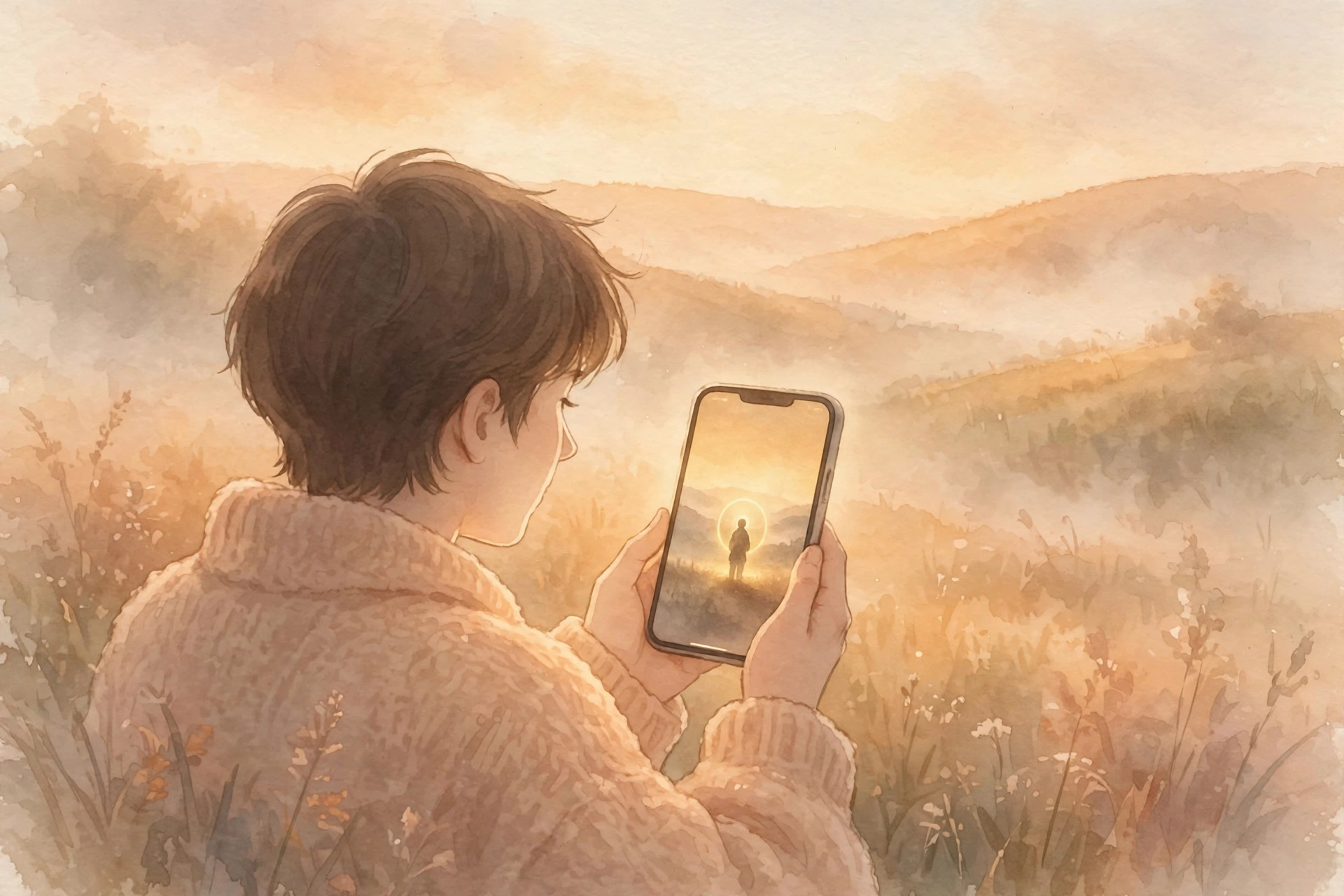
Parasocial Relationships: Why You Feel Attached to People You’ve Never Met
Reviewed by a Psychology Postgraduate (MA)
There’s a creator — let’s call her Maya — who posts apartment tours, morning routines, the occasional tearful confession about a bad week. You don’t know her. She doesn’t know you. But when her video pops up, something in you relaxes. You know her dog’s name.
Then someone asks your neighbor’s name, and you draw a blank. And it hits you: why do parasocial relationships feel so real — this celebrity, or a YouTuber, or a podcast host, who will never know I exist?
The short answer: A parasocial relationship is a one-sided emotional bond with a media figure — a celebrity, creator, or even a fictional character — who feels like a friend but doesn’t know you back. These bonds are normal, rooted in the same attachment machinery as real friendships. They only become a problem when they replace real-life connection.
A parasocial relationship is a one-sided relationship with a celebrity, creator, or fictional character: you invest real emotion, attention, and loyalty while the other person has no idea who you are. Sociologists Donald Horton and Richard Wohl coined the term in 1956, studying how TV viewers felt friendship toward hosts who looked into the camera and spoke like old friends. Vlogs, podcasts, Stories, and TikTok have turned that quiet phenomenon into the background texture of daily life.
What Is a Parasocial Relationship, Exactly?
A parasocial relationship is a one-sided emotional attachment to someone you interact with only through media — they cannot see you, hear you, or know your name.
The classic version was the TV news anchor who felt like a family guest every evening. Today’s versions are more intimate: the podcaster whose voice has talked you through a hundred commutes, the streamer who narrates every thought like you’re on the couch beside them, the actress whose interviews feel warmer than your brunch dates.
The key ingredient is perceived intimacy. When a creator looks into a lens, shares a struggle, and shows up on a reliable schedule, your brain reads it with friendship software. It has no category for “person who feels like a friend but isn’t,” so it files them under “friend” — and the warmth, loyalty, and protectiveness that follow are real, even though the relationship isn’t reciprocal.
That’s the parasocial relationship meaning at its simplest: genuine feelings, aimed at a relationship that only exists on one side.
Why Does My Brain Form Attachments to People I’ve Never Met?
Because the machinery that builds real friendships can’t tell real from simulated social input.
One key mechanism is social surrogacy: when direct social connection is thin, people reach for symbolic substitutes — favorite shows, books, music, media personalities — to fill the gap. Studies have found that reminding lonely people of a favorite TV show temporarily eases exclusion. It’s your brain doing exactly what it evolved to do: seeking out company.
Three forces make modern parasocial bonds especially sticky:
- The intimacy illusion. Vlogs, livestreams, and Stories mimic real friendship’s rhythms: regular contact, emotional disclosure, inside jokes, the “just between us” aside to the camera.
- Attachment needs. If you crave closeness but fear being let down, a one-sided relationship feels like the perfect fix. The creator never criticises you, never ghosts you, never leaves.
- Mood repair. Bad day? Your brain reaches for what soothed it before: a familiar voice, a funny channel, a singer whose lyrics once got you through a rough patch.
What Do Parasocial Relationships Give Us?
First, these bonds deliver real value — most researchers treat moderate parasocial engagement as healthy. For many people, a favorite creator or celebrity functions like a low-stakes companion. A familiar voice on a quiet evening genuinely registers as company — and loneliness in America is no small thing, with surveys regularly finding a significant share of US adults feel lonely at least sometimes. Even brief reminders of social connection can lift mood and reduce stress.
They also give us inspiration and models. The athlete whose discipline nudges you to the gym. The author whose essays make you braver in your own writing. The entrepreneur whose failure-before-success story reframes your own setback. This is observational learning — one of psychology’s oldest mechanisms — and it works through screens too.
When Does a One-Sided Relationship With a Celebrity Turn Unhealthy?
It stops being harmless when it takes more than it gives — time, money, peace of mind, or real-world relationships.
Pause and ask yourself: If this person stopped posting tomorrow, would you feel mildly sad — or would it genuinely shake your week, your sleep, your stability? The answer tells you how much weight this bond is carrying.
Watch for these signs the bond has tipped from comforting to compulsive:
- Real relationships are being neglected. You cancel plans to catch a livestream, or know a creator’s schedule better than your own friend’s birthday.
- Boundaries feel personal. The celebrity takes a break or starts a new relationship, and it feels like betrayal instead of their life happening.
- Distress runs the show. Anxious when they don’t post, devastated by their bad press, furious at their critics — a stranger’s week shouldn’t dictate your mood.
- Spending is compulsive. Merch, tickets, and donations that stretch your budget — driven by a feeling of owing them or fearing you’re not a “real fan” otherwise.
- Fantasy blurs into reality. Rehearsing conversations with them, assuming you’d be close friends if you ever met, reading posts as messages meant for you.
If several of these feel familiar, there’s no shame in it — platforms are engineered to make the bond feel real. Recognizing the pull is the first step to loosening it.
What Is the Link Between Loneliness and Parasocial Bonds?
Loneliness is both the fuel and, sometimes, the trap of parasocial relationships.
The fuel part is straightforward: when real connection is scarce — a new city, a breakup, weeks of remote work — your brain hunts for substitutes, and media figures are always there. Research links higher loneliness with stronger parasocial engagement: the bond forms partly because of the loneliness, and in the moment it soothes it.
The trap part is subtler. A parasocial bond satisfies some of the social hunger — like snacking before dinner — but it can’t provide what resolves loneliness: being known by another person, being chosen back. If it becomes your main source of “social” time, the loneliness stays untouched while your calendar fills with content instead of people. Healthiest framing: parasocial bonds work best as a bridge, not a destination.
How Can I Keep Parasocial Relationships Healthy?
Healthy parasocial bonds enrich your life without replacing it. Here’s how to keep it that way.
1. Name what it is. Say it out loud: “This person doesn’t know me. I like them, and that’s fine.” Naming the one-sidedness stops the illusion from setting the terms.
2. Notice your state. After a long scroll: lighter or heavier? Inspired or hollow? If the pattern is consistently “heavier,” the content is a habit wearing comfort’s clothes.
3. Budget it. Decide what this bond gets — one episode over dinner, not four hours and a shopping cart.
4. Feed the two-sided side. For every hour with a favorite creator, give an hour to someone who can reply. Text the friend. Say yes to the plan.
5. Use fandom as a doorway. Join the community as yourself, not as an extension of the figure. Strangers you talk to in the comments are real; the figure isn’t reachable the same way.
FAQs About Parasocial Relationships
Are parasocial relationships normal?
Yes. One-sided bonds with media figures are extremely common, and research treats moderate engagement as a normal part of the social brain. It only becomes a concern when it harms your mood, finances, or real relationships.
Can a parasocial relationship become real?
Rarely. A creator might reply to your comment, or you might befriend fellow fans – real moments. But the dynamic stays asymmetric until genuine two-way interaction develops. Treat contact as a nice surprise, not proof the bond was mutual.
Is it weird to cry over a celebrity’s death?
Not at all. It’s real grief — you lost a source of comfort, meaning, and routine. What hurts is the hole they filled, and holes are real whether or not someone knew your name. If grief lingers for weeks, talking to a counselor can help.
Do parasocial relationships affect kids and teens?
Young people are especially susceptible, since their social brains are still developing and they spend more time with creators. The bonds can inspire and comfort — but teens benefit from help separating performance from person, and from plenty of real-world social time.
Try It on Our Site
If this article hit close to home, take one small step with our free, anonymous tools:
- Take the Loneliness Check-In — how connected do you feel? Get a personalised snapshot.
- Name Your Feeling — can’t pin down what that celebrity news made you feel? Find the exact word here.
- Try the 7-Day Anxiety Toolkit — a guided week of calming tools for when one-sided attachments stir up anxiety.
- Explore the Mind Check-Ins — 27 check-ins across mood, sleep, stress, relationships and more.
Related reading: Feeling Lonely Around People · The Psychology of Feeling Invisible · Feeling Disconnected · The Psychology of Taylor Swift: Reinvention and Narrative Identity
Key Takeaways
- A parasocial relationship is a one-sided bond with a celebrity, creator, or character who doesn’t know you — and feeling it is normal.
- Your brain forms them through social surrogacy, the intimacy illusion of modern media, and attachment needs.
- They genuinely help: easing loneliness, inspiring growth, and opening doors to real fan communities.
- They turn unhealthy when they replace real relationships, dictate your mood, strain your budget, or blur fantasy and reality — stay healthy by naming the one-sidedness, budgeting your attention, and reinvesting in two-sided connections.
This article is for education and reflection only — not medical advice, therapy, or a diagnosis. If loneliness, anxiety, or low mood are weighing on you, consider a licensed mental health professional. In the US, you can call or text the 988 Suicide and Crisis Lifeline any time, 24/7, for free, confidential support.