
Reviewed by a Psychology Postgraduate (MA)
The Denmark fridge cyberattack psychology in this story is the psychology of trust in infrastructure we never see: fridges we assume will stay cold, controlled by systems most shoppers never knew existed.
Short answer
Overnight into Monday, November 2, 2026, attackers remotely turned up refrigeration units at more than 100 supermarkets across Europe, in some stores to 50 degrees Celsius, forcing shops to throw away chilled and frozen food. Three weeks after a similar attack hit hundreds of French supermarkets, the incident exposed how much everyday trust rests on machines most shoppers never think about.
What happened in the Denmark fridge cyberattack
In the early hours of Monday, November 2, 2026, refrigeration and freezer equipment at supermarkets across Europe began warming instead of cooling. At a store in Overijse, Belgium, alarms sounded at about 3 am and the manager arrived to find fridges switched into defrost mode, pumping warm air into food storage. Similar scenes played out across the continent through the night and into Monday morning.
The scale, as reported by retailers and cybersecurity outlets on November 2 and 3, was wide. In Belgium, Delhaize reported problems at several dozen stores, mostly in Belgium with a few in Luxembourg; Carrefour said 15 of its more than 700 Belgian stores were affected; Spar, Colruyt, and Intermarche also reported problems, and an IKEA store in Belgium was affected. In Sweden, Coop reported a cyber incident in which someone tampered with refrigeration without permission at six or seven of its roughly 800 stores, while ICA reported a limited number of affected stores; at an ICA store in Sjobo in southern Sweden, fridges and freezers were set to 50 degrees Celsius and staff threw out the affected goods. In Ireland, Musgrave said 13 SuperValu stores removed chilled and frozen products from sale as a precaution. In Estonia, a Selver supermarket freezer was set to 50 degrees Celsius. Further reports came from Finland, the Netherlands, Italy, and Portugal, taking the total past 100 stores in the latest wave. Belgium’s federal prosecutor opened an investigation.
The Danish thread runs through the story. Danfoss, a Danish maker of refrigeration controls, said its products were involved, as they had been three weeks earlier in France. Denmark’s Resilience Agency told broadcaster TV2 it was aware of five Danish food companies hit by cooling-system attacks, and supermarkets in several countries reported refrigeration problems that forced some retailers to discard food after temperatures rose overnight. The equipment at the center of both waves includes Danfoss AK-SM and AK-SC controllers and Copeland and Dixell xweb controllers, according to France’s cybersecurity agency alert.
What is known, and what is not, must be stated plainly. What is known: units were remotely manipulated, food was discarded, and the method resembles the French wave of October 11-12, when hundreds of supermarkets including Carrefour, Intermarche, Cooperative U, and Monoprix were hit and some fires were reported. What is unconfirmed: who carried out either wave, and whether the two waves are linked. No group has claimed responsibility, and investigators have not established a connection. Some retailers, including ICA, did not confirm a cyberattack at all, describing only an incident affecting refrigeration. This article reports the incidents as reported, not as proven attribution.
Why did the attack work?
The technical explanation is uncomfortably simple, and that simplicity is part of the psychological story. Refrigeration controllers are computers that run a store’s fridges and freezers, and many are connected to the internet so contractors can monitor and fix faults remotely. Security researcher Kevin Beaumont said every freezer hit on Monday had an internet-reachable management interface, many devices were end-of-life with no patch available, and threat-intelligence firm Lupovis observed login attempts since October 20 using publicly documented factory-default credentials. France’s CERT-FR alert, first published October 12, warns that attack campaigns against these devices are probably still underway and advises operators not to expose management interfaces directly to the internet, using a VPN or protected network instead. After the French attack, Belgium’s Centre for Cybersecurity warned on October 13 that affected equipment should be disconnected from the internet, yet Danfoss said some equipment hit in the Netherlands was not on a protected network and still used default passwords.
In other words, the warnings existed, the fixes were known, and the attack still worked, because patching thousands of controllers across thousands of stores, some of them old enough to have no patch at all, is slower than exploiting them.
Why does a warm fridge shake trust so deeply?
Invisible infrastructure trust is the confidence we place in systems we cannot see working, from cold chains to power grids, and it breaks differently from other kinds of trust.
Most trust is interpersonal: we trust a person because of what they did. Infrastructure trust is ambient: we trust the milk because the fridge hums, and we never think about the controller deciding the temperature. When that hum stops, or worse, when the fridge actively warms the food, the betrayal feels stranger than a broken promise, because the system did not fail passively. It was turned against its purpose by someone unseen, at 3 am, from somewhere else. Psychologists studying system trust find that invisible failures provoke a wider anxiety than visible ones, because the victim cannot point to what went wrong or check whether it has been fixed. Shoppers in Sjobo could see a display reading 50 degrees, but they could not see whether the food at the next store, or the next town, was safe.
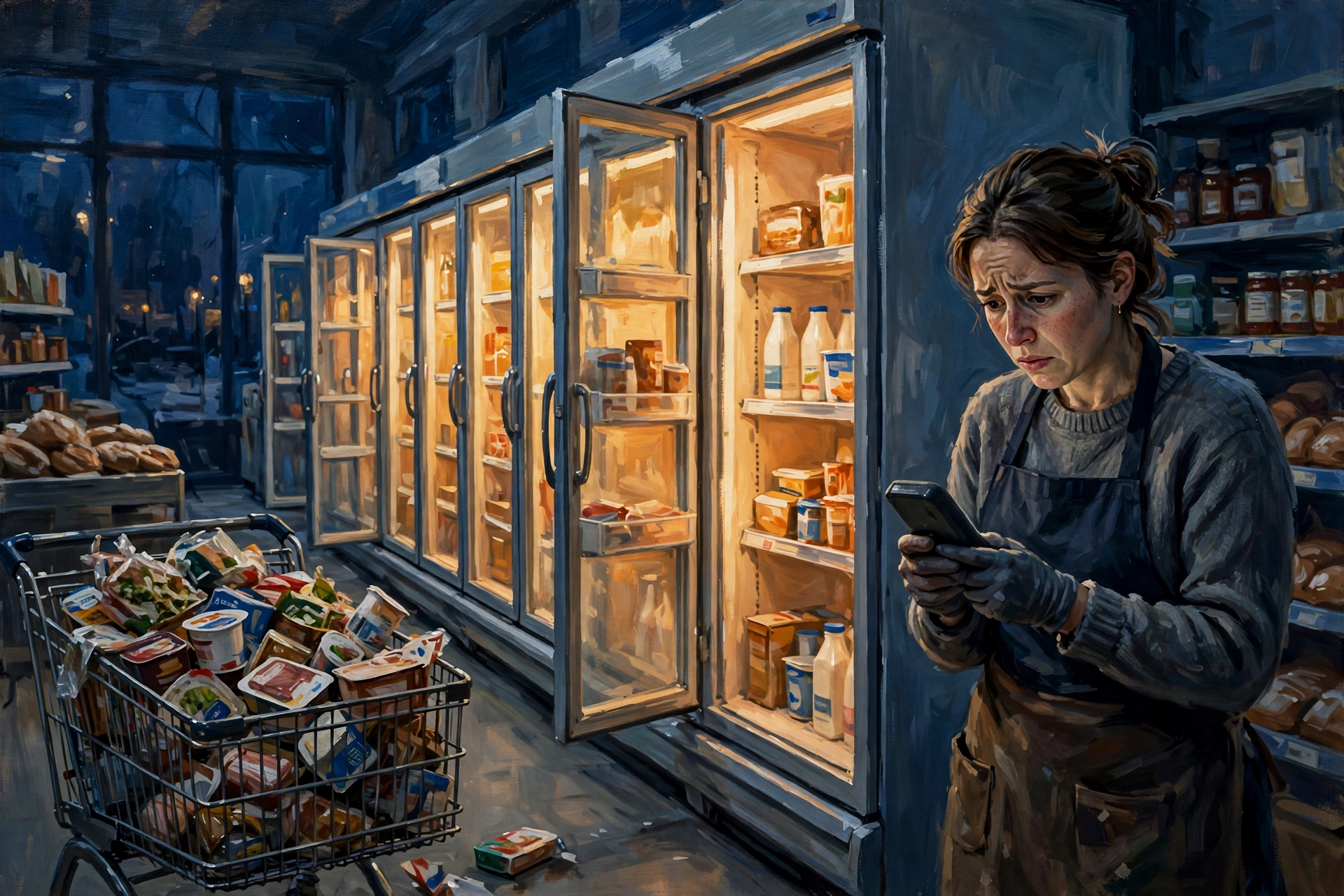
Food adds a second layer: disgust. Humans are wired to treat spoiled food as a contamination threat, and a fridge that warmed overnight triggers that system even when no illness follows. Discarding the food is the rational response, but it also makes the loss visible in a way a data breach never is: trolleys of thrown-away goods are a picture of trust being thrown away too.
How should shoppers think about food safety after an attack like this?
The practical rule is the one retailers themselves applied: when chilled or frozen food has warmed beyond safe temperatures for an unknown time, discard it rather than gambling on it. Shoppers cannot verify the cold chain by looking at a product, and “it feels cold now” is not evidence, because a unit switched back to cooling will re-chill food that already spent hours warm. If your store removed products from sale, that removal is the system working, not failing. If you are unsure about food at home after a local incident, local food-safety guidance and the store’s own advice are better guides than social media rumors, which in both waves spread faster than confirmed store lists.
The wider lesson is about agency. Individuals cannot patch a supermarket’s controllers, but they can notice the pattern that matters: a warning issued on October 12, repeated on October 13, still unheeded in places on November 2. The psychological shift worth making is from “someone will fix this” to “systems this old and this exposed need replacing, not just patching,” and that shift is what turns anxiety into a demand for change rather than a habit of worry.
Reflection: audit one invisible system you rely on
Pick one system you trust without thinking: your fridge, your home router, your bank’s app. Ask when it was last updated, whether it still uses a default password, and what you would do if it failed silently for a night. Changing one default password today is a small act, but it is the exact act whose absence let this attack spread, and doing it converts a news story about other people’s fridges into a concrete step in your own home.
Try it on our site
If news about cyberattacks and food safety is feeding a loop of worry, the Challenge the Thought tool can help you separate a verified risk from a feared one, and the Daily Tracker can show whether doomscrolling security news is tracking with your stress. Both are free, anonymous, and run in your browser.
Related reading: our earlier piece on Denmark’s warning that daily cyberattacks are the new normal explains the general trust problem this incident made concrete, and our piece on the UK’s preparedness campaign covers how households plan for disruptions they cannot control.
Key takeaways
- Overnight into November 2, 2026, refrigeration units at more than 100 European supermarkets were remotely manipulated, some set to 50 degrees Celsius.
- Delhaize, Carrefour, Coop, ICA, SuperValu, and Selver were among the affected chains, and food was discarded across several countries.
- Danfoss, a Danish maker of refrigeration controls, confirmed its products were involved, as in the French wave three weeks earlier.
- The attack exploited internet-exposed controllers, some end-of-life and some still using factory-default passwords, despite warnings issued October 12-13.
- No group has claimed responsibility, and investigators have not established whether the two waves are linked.
- Invisible infrastructure failures shake trust more widely than visible ones, because victims cannot check whether the system is safe again.
Frequently asked questions
What happened in the supermarket fridge cyberattack?
Overnight into Monday, November 2, 2026, attackers remotely changed refrigeration controls at supermarkets in Belgium, Sweden, Estonia, Ireland, Finland, the Netherlands, and other countries, warming fridges and freezers and forcing stores to discard chilled and frozen food.
How many stores were affected?
More than 100 stores reported refrigeration disruptions in the latest wave, including several dozen Delhaize stores, 15 Carrefour stores in Belgium, six or seven Coop stores in Sweden, and 13 SuperValu stores in Ireland.
Was this connected to the French supermarket attack?
The method resembles the October 11-12 attack on hundreds of French supermarkets, but investigators have not established a link and no group has claimed responsibility for either wave.
Why were the fridges hackable?
Many refrigeration controllers have internet-reachable management interfaces, some are end-of-life with no patch, and some still used factory-default passwords, despite cybersecurity warnings issued in mid-October 2026.
Is food from an affected store safe?
If a store removed chilled or frozen products from sale, follow that decision: food that warmed for an unknown time should be discarded, since re-chilling does not undo the time spent warm.
This article is educational only and is not cybersecurity or food-safety advice. If distressing news is affecting your wellbeing, Livslinien in Denmark can be reached on 70 201 201.