
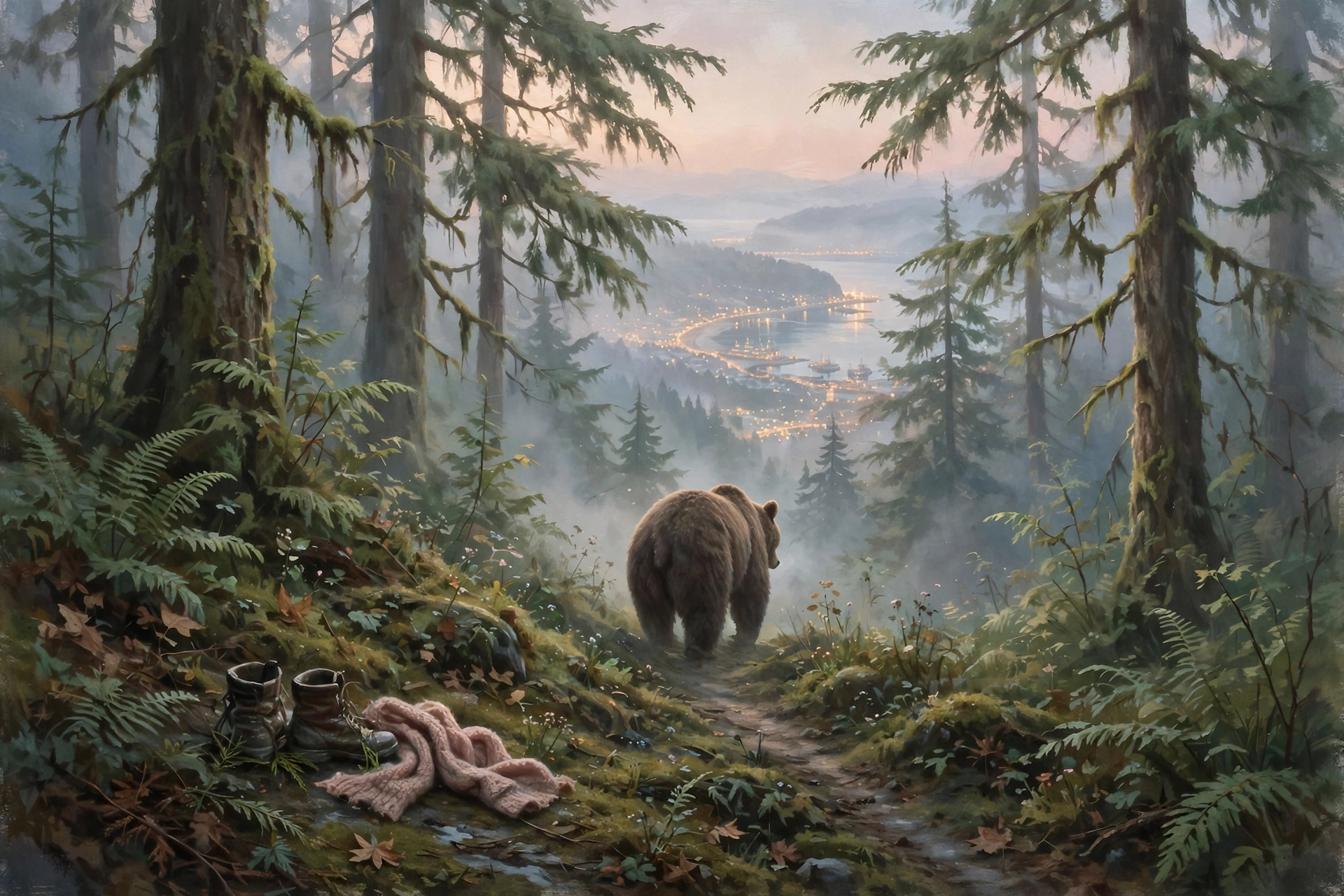
Short answer: A mother and her 20-year-old daughter died in a suspected grizzly bear attack near Bella Coola, British Columbia, on a trail minutes from home. The deaths, confirmed on 4 November 2026, have shaken a small coastal community and revived a fear that runs deeper than statistics: the fear that the places we feel safest can turn dangerous without warning.
What happened near Bella Coola?
Jennifer Balcarras, 48, an art therapist, and her daughter Selah Reed, 20, a teaching assistant, were reported missing by relatives on Sunday 1 November 2026 after they did not return from a walk on the Snooka West Trail, about eight kilometres east of Bella Coola on British Columbia’s central coast. The trail was a short afternoon walk, roughly a five-minute drive from their home.
Search teams from the Royal Canadian Mounted Police and the British Columbia Conservation Officer Service found the first body on Monday 2 November and the second on Tuesday 3 November. On Tuesday, conservation officers confirmed that both women had been found dead and that the deaths were being investigated as a suspected grizzly bear attack. Inspector Jeff Tyre of the Conservation Officer Service said it was not yet clear whether more than one bear took part; officers are working to trap any bears involved, and any bear found to have taken part will be put down under provincial guidelines. The Central Coast Regional District confirmed both deaths in a statement on 4 November, and residents have been urged to stay away from the Snooka West Trail area.
Why has this hit the community so hard?
Bella Coola is a small, remote town on a fjord in the Great Bear rainforest, a region known for its large population of grizzly and black bears. Seeing bears near homes is common there, and residents live with wildlife as neighbours rather than as a distant threat. That familiarity is part of why this attack feels so destabilising: it happened on a familiar trail, on a casual walk, minutes from home. Almost exactly a year earlier, in November 2025, a grizzly attacked a school group near Bella Coola, injuring 11 people, including children, and the bear was never captured.
Timeline: the women were reported missing on Sunday 1 November; the first body was found on Monday 2 November; the second on Tuesday 3 November; conservation officers confirmed the suspected grizzly attack on Tuesday; the regional district confirmed both deaths on Wednesday 4 November. What is known: two women died, a bear was very likely involved, and the trail is closed. What is unconfirmed: how many bears took part, and the precise sequence of events.
What is risk perception, in one sentence?
Risk perception is the way people judge how likely and how serious a danger is, shaped less by statistics than by how vivid, familiar and controllable the danger feels.
Why does a rare danger frighten us more than a common one?
Fatal grizzly attacks are rare. In British Columbia, far more people are hurt in road collisions, falls or drownings each year than by bears. Yet a bear attack commands fear that a car journey never does, and risk perception research explains why. Psychologist Paul Slovic showed that people dread risks that are unfamiliar, uncontrollable, catastrophic and vividly imaginable, even when the odds are tiny. A bear attack is all four: sudden, violent, beyond control, and easy to picture in terrible detail.
The availability heuristic sharpens the fear. When a story is recent, emotional and widely reported, examples spring to mind easily, and the mind mistakes ease of recall for likelihood. After Bella Coola, every rustle in the bush and every trail warning sign feels like evidence, because the story is fresh. The same mechanism explains why people fear flying more than driving, even though the statistics point the other way.
There is also the question of where it happened. The women were not deep in the backcountry or ignoring warnings. They were on a popular trail close to home, doing something ordinary. Psychologists call the assumption behind that ordinariness the just-world belief, the quiet conviction that bad things happen to people who take risks, not to people on a casual walk.
How does a community grieve a sudden, violent loss?
Grief after a sudden death is different from grief after a long illness. There is no preparation, no goodbye, and no time to adjust expectations. When two people die together, a mother and a daughter, the loss multiplies: a family loses two generations at once, and a community loses people it knew in two different roles, as a therapist and neighbour, and as a young teaching assistant starting her working life.
Small communities grieve differently from cities. In Bella Coola, the loss is not abstract. People knew the family, shared the trails, and will see the empty places they leave behind. That closeness brings support, but it also means there is nowhere to escape the reminders: the trailhead, the school, the art studio. Collective grief in such places is sustained and visible, and it needs sustained and visible support in return.
What happens to a community’s relationship with nature after an attack?
After a wildlife attack, a community’s relationship with its landscape changes. Trails that were routes to calm become routes to vigilance. Parents keep children closer. Walkers carry bear spray, make noise, travel in groups, and check the time of day. Some of these changes are sensible precautions. Others are the visible signs of anxiety settling into daily life.
Psychologists describe this as sensitisation: after a frightening event, the threat-detection system stays switched on, scanning for danger long after the danger has passed. It is adaptive in the short term, because caution genuinely reduces risk. But when it persists for months, it narrows life: fewer walks, fewer evenings out, less of the outdoors that made the place home in the first place. The challenge for Bella Coola is to keep the sensible precautions while letting the landscape become home again. The anniversary effect adds a further layer: the 2025 attack and the 2026 deaths fall in the same month, on the same trails, so this November now carries two memories, and next November will carry the weight of both.
Pause and reflect: Think of a place that feels completely safe to you: a familiar walk, a local park, a route you could follow with your eyes closed. If something frightening happened there, would you stop going, or would you go back differently? Noticing what you would protect, and what you would refuse to give up, is the start of reclaiming a place after fear.
What helps after a frightening event in a familiar place?
First, let the facts lead. Follow official advice from the Conservation Officer Service: stay away from the closed trail area, carry bear spray where recommended, make noise on trails, and travel in groups. Practical steps restore a sense of agency, which is the opposite of helplessness. Second, talk about it, especially with people who share the place: shared grief is lighter grief. Third, expect the fear to come in waves, and rebuild the routine gradually, a shorter walk, a busier trail, a companion alongside. Confidence returns through small, successful returns, not a single brave leap. Finally, if distress, sleeplessness or intrusive thoughts persist for weeks, reach out: in Canada, help is available day and night by calling or texting 988.
Try it on our site
If the fear or grief in this story feels familiar, these free tools may help: the 7-Day Anxiety Toolkit for a structured week of small calming steps, Challenge the Thought for testing a fearful thought against the evidence, and the Daily Tracker for noticing patterns in mood and sleep over time. All run in your browser, with no signup.
Key takeaways
- Jennifer Balcarras, 48, and her daughter Selah Reed, 20, died in a suspected grizzly bear attack near Bella Coola, British Columbia, after being reported missing on 1 November 2026.
- Conservation officers confirmed the suspected attack on 3 November; it is not yet clear whether more than one bear was involved, and the Snooka West Trail area remains closed.
- The attack comes almost a year after a grizzly injured 11 people, including children, near Bella Coola in November 2025, in an attack whose bear was never captured.
- Psychologically, rare and vivid dangers frighten us more than common ones because of dread, the availability heuristic and the breaking of the just-world belief.
- Sudden loss brings a distinct grief, and in a small community the loss is shared, visible and hard to escape.
- What helps is following official safety advice, talking with people who share the place, expecting fear in waves, and rebuilding routines gradually.
Frequently asked questions
What happened to the mother and daughter in Bella Coola?
Jennifer Balcarras, 48, and her daughter Selah Reed, 20, were reported missing on 1 November 2026 after a walk on the Snooka West Trail near Bella Coola. Their bodies were found on 2 and 3 November, and the BC Conservation Officer Service is investigating the deaths as a suspected grizzly bear attack.
Was more than one bear involved?
It is not yet clear. Inspector Jeff Tyre of the BC Conservation Officer Service said investigators are examining whether more than one bear was involved, and any captured bear will be assessed.
How can a community recover after an attack like this?
Recovery comes through shared grieving, following official safety advice, talking openly about fear, and rebuilding outdoor routines gradually. If distress persists for weeks, professional support helps: in Canada, call or text 988 at any time.
Related reading: The Bike Fire Forced Santa Clarita to Evacuate: The Psychology of Wildfire Anxiety; Hurricane Anxiety: Why the Waiting Feels Worse Than the Storm; Seasonal Depression: Why Autumn Lowers Your Mood and What Helps.
Educational disclaimer: This article is for education only and is not medical advice. If you are grieving or in distress in Canada, call or text 988 at any time, day or night. If you feel you may act on thoughts of harming yourself, call emergency services on 911.