
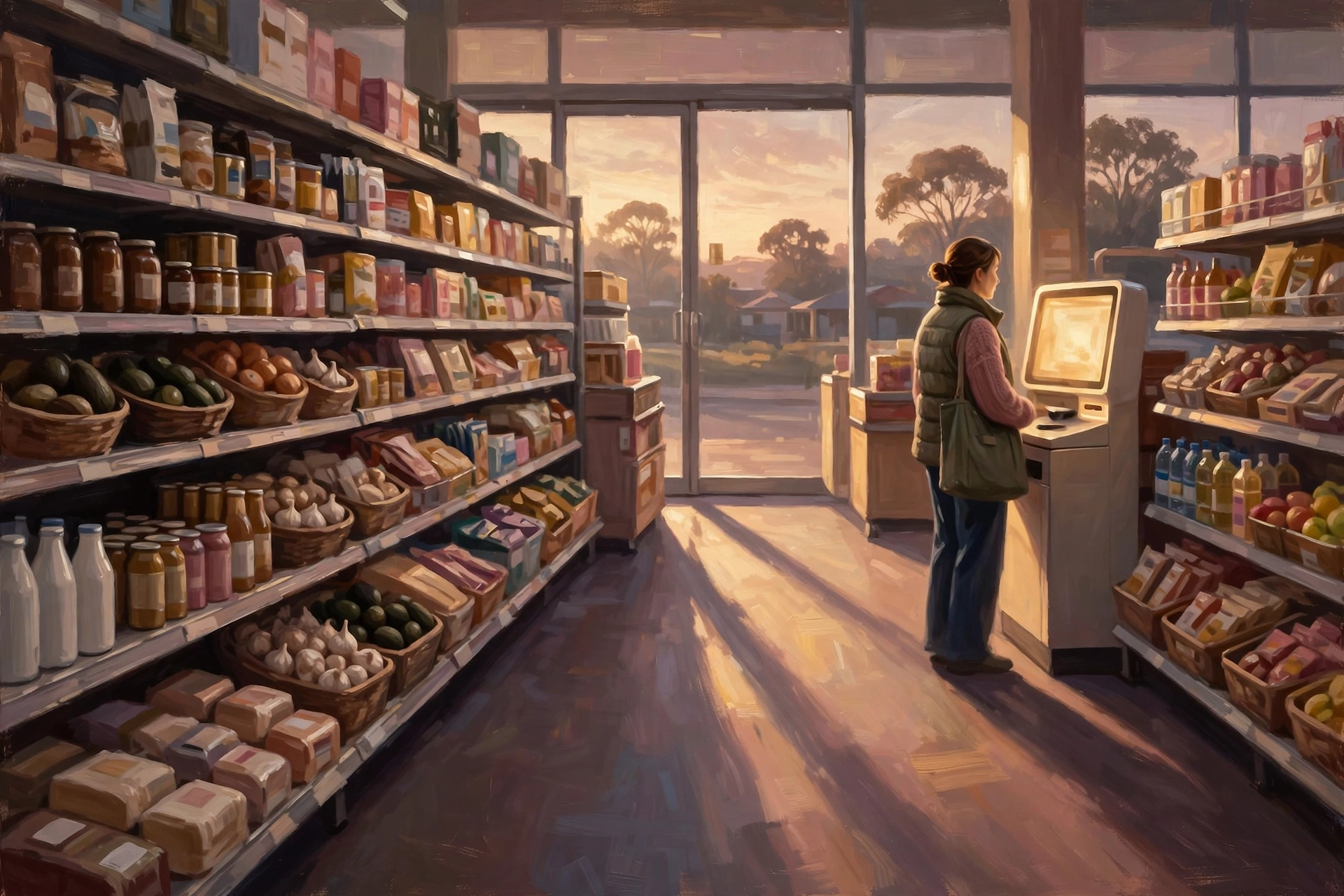
Coles Says “Shop as Normal” After a Cyber Attack: The Psychology of Breach Anxiety
Reviewed by a Psychology Postgraduate (MA)
Australia’s second-biggest supermarket chain has been hit by a cyber attack — and its message to millions of shoppers is to carry on as usual. The short answer: Coles disclosed a cyber security incident to the Australian Securities Exchange on Monday 16 November 2026, saying it has found no evidence so far that customer, staff or supplier data was compromised or removed. Stores and online shopping are operating normally, with only a small number of Liquorland click-and-collect orders disrupted. The Coles cyber attack psychology is simple: the reassurance is genuine, but it will not feel reassuring — because breach anxiety is not really about what happened. It is about what might have happened, and the fact that nobody can yet say for sure.
What happened at Coles?
Coles Group told the ASX on the morning of Monday 16 November 2026 that it was investigating a cyber security incident. The incident happened over the weekend, according to incident trackers, and the company said it was working with the Australian Cyber Security Centre and global cyber security experts to contain and secure its IT environment. Its statement said: “Based on the findings of our investigation to date, we have not identified any evidence that customer, team or supplier data has been compromised or removed from Coles’ systems.” The company added: “Operations continue and customers are able to shop as normal with Coles in stores and online.”
What Coles has not said is just as important. The announcement did not identify what kind of incident it is dealing with, when it was detected, which systems are involved, or who is behind it. It made no mention of ransomware or of any demand for payment. The one concrete disruption it flagged was in liquor retail: a small number of customers are having problems with Liquorland click-and-collect orders, and the company is investigating whether that is connected. The app and website are operating normally, gift cards still work, and Flybuys accounts show no sign of being affected. Coles shares were little changed in morning trade after the announcement, and the company recommended customers use a strong, unique password for their accounts.
The timing matters. The incident comes days after a global Microsoft outage disrupted services around the world, including in Australia, where experts have called for a national review of the country’s dependence on overseas technology. It also follows a run of major Australian breaches in recent years — Optus in 2022 and Medibank in 2022 both exposed the personal data of millions of Australians — which means shoppers are not hearing this news with fresh ears. They are hearing it with ears trained by experience.
What is Coles cyber attack psychology?
Breach anxiety is the uneasy, watchful state that follows news of a data breach or cyber attack: the urge to check your accounts, change your passwords, and wonder what criminals might do with information you never chose to hand over — even when nobody has confirmed that any data was taken.
It is a textbook case of ambiguity aversion, one of the most reliable findings in decision psychology. People prefer a known risk to an unknown one, even when the known risk is worse. A confirmed breach with a clear list of exposed data is frightening, but it is bounded: you know what was taken, and you know what to do. “No evidence of compromise so far” is unbounded. It could mean nothing was taken. It could mean the investigation has not found it yet. The brain, faced with that gap, fills it with the worst case — and then treats the worst case as if it were the news.
That is why Coles’ statement, honest as it is, cannot do the job shoppers want it to do. “We have not identified any evidence” is a statement about the investigation’s progress, not a guarantee about the data. Most readers hear it as a guarantee anyway, and then feel uneasy because they sense the gap between what was said and what they need to know. The unease is not irrational. It is the mind correctly noticing that the question — was my data taken? — has not actually been answered yet, only postponed.
Why does this keep happening — and why does it feel worse each time?
The Coles incident underlines a rising tide of cyber attacks in Australia, as Reuters noted in its report on the disclosure. Each new incident lands on top of the last one, and the accumulation changes how people respond. Psychologists call this sensitisation: after repeated exposure to the same kind of threat, the response gets faster and stronger, not weaker. The first time a major company disclosed a breach, it was a shock. The fifth time, it is a reflex — check the accounts, change the passwords, wonder what else is out there.
There is a second effect, and it cuts the other way: breach fatigue. When warnings arrive constantly, people start to tune them out — not because they do not care, but because the brain conserves effort for threats it can actually act on. You cannot personally secure Coles’ servers. You can change a password, and then there is nothing left to do but wait. That combination — high alert plus low control — is one of the most stressful states psychology knows.
Trust is the deeper casualty. Supermarkets are infrastructure, not just shops: millions of Australians hand Coles their name, address, payment details and shopping history every week, through loyalty programmes, delivery accounts and apps. That relationship runs on an unspoken deal — you give us your data, we keep it safe. A breach, even a suspected one, breaks the deal in a way that a price rise never could, because it touches identity and safety rather than money. Denmark’s experience with a cyberattack and digital trust showed the same pattern, and a supermarket cyberattack in Germany produced the same questions about how much of daily life now depends on systems shoppers cannot see. Our Outlook outage piece explored what happens when the tools everyone relies on simply stop working — and why the helplessness that follows is so wearing.
Pause and ask yourself: When a breach is announced, what do you check first — and does checking actually make you feel safer, or just busier?
What should you actually do?
The practical steps are short, and that is part of the point. Use a strong, unique password for your Coles account, as the company itself recommended, and turn on two-factor authentication if you have not already. Check your bank statements and your Flybuys account over the next few weeks, not every hour. If you reuse the same password across services — and most people do — change it on the accounts that matter most, starting with email and banking. These steps are worth doing, and they are also worth stopping at. Checking your accounts ten times a day does not make them safer; it makes you more anxious, and anxiety makes you more likely to click on the phishing messages that typically follow a breach announcement.
That last point deserves emphasis, because it is where the real risk now sits. After a breach is announced, criminals send fake “Coles security alert” emails and texts, hoping to catch people while they are worried. The defence is boring and effective: never click a link in a message about your account; go to the app or type the address yourself. If a message creates urgency — “your account will be locked in 24 hours” — that urgency is the tell.
What happens next?
Coles says the investigation is continuing, and it will keep engaging with the appropriate agencies and regulators. The honest timeline is that a full picture may take days or weeks: forensic investigations of this kind rarely produce a final answer quickly, and the company’s position — no evidence of compromise so far — may be confirmed, or it may change. Either way, the story is a reminder of something larger than one supermarket. Daily life now runs through systems most people cannot inspect, and the bargain behind them is trust. When that trust is shaken, the repair is not a press release. It is time, transparency and a record of straight answers — including the answer “we do not know yet,” which is the one people find hardest to hear, and the one they most need to be given.
Frequently asked questions
Was my data stolen in the Coles cyber attack?
As of 16 November 2026, Coles says it has found no evidence that customer, team or supplier data was compromised or removed. That reflects the investigation so far, not a final ruling — the company has said it is too early to determine definitively whether any data was taken.
What should I do now?
Use a strong, unique password for your Coles account, enable two-factor authentication, and check your bank and Flybuys accounts over the next few weeks. Do not click links in messages claiming to be about the breach; go to the app or website directly.
Why does “no evidence” not feel reassuring?
Because of ambiguity aversion: the brain prefers a known risk to an unknown one. “No evidence so far” describes the investigation’s progress, not a guarantee — and the mind fills the gap with the worst case, then treats the worst case as the news.
Is this happening more often?
Yes. Reuters noted the incident underlines a rising tide of cyber attacks in Australia, and it follows the global Microsoft outage days earlier. Repeated exposure makes people react faster and more strongly each time — a process psychologists call sensitisation — while also producing breach fatigue, where constant warnings get tuned out.
Can I still shop at Coles?
Yes. Coles says stores and online shopping are operating normally, the app and website are available, and gift cards work. The only disruption identified so far is a small number of Liquorland click-and-collect orders.
Key takeaways
- Coles disclosed a cyber security incident to the ASX on 16 November 2026, saying no customer, team or supplier data has been found compromised so far.
- Stores, online shopping, the app and gift cards are operating normally; only a small number of Liquorland click-and-collect orders are disrupted.
- The nature of the incident, when it was detected, which systems are involved and who is behind it have not been disclosed — and no ransomware or demand has been mentioned.
- Breach anxiety comes from ambiguity aversion: an unconfirmed breach feels worse than a confirmed one, because the brain fills the unknown with the worst case.
- Change your password, turn on two-factor authentication, check statements over the coming weeks — and never click links in messages about the breach.
Try it on our site
Anxiety about things you cannot control is a skill you can practise managing. Try these free tools, no signup needed:
- Challenge the Thought — test a worried thought against the evidence, step by step.
- Thought Reframe — turn a spiralling “what if” into a fairer, calmer thought.
- Relaxation Techniques — short exercises to bring your nervous system down from alert.
- Mind Check-Ins — see where your anxiety sits right now, and what helps.
This article is for education only and is not a substitute for professional advice. If anxiety about a data breach or anything else is seriously affecting your sleep or daily life, consider speaking to a healthcare professional. In Australia, Lifeline is available 24 hours a day on 13 11 14.