
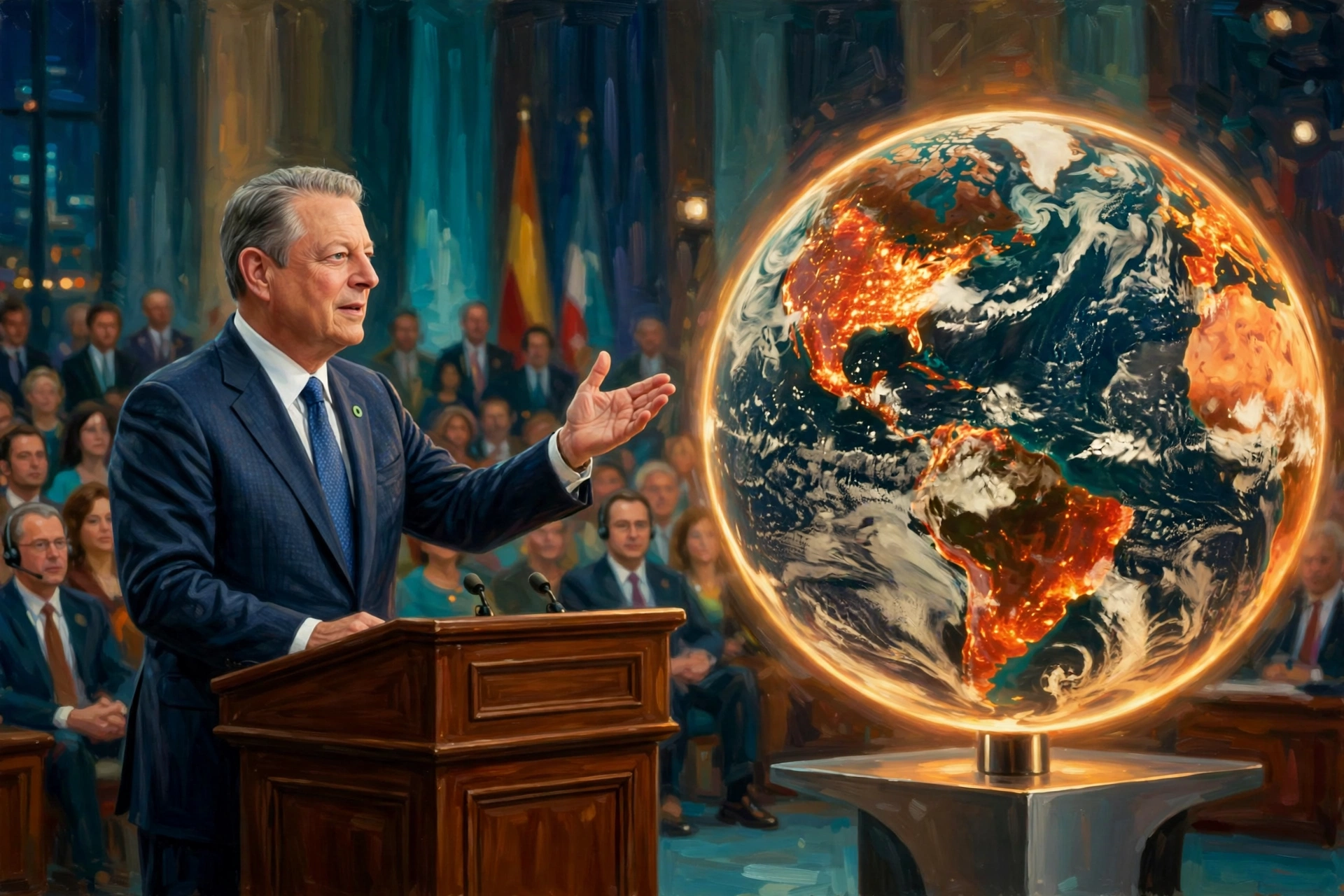
Al Gore and the Psychology of Reinvention: From the Closest Election in History to a Second Act That Changed the World
Reviewed by a Psychology Postgraduate (MA)
Al Gore psychology is the study of how a person rebuilds purpose after a public defeat. Gore won the popular vote in 2000 and still lost the presidency, then spent the next 25 years turning one cause, the climate, into a second career that earned him a Nobel Peace Prize and made him the most recognised climate voice on the planet.
In November 2026, at the age of 78, he was back in the headlines. At COP31 in Antalya, Turkey, he called a bipartisan US permitting bill, the Bipartisan American Affordability and Jobs Act, a “serious mistake” (The Guardian, 16 November 2026). Three days earlier he had told AFP it was “literally insane” that one country, such as Saudi Arabia, could block the whole world from acting on climate change (AFP, 13 November 2026). The name “al gore” spiked as a new trending search in the United States on 19 November 2026, with more than 10,000 searches. Twenty-six years after the election that defined him, people are still searching for him, still arguing about him, and still listening.
This profile is an educational look at public behaviour and research, not an assessment of the person. Everything here comes from the public record: interviews, books, speeches, and widely reported events, dated and sourced where it matters. The question it tries to answer is a human one, not a political one. What do you do when the biggest goal of your life is taken away in public, and you have to decide who you are without it?
Story
Albert Arnold Gore Jr. was born on 31 March 1948 in Washington, D.C., the second child of Albert Gore Sr., a congressman who later served 18 years as a US senator from Tennessee, and Pauline LaFon Gore, one of the first women to graduate from Vanderbilt University Law School. He grew up between the family farm in Carthage, Tennessee, and the capital, where politics was dinner-table conversation.
He went to Harvard, graduating in 1969, and his senior thesis was about the effect of television on the presidency, an early sign of his lifelong interest in how information shapes public life. He served in the US Army in Vietnam as a military journalist, then worked as a reporter for The Tennessean in Nashville. In 1976 he won a seat in the US House of Representatives. He served there until 1985, then in the Senate from 1985 to 1993, building a reputation as a serious, policy-minded legislator who was unusually early on two subjects: the environment and the potential of the internet.
In 1988 he ran for president for the first time and lost the Democratic nomination. He was 40, ambitious, and widely seen as a man in a hurry. Then, on 3 April 1989, his six-year-old son Albert was hit by a car while the family was leaving a Baltimore Orioles baseball game. The boy was thrown 30 feet through the air, suffered severe injuries, and spent nearly a month in Johns Hopkins Children’s Center. Gore later called it the most painful experience of his life. He spent weeks at his son’s bedside, and during that long hospital stay he began writing the book that would become “Earth in the Balance”, published in 1992.
In August 1991 he announced he would not run for president in 1992, saying his son’s accident and recovery were a factor.
A year later Bill Clinton picked him as his running mate. They won in 1992 and again in 1996, and Gore served as the 45th vice president of the United States from 1993 to 2001. He led the administration’s work on technology, government reform, and the environment, and he helped negotiate the Kyoto Protocol in 1997. By 2000 he was the obvious Democratic nominee for president, the sitting vice president of a popular administration, the heir apparent. Everything pointed one way. Then it did not.
Turning Point
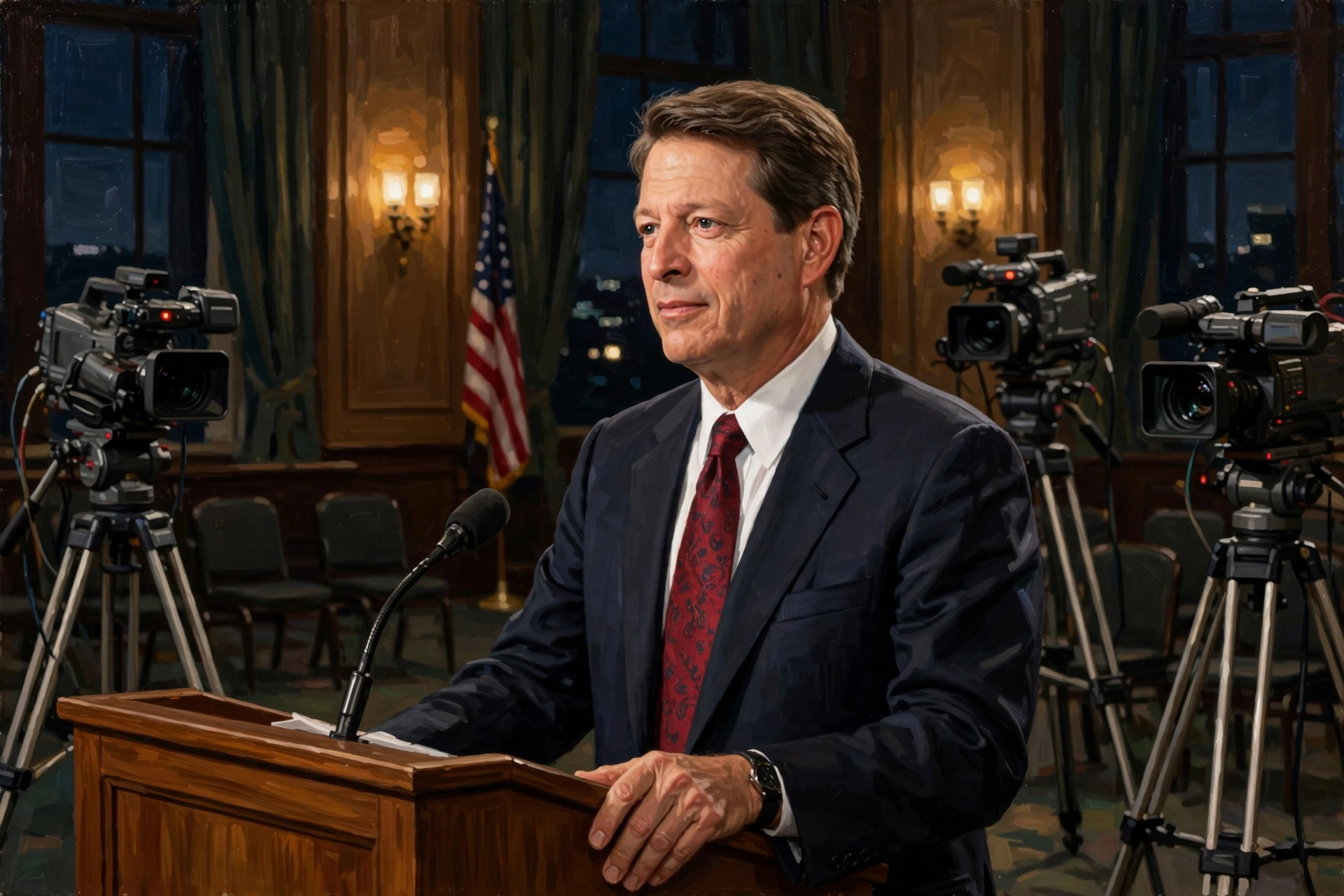
The 2000 presidential election was decided by 537 votes in Florida, after a 36-day recount, legal challenges, and a Supreme Court decision, Bush v. Gore, on 12 December 2000 that halted the recount. Gore conceded the next day, 13 December 2000. He had won the national popular vote by about 543,000 votes and still lost the presidency. No modern American election had ended that way, and none has since.
This is the turning point that defines the whole profile. Most people never face a defeat that public or that final. But almost everyone faces a smaller version of it: the promotion that goes to someone else, the business that fails, the relationship that ends, the exam result that closes a door you had planned your life around. The psychology is the same at any scale. A goal that organised your identity disappears, and you are left with the question of what remains.
Mindset
What is Al Gore’s mindset, as far as the public record shows it? The first word that fits is long-horizon thinking. Most political careers run on two-year, four-year, or six-year cycles. Gore’s climate work runs on decades. In “Earth in the Balance” he wrote about the planet as a system that would outlive every politician alive. In “An Inconvenient Truth” (2006) he presented graphs that stretched back thousands of years and forward to the end of the century. In 2020 he helped launch Climate TRACE, a project that uses satellites and artificial intelligence to track greenhouse gas emissions in near real time, because he believes you cannot fix what you cannot measure. The mindset is simple to state and hard to live: choose the problem that will still matter in fifty years, and let that decide what you do today.
The second word is stubbornness, in the best sense. Gore has been mocked for decades for talking about climate change: the jokes about inventing the internet, the cartoons, the political attacks. He kept going. Psychologists call this “grit”, the combination of passion and perseverance for a long-term goal that Angela Duckworth has studied and written about extensively. Grit is not the same as talent, and it is not the same as optimism. It is the willingness to keep showing up for the same cause after the applause stops. Gore showed up for climate talks in Antalya in 2026, a quarter of a century after leaving office, still making the same argument, still taking the same criticism. That is grit with a public record behind it.
None of this means he is free of ego or doubt. Public figures rarely are, and this profile does not claim to know his inner life. What the record shows is a pattern of choices: a long horizon, a single cause, and a willingness to be unpopular for it. That pattern is worth studying, whatever you think of his politics.
Decisions
How does a person decide what to do after a defeat like 2000? Gore’s public decisions after the election tell a clear story, and each one is a lesson in how people rebuild.
His first big decision was not to fight on. He could have spent years contesting the result in public, and some of his supporters wanted him to. He conceded, thanked his supporters, and stepped back. In the psychology of loss, this matters more than it looks. Rumination, the habit of turning the same painful event over and over in your mind, is one of the strongest predictors of prolonged distress. Research on how to stop overthinking shows the same pattern again and again: the people who recover fastest are not the ones who feel least, they are the ones who stop rehearsing the loss and start acting on something new. Gore’s concession was not just a political act. It was a decision to stop rehearsing.
His second decision was to refuse the most obvious next step. Losing presidential candidates are usually offered television contracts, corporate boards, and the chance to run again. Gore took some board work, including joining the board of Apple in 2003, where he served until 2024, and becoming a partner at the venture capital firm Kleiner Perkins. But he did not build his life around the next campaign. He built it around the subject he had written about in 1992, when nobody was listening.
Method
What is Gore’s method, the way he actually works? If you watch the film, read the books, and listen to the summit speeches, a pattern emerges, and it is surprisingly teachable.
First, he learns the subject deeply before he speaks about it. His 1992 book ran to hundreds of pages of science, history, and policy. His film was built on data from ice cores, temperature records, and satellite images. This is not a small point. In a world of hot takes, the person who has done the reading has an unfair advantage: they can answer the hard question, not just the easy one. For anyone rebuilding after a setback, depth is the most reliable foundation. A new skill, learned properly, is a new identity you can stand on.
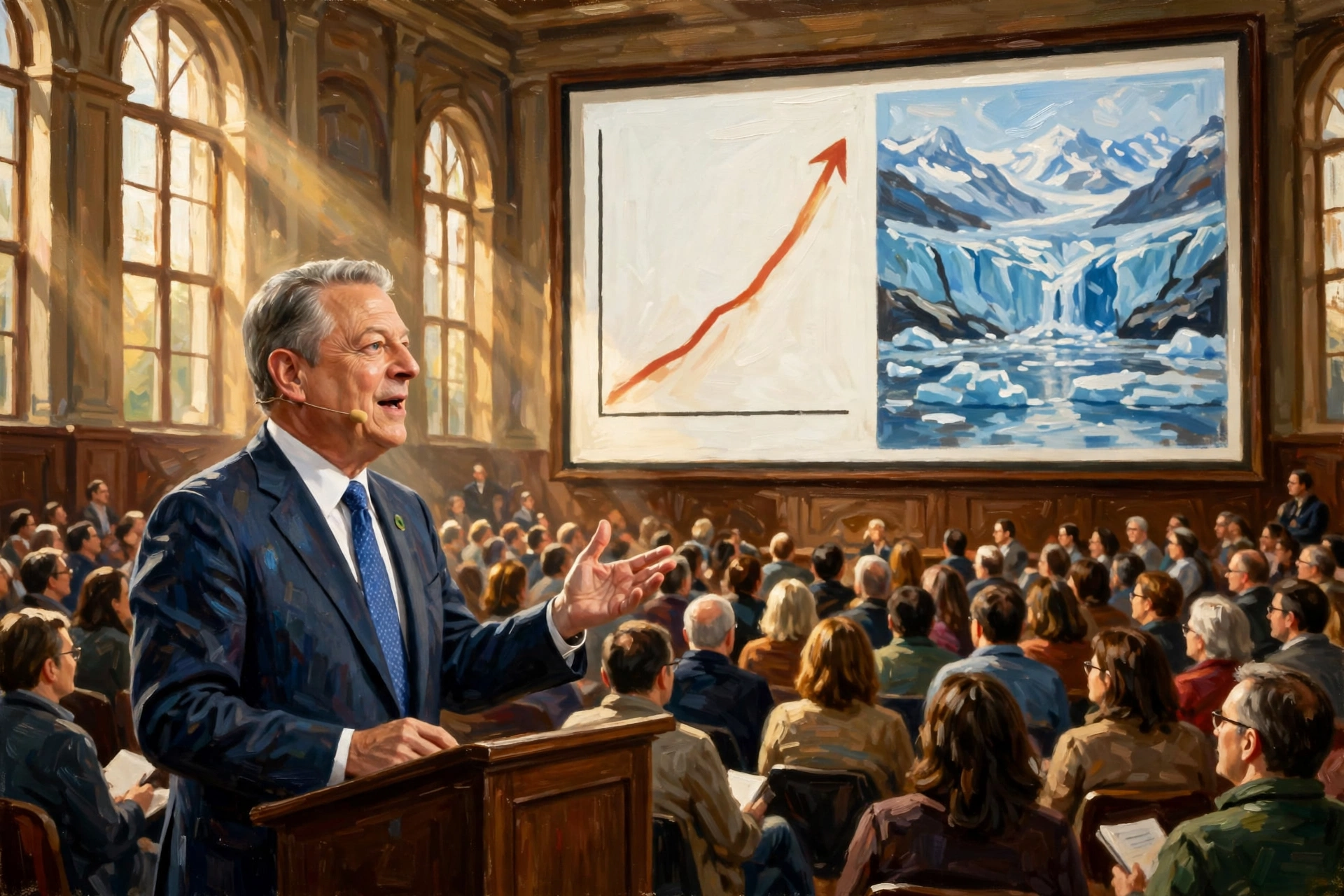
Second, he makes the abstract concrete. Climate change is the hardest subject in the world to make people feel, because it is slow, invisible, and global. Gore’s method is to find the image that makes it real, in an age when brain rot and shrinking attention spans make depth hard to hold: a glacier retreating, a chart that climbs off the page, a flood in a town you know. This is what psychologists call “construal level theory”, the idea that we care more about things that feel close and concrete than about things that feel distant and abstract. He spent twenty years pulling a distant problem closer to people’s lives, one picture at a time.
What If?
What if Gore had won Florida in 2000? It is the great counterfactual of modern American politics, and it is worth asking, not for politics, but for psychology. The “what if” question is one of the most powerful tools the mind has, and also one of the most dangerous.
Psychologists call it counterfactual thinking: the habit of imagining how things might have gone differently. It comes in two directions. Upward counterfactuals imagine a better outcome, “if only I had won”. Downward counterfactuals imagine a worse one, “at least I did not lose by more”. Research by Neal Roese and others shows that upward counterfactuals can motivate us, they show us what to do differently next time, but they can also trap us in regret if we keep replaying them. Downward counterfactuals bring relief, but they can also breed complacency.
Here is a smaller, more useful what-if for the reader. What if your biggest setback is not the end of your story, but the end of one chapter? Gore’s first chapter was politics. His second chapter was the climate. The first chapter ended in public defeat. The second chapter earned him a Nobel Peace Prize in 2007, shared with the Intergovernmental Panel on Climate Change, and a global platform he never had as vice president. Nobody can promise that outcome. But the structure of it, defeat, pause, new direction, is available to anyone.
What Most People Lack
What do most people lack that Gore seems to have in abundance? It is not talent, and it is not luck. It is a set of quiet capacities that are easy to overlook and hard to build.
The first is patience with slow results. Climate work is the slowest kind of work there is. Gore has been making the same case since 1992. The planet has kept warming. Treaties have been signed and weakened. Elections have swung back and forth. And yet he keeps going. Most people give up on a goal when the results do not arrive quickly, and that is understandable: the brain is wired to prefer immediate rewards, a bias psychologists call “temporal discounting”. We overvalue what we can have today and undervalue what we might have in ten years. Gore’s career is an exercise in beating that bias. He chose a goal whose payoff might arrive after his lifetime, and he worked at it anyway. The practice is small: pick one thing that matters to you in ten years, and do one small thing for it this week, even though nobody will notice. A short daily gratitude practice is one way to keep a long goal in view.
The second is tolerance for being unpopular. Gore has been ridiculed, caricatured, and dismissed for most of his public life. The jokes about him are a cultural fixture. Most people, faced with that level of mockery, would soften their message or change the subject. He did not. Psychologists who study conformity, from Solomon Asch onwards, have shown how powerfully the fear of social disapproval shapes behaviour. Standing apart from the group takes real psychological resources. One way to build them is to separate your identity from other people’s opinions, a skill that is closely related to what the Stoics called the difference between what you control and what you do not. You control the work. You do not control the applause.
None of these capacities is a gift. Each one is a practice, built slowly, and each one can be built by anyone, starting from wherever they are.
What Successful People Do Differently
What do successful people do differently after a defeat? The research on resilience and recovery points to a few patterns, and Gore’s public life happens to illustrate most of them.
First, they name the loss honestly. Gore conceded publicly and clearly, and he has spoken about the 2000 election as a loss, not as a theft or a misunderstanding. Honest naming is the first step in grief research and in trauma recovery alike: you cannot process what you will not name. People who reframe a defeat as “not really a loss” often stay stuck longer than people who say, plainly, “I lost, and it hurt.”
Second, they find a purpose larger than themselves. This is the pattern that matters most in Gore’s story. A purpose that depends on your own status is fragile: lose the status, lose the purpose. A purpose that serves something bigger, the climate, a community, a cause, survives the loss of a title. Watching for the signs of burnout matters here, because a purpose that consumes you is not sustainable. Viktor Frankl, writing about his experience in the concentration camps, argued that meaning is the most reliable source of resilience humans have. Gore’s second act is a public demonstration of that idea. The cause did not need him to be president. It needed him to be persistent.
Third, they ask for help and use their people. Gore’s reinvention was not a solo project. He worked with scientists, filmmakers, investors, and thousands of volunteers. He leaned on his family, including his wife Tipper at the time, and on a network built over decades. The research is unambiguous: social support is one of the strongest predictors of recovery after any major setback. The people who bounce back fastest are rarely the toughest. They are the most connected.
Success Mindset
What does success look like in a second act? Not the way it looks in a first act, and that is the point. In a first act, success is usually measured in titles, wins, and recognition. In a second act, it is measured in depth, usefulness, and staying power.
Gore’s success mindset, as far as the public record shows it, has three parts. The first is mission over ego. A candidate needs to be the centre of attention. A teacher needs the audience to remember the lesson, not the teacher. Gore’s film worked because people remembered the graphs, not just the man presenting them. That is a shift in how success is defined: from being seen to being useful.
The second is optimism without naivety. Gore has said many times that he believes the climate crisis can still be addressed, and at COP31 in 2026 he pointed to the rapid spread of solar power in developing countries and rising sales of electric vehicles as reasons for hope. That is not blind optimism. It is what psychologists call “realistic optimism”: the belief that effort matters, paired with a clear-eyed view of the obstacles. Realistic optimists do better than both pessimists and blind optimists, because they prepare for difficulty while still believing that preparation is worth it.
Failures
What did Al Gore get wrong? A profile that only lists the wins is not a profile, it is a poster. The public record shows several real failures, and they are as instructive as the successes.
The first failure is the 1988 presidential campaign. He entered the race at 40, young and confident, and was eliminated early. He misjudged the field, the timing, and his own readiness. The lesson is a common one: ambition without timing is just noise. He learned it, waited, and came back as a running mate four years later rather than as a candidate. Waiting is not the same as quitting, and the difference matters.
The second failure is the 2000 campaign itself. Whatever you think of the recount, the campaign made mistakes that are a matter of public record: a stiff, awkward public image that never quite connected with voters, a decision to distance himself from President Clinton, whose popularity might have helped him, and a campaign that struggled to tell a simple story about why he should be president. In a race decided by 537 votes in Florida, any one of those choices might have been the difference. The psychology here is worth noting. Gore was, by most accounts, the better-prepared candidate on policy. But elections are not exams. They are decided by trust, warmth, and story, and he struggled with all three. Competence alone is not enough when people are choosing a leader. That is a lesson for anyone whose work is excellent but whose story is unclear.
The third failure is the long gap between the science and the politics. Gore has been warning about climate change since the 1980s. Global emissions have kept rising. The Kyoto Protocol, which he helped negotiate in 1997, was never ratified by the United States. The Paris Agreement of 2015 was a step forward, but progress since then has been slower than he hoped. This is not entirely his failure, it is a failure of the political system, but it is fair to say that his core project has not yet succeeded on the scale he wanted. And yet he keeps going, which raises a hard question for anyone with a long-term goal: what do you do when the evidence says you are losing? His answer, so far, is to keep working and to keep updating the method. The film became a sequel in 2017. The speeches became satellite data. The message stayed, but the tools changed.
Relationships
Who shaped Al Gore, and who did he shape? Relationships are the part of a life that most biographies rush past, but psychology says they are the part that matters most.
His father, Albert Gore Sr., was a US senator from Tennessee who opposed the Vietnam War and lost his seat in 1970 partly because of that stand. The lesson Gore took from his father, by his own account, was that principle can cost you your job, and that the job is not worth keeping if it costs you the principle. That is a heavy inheritance. It also helps explain why Gore has been willing to take unpopular stands: he watched his father do it and survive it.
His sister, Nancy LaFon Gore, died of lung cancer in 1984 at the age of 46. She was a heavy smoker, and her death turned Gore into a vocal critic of the tobacco industry. He has spoken about sitting with her as she died and about how the experience changed his view of corporate responsibility. This is a pattern in his life: personal loss becomes public conviction. The accident with his son did the same thing a few years later, turning a private trauma into a book about the planet. Grief, when it is channelled rather than buried, can become fuel. That is not a prescription, and grief does not always work that way. But it is a real pattern, and it is worth naming.
His marriage to Tipper Gore, whom he met at his high school senior prom and married in 1970, lasted forty years and produced four children: Karenna, Kristin, Sarah, and Albert III. Tipper became a public figure in her own right, campaigning on mental health awareness after her own experience of depression following their son’s accident, and later serving in mental health advocacy. Their separation in 2010 was announced with a joint statement asking for privacy, and both have kept the details private ever since. The public record respects that boundary, and so does this profile.
Dark Side
Every public life has a shadow, and an honest profile names it. This section is not about scandal. It is about the traits that made Gore effective and also made him difficult, the same qualities, seen from the other side.
The first shadow is rigidity. The same stubbornness that kept him working on climate change for thirty years also made him hard to manage as a candidate. Staff from the 2000 campaign have described a man who trusted his own judgement over his advisers, who resisted coaching on his public image, and who could be stiff and didactic when warmth was what the moment needed. Stubbornness is a virtue when the cause is right and the timeline is long. It is a liability when the situation needs flexibility. The difference between grit and rigidity is often just the result, and it is worth asking, in your own life, which one you are practising.
The second shadow is the gap between the messenger and the message. Gore’s wealth, his houses, his private travel, and his corporate board seats have been used by critics to question his sincerity. Some of that criticism is politically motivated, and some of it is fair. The psychological point is broader: when you speak for a cause that asks others to sacrifice, people will hold you to a higher standard, and any gap between your words and your life becomes the story. Gore has tried to close that gap with renewable energy and carbon offsets, but the perception has lingered. For anyone who leads on values, the lesson is that credibility is not just about what you say. It is about what people can see.
None of this diminishes the achievements. A dark side is not a verdict. It is the price of a strong personality, and the honest version of any life includes it.
Al Gore’s Second Act
What does a second act actually look like, day by day? For Gore, it began in January 2001, when he left office and went home to Tennessee. He taught at universities, including Middle Tennessee State University and Columbia University. He wrote. He gave the slide presentation that would become a film. And slowly, almost without announcing it, he built a new career.
The film “An Inconvenient Truth” arrived in 2006, and it changed everything. A documentary built around a lecture should not have worked. It did, because the lecture was good, the images were powerful, and the moment was right. The film won two Academy Awards, including Best Documentary Feature, in 2007. In the same year, Gore shared the Nobel Peace Prize with the Intergovernmental Panel on Climate Change, for “their efforts to build up and disseminate greater knowledge about man-made climate change”. “An Inconvenient Sequel: Truth to Power” followed in 2017, premiering at the Sundance Film Festival. The man who had lost the presidency by 537 votes was now standing on a stage in Oslo, accepting the world’s most respected prize. That is what a second act can look like when it works.
There is a lesson in the shape of this second act for anyone who feels too old, too late, or too finished to start again. Gore was 52 when he left office. He was 58 when the film came out. He was 59 when he won the Nobel Prize. He was 78 when he stood at COP31 and made headlines around the world. The second act did not happen quickly, and it did not happen because of one lucky break. It happened because he kept working at the same subject, in public, for decades, until the world caught up with him.
That is the most useful definition of reinvention in this profile. It is not a dramatic pivot or a sudden discovery. It is the slow, patient work of taking what you already know and what you already care about, and finding a new place for it to live. Gore’s knowledge of the climate did not change in 2001. The place where he used it did.
Fun Facts
Here are a few things about Al Gore that do not fit neatly into the big story, but that make him human.
- His audiobook of “An Inconvenient Truth” won a Grammy Award in 2009 for Best Spoken Word Album, which means his shelf holds an Oscar, a Nobel Peace Prize, and a Grammy, a combination very few people in history can claim.
- His 1992 book “Earth in the Balance” became a bestseller and was one of the first books by a sitting US senator to treat the environment as a central political subject, not a side issue. He wrote much of it while his son recovered in hospital.
What the Research Says: The Psychology of Al Gore
What does the research say about the psychology behind a reinvention like Gore’s? This section looks at the science, not the man, and it applies to anyone facing a major setback.
First, there is the science of post-traumatic growth. Psychologists Richard Tedeschi and Lawrence Calhoun, who coined the term in the 1990s, found that some people do not just recover from a major loss, they grow through it. They report a deeper appreciation of life, closer relationships, new possibilities, and a stronger sense of personal strength. Post-traumatic growth is not universal, and it is not a consolation prize for suffering. It is a documented pattern, and it tends to happen when people do three things: they process the loss honestly, they find meaning in it, and they act on that meaning. Gore’s public record shows all three.
Second, there is the science of purpose. Research by psychologists including Patrick Hill and Nicholas Turiano has found that people with a strong sense of purpose live longer, stay healthier, and recover better from setbacks. Purpose is not the same as a goal. A goal is something you achieve and finish. A purpose is something you serve, and it can outlive any single goal. Gore’s shift from the goal of the presidency to the purpose of the climate is the clearest example in this profile of why that distinction matters. When the goal died, the purpose was still there, waiting.
Third, there is the science of rumination and recovery. Studies of people who lose elections, jobs, and relationships show that the ones who recover fastest are the ones who limit rumination, the repetitive, unproductive replaying of what went wrong. Susan Nolen-Hoeksema’s research showed that rumination predicts depression and prolongs distress, while problem-solving and distraction, used well, predict recovery. Gore’s decision to stop relitigating 2000 and to start building something new fits this pattern. He did not forget the loss. He stopped rehearsing it.
Fourth, there is the science of climate anxiety itself. Surveys in 2021 and 2022, including a widely cited study published in The Lancet Planetary Health, found that a large share of young people around the world report feeling worried, sad, and powerless about climate change, with many saying it affects their daily functioning. This is the emotional landscape Gore’s work now sits inside, and it is why his approach matters. Research on climate anxiety finds that action, even small action, reduces feelings of helplessness far more effectively than reassurance alone. That is the psychology behind his teaching model: do not just tell people the problem, give them something to do about it.
Pause and ask yourself: if the goal you have been chasing disappeared tomorrow, what would you still want to be known for? Write it down in one sentence. That sentence might be the start of your own second act.
If that question stirs up worry about the future of the planet, you are not alone. Many people feel a real, heavy anxiety when they read the climate news, and the research says the feeling is common, not a personal failing. If it ever feels overwhelming, talking it through helps, whether with a friend, a counsellor, or, in the US, by calling or texting 988. You do not have to carry it alone.
Activity
Test what you have learned, and test how you think about your own setbacks. Answer each question, then check the answers below.
1. How many votes decided the state of Florida in the 2000 presidential election?
a) About 5,000
b) 537
c) About 50,000
d) About 500,000
2. What did Al Gore win in 2007, shared with the Intergovernmental Panel on Climate Change?
a) An Academy Award
b) The Nobel Peace Prize
c) A Pulitzer Prize
d) The Presidential Medal of Freedom
3. What did Gore start writing during his son’s recovery in hospital in 1989?
a) A campaign speech
b) A newspaper column
c) “Earth in the Balance”
d) A memoir of his father
4. According to the research in this profile, what predicts recovery after a major setback better than toughness?
a) Working longer hours
b) Social support and connection
c) Avoiding all mention of the loss
d) Setting a bigger goal immediately
5. What is the difference between a goal and a purpose, as psychologists describe it?
a) A goal is bigger than a purpose
b) A goal is something you achieve and finish, while a purpose is something you serve and can outlive any single goal
c) There is no difference
d) A purpose is always about work
Answers: 1. b) 537 votes. 2. b) The Nobel Peace Prize. 3. c) “Earth in the Balance”. 4. b) Social support and connection. 5. b) A goal is something you achieve and finish, while a purpose is something you serve and can outlive any single goal.
Now try the reflection exercise. Think of a setback you have faced, large or small, and write down three things: what the loss actually was, in one honest sentence; what you learned from it that you did not know before; and one small action you could take this week that points toward a purpose, not just a replacement goal. Keep the note somewhere you will see it. Research on writing and recovery, from James Pennebaker onwards, shows that putting a difficult experience into words, even briefly, helps people process it and move forward.
Frequently Asked Questions
Why is Al Gore trending in November 2026?
He spoke at COP31 in Antalya, Turkey, calling a bipartisan US permitting bill a “serious mistake” on 16 November 2026 and telling AFP it was “literally insane” that one country could block global climate action on 13 November 2026. The name “al gore” became a new trending search in the US on 19 November 2026, with more than 10,000 searches.
Did Al Gore win the popular vote in 2000?
Yes. He won the national popular vote by about 543,000 votes, but lost the Electoral College to George W. Bush after the Supreme Court’s Bush v. Gore decision on 12 December 2000 halted the Florida recount. He conceded on 13 December 2000.
What is the psychology of losing an election?
It is the psychology of losing a goal that organised your identity. Research on post-traumatic growth, purpose, and rumination shows that recovery depends on naming the loss honestly, limiting repetitive replaying of it, leaning on social support, and finding a purpose larger than the lost goal.
What is Al Gore doing now?
He chairs The Climate Reality Project and Generation Investment Management, co-founded Climate TRACE, which tracks greenhouse gas emissions using satellite data, and continues to speak at climate summits, including COP31 in Antalya in November 2026.
What is climate anxiety, and is it normal?
Climate anxiety is worry, sadness, or a sense of helplessness about climate change and the future of the planet. Surveys published in The Lancet Planetary Health in 2021 and 2022 found it is common, especially among young people. Research finds that taking small, concrete actions reduces feelings of helplessness more than reassurance alone.
Try it on our site
Reinvention starts with a small, honest step, not a grand plan. These free tools can help you take yours, with no signup and everything staying in your browser:
- Thought Reframe – challenge the label you have accepted about yourself after a setback, step by step.
- Confidence Builder – rebuild self-trust after a knock, one small win at a time.
- Burnout and Money-Stress Check – check where you stand when a hard season has worn you down.
- Mind Check-Ins – short questionnaires on mood, anxiety, sleep, and stress, to see your own pattern before you try to change it.
Related reading: how to stop overthinking everything, signs of burnout, why scary health news feels terrifying.
Key Takeaways
- Al Gore won the popular vote in 2000 by about 543,000 votes and still lost the presidency by 537 votes in Florida, after the Supreme Court’s Bush v. Gore decision on 12 December 2000. He conceded the next day.
- His reinvention was not a sudden pivot. It was the slow work of taking a subject he had studied since 1992, the climate, and building a second career around it: a film, a Nobel Peace Prize in 2007, and institutions that still work today.
- The psychology behind his story is well studied: post-traumatic growth, the power of purpose over goals, the damage done by rumination, and the protection offered by social support and identity complexity.
- His method is teachable: learn deeply, make the abstract concrete, repeat the message, measure what matters, and train other people to carry it forward.
- In November 2026, at 78, he was still making headlines at COP31 in Antalya, calling the Baaja permitting bill a “serious mistake” and a single country’s veto over climate talks “literally insane”. A second act does not have to end. It just has to keep moving.
- If you are rebuilding after your own setback, start with one honest sentence about what you lost, one lesson it taught you, and one small action this week that serves a purpose, not just a replacement goal.
This article is for education only and is not a substitute for professional advice. If you are struggling with low mood, anxiety, or thoughts of harming yourself, please reach out to a licensed mental health professional or a crisis line in your country, such as 988 in the United States, for support. You deserve help, and asking for it is a sign of strength.