
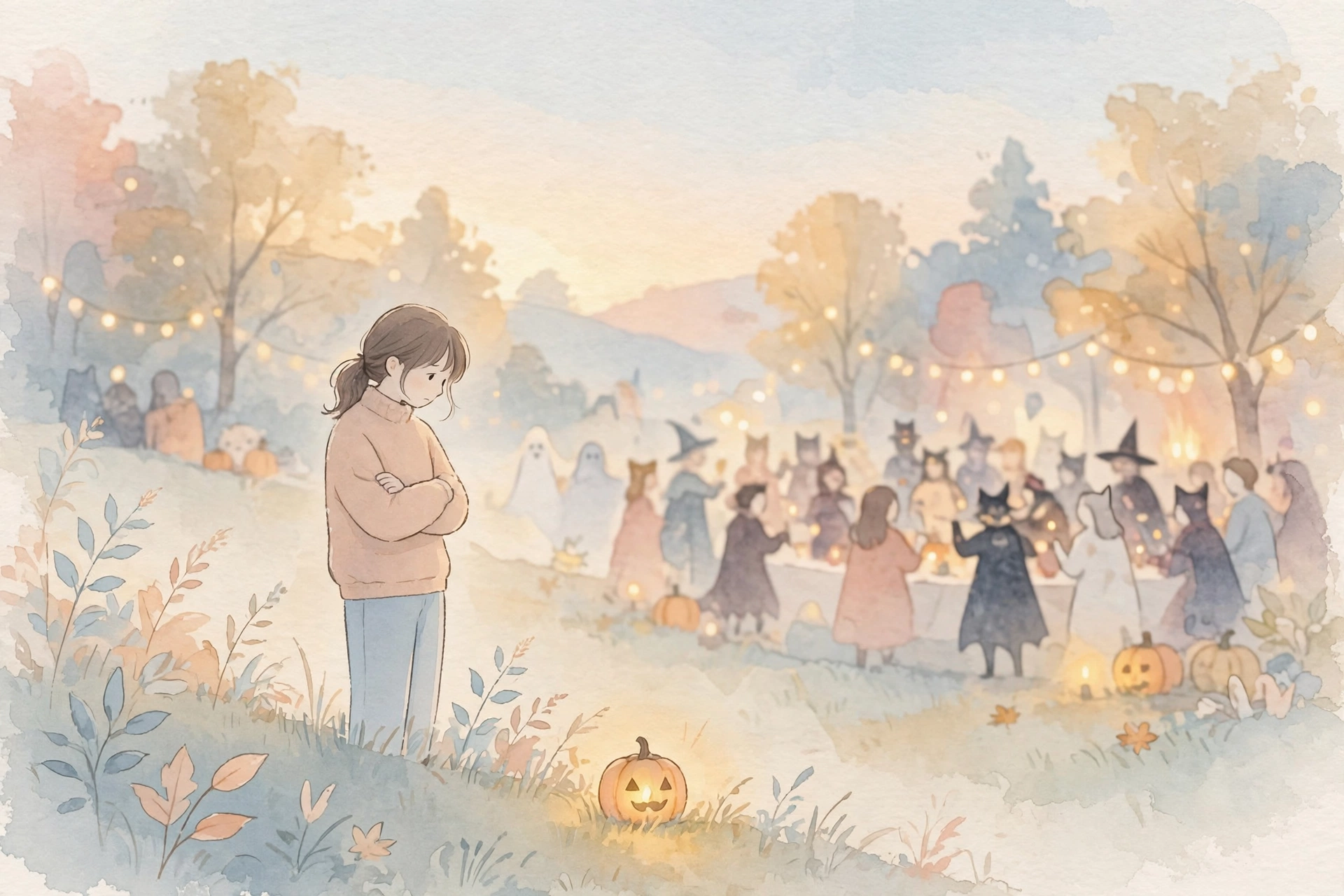
Halloween Anxiety: Why October Feels Overwhelming and How to Calm It
Reviewed by a Psychology Postgraduate (MA)
October arrives, the stores fill with costumes and candy, and everyone around you seems thrilled about Halloween — everyone except you, because while your group chat buzzes with party plans, your stomach is knotting up. If the season makes you tense instead of excited, you are far from alone: halloween anxiety is one of the most common, least talked-about seasonal stress spikes in the United States.
The short answer: Halloween anxiety is the wave of worry, social pressure, and sensory overload many people feel in the run-up to October 31 — driven by costume scrutiny, crowded parties, drinking culture, children’s logistics, fear of missing out, and loneliness. It spikes because Halloween compresses social comparison, performance pressure, and overstimulation into a single night, and it usually fades once November arrives.
And note: this is not about fear of horror movies. It is about everything around the holiday — the parties, the costumes, the expectations, the noise.
What exactly is halloween anxiety?
A direct answer first: halloween anxiety is the stress, dread, or overwhelm people feel around Halloween — about parties, costumes, social plans, sensory overload, or being alone on a night when everyone else seems to be celebrating.
It is not a diagnosis — for most people it is a normal response to a genuinely stressful setup. Two familiar mechanisms do the heavy lifting. The first is anticipatory anxiety: suffering in imagination long before the event. Your brain rehearses everything that could go wrong — the silly costume, the party where you know nobody, the photos you will be tagged in. That is why the two weeks before Halloween often feel worse than the night itself.
The second is social comparison theory: we constantly measure ourselves against others, and Halloween is comparison on steroids — costumes are a public performance of creativity and belonging.
Why does Halloween spike anxiety instead of feeling fun?
Short answer: because Halloween concentrates almost every known social anxiety trigger — being watched, judged, crowded, photographed, and expected to perform — into one night, with a hard deadline of October 31.
A “normal” Halloween asks a lot. Pick a costume — which means deciding how you want to look and be judged, under real body-image pressure. Then add the parties: loud, crowded, and built around alcohol in a way ordinary gatherings are not. About one in eight US adults experiences social anxiety disorder at some point in their lives, according to the National Institute of Mental Health. And some people have higher sensory processing sensitivity, meaning they are wired to be more affected by loud music, flashing lights, and chaotic crowds.
Then there is the signature whiplash: say yes to the party and you spend a week dreading it; stay home and you scroll through costume photos feeling left out. Daniel, a 29-year-old from Ohio, lives this cycle every October — he agrees to a party in the group chat, half-dreads it for a week, drinks too much to take the edge off, and leaves feeling flat. (A composite example, but a familiar one.)
Parents get a second layer: logistics. Trick-or-treat routes, school costume parades, candy budgets, keeping kids safe after dark — the holiday becomes a project, not a pleasure.
Pause and ask yourself: When you picture Halloween night this year, what is the single moment that tightens your chest the most — the costume, the party, the photos, being alone, or something else?
Vague dread feels enormous; a specific worry is something you can actually plan around.
Is fear of halloween a real phobia?
Short answer: yes, the clinical fear of Halloween is called samhainophobia, but it is rare — most halloween anxiety is ordinary seasonal stress, not a phobia.
The name comes from Samhain, the ancient Celtic festival Halloween grew out of. Like other specific phobias, it involves intense, persistent fear and avoidance that interferes with daily life — a different league from feeling jittery about a party. If your fear of halloween is closer to “I do not want to go to the party” than “I cannot leave my house in October,” you are dealing with situational anxiety: uncomfortable, but manageable.
Why does social anxiety at halloween feel worse than at other parties?
Short answer: because costumes raise the stakes — you are not just showing up, you are performing, and your appearance is up for public review in a way it never is at a normal dinner party.
At an ordinary party, nobody evaluates your outfit. At a Halloween party, your costume is the conversation — commented on, photographed, ranked. Being seen and judged becomes the centerpiece of the evening.
Then there is the alcohol pressure. Research on social anxiety consistently shows that drinking to cope leaves people more anxious over time, not less — alcohol quiets the nerves for an hour and hands them back, with interest, the next morning. Going sober, leaving early, or skipping the party is not unhealthy avoidance; it is a boundary.
Check in with your anxiety level
How can I get through halloween party anxiety without drinking?
Short answer: give yourself a role, a plan, and an exit — structure replaces liquid courage.
Drinking feels necessary because the night is unstructured chaos. Structure is the antidote:
- Take a job. Be the photographer or the DJ. A role gives your attention somewhere to go — and nobody questions the DJ.
- Arrive with a plan. “I will stay 90 minutes and leave after the costume contest” beats “I will see how it goes” every time.
- Hold something. Sparkling water with lime removes the repeated “can I get you something?” pressure.
- Buddy up. Go with one trusted person and agree on a signal for “time to leave.”
- Plan the morning after. Book something pleasant for November 1. Knowing tomorrow is already good makes tonight feel lower-stakes.
What if staying home triggers FOMO or loneliness?
Short answer: staying home is a valid choice, but an empty evening plus a glowing phone is a recipe for misery — so if you skip the party, fill the night on purpose.
Here is the cruel math of FOMO: social media shows you everyone else’s highlight reel precisely when you are most vulnerable to comparison — without the awkward small talk or the early exits. If you stay in, make it a decision, not a default: cook something good, watch what you enjoy, hand out candy if that sounds fun, or turn off the porch light guilt-free if it does not. Add one small ritual of connection — text a friend, call a sibling. Loneliness hurts most when the night feels accidental; a planned cozy evening is a different experience.
Our Name Your Feeling tool can help you pin down whether what you feel is loneliness, envy, or relief — naming an emotion is the first step to working with it.
A calm plan for October 31
Short answer: decide your version of the night early, set a time boundary, and prepare one grounding tool.
- Decide by October 25. Party, small gathering, family night, or full opt-out — pick one and commit. Indecision feeds anticipatory anxiety.
- Simplify the costume. A comfortable, low-effort costume you feel good in beats an ambitious one that makes you self-conscious.
- Set an exit time. A time boundary turns an endless evening into a manageable event.
- Prepare one grounding tool. The 5-4-3-2-1 technique — name 5 things you see, 4 you hear, 3 you can touch, 2 you smell, 1 you taste — calms an overloaded nervous system in about a minute. Practice it in our relaxation techniques section first.
- Limit the scroll. FOMO cannot reach you if you are not watching everyone else’s night.
- Plan a soft landing. The post-Halloween letdown is real — after weeks of buildup, November 1 can feel flat. Schedule something kind for the next day.
Frequently Asked Questions
Is halloween anxiety normal?
Yes. Halloween packs social pressure, costume scrutiny, noise, crowds, and FOMO into one night — feeling anxious is a normal response.
What is samhainophobia?
The clinical term for an intense, persistent fear of Halloween that disrupts daily life. It is rare — most halloween anxiety is ordinary seasonal stress, not a phobia.
Should I force myself to go to the Halloween party?
Not necessarily. A middle path works best: set a short time limit, bring a buddy, give yourself a role, and let yourself leave when you planned to.
How do I calm down if Halloween night feels overwhelming?
Step outside, try the 5-4-3-2-1 grounding exercise, and remind yourself the feeling is temporary. Leaving early is always an option.
Try it on our site
If Halloween season is stirring up anxious feelings, these free tools can help:
- Anxiety check-in — a quick private check on your anxiety level
- Name Your Feeling — pin down what you are feeling: FOMO, loneliness, or relief
- Relaxation techniques — including the 5-4-3-2-1 grounding exercise
- 7-Day Anxiety Toolkit — a guided week of science-backed anxiety tools
Related reading: The Psychology of Halloween Costumes and The Psychology of Scary Movies: Why We Love Being Frightened
Key Takeaways
- Halloween anxiety is the seasonal wave of stress around parties, costumes, sensory overload, FOMO, and loneliness — a normal response to a demanding holiday, not a personal failing.
- Anticipatory anxiety and social comparison are the main drivers — the dread before October 31 is usually worse than the night itself.
- A role, a plan, and an exit time make parties far easier; structure replaces the need to drink for courage.
- If you stay home, make it a deliberate cozy night and limit the scroll — FOMO feeds on highlight reels.
- Grounding tools like 5-4-3-2-1 can calm an overloaded nervous system in about a minute.
This article is for educational purposes only and is not medical advice or therapy. If anxiety is interfering with your daily life, consider speaking with a licensed mental health professional.