
Bonfire Night Is Tonight: The Psychology of Fireworks Anxiety
Reviewed by a Psychology Postgraduate (MA)
Tonight is Bonfire Night, and across the United Kingdom the sky will fill with bangs, whistles, and flashes from garden displays and organised shows alike. For many people it is the highlight of the autumn. For many others, children, pets, veterans, and anyone sensitive to sudden noise, it is the most stressful night of the year for anyone living with fireworks anxiety. Police Scotland is deploying as many as 1,700 officers in its biggest Bonfire Night operation, with police escorting fire crews in a crackdown on disorder, while fire services are asking people to attend organised displays and to soak used fireworks before binning them. The evening is expected to be chilly and foggy in places, which will carry the sound further and keep the smoke hanging low.
The scale of the night is part of the problem. A single evening of fireworks is predictable in the calendar and entirely unpredictable in the moment: nobody knows when the next bang will come, how loud it will be, or how long the noise will last. That combination, a known event with unknown timing, is exactly what the anxious brain finds hardest to tolerate. Add the fires already reported this week, including a blaze on Canford Heath nature reserve in Poole on Wednesday evening that needed fourteen fire engines across around two and a half acres of heath, and it is easy to see why the night feels bigger and less safe than the celebration in the posters suggests.
The short answer: Fireworks anxiety psychology is the psychology of sudden, uncontrollable noise. The brain treats an unexpected bang as a threat before conscious thought gets a vote, flooding the body with adrenaline. The fear is not irrational, it is the threat system doing its job too well, and the way through it is to restore predictability and control, not to tell the frightened person to toughen up.
Bonfire Night has been marked on 5 November since 1605, when Guy Fawkes and his fellow conspirators were caught trying to blow up Parliament. Four centuries later the gunpowder plot is history, but the fireworks remain, and so does the noise that makes the night hard for a large minority of the population. Surveys in the UK consistently find that a majority of pet owners report their animals showing fear during fireworks season, and a substantial share of parents say their young children are frightened too. The celebration is communal. The fear is private, and often lonely.
Why does fireworks anxiety strike even when we know they are coming?
The answer starts in the amygdala, the brain’s threat-detection centre, which reacts to sudden loud sounds in milliseconds, long before the thinking part of the brain has worked out that the noise is a firework and not a danger. This is the startle response, and it is one of the fastest reflexes humans have. A bang of 150 decibels, which is roughly what a firework produces at close range, triggers a cascade: adrenaline, a faster heartbeat, tense muscles, and a rush of attention to the source of the sound. Knowing intellectually that fireworks are harmless does not switch this off, because the reaction happens before intellect gets involved.
What makes fireworks worse than other loud noises is their unpredictability. Research on stress shows that unpredictable threats are far more distressing than predictable ones of the same intensity. A person can tolerate a loud noise they control, a concert they chose, a drill they started. The same noise arriving without warning, from an unknown direction, at an unknown moment, feels threatening because the brain cannot prepare for it and cannot predict when it will end. Fireworks season stretches this over days or weeks, with bangs arriving at random intervals, and that chronic unpredictability keeps the threat system switched on. This is also why organised displays are usually easier to bear than scattered garden fireworks: a display has a start, a middle, and an end, and the brain can count down to the finish.
Why are children and pets affected most?
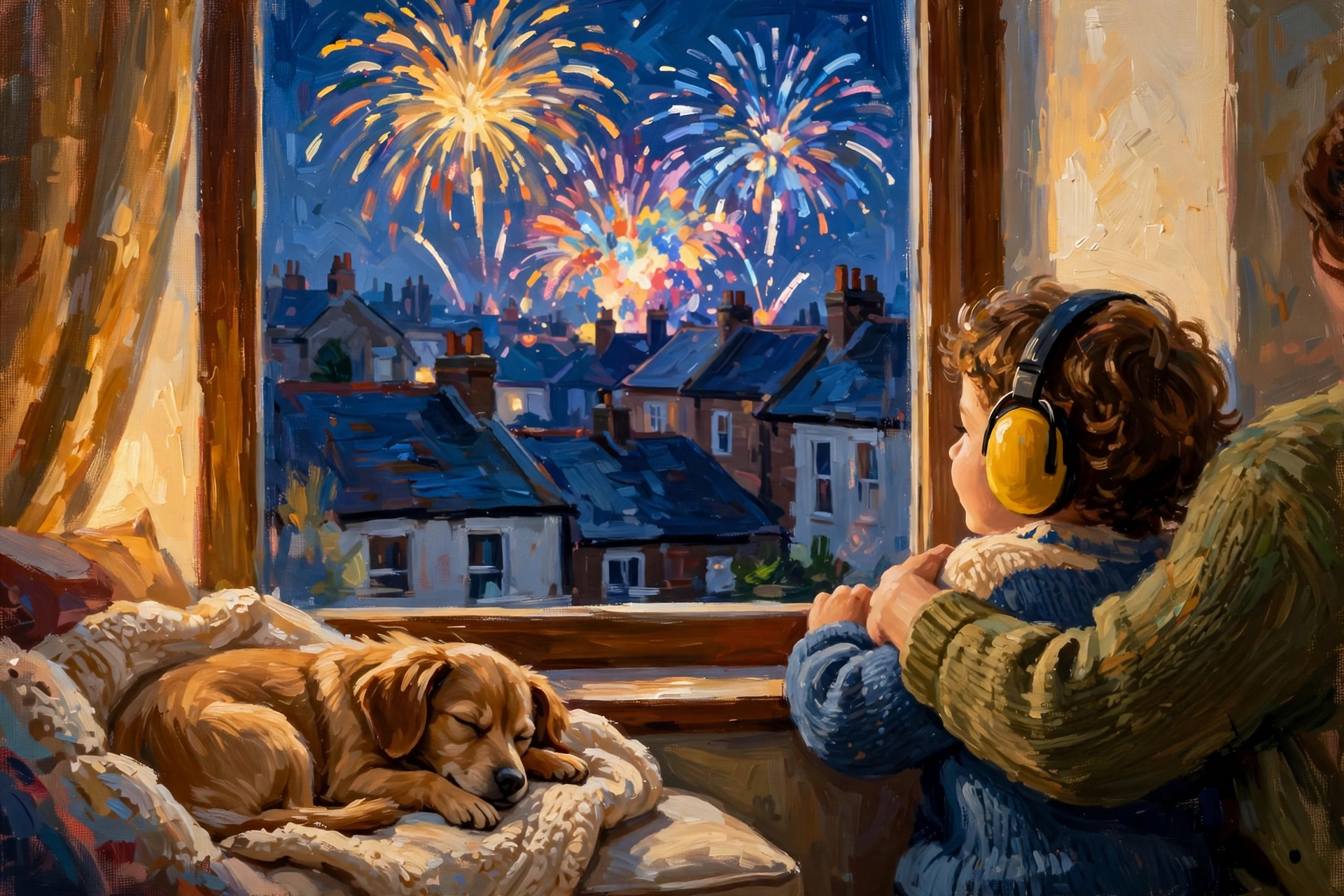
Children are affected for two reasons. First, their threat systems are still learning which sounds are dangerous and which are safe, and a loud bang at night, when the world is dark and the adults are also reacting, reads as danger. Second, children have less control over their environment than adults do. They cannot choose to leave, cannot put on ear defenders without an adult’s help, and cannot reframe the experience in words. A child who is frightened by fireworks and then told that they are being silly learns a second lesson on top of the fear: that their feelings are wrong. That lesson lasts longer than the night does.
Pets have no explanation at all. A dog hears a bang four times louder than a human does, with no idea where it came from or when it will stop. The RSPCA and veterinary surveys report the same pattern every year: dogs hiding, shaking, refusing food, and in some cases injuring themselves trying to escape. Cats vanish into cupboards. The fear is not a training failure; it is a normal animal response to an overwhelming stimulus. What helps is the same thing that helps humans: predictability, a safe hiding place, and a calm companion who stays nearby.
For some adults the night is harder still. Veterans and people living with post-traumatic stress can find the sound of explosions, even celebratory ones, triggering. The brain that learned to associate sudden bangs with real danger does not automatically unlearn the association because the calendar says it is a celebration. The same is true for people with sensory sensitivities, including many autistic people, for whom the combination of bright flashes, loud bangs, and crowds is a sensory overload, not a party. These are not people who need to be told to enjoy themselves. They need a plan.
Pause and ask yourself: Who in your household, human or animal, dreads tonight? What is one thing you can do before dark, a safe room, ear defenders, a plan to stay in, that would make the night easier for them?
If the noise tonight brings up feelings that feel bigger than the fireworks, try a calming exercise: Relaxation Techniques offers breathing and grounding practices you can use in the moment, no signup needed.
How can you get through tonight?
The most useful principle is control. Give the frightened person, or animal, as much of it as you can. For children, that means warning them in advance, letting them choose where to watch from, indoors with the curtains drawn if they prefer, and giving them ear defenders or headphones with music they like. Let them decide when they have had enough, and treat that decision as sensible, not cowardly. A child who feels in control of the experience is far less likely to be frightened by it, and the memory they form will be of coping, not of panic.
For pets, start before dark. Walk the dog early, feed them before the noise begins, and set up a den, a quiet room with blankets, familiar smells, and a radio or television on to mask the bangs. Stay home if you can; your calm presence is the strongest signal of safety a pet has. Do not punish a frightened animal for hiding or shaking. Fear is not disobedience. If your pet’s distress is severe, talk to your vet about short-term options before the next fireworks season, because desensitisation, gradually exposing the animal to recorded firework sounds at low volume over weeks, works best when it starts long before November.
For adults who find the night difficult, the same logic applies. Plan the evening in advance: know when the local display starts and ends, choose a quieter location, use earplugs or noise-cancelling headphones, and have a friend or family member who knows the plan. If the sounds trigger memories of trauma, grounding techniques help, naming five things you can see, four you can touch, three you can hear, two you can smell, and one you can taste, to anchor yourself in the present room. And if Bonfire Night consistently causes real distress, that is worth mentioning to your GP, because effective help for noise-related anxiety exists and does not require you to simply endure it every year.
Frequently asked questions
Why do fireworks cause anxiety? Because they are sudden, loud, and unpredictable. The brain’s threat system reacts to an unexpected bang before conscious thought, releasing adrenaline. Unpredictable noise is far more stressful than predictable noise of the same volume.
How can I help a child who is scared of fireworks? Warn them in advance, let them choose where to watch from, offer ear defenders or headphones, and let them decide when they have had enough. Never dismiss the fear; a child who feels in control copes far better than one who feels trapped.
What should I do for a dog scared of fireworks? Walk and feed them before dark, create a quiet den with blankets and familiar smells, keep a radio or TV on to mask the bangs, and stay home with them. Do not punish hiding or shaking. Ask your vet about desensitisation training before next year.
Can fireworks trigger PTSD? Yes. For veterans and people with post-traumatic stress, sudden explosions can trigger flashbacks and intense distress, even when the person knows the fireworks are celebratory. Planning the evening, using ear protection, and having a support person nearby all help.
Are organised displays better than garden fireworks? Usually, yes. An organised display has a clear start and end, so the brain can predict when the noise will stop. Scattered garden fireworks, arriving at random times over days, are harder to tolerate because the unpredictability lasts longer.
Try it on our site
If tonight, or the noise around it, is weighing on you, these free tools can help:
- Relaxation Techniques – breathing and grounding exercises for the moment the noise starts.
- Mind Check-Ins – a short check-in on how anxiety is affecting your sleep and mood.
- Name Your Feeling – put a precise name to what the noise brings up, and see that others feel it too.
Related reading: Halloween Anxiety: Why the Spooky Season Stresses You Out, Hurricane Anxiety: The Psychology of Watching the Storm Approach, and Derek Hough and the Psychology of Pet Loss Grief.
Key Takeaways
- Bonfire Night falls on 5 November 2026, with Police Scotland deploying up to 1,700 officers and fire crews urging people to use organised displays.
- Fireworks frighten us because they are sudden, loud, and unpredictable, and unpredictable threats are far more stressful than predictable ones.
- Children, pets, veterans, and people with sensory sensitivities are affected most, and their fear is a normal threat response, not a weakness.
- Control is the antidote: advance warning, ear protection, a safe room, and the freedom to leave when you have had enough.
- For pets, prepare before dark, a quiet den, familiar smells, background sound, and your calm presence nearby.
- If fireworks night causes real distress every year, talk to your GP or vet: effective help for noise anxiety exists.
This article is for education only, not therapy, diagnosis, or medical advice. If you are struggling, speak to a licensed professional, your doctor, or a trusted support service. In the UK, Samaritans is available on 116 123. In the US, call or text 988.