
Do Vision Boards Work? What Psychology Says
Reviewed by a Psychology Postgraduate (MA)
A friend of mine started January with a corkboard covered in images: a marathon medal, an apartment listing, the word “BOLD” cut from a magazine. By spring she had run the marathon — and moved somewhere cheaper than the apartment she had pictured, because the fantasy had quietly skipped the budget. Ask her whether the board worked and she will hesitate — and that hesitation is the honest answer this article unpacks.
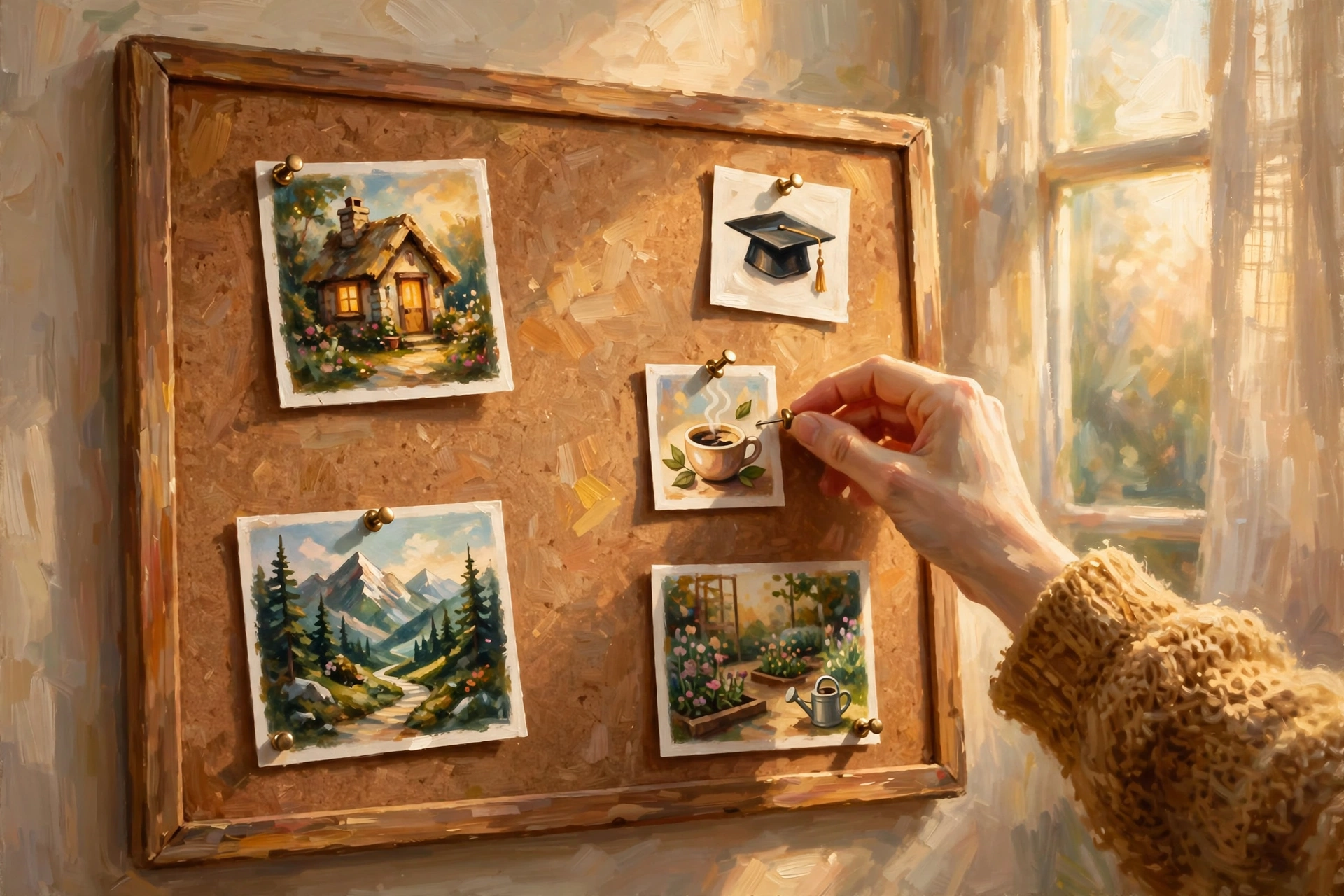
Do vision boards work? A vision board is a collage of images, words, and quotes representing the life you want, kept where you will see it. Psychology has a calmer verdict on it than either camp. There is no magic in it — but a well-built board does two genuinely useful psychological jobs: it keeps a goal constantly visible, and a goal you keep noticing is a goal you keep acting on. Choosing the images also forces you to get specific, which goal-setting research links to far better results than vague wishes. A bad board is decoration; a good one is a reminder system and a clarity tool.
Short answer
No magic — but two real jobs. A board you see every day keeps your goal salient (selective attention, the frequency illusion), and choosing images forces the specificity goal research links to better results. Boards fail when vague, hidden, or all fantasy with no action.
Do vision boards work?
As magnets for the universe, no: no image rearranges the outside world. As psychological tools, sometimes yes — and the pattern of when they work is well understood.
The honest framing is this: a vision board is a goal cue, not a spell. Its power lives in the viewer, not the paper. Attention research, goal-setting research, and work on mental imagery all point the same way: a board works to the extent that it keeps your attention on something specific and pulls action behind it. Where boards fail, the pattern is just as clear — vague images nobody looks at, wishes with no steps, and the quiet belief that the board is doing the work so you do not have to.
Job one: a board you see daily keeps the goal on your mind
The first job is attentional. A board you will genuinely see every morning is a persistent reminder of a goal — and reminders matter, because attention is a ruthless filter that mostly serves whatever is loudest right now.
Once a goal is front of mind, your brain starts flagging anything connected to it. This is selective attention — the mechanism behind the frequency illusion: decide you want a certain used car, and suddenly it appears on every street. You are not seeing more of them; you are noticing the ones that were always there. The opportunities were not created by the board. The noticing was. A board buried in a closet or a phone folder nobody opens does none of this.
Job two: choosing images forces you to get specific
The second job is clarity. “I want a better life” fits on no board. The moment you must pick actual images, vagueness becomes impossible: which neighborhood, what kind of work, what exactly does the finished thing look like. Board-building forces specificity, and goal research is emphatic about what specificity is worth.
In the work of Edwin Locke and Gary Latham, specific and challenging goals produced higher performance than vague “do your best” goals across hundreds of studies. “Save money” drifts; “transfer $300 to savings on the first of every month” acts. A board of chosen images is, almost by accident, a specificity engine: you cannot pin “happiness,” but you can pin a trailhead photo, a dance-class flyer, a savings chart with your number on it.
What makes a vision board effective instead of just decorative?
Four features separate boards that work from boards that decorate:
1. Specificity. Each image should name something concrete: not “travel,” but the Big Sur trail you will hike in October; not “wealth,” but the freelance rate you will charge by summer.
2. Daily visibility. The board must live where your eyes actually land — beside the bathroom mirror, across from the desk, as your phone’s lock screen.
3. Process images, not only prizes. This is the one most boards get backwards. Gabriele Oettingen found that visualizing only the outcome — the medal, the keys — can reduce effort, because the mind tastes the reward early and relaxes. Visualizing the process — the steps, the effort, the recovery from slips — performs measurably better. Pin the prize, but pin the process too: the 6 a.m. alarm, the open laptop, the training plan with weeks crossed off.
4. One action per image. Every image should have a real-world action glued to it: the marathon photo gets “register for the training group this week”; the apartment photo gets “tour two buildings this month.” With actions attached, the board is a to-do list that happens to be beautiful. Without them, it is a wish list that happens to be framed.
Pause and ask yourself
Picture the most vivid image on your board — or the goal you would pin first. What is the smallest real action that image asks for this week? If you cannot name one, the image is a wish. Give it an action.
How to build a board that works in 30 minutes
You do not need craft supplies or a free afternoon. A board that works is built by decisions, not glue. Set a timer and work through five steps.
Step 1: Pick three to five goals, no more. Write each in specific language — a number, a date, a name. A board holding twelve dreams holds none; choosing what makes the wall is half the clarity.
Step 2: Find one image and one action cue per goal. One vivid image — a photo, a printed picture, a word in big letters — plus one concrete action beside it. “Apply to three nursing programs by March.” “Call the studio about beginner classes Tuesday.”
Step 3: Add process images. For at least half your goals, add an image of the doing, not only the having: the textbooks, the running shoes by the door, the half-finished draft. These keep effort up instead of letting the fantasy spend it.
Step 4: Put it where mornings happen. Corkboard, fridge, wall beside the bed, phone lock screen — any format is fine as long as you will see it without trying. A digital board counts if it is in your daily line of sight; a folder you open once does not.
Step 5: Review it for two minutes a day. Each morning, look at the board and ask: what moves any image closer today? Write it down. That daily question turns a passive display into a decision routine.
When can a vision board backfire?
The biggest risk is the one Oettingen’s work warns about: a board of pure fantasy can make the future feel achieved already, quietly draining the urgency to act. If looking at your board feels like the goal is done, the board is working against you — replace the prizes with processes.
The second risk is subtler: a board can become a substitute for planning. An hour arranging images feels productive; it is not the same as sending the email. Treat board-building as the kickoff, never the workout — finish your thirty minutes with one concrete step the same day. And the honest counterweight: no board guarantees anything. A goal you worked toward and missed is not proof you visualized wrong; some variables no image can control.
Frequently asked questions about vision boards
Are vision boards effective?
There is no clinical trial on “vision boards” as such, but the mechanisms they use have strong support: visible goal cues sustain attention, specific goals outperform vague ones (Locke and Latham), and process visualization improves follow-through (Oettingen). A specific, visible, action-linked board is effective in exactly those ways.
Does making a vision board work better than just writing goals down?
Writing a specific goal already does most of the heavy lifting. A board adds constant visual priming and emotional vividness that abstract words lack. If you never look at the board, the written list wins. Format matters less than exposure.
Should I include pictures of outcomes or the steps to get there?
Both, weighted toward the steps. Outcome images supply motivation and direction; process images supply the effort and the plan. A good rule is one prize image for every two process images.
Can a vision board make me feel worse?
It can, if the gap between the images and your current life feels like evidence of failure. That is a sign to rebuild: bring the goals closer, add process images, include something you already have. A board is a reminder of direction, never a report card.
Try it on our site
Build the honest version of a board with our free Vision Board Builder — pick your images and words, arrange them, and save or print the board for your wall. Then turn it into a plan with the Manifestation Planner: clear goals, process pictures, obstacles, and a daily evidence log.
Related reading: Manifestation, Explained by Psychology: What It Is and How It Works · How to Manifest: A Beginner’s Guide That Actually Works · Does Manifestation Work? What the Science Actually Says
Key Takeaways
- Vision boards have no magical power — but they do two real psychological jobs: keeping a goal salient through daily visual priming, and forcing the specificity that goal-setting research links to better results.
- A board that works is specific, visible every morning, weighted toward process images over prizes, with one action per image.
- Boards fail when they are vague, hidden, all fantasy, or a substitute for action.
- Pure outcome imagery can quietly drain effort; visualizing the steps keeps follow-through up.
- A vision board is a reminder system and a clarity tool — honest, useful, and never a contract with the future.
This article is educational content only and is not therapy, diagnosis, or professional advice. If you are struggling, consider speaking with a licensed mental health professional.