
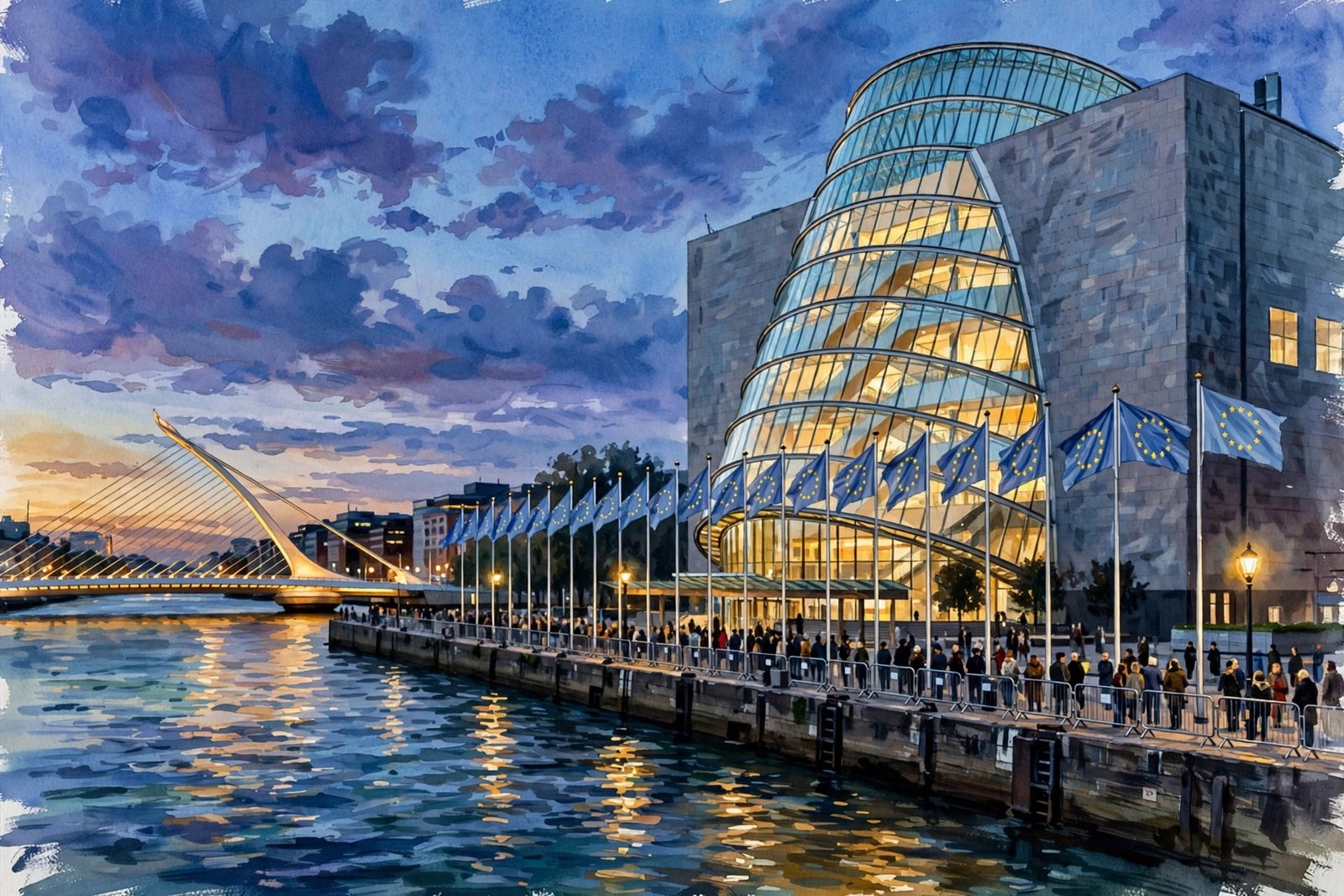
Europe’s Leaders Are in Dublin Today: The Psychology of Hosting the Continent’s Biggest Summit
Reviewed by a Psychology Postgraduate (MA)
The short answer: Leaders from around 50 European countries are in Dublin today, 12 November 2026, for the ninth European Political Community summit – the largest gathering Ireland has ever hosted. Behind the handshakes is a city under the biggest security operation in the history of the Irish state, and a continent trying to decide how safe it really is.
This is an update to our earlier piece on the Dublin summit, published yesterday. The Dublin EPC summit psychology starts with a simple contrast: then, the summit was a plan – a public-sector strike called off in the small hours, a security operation being assembled, leaders on their way. Today, it is happening. Ukrainian President Volodymyr Zelenskyy is in the room. Canadian Prime Minister Mark Carney is there as a special guest. The US envoys Steve Witkoff and Jared Kushner are expected to meet Zelenskyy after talking to Russian President Vladimir Putin in Moscow. And Dublin – a city of about 550,000 people – is hosting the whole of Europe for a day.
The summit, at the Convention Centre Dublin, is co-chaired by European Council President António Costa and Taoiseach Micheál Martin. Its theme is “Europe – strong, secure and connected”. The agenda is the war in Ukraine and Europe’s own security, discussed in a plenary session with Zelenskyy and in two roundtables: one on competitiveness, innovation and energy, and one on protecting and strengthening a democratic Europe. A press conference with Martin, Costa and Swiss President Guy Parmelin is scheduled for the early evening, and EU leaders stay on for a separate informal meeting on Friday 13 November.
Dublin EPC summit psychology: what does it feel like to host the world?
There is a particular psychology to being the host. When a small country puts on the biggest event in its history, the national mood splits in two directions at once: pride and performance anxiety. Pride, because the world is looking – and for a country that has spent much of its history on the edge of European affairs, that attention matters. Performance anxiety, because the world is looking, and anything that goes wrong will be seen by everyone.
Psychologists call the upside “collective effervescence”: the shared lift that comes from being part of something bigger than yourself. It is the feeling in a stadium, or a street, when a whole crowd is paying attention to the same thing. Dublin has some of that today. But effervescence has a shadow. When identity is on display, every detail feels like a verdict: the traffic, the weather, the welcome, the security. Host nations do not just run a summit. They audition in front of it.
Martin captured the official version when he said the EPC allowed European leaders “to come together to advance the security, stability and prosperity of our continent”. The unofficial version is simpler: Ireland is showing Europe it can hold the room.
What does the biggest security operation in Irish history do to a city?
It changes the texture of an ordinary day. Roads close, police appear on corners where they do not usually stand, and helicopters join the soundscape. For most Dubliners, the summit is not something they attend; it is something they move around. That is a strange position: the most important event your city has ever hosted, and your part in it is to take a different route to work.
Security operations work on the mind in two opposite ways. Visible security reassures – it says someone is in charge. It also reminds – it says there is something to be protected from. Research on risk perception shows the same measure can lower anxiety in one person and raise it in another, depending on what they feared in the first place. For a city that has lived with European security mostly as an abstraction, the sudden physical presence of it – barriers, cordons, convoys – makes it concrete. The war in Ukraine is no longer a news story. It is the reason your street is closed.
And then there is the disruption itself. The trade union Fórsa announced a 24-hour work stoppage for 12 November, with a rally in Dublin, adding a domestic argument to an international day. Disruption stacks: when a summit and a strike land on the same day, it is not two separate inconveniences. It is one city, interrupted twice.
Why is Ukraine at the centre of the room?
Because the summit was built for this moment. The European Political Community was established in 2022, after Russia’s full-scale invasion of Ukraine shattered Europe’s sense of security, as a forum for countries inside and outside the European Union. It brings together nearly 50 nations – every European country except Russia and Belarus – the brainchild of French President Emmanuel Macron and former German Chancellor Olaf Scholz.
Zelenskyy’s day in Dublin is a measure of how much rides on the meeting. He arrived on 11 November, met Martin, and is due to address the plenary, join a roundtable, and hold meetings with Polish Prime Minister Donald Tusk, Costa, European Commission President Ursula von der Leyen, NATO Secretary-General Mark Rutte and Czech Prime Minister Andrej Babiš. The most watched meeting may be the one not yet confirmed in detail: with Witkoff and Kushner, fresh from Moscow, carrying whatever came out of their talks with Putin. Zelenskyy said he expects an update from them after their recent talks in Abu Dhabi. Everyone in the room will be reading the same question into that meeting: is a deal any closer?
The psychology of that wait is familiar to anyone who has waited for news that could change everything. It is the same intolerance of uncertainty that runs through every story in this series: the mind would rather have bad news than no news, because bad news can be planned around. The summit exists, in part, to shorten that wait – to turn months of speculation into a day of decisions, or at least a day of being seen to decide.
Pause and ask yourself: When leaders gather to talk about war and security, do you feel safer, or does the gathering itself remind you of the danger? Both answers are reasonable. A summit is a symbol of unity, and symbols matter – but a symbol is not a shield. Noticing which feeling is stronger in you is a good way to read the news without being read by it.
What happens next?
Two things. First, the evening press conference with Martin, Costa and Parmelin, where the summit’s conclusions will be set out in public. Second, Friday’s informal meeting of EU heads of state and government – also in Dublin, chaired by Costa and hosted by Martin – where the conversation narrows from the whole continent to the 27 member states. The next EPC gathering is already fixed: April 2027 in Zurich, hosted by Switzerland, which will treat Dublin as its dress rehearsal.
For Ireland, the test does not end when the leaders leave. Hosting is a one-day performance with a long tail: the judgment comes later, in the reporting, the photographs, and the quiet assessment of whether the country looked like it belonged at the centre of Europe. That is the host’s bargain. You do the work, the world watches, and the feeling lingers after the barriers come down.
If the news from Dublin is leaving you anxious, you are not alone. In Ireland, the Samaritans (116 123) offer free, confidential support around the clock, and your GP can help with ongoing anxiety about the war and the news.
Frequently asked questions
What is the European Political Community summit?
It is a forum of nearly 50 European countries, inside and outside the EU, set up in 2022 after Russia’s full-scale invasion of Ukraine. The ninth meeting is in Dublin on 12 November 2026, under the theme “Europe – strong, secure and connected”.
Who is in Dublin today?
Leaders from around 50 countries, including Ukrainian President Volodymyr Zelenskyy, Canadian Prime Minister Mark Carney as a special guest, and NATO Secretary-General Mark Rutte. The meeting is co-chaired by European Council President António Costa and Taoiseach Micheál Martin.
Why is this the biggest summit in Irish history?
It is the largest gathering of heads of state and government Ireland has ever hosted, with the largest security operation in the history of the Irish state. Dublin is also hosting an informal EU leaders’ meeting on Friday 13 November.
What are the US envoys doing in Dublin?
Steve Witkoff and Jared Kushner are expected to meet Zelenskyy in Dublin after talks with Russian President Vladimir Putin in Moscow, following US-mediated talks in Abu Dhabi on the war in Ukraine.
Try it on our site
If the news from Dublin – or the war at the centre of it – is weighing on you, these free tools can help:
- Challenge the Thought — test a worrying thought about the news
- Name Your Feeling — put a name to what you are feeling right now
- Mind Check-Ins — a quick check on how you are feeling
- Daily Tracker — track mood, sleep, and stress
Related reading: Dublin EU Summit Psychology: The Disruption, the Deal, and the Relief · Trump Says a Strike on Iran Could Come “Tomorrow”: The Psychology of War Anxiety · Finland Drone Alerts Psychology: What a Night of Warnings Does to a Country
Key Takeaways
- Leaders from around 50 European countries are in Dublin on 12 November 2026 for the ninth European Political Community summit, the largest gathering Ireland has ever hosted.
- Ukraine is at the centre: Zelenskyy is addressing the plenary and meeting US envoys Witkoff and Kushner after their talks with Putin in Moscow.
- Dublin is under the biggest security operation in the history of the Irish state, and a Fórsa work stoppage adds disruption on the same day.
- Hosting brings collective pride and performance anxiety in equal measure – and visible security both reassures and reminds.
- EU leaders stay on for an informal meeting on Friday 13 November; the next EPC summit is in Zurich in April 2027.
This article is for education only, not a substitute for professional advice. If you are struggling, please consider speaking to a licensed professional.