
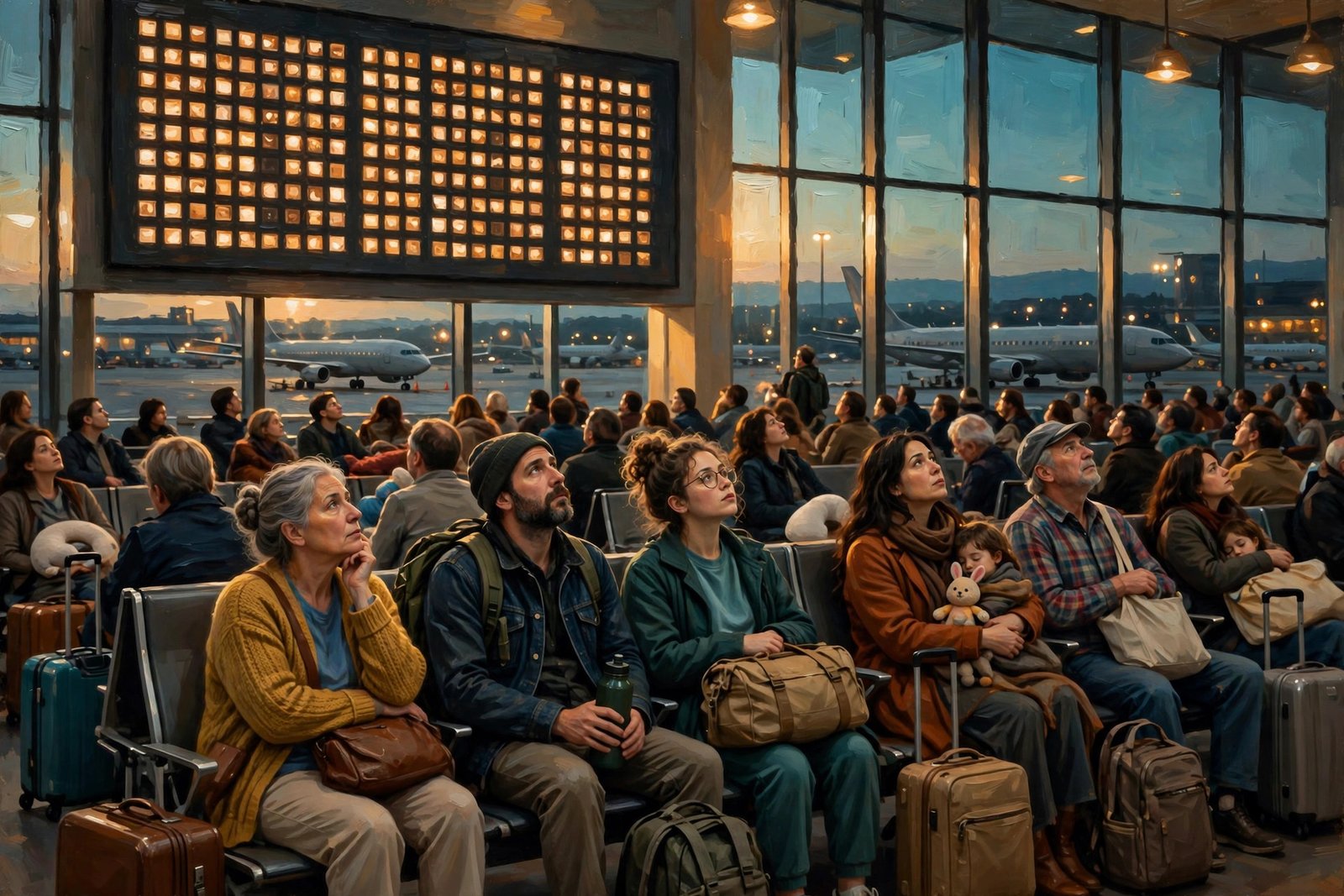
FAA Ground Stop Psychology: Why America’s Four-Hour Flight Halt Felt So Stressful
Reviewed by a Psychology Postgraduate (MA)
On Friday 13 November 2026, at 3:54pm Eastern Time, the FAA ordered a nationwide ground stop after a telecommunications failure disrupted air traffic control at all 22 control centres. It was lifted at 8:15pm, just over four hours later. FAA ground stop psychology explains why those four hours felt so much longer to the people living through them.
In short, the stress was not really about the delay itself. It was about not knowing when planes would move, whether a trip would happen at all, and who to ask. When the brain loses control and information at the same time, it treats the gap as a threat.
What happened on Friday 13 November?
Flightradar24 reported 4,042 flights already in the air heading to US airports when the order was issued. Those aircraft could continue, but nothing new could take off.
By the end of Friday, Flightradar24 counted more than 4,700 flights cancelled and 10,000 delayed, plus 700 more for Saturday. Cirium estimated about 11,000 flights carrying more than 1.5 million passengers had been scheduled to depart after 4pm, and FlightAware counted about 6,500 cancellations by late evening. The trackers count differently, but all point to one of the biggest single-day disruptions in recent US aviation history.
The disruption spread beyond the United States: Canadian airports cancelled flights, flights from Europe were cancelled, Las Vegas airport told passengers there would be no departures for 24 hours, and JetBlue cancelled its remaining Friday flights except Europe-bound services from New York JFK and Boston.
What caused the ground stop?
US Transportation Secretary Sean Duffy blamed ageing air traffic control technology and routers overwhelmed by data. Homeland Security Secretary Markwayne Mullin said investigators found no indication of a cyberattack or deliberate threat, and President Donald Trump told Fox News it did not appear to have been caused by a cyberattack or artificial intelligence.
This was the first nationwide ground stop since January 2023, when a malfunction in the FAA’s Notice to Air Missions system halted flights, and analysts warned it could take several days for airlines to restore schedules.
Do not confuse this with the week before, when on Saturday 7 November 2026 the FAA ordered airlines to cut flights at 40 airports during the government shutdown, a planned reduction covered in our article on the FAA flight cuts and the psychology of travel chaos. The 13 November stop was different: unplanned, nationwide, and caused by a technology failure.
FAA ground stop psychology: why did a four-hour halt feel so much worse than four hours?
A four-hour delay sounds manageable on paper, yet passengers described Friday evening as exhausting and infuriating. The gap between the clock and the feeling is where the psychology lives.
Flight delay anxiety is the worry, restlessness and physical tension that builds when a journey you were counting on is suddenly out of your hands.
The first reason is that it removed control without warning. Most of us tolerate travel stress because we have a plan: arrive, board, land, move on. A ground stop breaks the plan at the exact moment you can do nothing about it. Psychologist Martin Seligman’s research on learned helplessness showed that when people face outcomes they cannot influence, they stop trying to cope and feel worse. You cannot fix a radar system from seat 14B.
The second reason is the crowd: stress is socially contagious, so we read tension in other people’s faces and our own nervous systems respond as if the threat were bigger than it is.
Why does “no information” hurt more than bad news?
Many passengers said the worst part was not the cancellation but the silence before it: frozen boards, vague announcements, useless apps. Then, when a cancellation finally arrived, some felt calmer, even though the news was bad.
There is a name for this: intolerance of uncertainty, the tendency to experience not knowing as threatening in itself. Research by Mark Freeston and Michel Dugas has shown that people high in it find ambiguous situations harder to bear than clearly negative ones. A definite cancellation can be planned around: rebook, find a hotel, call home. An indefinite delay cannot.
This is why “no information” hurts more than bad news. Bad news closes a loop, while no news leaves it open, and an open loop is exactly what the worrying mind feeds on: the same loop that drives overthinking in everyday life.
Pause and ask yourself: When your plans last fell apart, what bothered you more – the delay, or not knowing when it would end? If it was the not knowing, you have met your own intolerance of uncertainty.
What happens in your brain when a flight is grounded?
When a plan collapses without warning, the brain’s threat-detection system switches on. The amygdala, a small structure deep in the brain, flags the situation as uncertain and threatening, and the body responds with a faster heartbeat, tighter muscles, shallow breathing, and a mind that keeps scanning for updates.
The trouble is that the system is built for short bursts, not for sitting in a departure lounge for four hours. When the stress response stays switched on with nothing to act on, the result is the wired-but-exhausted feeling travellers described on Friday: too alert to rest, too tired to think clearly. A flight anxiety episode can be triggered by far less.
How can you cope when your flight is grounded?
You cannot restart an air traffic control system, but you can change how the waiting affects you. These steps target the two things that make delays stressful: uncertainty and loss of control.
- Get one clear fact, then stop refreshing. Check the airline app once, then wait thirty minutes. Constant refreshing only feeds the open loop.
- Make a small plan for each outcome: if the flight goes, what will you do on landing? If it is cancelled, what is your first step – rebook, hotel, or home?
- Move your body. Walk the terminal or climb a set of stairs. Movement burns off stress hormones that build up while you sit and worry.
- Breathe slowly on purpose: four slow breaths in through the nose, six out through the mouth, repeated for two minutes, is enough to slow a racing heart.
- Connect with one person. Text a friend or talk to the person next to you. Research on travel uncertainty shows the travellers who cope best focus on what they can choose.
If the anxiety does not fade once you are home, talk to a professional rather than white-knuckling through every journey.
Frequently asked questions
What was the FAA ground stop on 13 November 2026? At 3:54pm Eastern Time on Friday 13 November 2026, the FAA ordered a nationwide ground stop after a telecommunications failure hit air traffic control systems at all 22 control centres. It was lifted at 8:15pm.
How many flights were affected? Flightradar24 counted more than 4,700 cancellations and 10,000 delays on Friday, plus 700 more for Saturday. Cirium estimated about 11,000 flights carrying over 1.5 million passengers were due to depart after 4pm, and FlightAware counted about 6,500 cancellations by late evening.
Was the ground stop caused by a cyberattack? No indication of one has been found. Homeland Security Secretary Markwayne Mullin said investigators found no indication of a cyberattack, and President Donald Trump told Fox News it did not appear to have been caused by one.
Why do flight delays cause so much stress? Delays combine uncertainty with loss of control, the two ingredients the stress system reacts to most strongly. Research on intolerance of uncertainty shows not knowing is often harder to bear than bad news, because a definite outcome can be planned for.
Try it on our site
Flight delays leave your mind racing. These free tools can help:
- Name Your Feeling – put a precise name on what you are feeling.
- Relaxation Techniques – guided breathing exercises for a crowded terminal.
- Thought Reframe – untangle worst-case thoughts during an indefinite delay.
- Focus Room – a calm space with gentle focus exercises.
Related reading: FAA Flight Cuts Hit 40 Airports – and 1,000 Flights Were Cancelled in a Day: The Psychology of Travel Chaos | United Flight 1681: The Hijack Text That Spread Fear | Uncertainty Anxiety: Budget Day, Fed Day, One Nervous Week
Key Takeaways
- The FAA ordered a nationwide ground stop at 3:54pm Eastern Time on Friday 13 November 2026, lifting it at 8:15pm, just over four hours later.
- More than 4,700 flights were cancelled and 10,000 delayed on Friday; about 11,000 flights carrying more than 1.5 million passengers had been scheduled to depart after 4pm.
- Officials blamed ageing technology and data-overwhelmed routers, and said there was no indication of a cyberattack.
- Flight delay anxiety is driven less by the delay than by uncertainty and loss of control. Intolerance of uncertainty explains why silence feels worse than bad news.
- Small steps – one clear fact, a plan for each outcome, movement, slow breathing and connection – make an indefinite wait far more bearable.
This article is for education only, not a substitute for professional advice. If you are struggling, please speak to a licensed mental health professional or contact a crisis line, such as 988 in the United States.