
France Riots: Why Do People Loot During Protests?
Reviewed by a Psychology Postgraduate (MA)
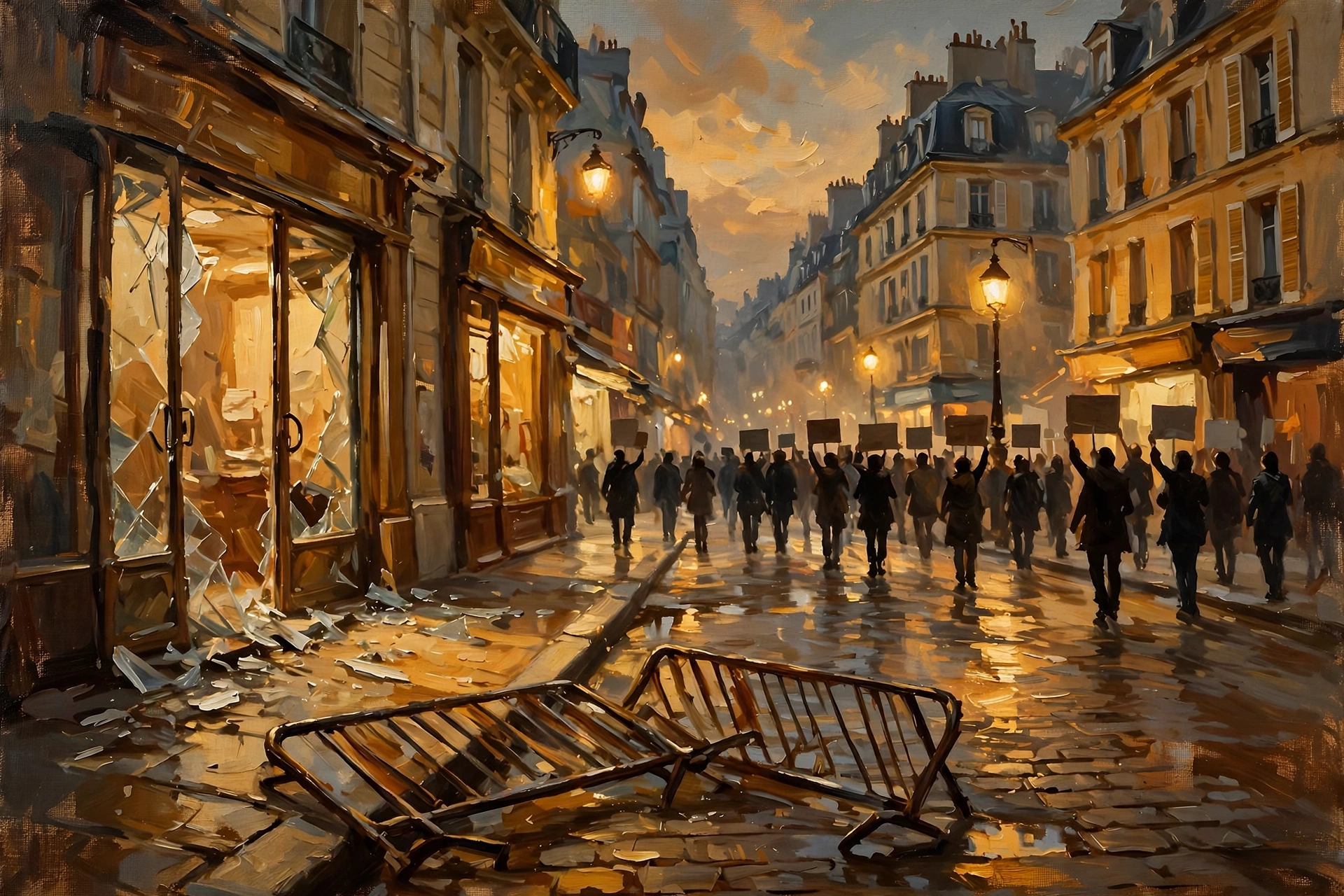
Saturday, October 17, 2026, was one of France’s most disruptive protest days. What began as nationwide cost-of-living demonstrations — the CGT counted rallies in roughly 1,750 locations, the Interior Ministry estimated 550,000 participants, organizers claimed 800,000 — ended with luxury stores and boutiques looted in Paris, hundreds of shops damaged in Lyon, more than 500 businesses hit in Marseille, and a town hall in flames in Limoges. Watching the footage, one question returns: why do people loot during protests — ordinary-looking people, many of whom had never broken the law before?
Short answer: People loot during protests because the crowd dissolves the brakes that normally hold them back: anonymity reduces self-awareness, shared responsibility makes guilt fade, and once someone else has broken a window, theft no longer feels like a personal choice. About half of those detained in France had no previous criminal record (Le Figaro, October 22-23, 2026).
The daytime marches were strikingly ordinary. Families, students, union members, and yellow-vest activists turned out against fuel prices, living costs, and school conditions; in Paris, marchers even sang the national anthem (Yonhap and Chosun, October 18, 2026). By evening, fringes turned violent in Paris, Lyon, Marseille, and Limoges: the Galeries Lafayette, luxury boutiques Celine and Dior, phone shops, and supermarkets were looted in Paris; Lyon’s tourism office was set alight and hundreds of shops damaged; more than 500 businesses were damaged in Marseille (Yonhap, October 18, 2026).
In Limoges, rioters forced entry into the town hall; the clock tower and the ornate city hall roof burned and collapsed. A 66-year-old was arrested on October 22, and a man in his 30s was detained on suspicion of attempting to murder police officers there (Ghana Guardian, October 23, 2026).
The aftermath figures are staggering. Justice Minister Gérald Darmanin said on October 22 that 2,700 people had been detained since the weekend, more than 1,000 had appeared in court, and 217 had been jailed in fast-track trials — “and this figure is continuing to rise a lot” (AFP, October 22, 2026). Nearly 1,000 police officers and gendarmes were injured, and police are identifying suspected looters through social media footage (AFP, October 22, 2026). Interior Minister Laurent Nuñez acknowledged police had “lost control” in places; Prime Minister Sébastien Lecornu promised a “massive” deployment for October 24.
But the most psychologically revealing number is not 2,700 or 217. It is the one reported by Le Figaro on October 22-23: about half of those detained had no previous criminal record. That forces a harder question than “what is wrong with looters?”: what is it about a crowd that pushes law-abiding people across a line they would never cross alone?
Why do people loot during protests when they are not criminals?
The direct answer: looting in a riot is rarely about a person’s character — it is about a situation that temporarily overrides it. When accountability vanishes inside a crowd, the gap between “who I am at home” and “who I am here” widens, and stepping across it can feel effortless.
Psychologists distinguish dispositional explanations (“he stole because he is a thief”) from situational ones (“he stole because the situation made theft feel normal”). The France data pushes hard toward the situational side: if half the detainees had no record, the moment mattered more than who they were before it. Understanding that does not excuse looting — the 217 jailed in fast-track trials are a reminder of the consequences — but it explains why the line between bystander and participant is thinner than we like to believe.
What is deindividuation, and how does it work in a crowd?
The direct answer: deindividuation is the psychological state in which immersion in a crowd reduces a person’s self-awareness and sense of personal accountability, so behavior is driven by the immediate social context instead of by individual standards.
The idea comes largely from psychologist Philip Zimbardo, whose late-1960s experiments showed that anonymous people — hooded, in groups, in the dark — behaved more aggressively than identifiable ones. The mechanism is simple: our conscience relies partly on being seen, and in a dense crowd that self-observation switches off.
Consider a composite example — an ordinary pattern, not any one person. A nurse in her thirties marches with her sister on October 17. Hours later, near a smashed Paris boutique window, she watches strangers walk out with goods. Nobody is stopping them; nobody is even looking at her. She takes a pair of sunglasses — something she has never done, which feels “unreal” afterward. That is deindividuation: not evil, not planning — a sudden dimming of the self.
Pause and ask yourself
Think of a time you did something in a group you would never do alone — what changed?
How does moral disengagement turn theft into “everyone is doing it”?
The direct answer: moral disengagement is the set of mental tricks that let people break their own rules without feeling like rule-breakers — in a riot, the most powerful is simple: “everyone is doing it, so it is not really stealing.”
Psychologist Albert Bandura described several of these tricks, and three show up clearly in looting. First, diffusion of responsibility: when hundreds stream through a broken storefront, personal guilt is divided by the size of the crowd — no one feels like the thief. Second, displacement of responsibility: “the police lost control,” “the shop was already open” — blame lands anywhere but on the self. Third, euphemistic labeling: looters say they are “taking” or “grabbing,” rarely “stealing.” Once the first person walks out unchallenged, theft is reclassified from crime to opportunity — and it spreads fast.
What is the tipping moment — the first broken window?
The direct answer: crowds do not slide into looting gradually; they tip. The first broken window or unchallenged thief signals that the rules have changed, and behavior unthinkable a minute earlier becomes copyable.
This is the “broken windows” insight: visible disorder signals that nobody is in charge, which invites more disorder. Zimbardo showed this decades ago with abandoned cars: one left intact stayed mostly untouched; one with a smashed window was stripped within hours. The window was not the point; the signal was. In France, the tipping moments were public and fast: a window gives way, a door is forced, and within minutes damage becomes shopping. Social-media footage used to identify suspected looters (AFP, October 22, 2026) shows it: hesitant onlookers at the edges, joining in once others walk away freely.
What is the difference between expressive and opportunistic looting?
The direct answer: expressive looting is aimed at a target — a boutique, a town hall — and carries a message, however inarticulate. Opportunistic looting has no message; it seizes a moment when consequences have vanished.
Both were visible in France. The Limoges town hall — forced open, its clock tower and roof burned — reads as expressive: an attack on the symbol of authority itself. The Galeries Lafayette, Celine, Dior, phone shops, and supermarkets read as more opportunistic: goods taken because the moment allowed it. The distinction matters because the two respond to different things. Expressive looters communicate rage and may escalate if ignored. Opportunistic looters respond to the absence of guardianship — and tend to stop the moment credible consequences reappear.
How can we understand looting without excusing it?
The direct answer: understanding crowd psychology explains how normal people cross a line — it does not erase the line. The 217 jail sentences show the law holds them accountable, and it should.
But seeing looters as human rather than monstrous helps prevent the next riot. The research points to a few lessons:
- Opportunistic looting collapses when consequences are visible and credible — rapid presence and identification beat harsh rhetoric after the fact.
- The gap between the first broken window and the tenth is where intervention matters most.
- The daytime marchers and the evening looters were largely different groups; treating the peaceful majority as potential looters can push the undecided toward the fringe.
Frequently asked questions
Is looting during protests the same as ordinary theft?
Legally, no distinction protects looters — French courts jailed 217 people in fast-track trials. Psychologically, though, it is different: ordinary theft is usually planned and individual, while riot looting is impulsive and collective, driven by anonymity and diffused responsibility.
Why did half of those detained have no criminal record?
Because looting in a riot is largely situational, not dispositional: deindividuation and moral disengagement can sweep ordinary people across a line they would never approach alone — which is why this is the most important number in the France story.
Does poverty or grievance explain looting?
Only partly. Grievance explains why people march; the crowd explains why some of them loot. The October 17 marches had clear grievances, but hundreds of thousands of marchers with the same grievances went home without touching a thing.
Try it on our site
Our free tools help you slow down and check in with yourself:
- Mind Check-Ins — quick anonymous check-ins for mood, stress, and anxiety
- Name Your Feeling and relaxation tools — label what you feel, then try guided relaxation exercises
- Challenge the Thought — an interactive CBT tool for examining hot, unhelpful thoughts
Related reading: Gen Z Protest Psychology and Hurricane Anxiety.
Key Takeaways
- On October 17, 2026, France’s cost-of-living marches tipped into evening violence in Paris, Lyon, Marseille, and Limoges: 2,700 detained, 217 jailed in fast-track trials.
- About half of those detained had no criminal record — the key evidence that looting is situational, not a character trait.
- Deindividuation (Zimbardo): anonymity in crowds dims self-awareness and personal accountability.
- Moral disengagement (Bandura): “everyone is doing it” and diffused responsibility let people break their own rules without guilt.
- The first broken window is the tipping moment, when private morality gives way to public permission; early, credible guardianship is the best prevention.
Educational content only — not therapy, diagnosis, or professional advice. If you are struggling, consider speaking with a licensed mental health professional. In France, the national crisis line 3114 is available 24/7.