

Kirk Cousins and the Psychology of the Comeback: Unfinished Business at 38
Reviewed by a Psychology Postgraduate (MA)
The short answer: Kirk Cousins psychology is the study of how a quarterback keeps coming back. At 38, after a torn Achilles, a benching, a release, and a year as a mentor in Las Vegas, Cousins is back with the Minnesota Vikings. His career is a case study in resilience, dignity under demotion, and second chances.
On Tuesday 10 November 2026, the Minnesota Vikings traded for Kirk Cousins. The deal, announced at about 2:43 PM ET according to reports from Reuters and USA Today, sent a 2027 third-round pick to the Las Vegas Raiders. The Raiders paid 650,000 dollars of his 1.3 million dollar base salary; the Vikings pay the balance, plus a 10 million dollar roster bonus due in 2027. To open a roster spot, the Vikings released wide receiver Odell Beckham Jr. The Vikings had also inquired about Justin Herbert, Daniel Jones and Geno Smith. One day later, on Wednesday 11 November, Cousins was reintroduced to the Minnesota media and called his career “unfinished business”. The Vikings are 6-2 with nine games to go, and his possible first start, on Sunday 15 November, is at Lambeau Field — the same stadium where his first Vikings stint ended with a torn Achilles tendon.
Story — Kirk Cousins and the Long Road to Starting
Kirk Daniel Cousins was born on 19 August 1988 in Barrington, Illinois, the second of three children of Don and Maryann Cousins. He grew up in a household where faith was central and where sport was a way of learning how to live, not simply a way of winning. That upbringing matters here, because Cousins has spoken about his faith openly throughout his career, and because it is one of the resources he has returned to, in public, at every stage of it.
He played college football at Michigan State University from 2007 to 2011, starting from 2009 to 2011, and became only the second three-time captain in school history. He graduated with a degree in Kinesiology, and in 2019 the university awarded him an honorary doctorate and invited him back to give the commencement keynote. In a college locker room, the captaincy is voted on by players. Being chosen three times says something about how teammates saw him: steady, prepared, and worth following.
The NFL draft of 2012 told the same story in a different language. Cousins was selected in the fourth round, 102nd overall, by Washington, as the backup to fellow rookie Robert Griffin III. Griffin was the second overall pick, the face of the franchise, the future. Cousins was insurance. Most fourth-round quarterbacks never start a meaningful game. Cousins spent his early years waiting, preparing, and playing well enough in relief that the coaches kept noticing.
The waiting ended in 2015. Griffin was injured, and Cousins took over as the starter. He led Washington to the NFC East division title that season. The defining moment came on 25 October 2015, against the Tampa Bay Buccaneers, when Washington came back from 24-0 down to win 31-30, and Cousins ran to the cameras afterwards and shouted “You Like That!” It became the most famous line of his career, because it was so unlike the buttoned-up image he had built. For one afternoon, the careful, prepared, deeply controlled quarterback let the joy out in public.
On 15 March 2018, Cousins signed with the Minnesota Vikings: three years, 84 million dollars, fully guaranteed — the first fully guaranteed multi-year contract in NFL history. He extended the deal in March 2020 for two more years and 66 million dollars, and again in March 2022 for one year and 35 million dollars. Over his first Minnesota stint he threw 171 touchdown passes, 47 of them under head coach Kevin O’Connell, according to The Ringer on 10 November 2026. He made the Pro Bowl in 2016, 2019, 2021 and 2022.

Resilience is the ability to recover from difficulty and keep functioning, and often to grow through the experience rather than simply returning to how things were before it.
Turning Point
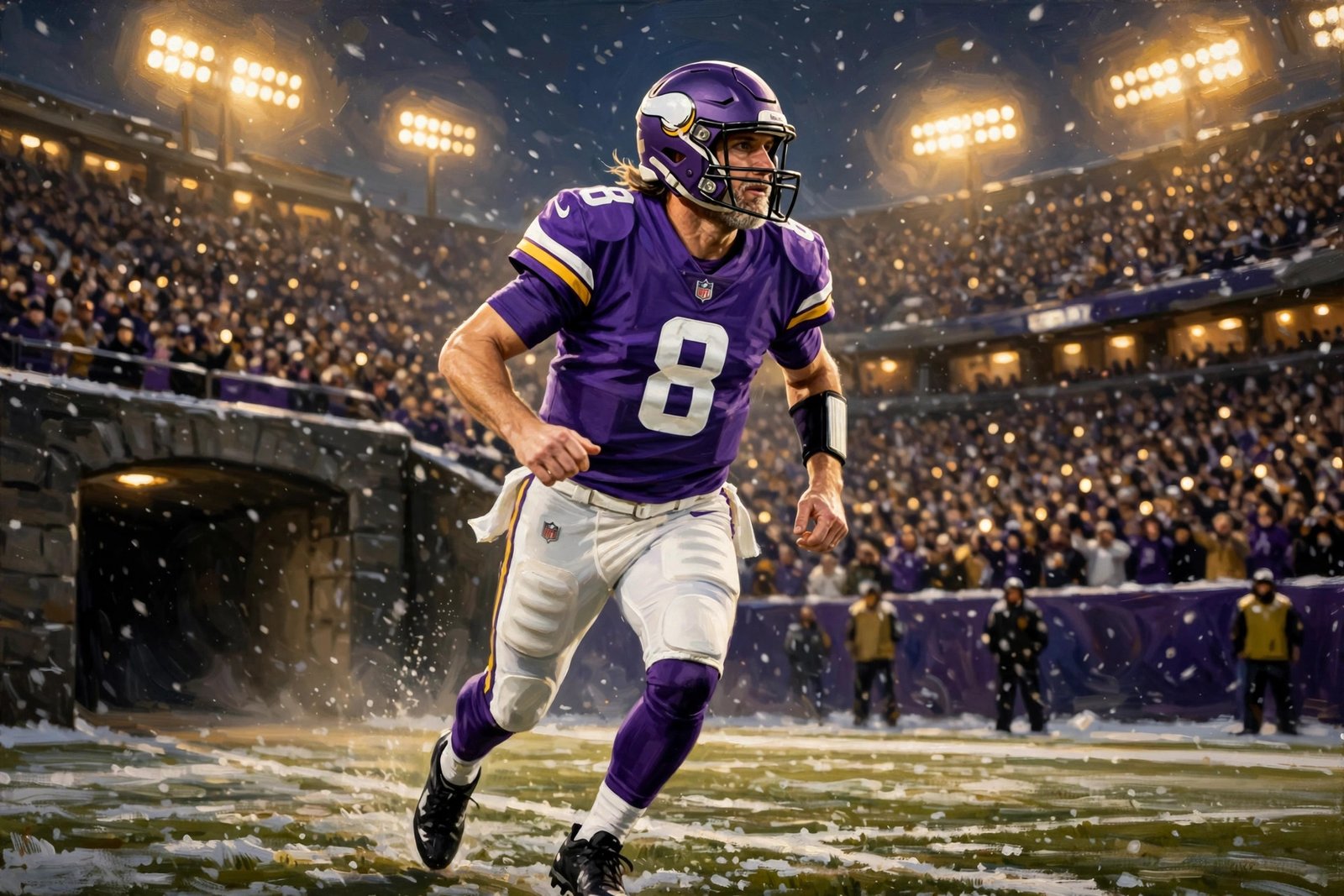
There are two turning points in Kirk Cousins’ career, and the first of them ended a season while the second may yet restart one. The first came on 29 October 2023, at Lambeau Field, in Week 8 against the Green Bay Packers. Cousins tore his Achilles tendon. The injury ended his season after eight games, in which he had thrown for 2,331 yards, 18 touchdowns and 5 interceptions. Those were the first games he had ever missed through injury. The Vikings finished 7-10 and missed the playoffs.
Between those two moments sits the chapter that explains why the comeback matters. On 13 March 2024, Cousins signed with the Atlanta Falcons: four years, 180 million dollars, 100 million dollars of it guaranteed. He started 22 games over two seasons, was benched in December 2024 for rookie Michael Penix Jr., and released in March 2026. In April 2026 he signed with the Las Vegas Raiders on a one-year deal worth about 11.3 million dollars, as a bridge and mentor to Fernando Mendoza, the number one overall pick. With the Raiders in 2026 he threw for 2,340 yards, 20 touchdowns and 8 interceptions, completing 64.1 percent of his passes, as the team went 4-5. He changed roles five times in three years, in public, with millions of people watching. The turning point is not the trade. It is that he kept showing up through all of it, and that when the call came, interrupting his breakfast on a Tuesday in November, he was ready.
Mindset
First, he prepares as if the job is already his. This runs from Michigan State, where he won the captaincy three times, through Washington, where he waited behind Griffin, to Las Vegas, where his job was to prepare the rookie who would replace him. Preparation is the psychological version of insurance: it makes you ready for the opportunity, and less anxious about whether it will come, because the work itself gives you something to control. Psychologists call the belief that you can handle what comes next self-efficacy. Bandura showed that it grows mainly from mastery experiences.
Second, he separates what he controls from what he does not. A quarterback cannot control whether the front office signs a rookie, whether a coach benches him, or whether a tendon tears on a routine play. He can control his preparation, his effort, his conduct, and his response to bad news. People who chase control over things they cannot influence burn out. People who focus on the small patch they genuinely control tend to last longer, and to suffer less.
Third, he treats routine as a shelter. The daily structure of a professional athlete — the wake time, the film study, the practice, the recovery work — is easy to dismiss as boring. Psychologically it is load-bearing. Routines move behaviour from conscious effort to automatic execution, freeing attention for the decisions that matter, and they give a person a sense of order when everything else is uncertain. When Cousins tore his Achilles, the routine broke. When he was benched, it changed. When he was traded, it changed again. Each time, the work was to build a new one quickly, and to trust it.
Fourth, he holds his faith as a coping resource. Cousins is openly Christian, and he has described his faith as central to how he understands his career, including its setbacks. In psychology, faith can function as a coping resource in several ways: it offers a framework for making sense of events that feel random, a community that is not tied to performance, and a sense of identity that is not the same as the job. If who you are is only “the starting quarterback”, then losing the job is losing yourself. If your identity has other anchors, the loss hurts without being total.
Decisions
Cousins’ career is a series of decisions that looked ordinary at the time and revealing in hindsight.
Betting on himself in Washington. After the franchise tags of 2016 and 2017, Cousins played on consecutive one-year deals, betting that his performance would force the market to pay him. It worked: the Minnesota contract in March 2018 was the first fully guaranteed multi-year deal in NFL history, and it was the direct result of refusing to settle. The decision shows a growth mindset in action — the psychologist Carol Dweck’s term for the belief that ability grows through effort and learning, rather than being fixed at birth.
Accepting the benching in Atlanta. When he was benched in December 2024 for Michael Penix Jr., Cousins handled it with public dignity. There was no public complaint, no demand for a trade, no drama in the building. Dignity under demotion is easy to praise and hard to practise, and the psychology of it is straightforward: how a person behaves when status is taken away reveals whether their self-worth was ever tied to the status in the first place.
Accepting the mentor role in Las Vegas. In April 2026 he signed with the Raiders as a bridge and mentor to Fernando Mendoza, the number one overall pick. The bridge quarterback is a strange job: you are hired to play well enough to keep the team competitive and to teach the young player who will take your job. Cousins did it, and he played well while doing it. The decision to accept that role, rather than holding out for a starting job that was not available, is what kept him ready for the call that came in November.
Saying yes to the trade. The final decision is the simplest and the hardest: when the call came, interrupting his breakfast, he said yes to going back. Going back to Minnesota meant going back to the place where the Achilles tear happened, to the expectations that come with a 6-2 team, and to the possibility of failing in public again. Saying yes to that is the psychology of second chances in its purest form: the willingness to risk a comfortable ending for an uncertain one.
Method — How Kirk Cousins Prepares
Deliberate practice, not just repetition. The psychologist Anders Ericsson drew a sharp line between doing something many times and practising it deliberately — working on the specific parts you are worst at, with feedback, on purpose. Cousins was not the most gifted thrower in his draft class. He became a starter by preparing more carefully than the players around him.
Routine as the foundation of pressure performance. Before a game, Cousins runs the same preparation, in the same order, every time. Research on routines in sport and in other high-stakes professions — surgeons, pilots, musicians — shows the same pattern: a short, repeatable sequence of actions before a stressful event reduces the brain’s threat response and frees up working memory. The routine tells the nervous system that this moment is familiar.
Recovery as a skill, not a break. After the Achilles tear in October 2023, Cousins faced a year of rehabilitation. The unglamorous work of recovery — the treatment, the gradual loading, the patience — is where comebacks are actually made, and it is also where most of them fail, because the work is boring and the progress is slow. Cousins treated recovery as part of the job, not as time off from it.
Pause and ask yourself: What is the one part of your work you keep avoiding because you are bad at it — and what would thirty minutes of deliberate practice on that one part, this week, actually look like?
What If?
What if Robert Griffin III had never been injured in 2015? Cousins might have spent his whole Washington career as a backup, and the fully guaranteed contract, the Minnesota years, and this comeback might never have happened. The question is worth asking because it reveals how much of a career is timing — and how much of Cousins’ career has been about being ready when timing finally turned his way.
What if the Achilles had not torn on 29 October 2023? He was 35, playing well, and the Vikings were in the middle of a season that still had promise. Instead the injury became the hinge of the story. It is what forced the next chapter — the benching, the release, the mentor role — and the next chapter is what made the trade possible.
What if he had refused the mentor role in Las Vegas? A prouder player might have held out for a starting job, or retired rather than accept a bridge role. Cousins accepted it, played well, and stayed ready. The lesson is not that everyone should accept a lesser role. It is that the role you accept determines whether you are in the building when the opportunity arrives.
What Most People Lack
The first thing most people lack is a pre-performance routine. Cousins has one for every game, and it does the same job every time: it tells his nervous system that this moment is familiar. Research on routines in sport and in high-stakes professions shows the same pattern: a short, repeatable sequence of actions before a stressful event reduces the brain’s threat response and frees up working memory.
The second thing most people lack is a process standard. When Cousins throws an interception, he can judge himself by whether he made the right read, not by whether the ball was caught. Most people judge themselves entirely by outcomes — the interview, the exam, the presentation — which they cannot fully control. A process standard gives you something to hold on to when the outcome goes wrong.
The third thing most people lack is an identity beyond the job. If who you are is only your title, then losing the title is losing yourself. Cousins has other anchors — his family, his faith, his community — and they held when the football identity cracked. Most people never build those anchors deliberately. They discover they need them only when the job goes away.
The fourth thing most people lack is a plan for the demotion. Everyone plans for promotion. Almost nobody plans for the day they are benched, passed over, or let go. Cousins’ career is a masterclass in the demotion plan: keep preparing, keep behaving well, keep the door open. The plan is not complicated. It is just rarely written down before it is needed.
What Successful People Do Differently
They narrow their attention. On the field, a quarterback’s world shrinks to the defence, the play clock, and the next read. Everything else — the crowd, the contract, the headlines — is filtered out. Successful people in any field do the same thing: they decide, in advance, what deserves their attention and what does not, and they defend that boundary. The skill is not focus in general. It is focus on the right thing at the right moment.
They build systems, not moods. Cousins did not wait to feel confident before a game. He ran his routine, studied the film, and took the field. Confidence followed the preparation; it did not precede it. This is the opposite of how most people operate: they wait for motivation, for the right feeling, for the fear to pass — and the waiting becomes the problem. Successful people act first and let the feeling catch up.
They treat a demotion as information, not as identity. Being benched in Atlanta in December 2024 could have been the end of the story. Cousins treated it as information about the team’s plans, not as a verdict on his worth. That distinction is the core of a growth mindset: the belief that ability and value are not fixed by a single event, and that a setback is data, not destiny.
They stay ready for a call that may never come. The mentor year in Las Vegas was, by any honest measure, a job with no future in it. Cousins prepared as if the future was still open. That is the hardest habit of all, because it requires effort without a guaranteed reward. It is also the habit that made the trade possible. When the call interrupted his breakfast on 10 November, he did not need to get ready. He already was.
Success Mindset
For a quarterback, the past is an interception you just threw and the future is the next third down. Neither is useful. The only moment that matters is the one happening right now, and Cousins’ whole method is built around returning to it. Sports psychologists call this present-moment focus, the foundation of both flow and resilience: you cannot perform in the present if your mind is replaying the last mistake or rehearsing the next disaster.
The second pillar of his mindset is self-efficacy — the belief, built from evidence, that he can handle what comes next. Bandura showed that self-efficacy grows from mastery experiences, watching others succeed, encouragement, and managing your own emotional state. Self-efficacy is not arrogance. It is the quiet knowledge, earned through repetition, that you have survived hard things before and can survive this one too.
The third pillar is a growth mindset. Dweck’s research distinguishes between a fixed mindset — the belief that ability is set and unchangeable — and a growth mindset — the belief that ability develops through effort, strategy, and learning. None of that happens to a person who believes their ability is fixed.
The fourth pillar is identity beyond the job. Cousins is a husband, married to Julie since 2014, and a father of three young sons. He is the author of “Game Changer”, published in 2013. That distinction matters enormously when the job changes, as it has for Cousins again and again. Athletes who fuse their entire identity to their sport often collapse when it is over. Cousins has other anchors, and they held.
Imagine a teacher in her late thirties, passed over for a promotion she had earned, watching a younger colleague take the role she wanted. She could quit, loudly, and feel better for a week. She could stay and grow bitter, and feel worse for a year. Or she could do what Cousins did: keep preparing, keep behaving well, keep the door open, and trust that the next call might come from somewhere she did not expect. The psychology is the same. The stadium is different.
Failures
The playoff record. For all the yards and the touchdowns, Cousins’ teams have not won a Super Bowl, and his playoff record has been the criticism his detractors return to most. The failure is real, but it is not entirely his: football is a team sport, and a quarterback is judged by the results of fifty-three players. The important thing is not that the criticism exists. It is that he has kept answering it by playing, rather than by arguing.
The Achilles tear. The injury on 29 October 2023 ended a season in which he was playing well, and it was the first time he had ever missed games through injury. The Vikings finished 7-10 and missed the playoffs. Injuries are the part of sport that no amount of preparation can fully control, and the psychology of that fact — doing everything right and still being hurt — is one of the hardest things an athlete has to accept.
The benching and the release. He was benched in December 2024 for rookie Michael Penix Jr., after starting 22 games over two seasons in Atlanta, and released in March 2026. For a player who had once signed the first fully guaranteed multi-year contract in NFL history, the distance between that moment and the release is the whole story of how quickly status can change in professional sport. The failure was real, but it was not the end. It was the middle.
Relationships
Cousins’ most important relationship, by every account, is with his family. He married Julie in 2014, and they have three young sons. He has spoken about his family in interviews for years, and the Netflix series “Quarterback” showed the part of his life he usually keeps private: the home, the children, the routine around the game.
His relationship with his coaches has shaped his career at every turn. In Minnesota, head coach Kevin O’Connell built an offence in which Cousins threw 47 touchdown passes, according to The Ringer. The relationship between a quarterback and his coach is one of the most important in sport: part teacher and student, part partnership, part trust. Cousins’ return to Minnesota is, in part, a return to a coach who knows what he can do, and to a system he already understands.
His relationship with Fernando Mendoza, the number one overall pick he mentored in Las Vegas, is the newest and perhaps the most revealing. The bridge quarterback who teaches the rookie who will replace him is doing something unusual: investing in a person whose success will end his own job. That requires a particular kind of security — the belief that your value is not diminished by someone else’s rise.
Dark Side
First, the toll of public demotion. Being benched in December 2024, then released in March 2026, was public in a way that few people outside sport ever experience: the cameras, the commentary, the discussion that continues for weeks. Cousins handled it with dignity, but handling a demotion well does not mean it did not hurt. It means the hurt was managed, not erased, and the management itself takes energy that is not visible from the outside.
Second, the injury itself. The Achilles tear on 29 October 2023 was the first serious injury of his career, and it arrived at 35, when the body recovers more slowly and the doubt arrives more quickly. Rehabilitation is lonely work. The team moves on without you, the meetings happen without you, and the daily structure that organised your life is gone. The dark side of the comeback is the year in between — the year when nobody is watching, and the work is boring, and the outcome is uncertain.
Second Act
The mentor year came next. In April 2026 he signed with the Las Vegas Raiders on a one-year deal worth about 11.3 million dollars, as a bridge and mentor to Fernando Mendoza, the number one overall pick. The role was designed to end, and Cousins knew it. He played well anyway — 2,340 yards, 20 touchdowns, 8 interceptions, 64.1 percent completions — and the Raiders went 4-5.
Then came the trade itself. On 10 November 2026 the Vikings traded a 2027 third-round pick for him, the Raiders paid 650,000 dollars of his 1.3 million dollar base salary, and the Vikings took on the balance plus a 10 million dollar roster bonus due in 2027. On 11 November he was reintroduced to the Minnesota media and called his career “unfinished business”.
Fun Facts
- Cousins became only the second three-time captain in Michigan State history, and in 2019 the university awarded him an honorary doctorate and invited him back to give the commencement keynote.
- His contract with Minnesota in March 2018 — three years, 84 million dollars, fully guaranteed — was the first fully guaranteed multi-year contract in NFL history.
- He shouted “You Like That!” on 25 October 2015 after Washington came back from 24-0 down to beat Tampa Bay 31-30, and the line is still the most famous moment of his career.
- He made the Pro Bowl four times: in 2016, 2019, 2021 and 2022, and his career-high 4,917 passing yards came in 2016.
- He appeared in the first season of the Netflix series “Quarterback” in 2023, alongside Patrick Mahomes and Marcus Mariota.
- He is the author of “Game Changer”, published in 2013, and he is openly Christian, married to Julie since 2014, and a father of three young sons.
- He threw 171 touchdown passes in his first Minnesota stint, 47 of them under head coach Kevin O’Connell, according to The Ringer on 10 November 2026.
- The trade call from Raiders head coach Klint Kubiak interrupted his breakfast on 10 November 2026, and his possible first start back is at Lambeau Field — the same stadium where his Achilles tore on 29 October 2023.
What the Research Says
Kirk Cousins’ career is a case study in four well-established areas of psychology, and the research helps explain both his success and his struggles.
Resilience after injury. Research on athletes who return from serious injury finds that recovery is not only physical. The psychological work — rebuilding confidence in the injured body, tolerating the slow pace of rehabilitation, and accepting that the return will be gradual rather than instant — is often the harder part. Studies consistently find that athletes who maintain a routine during rehabilitation, who set small and specific goals, and who keep a social connection to the team recover better than those who withdraw.
Growth mindset. Carol Dweck’s research distinguishes between a fixed mindset, in which ability is seen as set and unchangeable, and a growth mindset, in which ability is seen as something that develops through effort, strategy, and learning. People with a growth mindset treat setbacks as information rather than as verdicts, and they are more likely to persist after failure.
Self-efficacy. Albert Bandura’s work shows that belief in your own capability is built primarily from mastery experiences — surviving hard things and remembering that you survived them. Cousins has accumulated them at every level: the division title in 2015, the fully guaranteed contract in 2018, the Pro Bowls, the return from the Achilles tear.
Identity and role transitions. Research on athletes and on workers more generally finds that people who fuse their entire identity to a single role — the starter, the star, the job title — struggle most when the role changes. People with multiple identities — family, faith, community, interests outside the job — adapt better, because the loss of one role does not mean the loss of the self. Cousins has changed roles five times in three years: starter, injured starter, expensive free agent, benched veteran, mentor.
This is an educational look at public behaviour and published research, not an assessment of Kirk Cousins as a person.
Activity: The Kirk Cousins Comeback Quiz
Cousins’ gift is not talent. It is the habit of coming back. How do you handle setbacks? Answer honestly. There are no wrong answers — only patterns worth noticing.
1. You are passed over for a role you wanted, and a younger colleague gets it. What happens first?
a) I keep preparing and doing the work well, and I keep the door open.
b) I feel angry and have to fight the urge to quit on the spot.
c) I decide the place was never worth my loyalty anyway.
d) I stop trying, because what is the point?
2. Before a big moment — a presentation, an exam, a difficult conversation — you usually…
a) Run through the same preparation, step by step, every time.
b) Feel nervous and try not to think about it.
c) Wing it and trust your instincts.
d) Talk yourself out of doing it.
3. Something you cannot control — an injury, a restructure, a decision made above you — derails your plans. You…
a) Focus on the small patch I can control and rebuild from there.
b) Replay what happened for weeks, looking for someone to blame.
c) Pretend it did not happen and carry on as before.
d) Decide the whole thing was doomed from the start.
4. What does “practise” mean to you?
a) Working on the parts I am worst at, on purpose.
b) Doing the whole thing over and over.
c) Doing the parts I enjoy most.
d) Something I avoid unless I have to.
5. When your identity is tied to a role — the starter, the manager, the expert — and the role changes, you…
a) Remember the other parts of who I am: family, friends, interests outside the job.
b) Feel lost, because the role was most of who I was.
c) Cling harder to the old role, even when it is gone.
d) Decide identity is a luxury I cannot afford.
6. A second chance arrives, unexpectedly, after you had made peace with the ending. You…
a) Say yes, and treat it as a fresh start with a concrete plan.
b) Say yes, but spend most of your energy proving the first ending wrong.
c) Say no, because the ending was comfortable.
d) Say yes, but keep one foot out the door in case it fails again.
Mostly A: You handle setbacks like Cousins at his best — keep preparing, control what you can control, keep your identity wider than your job, and say yes to the second chance with a plan. Keep it up.
Mostly B: Your setback response is real, and it costs you. Try Cousins’ trick: write down the one thing you can control today, and do that one thing well. The routine gives your attention somewhere to go besides the worry.
Mostly C: You protect yourself by detaching, but detachment is not control. Practise one deliberate pause — a slow breath, a check of the facts — before you decide the whole thing was worthless. The setback is information, not a verdict.
Mostly D: Avoidance is keeping you safe and stuck. Small, deliberate attempts at hard things build the belief that you can handle them. Start smaller than you think you need to, and tell one person you trust.
Pause and ask yourself: What is the second chance in your life right now — the one you have already decided is finished — and what would staying ready for it actually look like this week?
Frequently asked questions
Why is Kirk Cousins back with the Minnesota Vikings?
On 10 November 2026 the Vikings traded a 2027 third-round pick to the Las Vegas Raiders for Cousins, after also inquiring about Justin Herbert, Daniel Jones and Geno Smith. The Vikings are 6-2 with nine games to go, and Cousins threw 171 touchdown passes in his first Minnesota stint.
What is kirk cousins psychology?
Kirk cousins psychology is the study of how a 38-year-old quarterback keeps coming back: resilience after injury, a growth mindset, self-efficacy built from mastery experiences, and the psychology of second chances.
What happened to Kirk Cousins in 2023?
On 29 October 2023 he tore his Achilles tendon against the Green Bay Packers at Lambeau Field, ending his season after eight games in which he had thrown for 2,331 yards, 18 touchdowns and 5 interceptions. They were the first games he had ever missed through injury.
Could Kirk Cousins start on 15 November 2026?
His possible first start is on Sunday 15 November 2026 at Lambeau Field, the same stadium where his first Vikings stint ended with the Achilles tear.
What can a comeback teach us about resilience?
Research finds that resilience grows from routines, small and specific goals, a process standard rather than an outcome standard, and an identity wider than a single role. Cousins’ career is a public example of all four.
Try it on our site
Cousins’ story is about resilience, preparation, and second chances — all things you can practise. Try these free tools, no signup needed:
- Confidence Builder — build self-belief the way athletes do, one small win at a time.
- Focus Room — a calm space to practise deep focus before a big moment.
- Daily Tracker — track the small daily habits that add up to real change.
- Mind Check-Ins — a quick, anonymous check on how you are really feeling after a setback.
Related reading: Michael Jordan and the Psychology of Ruthless Competitiveness · Carey Price and the Psychology of Calm Under Pressure: From Anahim Lake to the Hall of Fame · Steve Smith Has Been Cleared for the New Zealand Tests: The Psychology of Waiting for a Scan
Key Takeaways
- Kirk Cousins was traded back to the Minnesota Vikings on 10 November 2026 for a 2027 third-round pick, and called his career “unfinished business” when he was reintroduced to the media on 11 November.
- His career is a case study in resilience after injury, a growth mindset, and self-efficacy: a fourth-round pick who became a franchise quarterback, a torn Achilles at 35 who came back to start again at 38.
- The psychology of second chances is practical, not sentimental: keep preparing, control what you can control, judge the process rather than the outcome, and keep your identity wider than your job.
- His possible first start, on Sunday 15 November at Lambeau Field, is the same stadium where his first Minnesota stint ended with the Achilles tear — the symmetry is real, and the outcome is unwritten.
- The most useful lesson is not “never give up.” It is: stay ready for a call that may never come, so that when it interrupts your breakfast, you do not need to get ready. You already are.
This article is for education only and is not a substitute for professional advice. If you are struggling, please consider speaking to a licensed mental health professional. In the US, call or text 988 for the Suicide and Crisis Lifeline. This profile is an educational look at Kirk Cousins’ public behaviour and the research around it, not an assessment of the man himself.