
400,000 Fans, One Parade, 58 Years of Waiting: The Psychology of the Brewers’ First World Series Win
Reviewed by a Psychology Postgraduate (MA)
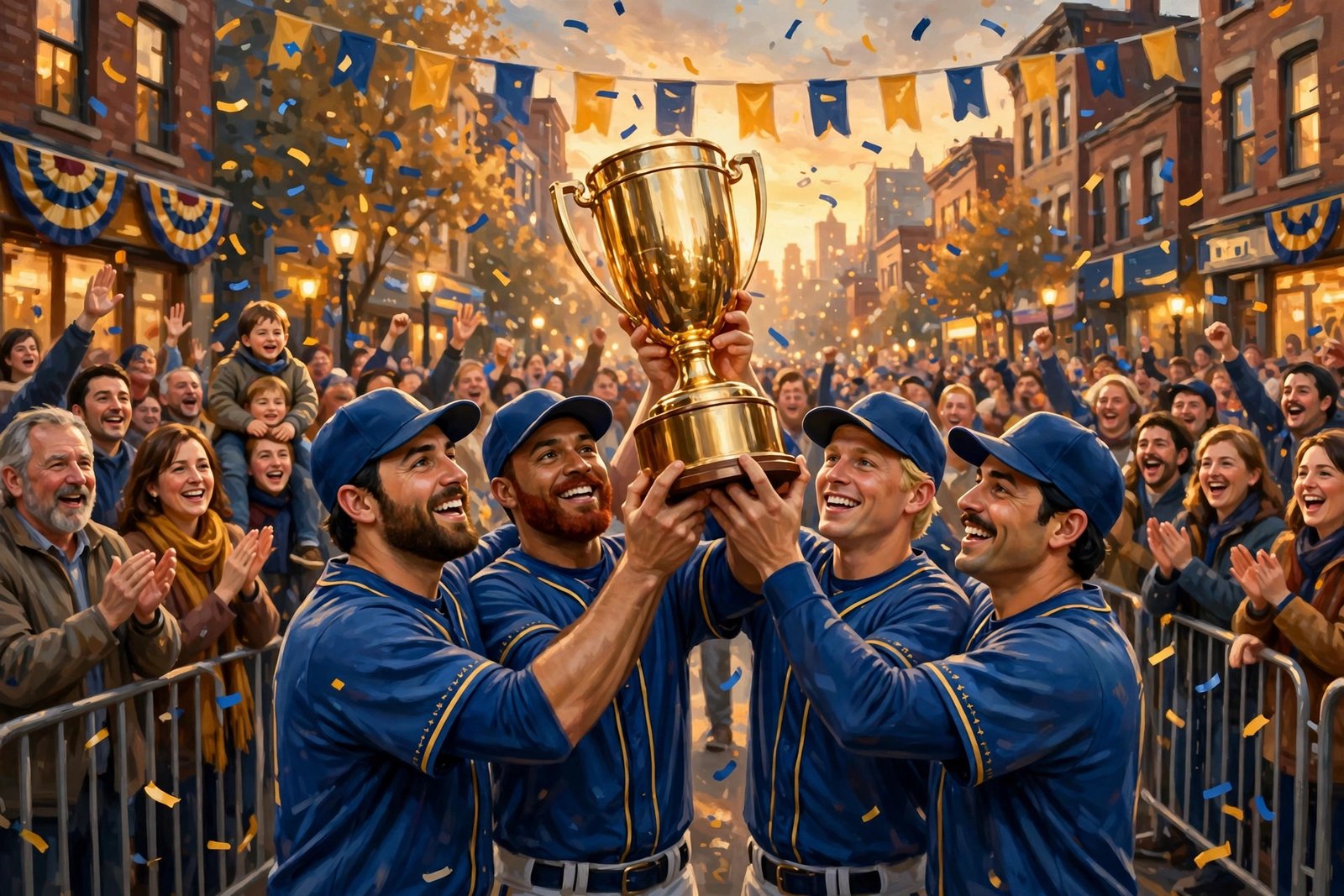
On Friday 30 October 2026, tens of thousands of fans flooded downtown Milwaukee for the Brewers’ first World Series victory parade, two days after the team clinched the title with a 4-1 win over the Tampa Bay Rays in Game 5 at Tropicana Field in St. Petersburg, Florida, on Wednesday 28 October. Milwaukee Brewers first World Series psychology is the study of that release: what 58 years of waiting does to a city, and what happens when it finally ends. City officials expected about 400,000 people at the parade and rally, nearly two-thirds of Milwaukee’s population, with the rally at Henry Maier Festival Park reaching its 150,000 capacity by 11:07 a.m. Central Time, according to Associated Press reporting. Milwaukee Public Schools closed for the day so families could attend. The parade paused at a giant mural of Bob Uecker, the Brewers broadcaster for 54 seasons who died in January 2025 at 90, 21 months before the franchise’s first title, as players hoisted the Commissioner’s Trophy toward his image and the crowd chanted his name.
In short, Milwaukee Brewers first World Series psychology is the study of collective joy after a very long wait: a small-market team that won 103 regular-season games, went 11-2 in the postseason, swept the defending champion Los Angeles Dodgers and beat Tampa Bay 4-1, gave a city a shared memory it had waited 58 seasons, since the franchise began as the Seattle Pilots in 1969, to make.
Collective joy is the amplified happiness people feel when a celebration is shared with a large group that has waited for the same thing.
What actually happened in Milwaukee?
The facts are worth stating plainly, because the psychology only makes sense against them. The Brewers, founded in 1969 as the Seattle Pilots and based in Milwaukee since 1970, had reached the World Series only once before, losing in seven games to St. Louis in 1982. They won a franchise-record 103 games in 2026, the best record in baseball, then beat San Diego in four games, swept the Dodgers, whose 338 million dollar payroll was more than double Milwaukee’s 144 million dollars, and beat Tampa Bay, 98-64 in the regular season, in five games. Catcher William Contreras, who hit .381 in the series, was named World Series Most Valuable Player. Jacob Misiorowski pitched five and two-thirds scoreless innings in the clincher despite leaving with a leg cramp. Manager Pat Murphy, who succeeded Craig Counsell after Counsell left for the Chicago Cubs, is now a World Series champion manager. The parade began at 10 a.m. on Wisconsin Avenue, ran to the lakefront, and ended at the Summerfest grounds, where the first 50,000 fans received a rally towel and Christian Yelich, the team captain, told the crowd the team had enjoyed, in his words, far too many parade beers.
That is the news. The psychology is why it mattered so much, and why a parade crowd of 400,000 in a city of about 600,000 is not just a party. It is a release.
Why does the Milwaukee Brewers first World Series feel different from any other championship?
A first championship is psychologically different from a repeat because it ends a story, not just a season. Psychologists call this narrative closure: the human brain loves a completed arc, and a 58-season wait is an arc with real weight. Every near miss along the way, 1982, the playoff runs in 2011, 2018 and 2025, the seven postseason appearances in eight years before 2026 that produced only 11 combined postseason wins, becomes part of the story that the title finally finishes. When the last out was recorded, fans were not just celebrating a win. They were closing a book they had been reading, in some cases, for their whole lives.
There is also a scarcity effect. Things that are rare feel more valuable, and a first title after 58 seasons is, by definition, the rarest thing a franchise can win. Fans who paid a World Series record 2,338 dollars just to get into American Family Field for Game 1, according to USA Today, and who bought every available plane ticket to Tampa for the clincher, were not behaving irrationally. They were pricing in the possibility that this moment, this exact combination of team, city and season, might never come again. Scarcity does not make people love a team more. It makes them act on the love they already have, urgently, before the moment passes.
Pause and ask yourself: What is something you waited years for, and did the wait make the arrival sweeter, or did it make you afraid to enjoy it in case it vanished?
How does a whole city feel joy at the same time?
Collective effervescence is a term coined by sociologist Emile Durkheim for the electric feeling of a crowd united in ritual, and a championship parade is one of the purest modern examples. When 400,000 people stand on the same streets, chant the same name, and watch the same trophy pass by, individual happiness is amplified by the crowd. Mirror neurons, social contagion and simple synchrony, thousands of people cheering at the same second, all push the same feeling higher. That is why fans describe parades as overwhelming rather than merely fun. The joy is not just yours. It is borrowed, multiplied and returned by everyone around you.
Milwaukee’s parade had a second, quieter layer: grief inside the joy. The stop at the Bob Uecker mural, where players climbed off the buses for about ten minutes, hoisted the trophy toward the image of a man who called Brewers games for 54 seasons and died 21 months too soon to call a championship, turned a celebration into a memorial. Uecker’s family led the celebration, and Ryan Braun led a “Ueck” cheer at the rally. Psychologists call this continuing bonds: the healthy, normal way people keep a lost person present in important moments, not by pretending they are alive, but by making room for them in the celebration. A city that had waited 58 years was always going to remember the people who waited with it and did not live to see the end.
Why do underdogs matter so much to fans?
The Brewers are baseball’s smallest market, with a payroll dwarfed by the Dodgers team they swept. Underdog psychology is powerful because it lets fans identify with effort rather than wealth. When a team with a 144 million dollar payroll beats a team with a 338 million dollar payroll, fans do not just see a win. They see proof that money is not destiny, that a well-run smaller organization can beat a richer one, and that their own lives, in which they often feel outspent and overlooked, might work the same way. That identification is why small-market titles feel personal in a way big-market titles rarely do. The Brewers did not just win for Milwaukee. They won in a way that made Milwaukee’s smallness part of the story, not an excuse within it.
There is a practical lesson here too, and it is about sustained effort. The Brewers did not win by accident. They won 92, then 93, then 97, then 103 games over four seasons under general manager Matt Arnold, made the playoffs in seven of eight years, and finally broke through. That is the psychology of compounding: small improvements, repeated, until a breakthrough that looks sudden from the outside feels inevitable from the inside. Fans who stayed through the lean Octobers were not being foolish. They were investing in a process that, in 2026, finally paid out.
What happens the morning after the parade?
The morning after a first championship carries its own psychology: the post-peak dip. After months of tension and a week of euphoria, ordinary life returns, and it can feel flat by comparison. Psychologists note this after weddings, graduations and major sporting wins alike. The trick is to treat the parade not as the end of the story but as a memory to draw on. Milwaukee fans now have a shared reference point, “where were you when the Brewers finally won it?”, that will anchor conversations, friendships and family stories for decades. The trophy will gather dust in a cabinet. The memory will not, because memories shared by 400,000 people are rehearsed, retold and passed on, and each retelling strengthens them.
There is also a warning in the celebration’s shadow: a lockout is expected to begin on 1 December, according to USA Today reporting, which could pause baseball for months. That makes the parade’s joy more poignant, not less. A first title, celebrated fully, in a season that might be followed by silence, is a reminder to enjoy good things while they are here, rather than postponing happiness until conditions are perfect. Conditions are rarely perfect. Milwaukee, on 30 October 2026, did not wait for them.
Frequently Asked Questions
When did the Milwaukee Brewers win their first World Series? The Brewers clinched their first World Series title on Wednesday 28 October 2026, beating the Tampa Bay Rays 4-1 in Game 5 at Tropicana Field, winning the series 4-1.
How long had Milwaukee waited for a World Series title? The franchise waited 58 seasons, since its inaugural 1969 season as the Seattle Pilots, and 44 years since its only previous World Series appearance, a seven-game loss to St. Louis in 1982.
How many fans attended the Brewers parade? City officials expected about 400,000 people at the 30 October 2026 parade and rally in downtown Milwaukee, with the Henry Maier Festival Park rally reaching its 150,000 capacity by 11:07 a.m. Central Time.
Who was the Brewers World Series MVP? Catcher William Contreras was named World Series Most Valuable Player after hitting .381 in the series.
Try it on our site
For collective joy, grief inside celebration, and savoring a long-awaited moment:
- Mind Check-Ins — one-minute self-reflection check-ins for mood, joy and stress.
- Name Your Feeling — put a precise word on joy, grief or pride. Naming an emotion measurably reduces its intensity.
- Relaxation Techniques — guided breathing and grounding exercises for high-emotion days.
- Wellness Tools — brain games, check-ins and exercises to keep a good day grounded.
Related reading: World Series 2026: Rays vs. Brewers — The Psychology of Sports Fandom and Why October Baseball Feels So Personal · Jackson Chourio, 22, Just Made World Series History — Then Came the 12-Inning Twist: The Psychology of Almost Winning · Jacob Misiorowski and the Psychology of Performing Under Pressure: Undrafted, Untouchable, and the Clincher That Ended Milwaukee’s 57-Year Wait
Key Takeaways: The Milwaukee Brewers won their first World Series on 28 October 2026, beating Tampa Bay 4-1 in Game 5 after a franchise-record 103-win season and an 11-2 postseason, ending a 58-season wait and a 44-year gap since their only previous Fall Classic in 1982. About 400,000 fans were expected at the 30 October parade and rally, which paused to honor Bob Uecker, the voice of the Brewers for 54 seasons who died in January 2025. A first title feels different because it delivers narrative closure, scarcity value and collective effervescence, and because it lets a small-market city see effort beat wealth.
This article is for education only and is not therapy, diagnosis or medical advice. If you are struggling, in the US call or text 988 for the Suicide and Crisis Lifeline.