
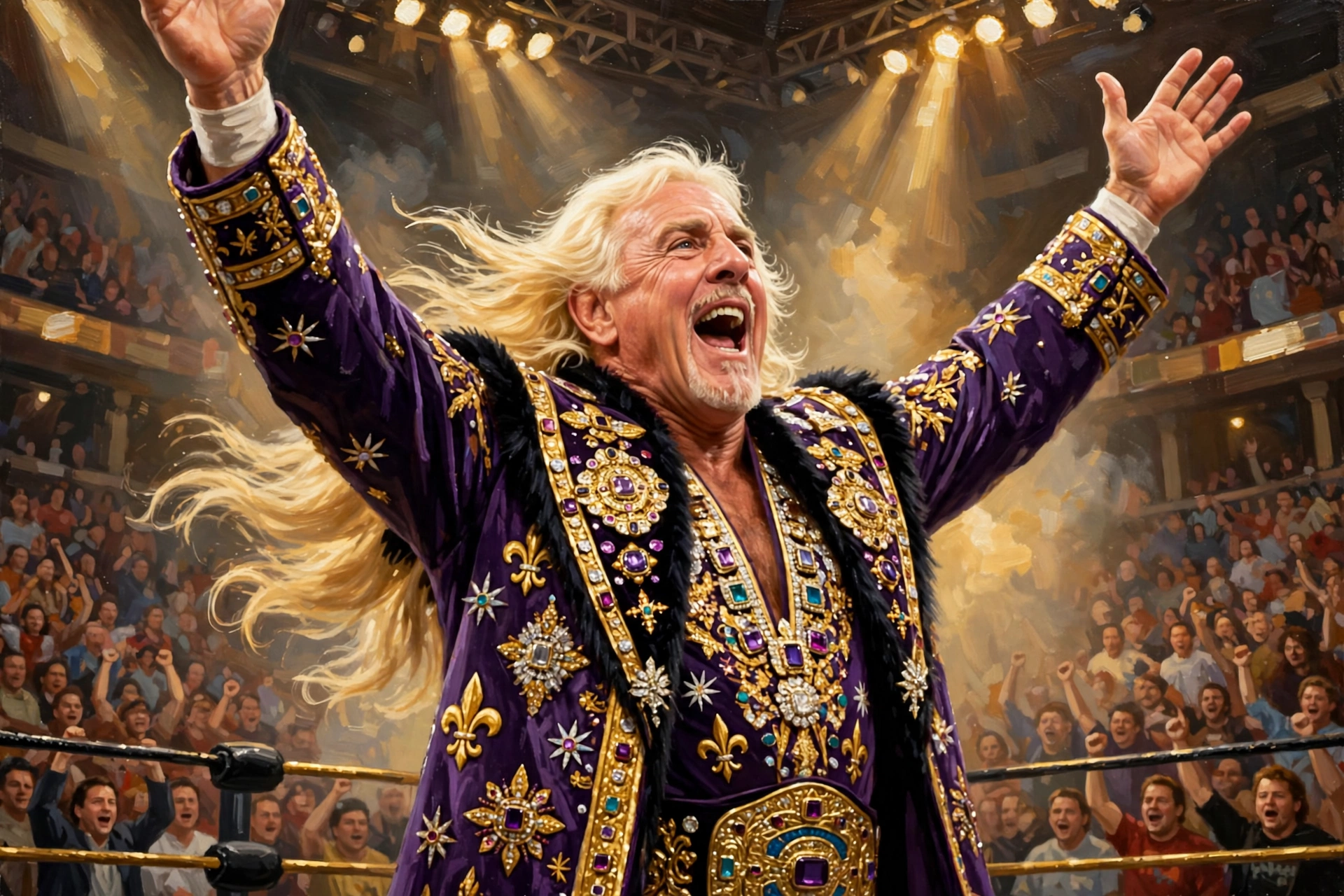
Ric Flair Hospitalized at 77: The Psychology of the Nature Boy’s Relentless Comebacks
Reviewed by a Psychology Postgraduate (MA)
Ric Flair psychology is the psychology of refusing to stay down. On October 23, 2026, the 77-year-old wrestling legend was rushed to a Tampa hospital after falling outside a restaurant — the latest chapter in a life that has already survived a plane crash, a month in intensive care, and a dozen retirements that never took. What makes a man keep getting up? This profile is an educational look at public behaviour and widely reported research — not an assessment of Ric Flair’s mental health or a clinical opinion about any person.
Here is what happened, as reported: on the morning of Friday, October 23, Flair was at a Wagamama restaurant in Tampa when he got up from the bar, walked across the street, and suddenly fell, cutting his head and eye open — with fears of a possible concussion, according to TMZ, whose sources were backed by a photo of emergency personnel treating him at the scene. He was loaded into an ambulance. Hours earlier, Flair had told fans on social media that a blood clot in his leg had forced him to cancel a convention appearance in Seattle — his doctors had limited his travel to three or four hours, and he was scheduled for a vein-stripping procedure. That evening, his daughter Charlotte Flair posted the update the wrestling world was waiting for: “Not my dad telling the doctor he fell bc of warrior dropping him on his head… (ps: he’s going to be ok).” Even flat on his back in a hospital, the Nature Boy was still cutting a promo.
In short: Ric Flair keeps getting up because identity fusion — the persona and the person merged into one — makes quitting feel like self-erasure. Resilience as a process, not a trait, explains the comebacks: stay connected, keep a forward story, and never let a setback become the whole story.
Story: How Ric Flair Became “The Man”
Ric Flair was born Richard Morgan Fliehr on February 25, 1949, in Memphis, Tennessee — though “born” undersells it. He was adopted from the Tennessee Children’s Home Society by Luther and Kathleen Fliehr and raised in Edina, Minnesota, a comfortable suburb where he was, by his own telling, a restless kid with more energy than direction. He went to Wayland Academy in Wisconsin, then the University of Minnesota, and drifted toward wrestling the way some people drift toward trouble: because it was the most exciting thing in the room.
Trained by the legendary Verne Gagne, Flair debuted in 1972. Three years later, on October 4, 1975, the small plane he was riding in crashed in Wilmington, North Carolina. He broke his back in three places. Doctors told him he might never wrestle again. He was back in the ring about three months later — a comeback so fast it sounds like fiction, and it set the template for the next fifty years.
What followed is the most decorated career in wrestling history: WWE recognizes him as a 16-time world champion (eight NWA titles, six WCW titles, two WWF titles — his own count is higher), the winner of the 1992 Royal Rumble, and the first person ever inducted into the WWE Hall of Fame twice — in 2008 for his solo career, and in 2012 as a member of the Four Horsemen. The strut. The “Woooo!” The robes that cost more than most people’s cars. For five decades, “To be the man, you gotta beat the man” wasn’t a catchphrase; it was a business model.
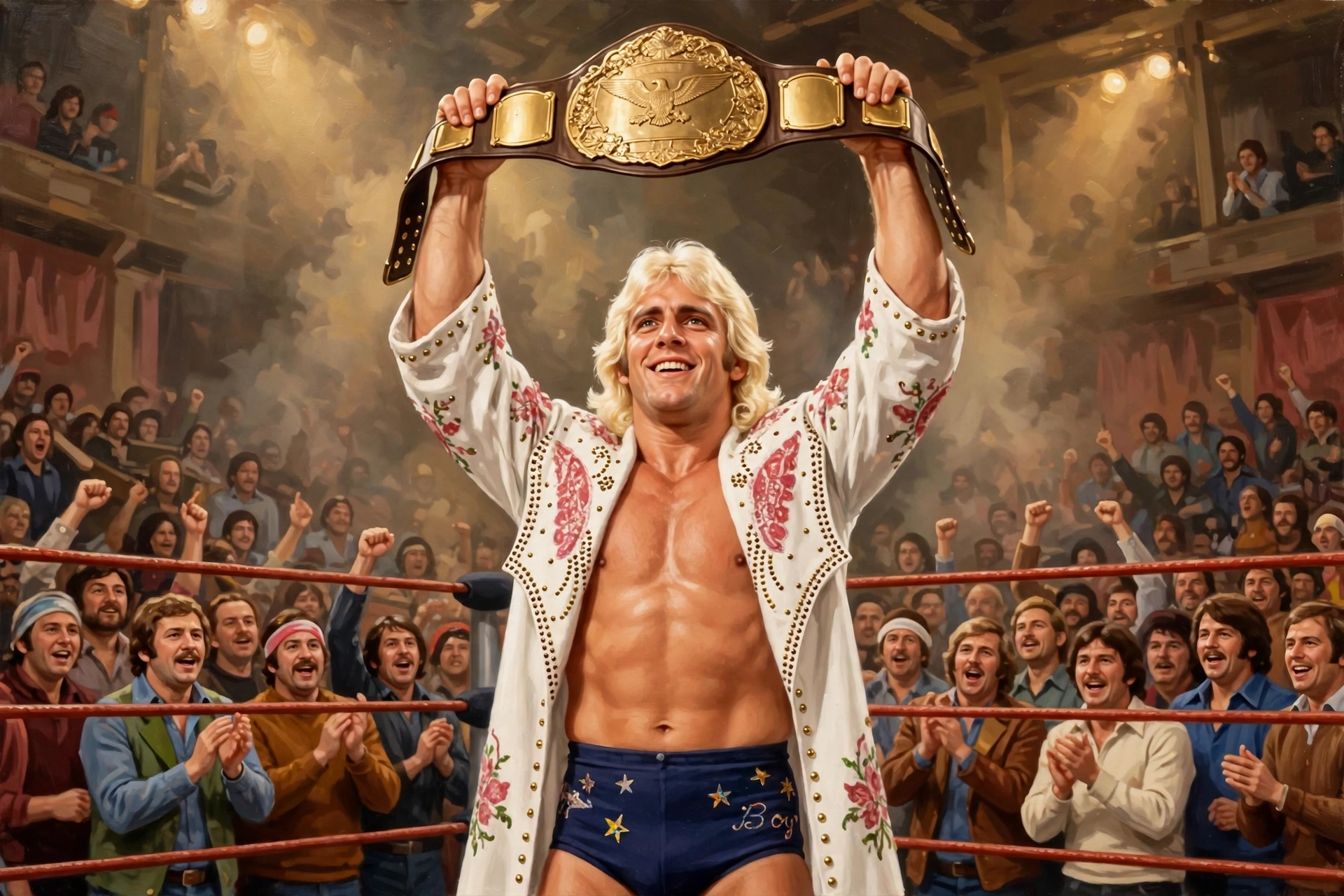
Turning Point: The Month He Almost Didn’t Come Back From
Every comeback story needs the moment that nearly ended it. For Ric Flair, it came in August 2017 — and it had nothing to do with wrestling.
An intestinal rupture spiraled into organ failure. Flair spent roughly a month in intensive care, including a stretch in a medically induced coma. His family was told to prepare for the worst; he has since said goodbye conversations happened. When he finally woke up, he weighed barely 200 pounds — a shell of the 243-pound billed machine — and had to learn to walk again.
Here’s the psychological pivot that matters: the 2017 crisis was the first time the danger came from inside the lifestyle, not from an opponent or a plane crash. Flair has spoken publicly since about the role alcohol played in his decline, with unusual candor for a man whose entire brand is invincibility. The Nature Boy didn’t just survive; he did the one thing his persona had never allowed — he admitted the persona had a cost. That admission is the hinge this whole profile swings on.
Mindset: Inside Ric Flair’s Head
Watch any Ric Flair promo from the 1980s and you’ll see a masterclass in what psychologists now study as embodied confidence — the finding that the body doesn’t just express the mind, it instructs it. The strut wasn’t decoration. The “Woooo!” — which Flair says he borrowed from Jerry Lee Lewis’s “Great Balls of Fire” — wasn’t a gimmick. They were technologies of self-belief, performed thousands of times until the performance and the person fused.
Researchers who study enclothed cognition have shown that what you wear measurably changes how you think and perform. Now scale that up: what happens when you wear a $10,000 sequined robe in front of 20,000 screaming people, four nights a week, for forty years? The line between Richard Fliehr and Ric Flair didn’t blur — it dissolved. Psychologists call this identity fusion (Swann and colleagues): when a role and a self become so intertwined that threats to one feel like threats to both. It’s why “retirement” never stuck. Retiring the Nature Boy didn’t feel like a career decision. It felt like an amputation.
Decisions: Why the Goodbyes Never Took
Flair has retired more times than almost anyone in wrestling history — the choreographed farewell against Shawn Michaels at WrestleMania in 2008 (“I’m sorry, I love you” remains one of the great wrestling moments), the TNA years, and then the genuinely startling one: on July 31, 2022, at age 73, he wrestled his actual “Last Match” in Nashville, teaming with his then-son-in-law Andrade El Ídolo against Jay Lethal and Jeff Jarrett. He reportedly passed out twice during the bout. Days later, he said he regretted calling it his final match. By September he was announcing he’d never retire; by 2024 he’d swung back to “no return to the ring ever.” The man contains multitudes, and most of them want an encore.
Decision science has a useful lens here: the sunk-cost fallacy explains why people keep investing in losing bets, but Flair’s case is the mirror image — call it the identity-investment effect. When you’ve poured fifty years into becoming the living embodiment of “the man,” walking away isn’t rational thrift. It’s self-erasure. Every comeback decision makes perfect sense once you see that the currency isn’t money or fame. It’s selfhood.
Pause and ask yourself: Is there a version of you — a role, a routine, a reputation — that you’d struggle to retire even if it stopped serving you? What would it cost to let it go, and what is it actually giving you back?
Method: Sixty Minutes a Night, Night After Night
It’s easy to remember the robe and forget the craft. The wrestling insiders’ consensus — from rivals who had every reason to diminish him — is that Ric Flair was the greatest in-ring psychologist who ever lived. He could wrestle a sixty-minute “broadway” (a full-hour draw) and have the crowd standing at the end, a feat of pacing, stamina, and audience manipulation that borders on athletic impossibility. The chops that left opponents’ chests welted. The figure-four leglock, applied with theatrical agony. The famous Flair “flop” — taking a bump face-first onto the mat and lying spread-eagled while the crowd counted along.
This is where deliberate practice (Ericsson’s research on expertise) meets showmanship. Flair didn’t just wrestle a lot; he iterated. Every arena was a laboratory: which pause gets the bigger pop, which sell draws the louder gasp, how long can you stretch a rest hold before the crowd turns. He ran that experiment thousands of times across five decades. The “Woooo!” looks spontaneous. Nothing about it was. Mastery researchers find that experts in every domain — chess, music, surgery — share one trait: they practice at the edge of their ability with immediate feedback. For Flair, the feedback was 20,000 people telling him, in real time, whether the experiment worked.
What If? The Alternate Lives of Richard Fliehr
Psychologists who study counterfactual thinking (Roese’s work) find that “what if” isn’t idle daydreaming — it’s how the mind extracts meaning from a life. So: what if the 1975 plane crash had ended his career at 26, the way doctors predicted? The territories era would have lost its defining champion, and Richard Fliehr might have become a cautionary tale instead of a folk hero. What if he’d stayed retired after the perfect 2008 farewell? He’d have the storybook ending — and none of the messy, human, gloriously stubborn chapters that followed.
The most interesting what-if is quieter: what if he’d never built the Nature Boy at all? The Fliehr who emerged from the Tennessee Children’s Home Society into a comfortable Minnesota suburb was a kid with something to prove and no obvious stage. The persona wasn’t decoration on the person. It was the person, fully expressed — permission to be as loud, as hungry, as much as he actually was. The what-if that matters isn’t about titles. It’s about whether Richard Fliehr would have found any other container big enough for himself.
What Most People Lack: The Willingness to Be Hated
Here’s the thing people miss about the Nature Boy: for most of his prime, he was the villain. The limousine-riding, jet-flying, kiss-stealing son of a gun who told the working-class crowd they couldn’t afford his lifestyle — and they hated him for it, gloriously, nightly, for years. To be a great heel (wrestling’s term for the bad guy) is to walk into a building full of people who despise you, absorb that hostility, and convert it into energy. Then do it again tomorrow in another town.
Most people organize their lives around being liked. Flair organized his around being unforgettable, and accepted hatred as the price of admission. That’s rarer than it sounds. Social psychology’s need-to-belong research (Baumeister and Leary) identifies belonging as a fundamental human motive — most of us will contort ourselves to avoid disapproval. The elite performer inverts it: disapproval becomes fuel. You don’t have to admire the ethics of the heel persona to recognize the psychological machinery. It takes a particular kind of nerve to let 20,000 strangers boo you and hear music.
What Successful People Do Differently: Reinvent the Act, Never the Core
Study the fifty-year arc and a pattern emerges: the surface changed constantly while the core never moved. Territories in the ’70s, NWA flag-bearer in the ’80s, WCW’s franchise player, WWF invader, TNA elder, WWE ambassador, AEW personality in his seventies. The business transformed around him — kayfabe died, the internet exposed the business, the audience changed three times over — and Flair adapted the delivery every single era while selling the exact same product: himself, at maximum volume.
Organizational psychologists call this adaptive expertise as opposed to routine expertise: the ability to apply deep skill to novel conditions rather than repeating one trick. The robe stayed; everything else was negotiable. Contrast that with performers who froze their act in amber and faded with their era. Flair’s true talent was never the strut. It was the willingness to keep learning the room — at 30, at 50, at 73 — while never once doubting that the room wanted him in it.
Success Mindset: Defiance as a Life Strategy
Strip away the catchphrases and Flair’s mindset is almost stark: limits are a rumor. Broke his back — back in three months. Told he’d never wrestle again — wrestled fifty more years. Medically induced coma — walked out and went back on the road. Fall at 77 with a blood clot in his leg — joking with the ER doctor about the Ultimate Warrior dropping him on his head.
There’s a name for this in the research literature, and it isn’t “toughness.” Psychologists studying resilience now describe it as a process, not a trait — a set of behaviors (seeking support, reframing, maintaining routines, staying engaged) rather than a personality type you’re born with. Flair’s observable process is textbook: stay connected to your people (the wrestling fraternity, his family, the fans), keep a forward-looking narrative (“I’ll be back”), and never let the setback become the story. Terror management theory (Greenberg, Pyszczynski, and Solomon) adds a darker layer: performing vitality — the strut, the “Woooo!”, the robe at 77 — can be read as a very public refusal to let mortality have the last word. Every comeback is an argument with death, and so far he’s winning on points.
Failures: The Parts the Highlight Reel Skips
No honest profile can skip this: the public record includes four divorces — Leslie Goodman (1971–1983), Elizabeth Harrell (1983–2006), Tiffany VanDemark (2006–2009), and Jackie Beems (2009–2014) — before his 2018 marriage to Wendy Barlow. It includes publicly documented financial troubles across the years: tax liens, lawsuits, and the kind of money chaos that seems impossible for someone who headlined for decades. It includes retirements announced and un-announced, business ventures that fizzled, and a 2022 “Last Match” that even he couldn’t let be last.
The psychology of the failures is the same as the psychology of the triumphs, which is what makes them instructive. The man who never accepted a three-count also never accepted a balance sheet, a marriage counselor, or a doctor’s timeline. Psychological rigidity — the flip side of resilience — is well documented: the same persistence that saves you in one domain sinks you in another. Flair’s superpower was never knowing when to quit. That’s also, by definition, his kryptonite. The lesson isn’t “be more like Ric” or “be less like Ric.” It’s that strengths and weaknesses are the same machinery running in different rooms.
Relationships: The Daughter, the Son, and the Bond That Held
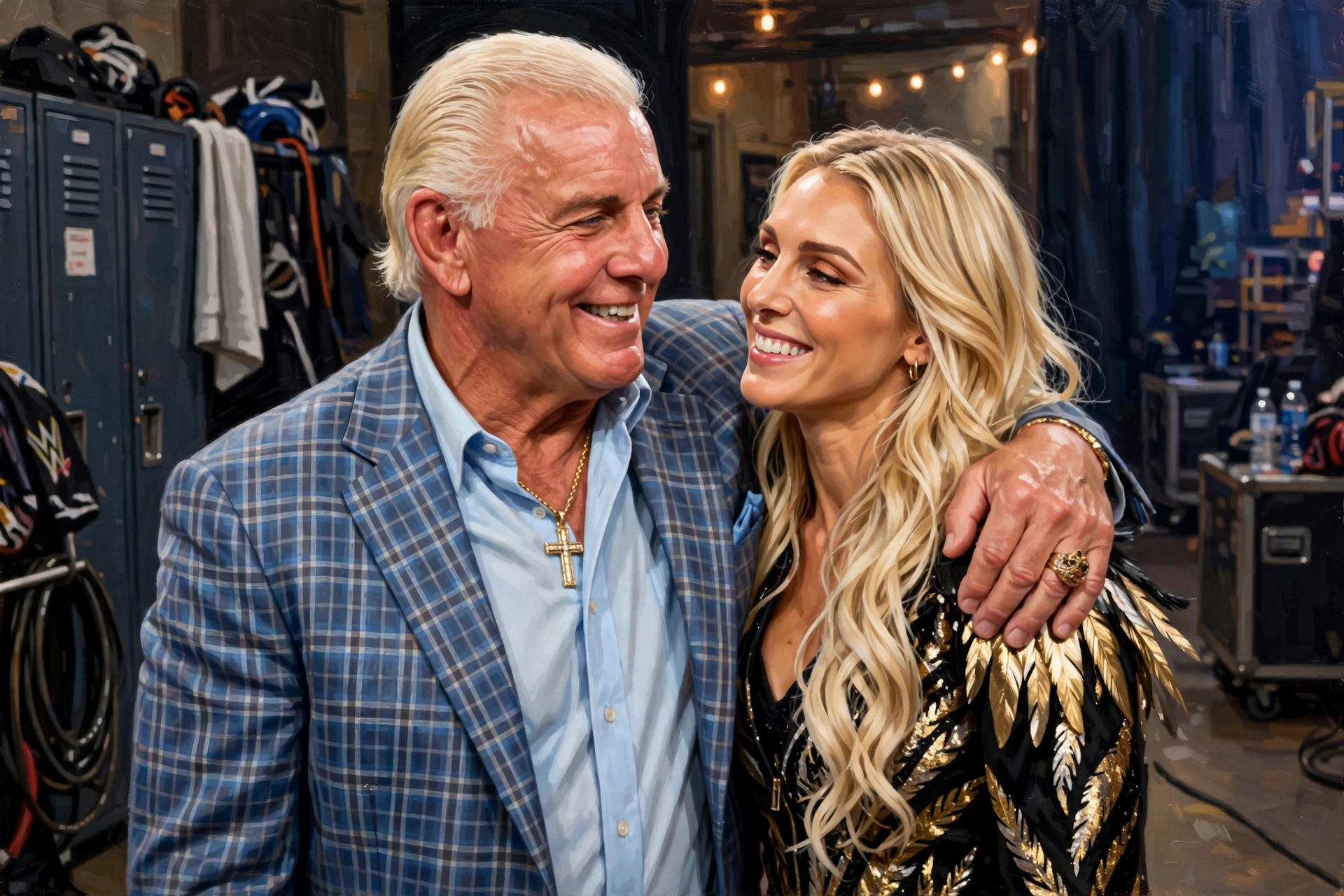
If you want to understand who Ric Flair is when the robe comes off, watch Charlotte Flair. Ashley Fliehr didn’t just follow her father into wrestling — she became one of the greatest women’s wrestlers ever, a multi-time world champion in her own right. Their bond is the warmest thread in the public record: the father who trained with her, cried at her matches, and now gets his hospital updates delivered to the world by her, with a joke attached. “He’s going to be ok” — posted at the end of the scariest night — is the whole relationship in five words. She knows exactly who he is, and she loves him at full volume.
The harder thread is Reid. Flair’s younger son, a gifted amateur wrestler in his own right, died on March 29, 2013, of an accidental overdose. In a later shoot interview, Flair admitted something devastating: in the years after Reid’s death, he self-medicated his grief by falling into serious alcoholism — the slide that led, by his own account, toward the 2017 medical crisis. Grief researchers talk about continuing bonds — the healthy, normal process of maintaining a relationship with the dead through memory, ritual, and meaning. Flair’s public candor about Reid, about the guilt of the absent father trying to compensate by being a friend, is that theory made flesh: painful, unresolved, and honest in a way the persona never allowed.
His other children — David, who wrestled briefly, and Megan, who stayed out of the spotlight — complete a family picture that the “limousine-riding” mythology mostly ignored. The Nature Boy had no entourage at 3 a.m. in the ICU. He had family. That’s the part of the story the robe can’t cover.
Dark Side: When the Persona Eats the Person
Let’s be plain about the public record, because softening it would be dishonest: Ric Flair has spent decades as his own cautionary tale. He has spoken openly about alcohol abuse. There were the bar incidents and altercations that made headlines across the years — including a widely reported 2024 confrontation at a Gainesville, Florida bar that went viral. There were the years when the “jet-flying, limousine-riding” excess wasn’t a promo but a lifestyle, with the wreckage to prove it. The 2017 hospitalization — the one that nearly killed him — is inseparable from that history by his own telling.
Carl Jung’s concept of the shadow — the disowned, appetite-driven part of the self — gets invoked a lot in celebrity profiles, usually as decoration. Here it earns its keep. The Nature Boy persona was built from real appetites: for attention, for luxury, for more. What made him magnetic in the ring made him combustible outside it, because the persona had no off switch. Psychologists who study identity fusion warn of exactly this: when the role and the self merge completely, there’s no “character” to take off at the end of the night. Richard Fliehr couldn’t leave Ric Flair in the locker room, because by the 1990s there was no locker room — there was only the road, the bar, and the next town. None of this is a diagnosis; it’s the observable pattern of a man whose greatest creation was also his most demanding roommate.
Second Act: The Reckoning and the Reinvention
Here’s what makes the Flair story more than a rise-and-fall: the second act actually happened. ESPN’s 30 for 30 documentary “Nature Boy” (2017) aired while he was still recovering — a brutal, intimate public reckoning that showed the hospital footage and didn’t flinch. His memoir To Be the Man (2004) had told the legend; the documentary told the cost. Then came the improbable victory lap: the 2022 Last Match at 73, the AEW deal putting him back on weekly television in his seventies, the convention circuit where fans line up to hear one more “Woooo!” in person.
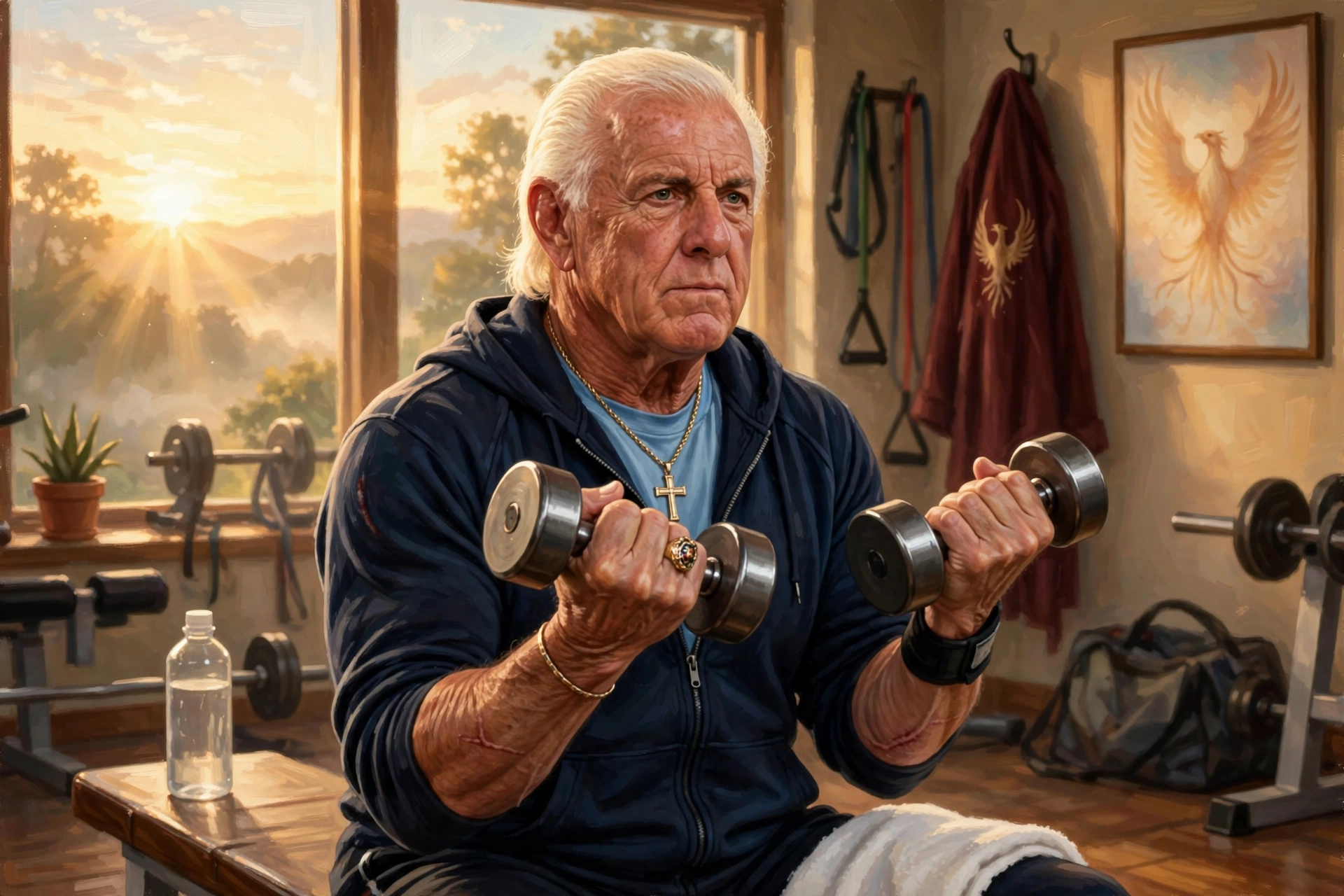
Researchers Tedeschi and Calhoun, who coined post-traumatic growth, describe five observable domains: appreciation of life, relationships with others, new possibilities, personal strength, and spiritual change. Watch Flair’s public behavior since 2017 against that checklist — the tearful candor about Reid, the visible devotion to Charlotte and his grandchildren, the willingness to say “alcohol nearly killed me” on camera — and the pattern is hard to miss. Growth after trauma isn’t the absence of damage; it’s what gets built on the site of the damage. The Nature Boy didn’t get a new act by pretending the fall never happened. He got it by finally talking about the fall.
Fun Facts: The Lore of the Nature Boy
- The Royal Rumble, 1992: Flair entered at number 3 and lasted the full 60 minutes to win the WWF Championship — still considered the greatest Rumble performance ever, done while, by his own admission, running on fumes and showmanship.
- The “Woooo!” has a birth certificate: Flair says he lifted it from Jerry Lee Lewis’s “Great Balls of Fire” — a piano-pounding scream of pure joy, repurposed into wrestling’s most imitated sound.
- The robes were an arms race: custom creations costing thousands of dollars apiece, each one designed to out-shine the last. The robe was the entrance.
- Five decades, one strut: from his 1972 debut to the 2022 Last Match, Flair performed across five different decades — a longevity record in a business that chews people up in five years.
- The strut was strategy: that exaggerated walk to the ring told the crowd everything — this man cannot be beaten, and he knows it — before a single lock-up. It was psychological warfare disguised as vanity.
- First of his kind, twice: the only two-time WWE Hall of Fame inductee of his era (2008 solo, 2012 with the Four Horsemen) — the institution had to invent a new category of honor to contain him.
What the Research Says About the Psychology of Ric Flair
Strip out the sequins and Flair’s life maps onto an unusual number of real research literatures — which is why the psychology of Ric Flair is worth taking seriously:
- Identity fusion (Swann et al.): when a role merges with the self, people will endure extraordinary costs to defend it. Flair’s inability to stay retired is fusion’s signature: the threat isn’t to a job, it’s to who he is.
- Narrative identity (McAdams): we become the stories we tell about ourselves. “The Nature Boy” isn’t a nickname; it’s a life story with a beginning (the children’s home kid who wanted more), a middle (the championships), and a redemption arc (2017 onward). Coherent life stories predict well-being — and Flair’s has never lacked coherence.
- Deliberate practice (Ericsson): expertise comes from feedback-rich repetition at the edge of ability. Sixty-minute matches in front of live crowds for decades is about as feedback-rich as practice gets.
- Terror management theory (Greenberg, Pyszczynski, & Solomon): reminders of mortality drive people to defend their worldviews and self-esteem. The strut at 77 reads, in this light, as mortality salience answered with maximum vitality.
- Post-traumatic growth (Tedeschi & Calhoun): the post-2017 pattern — candor, closeness, appreciation — matches the documented domains of growth after life-threatening crisis.
- Sensation seeking (Zuckerman): the appetite for intense, novel experience predicts both spectacular careers and spectacular wreckage. The research doesn’t moralize; it describes. So does this profile.
- Self-determination theory (Deci & Ryan): autonomy, competence, and relatedness drive sustained motivation. The ring gave Flair all three for fifty years. Retirement threatened all three at once — no wonder it never stuck.
None of this reduces the man to a case study. If anything, the research makes him more interesting: here is a human being running, at full volume, almost every motivational system psychology has named — and still getting up at 77.
Activity: The Nature Boy Comeback Quiz — What’s Your Resilience Style?
Ric Flair’s comebacks run on a particular fuel: identity, ritual, and refusal. But resilience wears different faces. Answer these five questions honestly, tally your score, and find your style.
1. When life knocks you flat, your first instinct is to…
2. Your relationship with your “persona” (the version of you the world sees) is…
3. A setback you thought would break you actually taught you…
4. Your rituals (morning routine, pre-game habits, lucky anything) are…
5. At 77, you hope people say you…
Frequently Asked Questions
How old is Ric Flair?
Ric Flair was born on February 25, 1949, in Memphis, Tennessee — which made him 77 at the time of his October 2026 hospitalization in Tampa.
What happened to Ric Flair in October 2026?
On October 23, 2026, Flair fell outside a Wagamama restaurant in Tampa, cutting his head and eye open, and was taken to hospital by ambulance. Hours earlier he had revealed a blood clot in his leg had forced him to cancel a Seattle convention appearance. His daughter Charlotte Flair posted that evening that “he’s going to be ok.”
How many times was Ric Flair world champion?
WWE officially recognizes 16 world championship reigns (eight NWA, six WCW, two WWF). Flair himself has claimed the real number is higher — 21 by some counts. Either way, it’s the most celebrated title record in wrestling history.
What happened to Ric Flair in 2017?
An intestinal rupture led to organ failure that put him in intensive care for roughly a month, including a medically induced coma. His family was told he might not survive. He has since spoken publicly about the role alcohol played in his decline.
Is Ric Flair still wrestling?
His billed “Last Match” took place on July 31, 2022, in Nashville, when he was 73. He later signed a deal with AEW as an on-screen personality. As of 2026, he appears at conventions and on television — but the in-ring career that began in 1972 appears to be over.
Try it on our site
Flair’s story is really about resilience — the practiced art of getting back up. These free tools can help you build your own version:
- Take a Mind Check-In — see where your stress and mood stand today, in two minutes
- Challenge the Thought — reframe the story you’re telling yourself about a setback
- Name Your Feeling — put words to what a hard week is actually doing to you
- Relaxation Techniques — 20 guided exercises for the nights your mind won’t strut off quietly
Related reading: The Psychology of Kobe Bryant’s Mamba Mentality · The Psychology of Erling Haaland’s Unshakeable Self-Belief · Tom Skerritt at 93: The Psychology of a Six-Decade Career
Key Takeaways
- The psychology of Ric Flair is the psychology of identity fusion — when the persona and the person merge, quitting feels like self-erasure, so he keeps coming back.
- His 2017 near-death experience became a turning point, not just a scare: public candor about alcohol and loss replaced the invincibility act.
- Resilience is a process, not a trait — Flair’s observable pattern (stay connected, keep a forward narrative, keep performing) matches what resilience researchers describe.
- Strengths and weaknesses are the same machinery: the refusal to quit that built the legend also fueled the wreckage. Know which room you’re in.
- Post-traumatic growth is real but not automatic — it took a reckoning (the documentary, the candor, the family) to turn survival into a second act.
This article is for education and entertainment — it is not therapy, diagnosis, or medical advice, and it is not a clinical assessment of any person. If you or someone you love is struggling with alcohol use, grief, or mental health, consider reaching out to a licensed professional. In the US, you can call or text 988 any time.