
What Is a Sound Bath? The Psychology Behind the Wellness Ritual 90,000 People Search Every Month
Reviewed by a Psychology Postgraduate (MA)
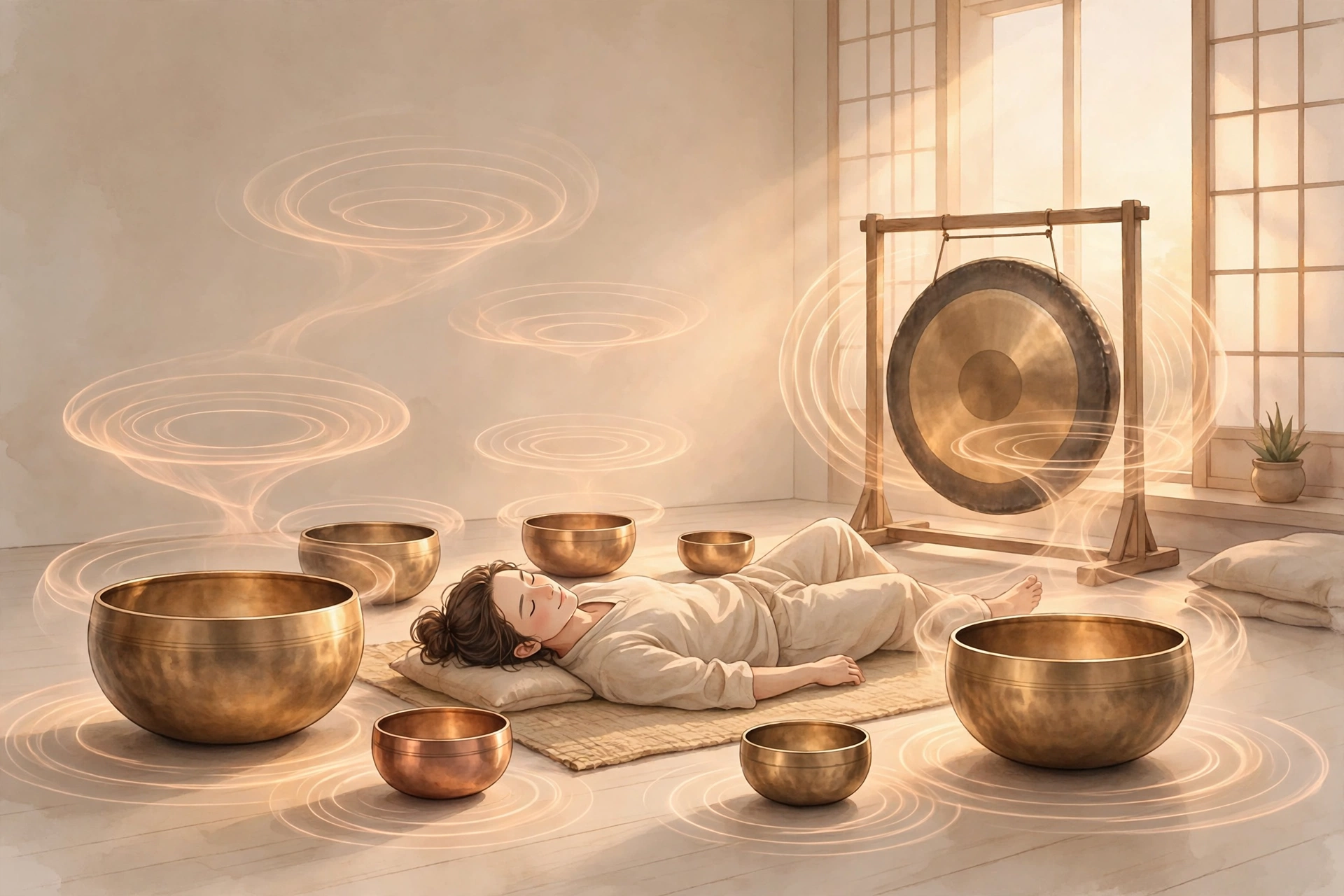
Picture it: a dim room, dozens of people lying on yoga mats, while someone walks between them striking a bronze gong. Nobody is exercising. Nobody is talking. So what is everyone listening to — and why is it suddenly everywhere?
A sound bath is a session where you lie with eyes closed while singing bowls and gongs fill the room with sustained tones. There is no water and no bathtub — you are “bathed” in sound. Small studies find it lowers tension and lifts mood, likely by shifting the brain from alert beta waves toward calmer alpha and theta states.
Put simply: a sound bath is a meditative group experience in which you rest quietly while resonant instruments — crystal singing bowls, gongs, chimes — wash over you in continuous waves of sound.
Maya, a night-shift nurse in Ohio, is exactly the kind of person who ended up converted. “I cannot meditate — my brain just runs the shift on repeat,” she told a friend. One Sunday a coworker dragged her to a sound bath. An hour later she was crying quietly into her eye pillow — not from sadness, but relief. For the first time in months, her mind had gone quiet without her forcing it.
Why is everyone suddenly talking about sound baths?
Because the numbers are hard to ignore. According to Exploding Topics’ October 2026 trends report, monthly US searches for “sound bath” grew from 39,988 in September 2024 to 90,500 in August 2026 — 163% growth over five years. The Atlanta Journal-Constitution named sound baths one of the top wellness trends of 2026.
The deeper story is psychological. Meditation has been prescribed as the antidote to our noisy lives for decades, yet most people who try it bounce off within a week. A sound bath promises the calm of deep meditation without the part everyone hates: the effort. One practitioner called it “a lazy form of meditation” — the sound does neurological work that active effort normally requires.
Do sound baths actually work?
Yes — modestly, and honestly. Research in the Journal of Evidence-Based Integrative Medicine found sound meditation significantly reduced tension and improved mood. EEG work shows the brain shifting from beta waves, the fast alert pattern of a stressed mind, toward alpha and theta, the slower rhythms of deep relaxation. The research base is small and early — but the effect is real and measurable.
What is striking: this shift mirrors what prolonged meditation produces — in people with zero meditation experience. The downshift that takes meditators years to access shows up in beginners after an hour of listening.
Why does a sound bath calm a racing mind?
The short version: continuous sound gives your brain’s electrical rhythms something to synchronize with, and gives your wandering attention somewhere to land.
First, brainwave entrainment. Beta is the alert, analytical, to-do-list frequency where most of us live all day; alpha and theta are slower states tied to relaxation and the edge of sleep. Sustained tones appear to nudge the brain’s dominant frequency downward — a downshift from mental rush hour onto a quiet country road. You do not have to try; the sound field does the shifting, and your nervous system follows.
Second, attention capture — which may matter more for overthinkers. Rumination thrives in silence: sit down to meditate and your brain fills the vacuum with rehearsed conversations and replayed mistakes. A sound bath fills that vacuum first. The tones are layered and constantly shifting, keeping your auditory system occupied. The mind cannot ruminate and track rich sound at once, so the worry loop starves for lack of attention.
Why does it work when meditation apps never did?
Because it removes the one ingredient most stressed brains cannot supply: effort. Traditional meditation is active practice — notice the breath, catch the wandering mind, return, repeat. For an anxious person, every wandering thought feels like failure. Sound healing meditation flips the formula: you are not doing anything. You are receiving.
This is the difference between effortful and passive coping: effortful coping asks a depleted person to spend more energy, while passive practices let the system recover. That is why sound baths have a devoted following among healthcare workers, new parents, and anxious minds — exactly the people meditation culture shames for “not being able to sit still.” Daniel, a 34-year-old software engineer, deleted three meditation apps after each became a guilt-inducing streak. At a sound bath he simply lay down, and for 45 minutes nobody — including himself — required anything of him.
Try Our 20 Guided Relaxation Exercises
Is the setting part of the effect?
Absolutely — the room, the ritual, and the group are active ingredients, not decoration.
Consider what a session asks of you: arrive, take off your shoes, lie down, pull a blanket over yourself, close your eyes, and do nothing for 45 to 60 minutes. Dim light, warm air, permission to be horizontal mid-day — every cue tells your nervous system the emergency is over. Ritual works this way in every culture: ceremony signals a transition, and the body complies. Then there is the group: hearing twenty strangers breathe slowly gives your nervous system social permission to stand down — the same co-regulation that makes a calm friend’s presence soothing, scaled up.
What happens at your first sound bath?
It is simpler than the mystical marketing suggests. You lie on your back, usually with a blanket and eye pillow provided, while the practitioner plays crystal singing bowls and gongs for 45 to 60 minutes. No chanting, no poses, no interaction. You just listen.
A few honest things to know: the gong can be LOUD. Practitioners build toward crescendos, and the first swell near your head can startle you — that is normal and by design. You may feel vibrations in your chest, fall asleep (extremely common), or feel emotional for no clear reason, like Maya did. Afterward comes a heavy, floaty calm, like waking from a deep nap. Give yourself a slow re-entry: water, then ease back into the day.
Who should be careful with sound baths?
Most people can try one safely, but proceed gently with sound sensitivity, misophonia, tinnitus, or PTSD triggered by loud sudden noises — gong crescendos may overwhelm rather than relax. Pregnant people should check with the practitioner first.
If you are unsure, try a gentle sound bath video at home at low volume first. If 20 minutes of singing bowls leaves you calm, an in-person session will likely be fine. If it irritates you, skip the gong bath — quieter paths to the same calm exist.
Can you get sound bath benefits at home for free?
Yes — and this is part of why the trend exploded. While typically in-person, sound baths are widely replicated through YouTube and streaming playlists: search “sound bath” or “sound healing” for hour-long sessions with millions of views. Headphones, a dark room, and a blanket get you surprisingly close to the studio experience.
To pick a reputable practitioner, look for someone who explains the session beforehand, offers intensity adjustments, and makes no medical claims. Anyone promising bowls will cure disorders or “realign your DNA” is selling something other than relaxation.
Try It on Our Site
If doing nothing on purpose appeals to you, start here:
- Relaxation Techniques — 20 guided exercises, from breathing drills to guided imagery.
- Mind Check-Ins — take the Stress check-in before and after a session.
- 7-Day Anxiety Toolkit — a week of small, science-grounded calming practices.
Related reading: relaxation techniques that actually work, how to reset your vagus nerve, and a beginner’s guide to self-compassion meditation.
Sound Bath FAQs
What actually happens during a sound bath?
You lie down, close your eyes, and listen while a practitioner plays singing bowls, gongs, and chimes for 45 to 60 minutes. That is the whole assignment — no meditation skill required.
What should I wear or bring?
Wear comfortable, warm clothes — you will be lying still in a cool room. Most studios provide mats, blankets, and eye pillows.
Do sound baths actually work, or is it just placebo?
Small studies show real reductions in tension and improved mood, with EEG shifts toward relaxed brainwave states. Expectation and ritual amplify the effect — and that amplification is a genuine mechanism.
Is a sound bath religious or spiritual?
Not inherently. The instruments have roots in various traditions, but most modern sessions are secular wellness experiences — check the studio’s description if that matters to you.
Can I do a sound bath at home?
Yes. Hour-long sessions on YouTube and streaming platforms are free and widely used. Use headphones, dim the lights, lie down, and give yourself the full session length.
- A sound bath is lying still while singing bowls and gongs fill the room with sustained tones — no water, no meditation skill required.
- Searches grew from about 40,000 to 90,500 per month in under two years, making it one of 2026’s defining wellness trends.
- Early research shows reduced tension and improved mood, with brainwaves shifting from alert beta toward relaxed alpha and theta — the same downshift long-term meditators achieve.
- It works through attention capture, passive rest, ritual, and group co-regulation — which is why it succeeds where meditation apps fail.
- Try it free at home with a YouTube session, or find a local practitioner who explains the session and makes no medical claims.
This article is for educational purposes only — not therapy, diagnosis, or medical advice. A sound bath is a wellness practice, not a treatment for any mental health condition. If you are struggling, consider speaking with a licensed mental health professional. If you are in crisis, call or text 988 in the US.