
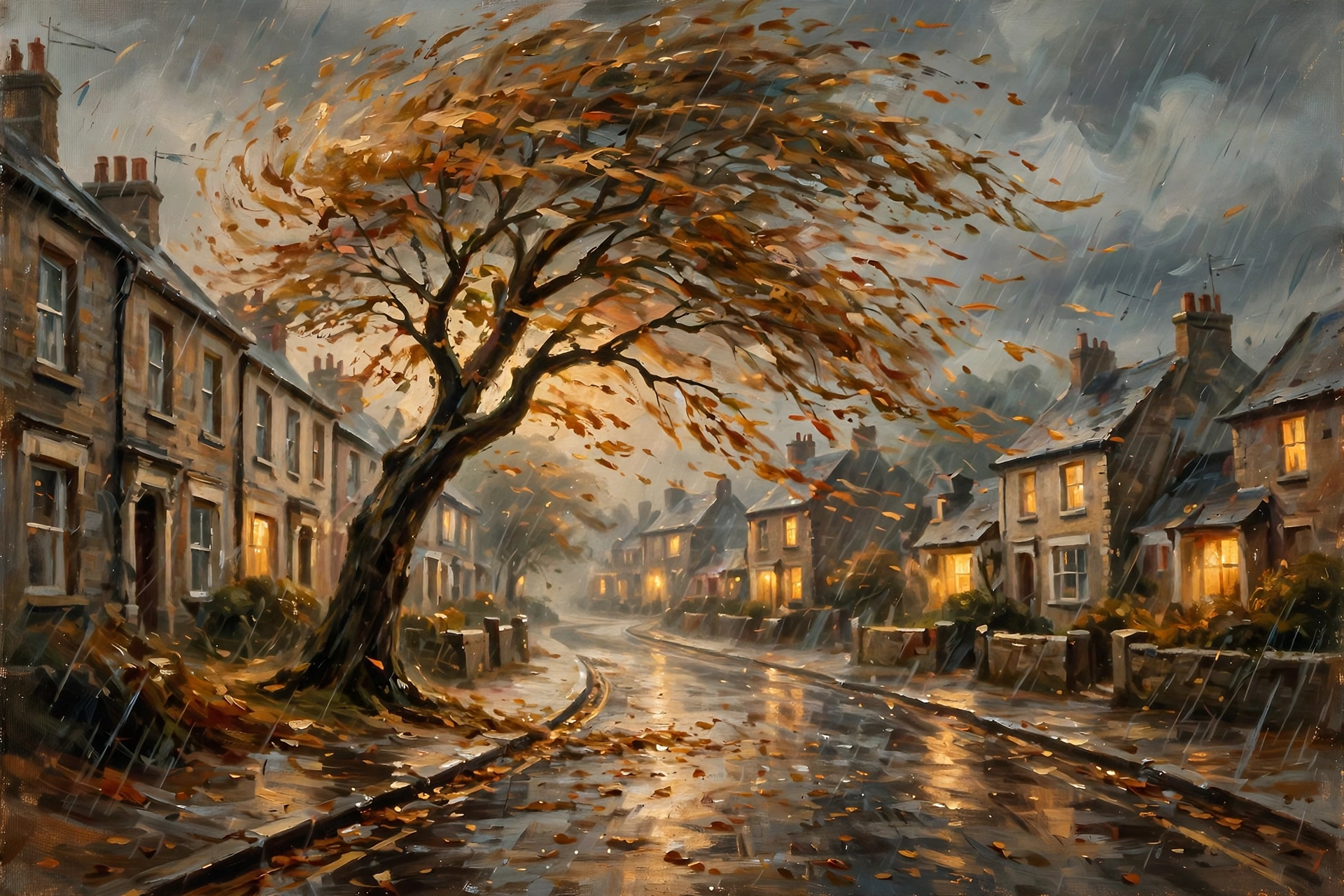
Storm Boelo Turns Deadly: Two Killed by Falling Trees and the Psychology of Storm Grief
Reviewed by a Psychology Postgraduate (MA)
In short: Storm Boelo deaths have turned a weekend of disruption into a weekend of grief. Two men were killed by falling trees in Scotland and London on Sunday 25 October 2026, two more people were injured when scaffolding collapsed in south-west London, and more than 160,000 properties were left without power. When a storm stops being an inconvenience and becomes a cause of death, our minds process it differently – and that shift, from frustration to fear and grief, is what this article explains.
The News: What Happened on Sunday 25 October
Storm Boelo, the second named storm of the UK season after Storm Austen battered southern England on Friday, hit Scotland, Northern Ireland and northern England hardest over the weekend. The Met Office had an amber wind warning in place across mainland Scotland, parts of Northern Ireland and the far north of England from Saturday night, with gusts of 60 to 70 mph widely and up to 80 mph in exposed coastal spots. On Sunday the highest gust recorded was 84 mph at Machrihanish in Scotland.
According to reporting on Sunday, a 60-year-old man was killed by a falling tree near Castle Douglas in Dumfries and Galloway at around 10.30am, while he was believed to have been walking. Police Scotland confirmed he was pronounced dead at the scene, that there were no suspicious circumstances, and that a report would be submitted to the Procurator Fiscal. Hours later, a man in his 20s was killed in Finchley, London, when a falling tree struck the moving car he was in. In south-west London, two pedestrians were injured when scaffolding was knocked over by strong winds; their injuries were not believed to be serious.
The wider disruption was severe. The Sun reported more than 160,000 properties without power, while the Energy Networks Association put the figure at 83,000 homes cut off on Sunday morning. Largs in Ayrshire was submerged at high tide, a 15-mile stretch of the A66 was closed, and trains, flights and ferries were disrupted. The Environment Agency issued 58 flood alerts in England, with SEPA issuing 30 flood warnings in Scotland.
Why Does a Storm Boelo Death Feel Different from Storm Damage?
A cancelled event is disappointing. A flooded road is stressful. A death is something else entirely, and the mind treats it differently for a clear reason. Psychologists who study risk perception, following Paul Slovic, describe two qualities that make a risk feel especially frightening: dread and unfamiliarity. A falling tree is a dread risk because it is sudden, uncontrollable and fatal, and it is an unfamiliar risk because most of us walk past trees every day without ever thinking of them as dangerous. When an everyday object becomes a cause of death, the brain updates its threat map for all similar objects, not just the one tree in the news.
That is why people who were nowhere near Dumfries or Finchley may still feel uneasy walking under trees on Monday, or flinch at a gust of wind they would have ignored on Friday. This is not overreaction. It is the availability heuristic at work: the easier an event is to picture, the more likely we judge it to be. A vivid, recent death is extremely easy to picture, so the mind overestimates the danger for a while. The feeling usually fades as days pass without a new event, but while it is fresh, it is real and it deserves to be taken seriously, not dismissed.
What Is Storm Grief, and Who Feels It?
Grief after a storm death is not limited to the families involved, though their grief is of a different order and this article does not presume to speak for them. Around them sits a wider circle: neighbours who heard the news, people in the same town, and strangers who read the same headline and felt a jolt of recognition – that could have been my street, my walk, my drive.
Psychologists call this collective or communal grief: a shared sense of loss that binds a community even when most members did not know the person who died. It often shows up as quiet behaviour rather than tears. People check on neighbours more. They share warnings more. They drive more slowly, or avoid a particular road for a few days. These are not signs of weakness. They are a community regulating itself after a shock, restoring a sense of safety through small, caring actions.
Pause and ask yourself: When you heard about the deaths, what was your first thought – for the families, for your own safety, or for someone you know who was out in the storm? There is no wrong answer. Naming where your attention went first tells you what kind of support you most need right now: information, reassurance, or a conversation.
If anxiety is running high, try a Mind Check-In or a short relaxation exercise on our site before you scroll for more updates.
Why Do We Keep Checking the Forecast After Bad News?
After a frightening event, many people check weather apps, news sites and social media far more often than usual. This is reassurance-seeking, and it makes sense: the brain wants certainty, and each check promises it. The problem is that checking rarely delivers certainty for long. A forecast changes, a new warning appears, and the anxiety returns, often slightly stronger, because the checking itself has taught the brain that the threat needs constant monitoring.
Research on anxiety describes this as a negative reinforcement loop: checking reduces anxiety for a moment, which rewards the checking, which makes the next urge to check stronger. Breaking the loop does not mean ignoring genuine warnings. It means checking on a schedule – for example, twice a day, from an official source like the Met Office – rather than every few minutes. Scheduled checking keeps you safe without letting the checking itself become the source of distress.
It also helps to separate what you can control from what you cannot. You cannot control wind speed, but you can avoid walking under large trees in high winds and keep your phone charged. Anxiety shrinks when attention moves to the controllable, even in small ways.
How Can Communities and Families Cope This Week?
Here are five practical, non-clinical steps that help after storm deaths, drawn from research on coping and community recovery.
- Name the loss plainly. Saying “two people died in the storm” out loud, rather than “something bad happened,” helps the mind process an event instead of circling it. Children in particular cope better with honest, age-appropriate facts than with vague reassurance.
- Check on one person. A short message to a neighbour, an older relative, or a friend who was travelling on Sunday does more for communal grief than hours of scrolling. Helping restores a sense of agency that bad news takes away.
- Limit the news diet. Choose two official updates a day – the Met Office and your local council or power network – and step away from dramatic footage in between. Your safety does not improve with the tenth video of a falling tree.
- Restore one routine. A normal meal, a normal walk when it is safe, a normal bedtime: routines signal to the nervous system that the emergency has passed. After back-to-back storms, that signal matters.
- Watch for lingering effects. If sleep problems, jumpiness at wind, or avoidance of going outside last more than a couple of weeks, or interfere with daily life, consider speaking to a licensed professional. That is not a failure; it is the right next step.
For families directly bereaved, none of this replaces loved ones, community services, and professional bereavement support in time. Samaritans is available in the UK and Ireland on 116 123, and in the US you can call or text 988.
Try it on our site
If this weekend left you on edge, try a Mind Check-In to put a name to what you are feeling, Challenge the Thought to test a frightening storm thought against the evidence, and a relaxation exercise from our Relaxation Techniques collection before bed. The Daily Tracker can help you rebuild one normal routine this week.
Related reading: Storm Boelo Cancelled Everything This Weekend: The Psychology of Cancelled Plans, Storm Austen and the Psychology of Storm Anxiety, The UK Government Just Told Everyone to Stock Up for 3 Days: The Psychology of Preparedness Anxiety.
Key Takeaways
- Storm Boelo killed two men on 25 October 2026, injured two more in a scaffolding collapse, and left more than 160,000 properties without power.
- Deaths feel different from damage because falling trees combine dread and unfamiliarity, and the availability heuristic makes the danger feel larger for a while.
- Communal grief is normal: checking on neighbours and restoring routines are how communities recover.
- Scheduled, official-source checking beats constant scrolling for both safety and calm.
- If distress lingers beyond a couple of weeks, speaking to a licensed professional is the right next step.
Frequently Asked Questions
How many people died in Storm Boelo? Two men were reported killed by falling trees on Sunday 25 October 2026, one in Scotland and one in London, and two people were injured in a scaffolding collapse in south-west London.
Why do I feel anxious about trees and wind after the storm? Because a vivid, recent death makes the danger easy to picture, so your brain temporarily overestimates the risk. This availability effect usually fades over days as no new event reinforces it.
Is it normal to grieve for strangers killed in a storm? Yes. Collective grief is a recognised response: a community shares a sense of loss and restores safety through checking on each other and small caring actions.
How much checking of weather news is too much? If checking no longer reassures you and instead makes you check again sooner, it has become a loop. Try two scheduled official checks a day instead of continuous scrolling.
If you are struggling, please consider speaking to a licensed professional. In the UK and Ireland, Samaritans is available on 116 123. In the US, call or text 988 for the Suicide and Crisis Lifeline. This article is educational only and is not therapy, diagnosis, or medical advice.