
Britain Was Told to “Be Ready” — Then the Shelves Started Emptying: The Psychology of Panic Buying
Reviewed by a Psychology Postgraduate (MA)
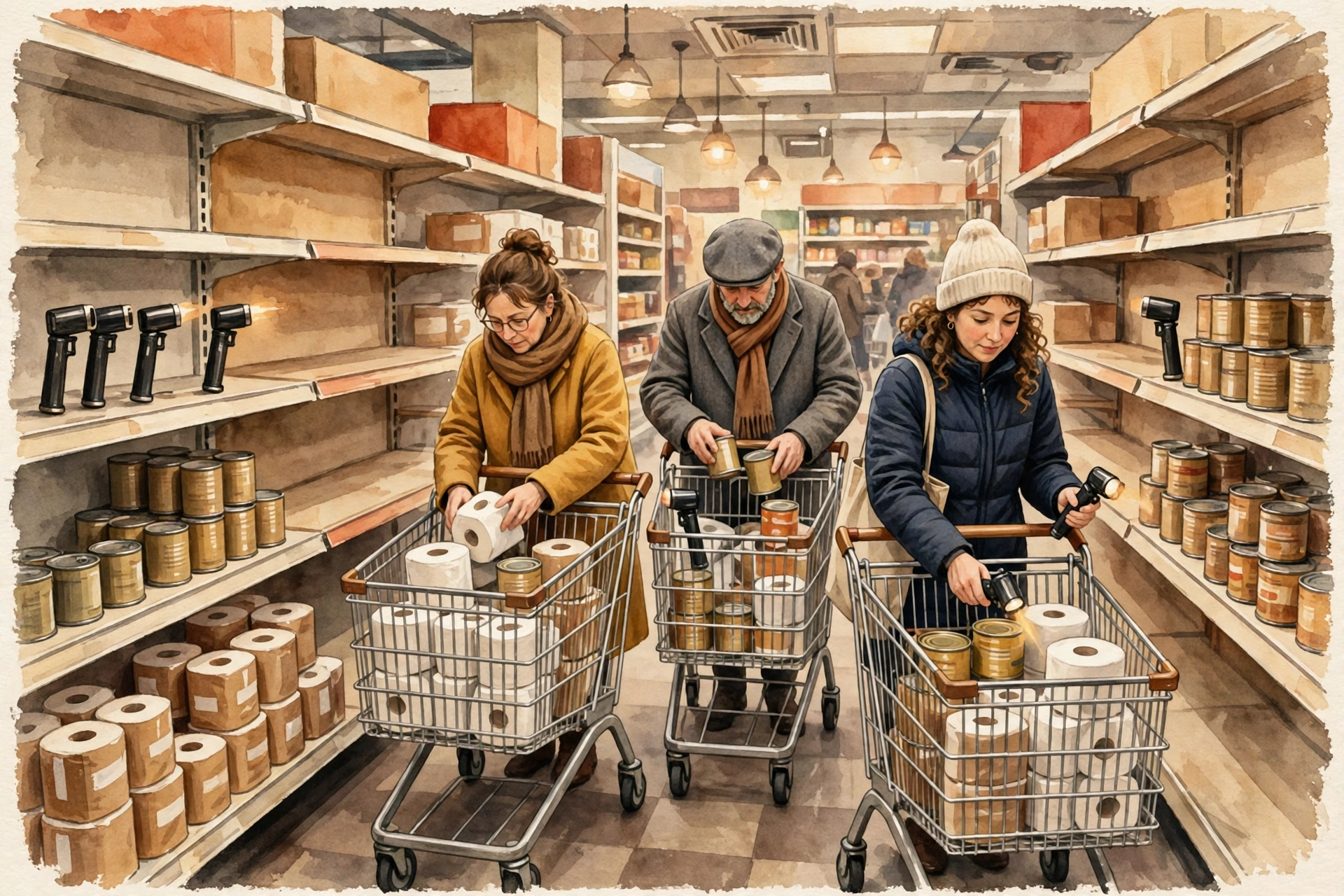
On October 22, 2026, the UK government launched its Be Ready campaign, asking households to be able to manage for three days if power, water, phone networks or the internet were disrupted. The official advice was deliberately calm: start with what is already in the cupboard, add an item or two during normal shopping trips, and do not rush out to buy everything at once. Within days, shoppers did something else entirely — and UK panic buying Be Ready psychology starts with that gap between calm advice and empty shelves. Discount retailer B&M reported a 19 percent rise in toilet paper sales since the guidance was issued, along with higher sales of power banks and torches. Electronics retailer Maplin reported radio sales up 92 percent, torch sales up 284 percent and power-bank sales up 106 percent compared with the previous month. Bamboo toilet-paper maker Cheeky Panda reported sales up 43 percent on the same period in 2025. The Independent described the rush as “pandemic-style” panic buying.
Defence Secretary Wes Streeting, responding on BBC Newsnight, called the response “encouraging”, saying that having a few everyday essentials at home helps households prepare for disruption, whether from flooding, power cuts or burst pipes. He has also urged the public to be “alert not alarmed”. The tension between those two reactions — official encouragement on one side, emptying shelves on the other — is exactly where the psychology lives. Nobody set out to cause a shortage. Yet a message designed to prevent panic helped to produce a small version of it anyway.
So why does panic buying psychology explain a rush that the advice itself warned against? In short: UK panic buying Be Ready psychology is the story of a calm message producing a rush — panic buying is rarely about the product. It is about control, social proof, and the fear of being the one person left without. When an authority names a threat and neighbors start stocking up, buying feels like the only action available — and not buying starts to feel like negligence.
Panic buying is the sudden, collective surge in purchasing of particular goods driven by fear of shortage rather than by present need: people buy more than usual, sooner than usual, because they believe others will do the same and the shelves will empty.
What actually happened after the Be Ready advice?
Retailers reported sharp, specific sales spikes in the days after the government’s three-day preparedness guidance: toilet paper up 19 percent at B&M and 43 percent at Cheeky Panda, and torches up 284 percent, power banks up 106 percent and radios up 92 percent at Maplin, with tinned food sales also reported soaring.
The checklist itself is modest. The government asks households to hold three days of drinking water (about three litres per person per day), non-perishable food that needs no cooking, a torch and spare batteries, blankets and warm clothing, a first-aid kit, several days of prescription medicines, cash, copies of important documents, a charged power bank and a battery or wind-up radio. Ministers framed it as preparation for everyday emergencies — storms, floods, wildfires and power cuts — not as a warning of an imminent crisis, and the campaign is planned to run for three years. Security Minister Dan Jarvis said that if people who can prepare do so, emergency services can focus on “people who need more support”.
But a checklist does not travel through the public mind in its original form. It travels as a headline, a photo of a trolley, a neighbor’s comment, and a half-remembered warning about war in 1,000 days — Streeting had separately warned in a Telegraph article on October 27 that hostile powers could be ready to attack by 2030. By the time the message reaches the supermarket aisle, “build up gradually” has quietly become “buy now, before it is gone”.
Why does the UK’s Be Ready advice trigger panic buying?
Because of social proof and anticipated regret: seeing others buy signals that buying is what sensible people do, and the imagined future shame of having done nothing outweighs the present knowledge that supplies are plentiful.
Psychologists call the first mechanism social proof. In uncertain situations we look sideways before we look at the facts. If the person ahead of you in the queue has six packs of toilet paper, your brain does not run a supply-chain analysis; it concludes that this person knows something you do not. The 2020 toilet-paper shortages worked the same way: there was no toilet-paper shortage until the buying created one, and then the empty shelf became proof that the buying had been wise all along. It is a self-fulfilling prophecy with a trolley.
The second mechanism is anticipated regret, and it is more personal. Consider Sarah, a composite of a very common reaction this week. She is 38, lives in Manchester, and has two children and a mother who relies on regular medication. She read the Be Ready coverage on her phone, felt a flicker of unease, and then saw a friend post a photo of a stocked cupboard. She did not believe disaster was coming. She believed she would feel terrible if something happened and she had ignored the advice. So she bought extra tinned food, water and batteries — not because she expected to need them, but because buying them bought her an evening without the nagging thought. Panic buying, for most people, is anxiety management with a receipt.
There is a third mechanism, and it is the one officials least control: the availability heuristic. When a danger is vivid — storm footage, empty shelves, a minister talking about war — the mind treats it as likely, whatever the statistics say. A government campaign, however carefully worded, makes the danger vivid by naming it. That is the paradox at the heart of this story: the same message that tells people to prepare also supplies the vivid image that makes them over-prepare.
Is panic buying selfish, or is it something else?
Mostly something else: research on disaster behavior consistently finds that panic is rarer than headlines suggest, and that most stockpiling is protective — people buying for their own household, often for vulnerable relatives, under uncertainty about what comes next.
That distinction matters, because shaming buyers tends to make the behavior worse, not better. When people are told they are selfish for stocking up, they do not stop worrying; they start hiding the worry, and sometimes hiding the shopping too, buying at different stores or at odd hours. The behavior goes underground rather than away. A more honest framing is that panic buying is a rational response to an irrational information environment: if you cannot be sure the shelves will be full tomorrow, and everyone around you is acting as though they will not be, buying today is a reasonable hedge.
Where it does become a problem is at the margins. The household that buys a month of supplies removes a month of supplies from people who shop day to day, including people on tight budgets who cannot buy ahead at all. The government’s own advice recognizes this: build up over time, during normal shopping, so that no single week empties anything. The failure this week was not that people prepared. It was that too many people prepared all at once, in the same few days, for the same few items.
Pause and ask yourself: Think of the last time you bought something “just in case” — extra food, extra fuel, an extra charger. Were you responding to a real shortage, or to the sight of other people buying? If it was the second, you have felt social proof working on you in real time. Noticing it is the first step to choosing differently next time, because the urge fades once you name what caused it.
How do you prepare without joining the rush?
Set a finish line, buy gradually, and separate the shopping list from the news cycle: one or two extra items per normal shop, a written household plan, and a deliberate stop once the three-day list is done.
First, use the government’s own pacing. The checklist is designed to be built over weeks, not a weekend. One extra tin per shop, a pack of batteries this week, a torch next week. Your brain gets repeated small experiences of completion instead of one big experience of urgency, and the shelves never notice you.
Second, write the plan, not just the list. Where are your medicines, documents and phone charger? Who would you call? Where would you go if you had to leave? A plan answers the question supplies cannot — what do we actually do — and it is the plan, more than the stockpile, that quiets the mind at 2 a.m.
Third, talk to one neighbor. Disaster researchers have repeatedly found that the strongest predictor of coping well in a disruption is not how much a household owns but how many people it knows nearby. A street that shares a torch, a phone charger and a check-in is more resilient than a street of fully stocked strangers.
Fourth, set a news boundary. Checking for updates every hour will not restock anything, but it will keep your threat system switched on and make the next shop feel urgent. Check official guidance once a day, do the practical steps, and then do something ordinary. Calm is not the absence of preparation. It is preparation with a finish line.
Frequently asked questions
Did the government tell people to panic buy? No. The Be Ready campaign explicitly advises building supplies gradually during normal shopping, starting with what is already in the cupboard, and ministers have said it is not a warning of an imminent crisis.
Why toilet paper, of all things? Because it is bulky, visible and hard to substitute, so it becomes the visible signal of a shortage. Once one shopper’s trolley carries it, every other shopper reads the same signal — which is why toilet paper leads almost every stockpiling wave.
What should a household actually hold for three days? About three litres of drinking water per person per day, non-perishable food, a torch, a battery or wind-up radio, blankets, a first-aid kit, several days of medicines, cash, copies of important documents and a charged power bank.
Does stocking up actually help? A modest three-day supply, built gradually, genuinely helps in a storm or power cut. A month’s supply bought in a rush helps one household while making life harder for neighbors who shop day to day.
Try it on our site
Preparation starts with a calmer mind:
- Mind Check-Ins — one-minute self-reflection check-ins for anxiety, stress, mood and sleep.
- Challenge the Thought — a 5-minute interactive thought record for catastrophic “what if” spirals about emergencies.
- Relaxation Techniques — guided breathing and grounding exercises for uncertain weeks.
- Name Your Feeling — put a precise word on what you feel when the news turns alarming. Naming an emotion measurably reduces its intensity.
Related reading: The UK Government Just Told Everyone to Stock Up for 3 Days: The Psychology of Preparedness Anxiety · The UK Budget Promised “Breathing Space”: The Psychology of Why £100 of Relief Feels Bigger Than It Looks · Storm Austen Batters the UK: The Psychology of Severe-Weather Anxiety
Key Takeaways: After the UK’s Be Ready advice, toilet paper sales rose 19 percent at B&M and 43 percent at Cheeky Panda, while Maplin reported torches up 284 percent and power banks up 106 percent. Panic buying spreads through social proof and anticipated regret, not through real shortages — and the empty shelf then becomes proof the rush was wise. The antidote is the government’s own pacing: build a three-day supply gradually, write a household plan, know one neighbor, and stop when the list is done.
This article is for education only and is not medical or emergency advice. In the UK, call Samaritans on 116 123 if you are struggling, or 999 in an emergency. In the US, call or text 988 for the Suicide and Crisis Lifeline.