
Kimi Antonelli Is Formula 1’s Youngest Ever World Champion at 20: The Psychology of a Prodigy Who Stayed Calm
Reviewed by a Psychology Postgraduate (MA)
This profile is an educational look at Kimi Antonelli’s public career and widely reported behavior, and at what psychology research says about prodigy pressure, composure, and early success. It is not an assessment of the person.
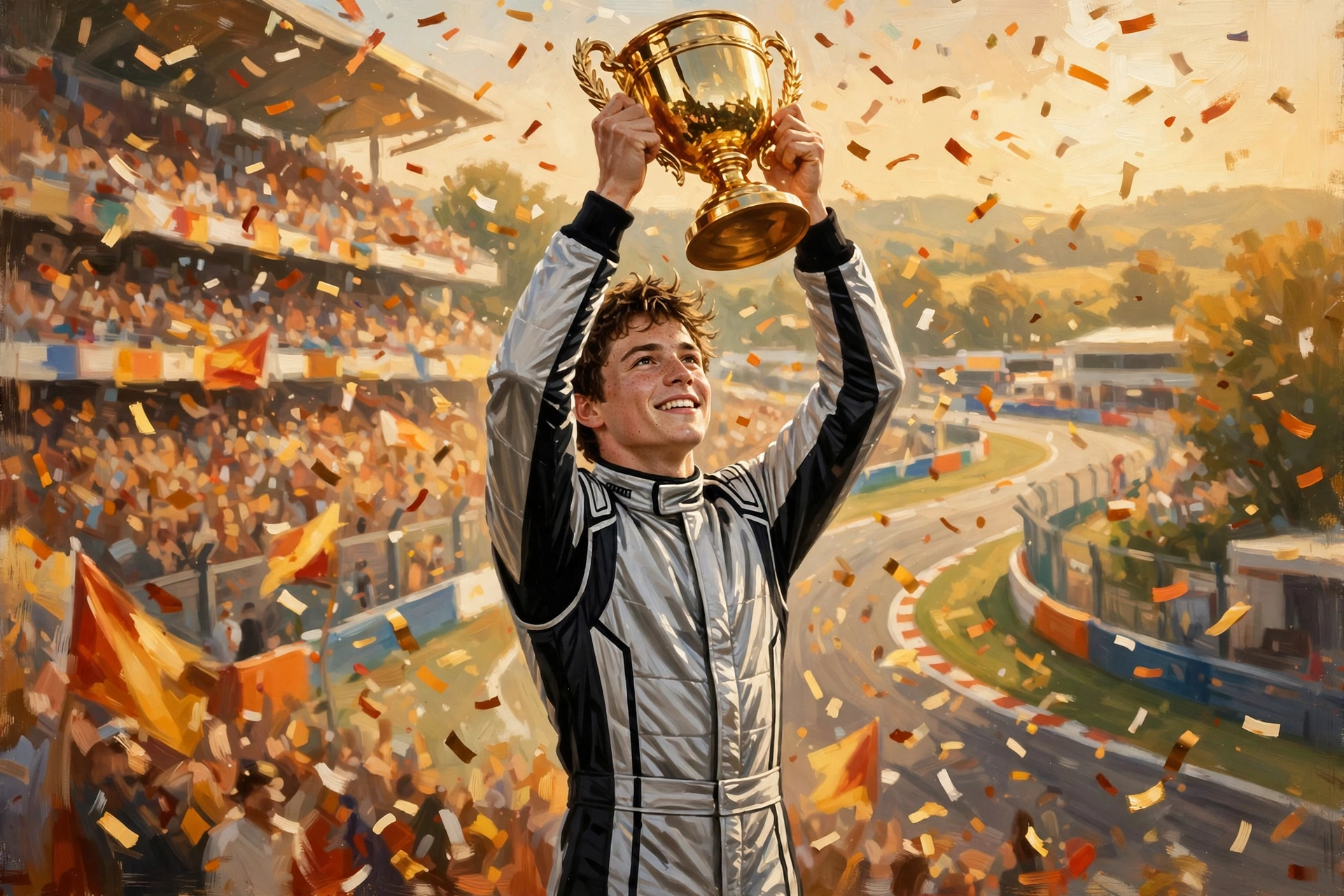
On Sunday 1 November 2026, in the thin air of Mexico City, a 20-year-old finished third in a chaotic, crash-interrupted Grand Prix and became the youngest world champion in Formula 1 history — and the Kimi Antonelli psychology story starts right there, with the composure that carried him through it. Andrea Kimi Antonelli, of Mercedes, crossed the line behind race winner Max Verstappen and Lewis Hamilton, and the two men with eleven world championships between them lifted him aloft on the podium. Over the team radio his voice cracked as he said, “We did it, we did it.” Later he called it “a day I will remember forever.” He was 20 years and 68 days old — more than three years younger than Sebastian Vettel, the previous youngest champion, who was 23 years and 134 days when he won in 2010. He is also the first Italian champion since Alberto Ascari in 1953, ending a 73-year wait, and only the fourth driver ever to win the title in his second season, after Juan Manuel Fangio, Jacques Villeneuve, and Hamilton himself.
The short answer: Kimi Antonelli psychology is the psychology of a prodigy who survived his own billing. Labeled a generational talent since childhood and fast-tracked by Mercedes from the age of 12, he won the 2026 title with nine victories and 16 podiums, sealing it with four races to spare, not by driving faster than everyone on every lap, but by staying composed when a race fell apart around him. Research on prodigies, pressure, and performance under stress explains why that composure — not raw speed — is the rarest part of his story.
Prodigy pressure is the stress of carrying exceptional expectations from childhood: every result is read as proof of a destiny others assigned you, so ordinary setbacks feel like broken promises.
Story
Antonelli was born in Bologna, Italy, on 25 August 2006, into motorsport. His father Marco was a racing driver and team owner, so the young Andrea grew up around pit lanes and kart tracks rather than discovering racing from the outside. He was nicknamed “Kimi” after Kimi Räikkönen, and the name stuck. By his early teens he was winning at karting’s highest levels, and Mercedes signed him to its junior program when he was just 12 years old — an age when most children are still choosing school subjects, not employers.
The junior ladder came fast after that. He won titles in Italian Formula 4 and Formula Regional, stepped up to Formula 2 in 2024, and then, in one of the boldest driver decisions of the decade, Mercedes put him straight into its Formula 1 team for 2025, replacing the departing seven-time champion Lewis Hamilton. It was the kind of promotion that makes headlines precisely because it can go wrong: a teenager, in a top team, in the seat vacated by the sport’s most successful driver, with the whole paddock watching to see whether the hype was real.
His second season answered the question. In 2026 he won nine races, stood on the podium 16 times, and built a 380-point total that left him with an unassailable 119-point lead before the Mexico race even started. All he needed in Mexico City was a ninth-place finish. He finished third, after a race that was red-flagged and restarted following multiple crashes and a long stoppage, while battling illness and exhaustion in the days before the race, according to USA Today. Verstappen won the race for a record sixth time in Mexico; Hamilton was second. The podium told the sport’s story in one frame: its past, its present, and its future, standing together.

Turning Point
Every prodigy has a moment when the label stops being a promise and becomes a test. For Antonelli, it was the Mexico race itself — not because the title was in doubt (it barely was, given his points lead), but because of how he won it. A chaotic race, a red flag, a restart, rivals crashing around him, his body already drained: this was exactly the kind of afternoon that exposes a young driver. Instead of chasing the win he did not need, he drove the race he needed. Third place, title sealed, four rounds remaining.
That restraint is the turning point worth studying. Young champions are often defined by the moment they stop trying to prove they belong and start managing what they already have. Antonelli’s Mexico drive was the second kind of performance: unglamorous, disciplined, and historically decisive.
Mindset
What stands out in Antonelli’s public manner is ordinariness under extraordinary attention. His interviews are notably free of grand statements. After the title he talked about the team — “we did it” — rather than about himself, and about remembering the day rather than owning the record. Psychologists who study high performers often distinguish between ego goals (proving you are the best) and mastery goals (getting better at the task). Antonelli’s public language consistently leans toward the second: the work, the team, the next race.
That matters because ego goals make pressure heavier. If every race is a verdict on your greatness, every mistake is a crisis. If every race is a problem to solve, a mistake is data. The difference shows up most clearly on bad days, and Antonelli’s worst days in 2026 — of which there were some, as there are for every driver — did not spiral into public drama or visible collapse.
Decisions
Three decisions shaped this story, and only one of them was his. The first was Mercedes’ decision to sign a 12-year-old, betting a decade of development on a child. The second was Mercedes’ decision to promote him directly to the works team in 2025 rather than loaning him to a smaller team first. The third was Antonelli’s own, repeated weekly: to accept the promotion’s terms — the scrutiny, the comparisons with Hamilton, the expectation that he would win quickly — without publicly fighting them.
Consider what the safer path would have looked like: two or three seasons at a midfield team, learning away from the spotlight, arriving at a top team at 22 or 23 with a reputation already built. Antonelli took the harder path, and the psychology of that choice is instructive. Avoiding pressure feels protective, but it also delays the evidence that you can handle it. By stepping into the hardest seat available, he collected that evidence early, and each season since has compounded it.
Method
Antonelli’s method, as far as the public record shows it, is built on preparation and emotional steadiness rather than visible intensity. He is not a driver famous for radio outbursts or theatrical celebrations. His team radio after the title — a cracked voice, two words repeated — was emotional precisely because it was so unguarded. The rest of the time, his driving does the talking: clean, fast, and notably free of the desperate lunges that mark drivers trying too hard to impress.
There is a lesson here about what elite preparation actually looks like. From the outside, fans imagine champions as people gripped by visible fire. In practice, the most durable performers often look calm, even boring, because their systems — practice, feedback, rest, repetition — carry the load that willpower cannot. Antonelli’s 16 podiums in a season are not the product of 16 inspired days. They are the product of a baseline so high that even an average day lands on the podium.
There is a second, quieter part of the method worth noting: how Antonelli handles the week between races. Young drivers in top teams live under a microscope that never switches off — debriefs, simulators, sponsor days, media sessions, and a phone full of opinions about their last performance. The ones who last learn to treat that noise as weather: real, sometimes unpleasant, but not something you can steer by. Antonelli’s public calm suggests he learned that lesson unusually early, perhaps because he has lived with attention since childhood and therefore never mistook it for a verdict. Attention was the background of his life long before it became the foreground of his career, and familiarity, in this case, seems to have bred steadiness rather than contempt.
That steadiness also shows up in how he talks about the car. Drivers who blame machinery sound defensive; drivers who praise it sound political. Antonelli mostly talks about the work — what the team changed, what he needs to improve, what the next track demands. It is unglamorous language, and that is the point. Glamorous language is for people performing confidence. Work language is for people who actually have it.
What If?
What if Mercedes had waited? If Antonelli had spent 2025 and 2026 at a smaller team, he might have arrived at a top team in 2027 as a polished 21-year-old with less scar tissue — or he might have spent those years learning habits that a top team would then have had to undo. The counterfactual cuts both ways, which is why it is worth asking: early promotion is a gamble, and this one paid off, but the same gamble has swallowed other prodigies whole.
What if he had needed to win in Mexico, rather than merely finish ninth? That is the more interesting question, because it tests the composure theory. A driver who must win a chaotic race drives differently from one who must merely survive it. Antonelli’s title was sealed by survival, and his career will eventually present him with a race he must win outright. How he handles that day will tell us more about him than Mexico did.
What Most People Lack
Most people, faced with Antonelli’s situation, would lack the ability to separate the noise from the job. Imagine being 20, carrying a nation’s 73-year wait, replacing a legend, and hearing every race described as a referendum on your talent. The natural response is to try harder — to overdrive, to force results, to answer critics with heroics. That response feels like ambition. In a racing car, it usually ends in a barrier.
What Antonelli appears to lack, mercifully, is that impulse. He drives within himself, takes the points available, and lets the championship arithmetic work. Most people lack that restraint not because they are weak, but because restraint looks like passivity from the outside, and nobody wants to look passive when the world is watching.
What Successful People Do Differently
Successful people in high-scrutiny fields tend to shrink the stage. They do not perform for the crowd, the cameras, or the history books; they perform for the task in front of them. Antonelli’s Mexico drive is a textbook example: the occasion screamed for drama, and he responded with arithmetic. Ninth would do; third was plenty.
They also protect their story from other people’s timelines. A prodigy is constantly told he is early or late — too young for the seat, too slow to justify the hype, already behind some record. The drivers who last are the ones who stop racing the timeline and start racing the track. Antonelli, at 20, already talks like someone who has learned that distinction.
Success Mindset
There is a particular danger in winning everything young: you can mistake early success for a finished identity. Antonelli’s title, won with four races still to run, could easily become the peak against which everything else is measured — the trap that has dulled many young champions. The healthier mindset, and the one his public comments suggest, treats a championship as a platform rather than a verdict: proof that the method works, not proof that the work is done.
Watch what he does next. Champions who stay champions usually get less interesting to the cameras after their first title — fewer headlines, fewer dramas, more routine excellence. If Antonelli’s next seasons look quieter, that will not be a decline. It will be the same discipline, applied to the harder problem of staying on top.
Failures
Antonelli’s public record is short, and it would be dishonest to invent a catalogue of failures he has not had. What can be said honestly is that his path contained real risk and real rough days: a debut season in the most scrutinised seat in the sport, races where the car and the occasion got the better of him, and a Mexico weekend in which illness and exhaustion preceded the biggest race of his life. None of these became defining failures, and that is itself the point worth noting.
Failure, for a prodigy, rarely arrives as one dramatic crash. It arrives as a slow drift: the hype curdles, the results plateau, the story changes from “the next great” to “whatever happened to”. Antonelli has avoided that drift so far, not by never struggling, but by never letting a struggle rewrite the story. The title, sealed early, is the strongest possible evidence that the drift is not happening.
Relationships
Two relationships frame this story. The first is with Mercedes, which has effectively raised him as a racing driver since he was 12 — a decade-long institutional relationship that is closer to a family arrangement than a normal employer-employee deal. Long relationships like that provide stability, but they also create dependency: the team that made you is the team you must eventually outgrow, or at least renegotiate with as an equal.
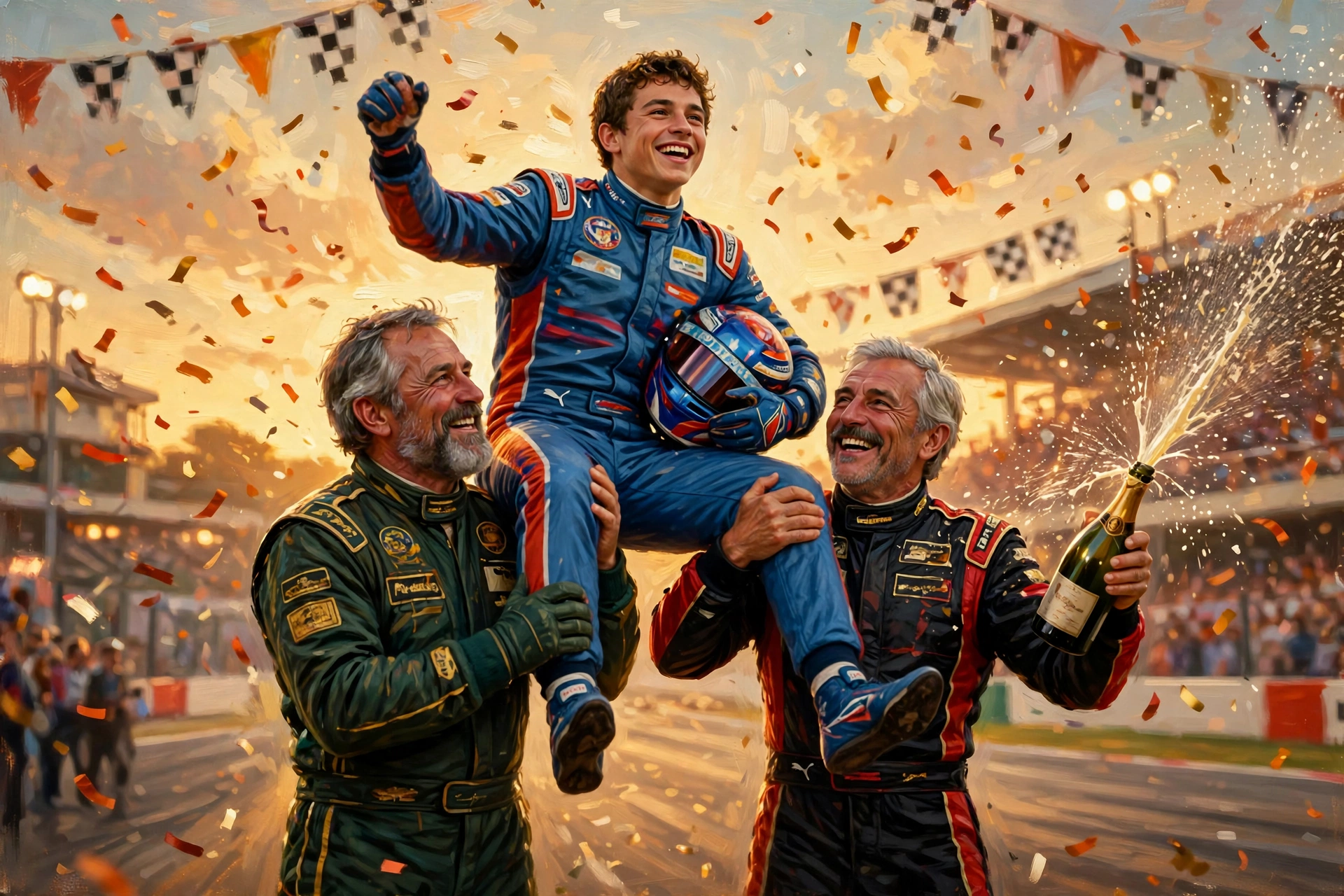
The second is with the two men who lifted him on the Mexico podium. Verstappen, the four-time champion he dethroned in narrative terms, and Hamilton, the seven-time champion whose seat he inherited, both celebrated him publicly. Hamilton’s tributes in particular — a young man has broken the record, “the first of many I reckon” — carry weight precisely because they come from the man with the most to lose from the comparison. Grace from rivals is rare in elite sport, and it is worth noticing when it happens.
Dark Side
Every prodigy story has a shadow, and Antonelli’s is the same one that follows every child star: a life organized around a single skill from childhood leaves little room for the ordinary experiments — friendships, failures, identities — through which most people discover who they are. When the skill becomes the self, a bad season can feel like an existential threat rather than a professional setback.
There is also the weight of a nation’s expectation. Italy waited 73 years for another champion, and that wait now attaches itself to a 20-year-old’s shoulders. National heroes are celebrated loudly and judged harshly, often by the same people. The honest version of this profile says: the pressure that made Mexico meaningful is the same pressure that could make the next difficult season feel unbearable. Naming that risk is not pessimism; it is the reason his composure matters so much.
Second Act
Antonelli’s second act has barely begun — he is 20, with four races left in his championship season and, if the usual career arc holds, another decade at the top ahead of him. But the shape of it is already visible in the constructors’ standings: Mercedes led Ferrari 630 points to 504 after Mexico and could clinch the constructors’ title in Brazil the following weekend. A drivers’ and constructors’ double in his second season would complete the transformation from prodigy to team leader.
The longer second act is psychological: from “the youngest champion” to simply “a champion”, and eventually to whatever comes after driving. The drivers who age best in this sport are the ones who build an identity wider than the cockpit while they are still winning. Antonelli has time — more time than almost any champion in history. How he uses it will be the real story of the next ten years.
Fun Facts
- Antonelli won the title at 20 years and 68 days, beating Sebastian Vettel’s 2010 record by more than three years.
- He is the first Italian world champion since Alberto Ascari in 1953 — a gap of 73 years.
- He is only the fourth driver to win the title in his second Formula 1 season, after Fangio, Villeneuve, and Hamilton.
- He sealed the 2026 title with four races still to run, on the back of nine wins and 16 podiums.
- He needed only ninth place in Mexico City — and finished third in a race interrupted by a red flag and multiple crashes.
- His nickname “Kimi” comes from Kimi Räikkönen, and it stuck so firmly that most fans know him by it.
- Mercedes signed him to its junior program when he was 12 years old.
What the Research Says
Research on prodigies draws a consistent distinction between early achievement and lasting performance. Psychologist Ellen Winner’s work on gifted children notes that prodigies master a domain early through intense practice and support, but that adult eminence depends on something else: the ability to move from technical mastery to creative contribution, and to survive the moment when being “the young one” stops being an advantage. Antonelli’s title is a mastery milestone; the creative phase — leading a team, shaping a car, defining an era — comes next.
On pressure, the research points to a mechanism called “choking under pressure”, studied by psychologist Sian Beilock: when attention turns inward and performers start monitoring skills that normally run automatically, performance drops. The antidote is not more effort but less self-monitoring — trusting trained routines, focusing on external cues, and shrinking the occasion to the size of the task. A driver who treats a title-deciding race as “finish ninth” rather than “make history” is, knowingly or not, applying exactly that antidote.
Finally, Carol Dweck’s work on mindset offers the frame for Antonelli’s next chapter. A fixed mindset treats a championship as proof of talent; a growth mindset treats it as evidence that the process works. The first makes the next season frightening, because any failure threatens the proof. The second makes it interesting, because failure becomes information. Antonelli’s public language — team-first, process-first, “a day I will remember” rather than “I am the greatest” — leans toward the second, and that is the most encouraging sign in the whole story.
Activity: How do you handle prodigy-style pressure?
Answer these five questions honestly, then tap the button for your snapshot. There are no right answers — only patterns worth noticing.
1. When everyone expects a lot from you, do you: (a) try harder and grip tighter (3 points), (b) stick to your normal routine (2 points), (c) step back and shrink the task (1 point)?
(a) Try harder (b) Normal routine (c) Shrink the task
2. After a public setback, do you: (a) replay it for days (3 points), (b) review it once, then move on (2 points), (c) treat it as data, nothing more (1 point)?
(a) Replay it (b) Review once (c) Data only
3. When a big day arrives, do you: (a) think about what it means for your reputation (3 points), (b) think about the first small step (1 point), (c) a mix of both (2 points)?
(a) Reputation (b) First step (c) Mix
4. Do you credit success mostly to: (a) yourself (3 points), (b) your team and supporters (1 point), (c) luck plus effort (2 points)?
(a) Myself (b) Team (c) Luck plus effort
5. When pressure peaks, do you: (a) force a big result (3 points), (b) take the safe points available (1 point), (c) decide case by case (2 points)?
(a) Force it (b) Safe points (c) Case by case
Pause and ask yourself: Where in your life are you driving for the win when ninth place would seal the title? Most pressure is self-imposed arithmetic — and most of it dissolves the moment you work out what result you actually need. Try our Thought Reframe tool to practice shrinking one oversized expectation today.
Try it on our site
If Antonelli's composure under pressure sparked something, these free tools can help you practice it:
- Thought Reframe — shrink an oversized expectation into a task you can actually do.
- Name Your Feeling — label what pressure is really leaving you feeling, in under two minutes.
- Relaxation techniques — calm the nervous system so big occasions feel manageable.
- Brain Games — low-stakes challenges that reward calm, flexible thinking under time pressure.
Related reading: James Milner: The Psychology of Relentless Consistency, The Psychology of Bill Murray: Spontaneity, Second Acts, and the Joy of Going Off Course, Ric Flair: The Psychology of Relentless Comebacks.
Key Takeaways
Key Takeaways: Kimi Antonelli became Formula 1's youngest world champion at 20 years and 68 days on 1 November 2026, finishing third in a chaotic Mexico City Grand Prix, with nine wins and 16 podiums in the season and the title sealed four races early. Signed by Mercedes at 12 and promoted to its works team at 18, he survived the heaviest billing in the sport by doing the unglamorous thing: driving the race he needed, not the race the occasion demanded. Research on prodigies, choking under pressure, and growth mindset explains why that composure matters more than speed — and why his next chapter, from youngest champion to lasting champion, is the real test.
Frequently asked questions
How old is Kimi Antonelli?
He was 20 years and 68 days old when he won the 2026 Formula 1 world championship on 1 November 2026, making him the youngest champion in the sport's history.
Who was the youngest F1 champion before Antonelli?
Sebastian Vettel, who won his first title in 2010 at 23 years and 134 days — more than three years older than Antonelli was in Mexico City.
How did Antonelli win the title in Mexico?
He finished third in the Mexico City Grand Prix behind Max Verstappen and Lewis Hamilton. He needed only ninth place to seal the championship, and did so with four races remaining in the season.
Why is Antonelli called Kimi?
His full name is Andrea Kimi Antonelli. He was nicknamed "Kimi" after Finnish champion Kimi Räikkönen, and the name stuck from childhood.
What does psychology say about prodigy pressure?
Research on gifted children and choking under pressure finds that early success depends on support and practice, while lasting success depends on handling scrutiny without self-monitoring — shrinking big occasions to small tasks and treating setbacks as data rather than verdicts.
This article is for education only and is not therapy, diagnosis, or medical advice. If you are struggling, please consider speaking to a licensed professional. In the US, call or text 988; in the UK, call Samaritans on 116 123.