

The Psychology of Bill Murray: Spontaneity, Second Acts, and the Joy of Going Off Course
Reviewed by a Psychology Postgraduate (MA)
This profile is an educational look at Bill Murray’s public career and widely reported behaviour, and at what psychology research says about spontaneity, play, and reinvention. It is not an assessment of the person.
On 25 October 2026, Bill Murray returns to screens in A Course Called Ireland, a six-part documentary series on Paramount+ (and on BBC channels in the UK) in which he and author Tom Coyne play their way across Ireland’s most famous golf courses, stopping in pubs, meeting locals, and — as the producers themselves put it — celebrating “life going gloriously off course”. It is, in a way, the perfect Bill Murray project — and a perfect case study in Bill Murray psychology: unscripted, wandering, and built around the possibility that the best moment of the day is the one nobody planned.
The short answer: The psychology of Bill Murray is the psychology of spontaneity made into a life strategy. Across five decades, from Saturday Night Live to Ghostbusters, Groundhog Day and Lost in Translation, Murray has built a career — and a public mythology — on saying yes to the unplanned moment, treating play as a serious adult skill, and reinventing himself without ever announcing a reinvention. Research on improvisation, psychological flexibility, and the benefits of novelty suggests there is real method in what looks like mischief.
Story: the ninth child from Wilmette who learned to make a room laugh
William James Murray was born on 21 September 1950 in Wilmette, Illinois, the fifth of nine children in an Irish-American Catholic family. His father was a lumber salesman who died in 1967, when Bill was 17. Money was tight, the house was loud, and humour was a survival skill — in a family that size, getting a laugh was a way of being noticed at all.
At Loyola Academy, a Jesuit boys’ school, Murray was, by his own later accounts, a talented but restless student — funny, athletic, and not obviously headed anywhere. He enrolled at Regis University in Denver to study pre-medicine, then dropped out in his first year, reportedly after an arrest for possessing marijuana at the airport on his way back to school. He drifted back to Chicago, where his older brother Brian Doyle-Murray was already working with the city’s improvisational theatre scene. Bill followed him into it — first into Chicago’s Second City, the improv school that would shape everything he did afterwards.
That apprenticeship matters more than any single film role. Improvisation trains a specific mental habit: you do not plan the scene and then perform it; you listen, accept what your partner offers, and build on it. Improv’s core rule, “yes, and”, is not just a comedy technique. Psychologists who study creativity describe the same process as divergent thinking under social pressure — generating something new from whatever is in front of you, without the safety net of a script. Murray spent his twenties learning to trust that habit, and he never really stopped.
He joined Saturday Night Live in 1977, in its second season, and stayed until 1980, creating the lounge-singer Nick the Lounge Singer and a gallery of deadpan oddballs. Film stardom followed fast: Meatballs (1979), Caddyshack (1980), Stripes (1981), Tootsie (1982), and then Ghostbusters (1984), in which his Dr Peter Venkman — sardonic, lazy, charming, allergic to earnestness — became one of the defining comic creations of the decade. The film made over $280 million worldwide on its original run and turned Murray into a global star.
What is easy to forget is that he then walked away. After Ghostbusters, at the very peak of his box-office power, Murray took four years away from Hollywood, living in Paris and studying philosophy and history at the Sorbonne. It was the first of several disappearances that would define his career: the star who refuses to be available on demand. He has famously never had an agent or a manager in the conventional sense; for decades, filmmakers who wanted him had to call a toll-free number and leave a message, and he would call back if the project interested him. The voicemail box became part of the legend — a man who built a moat around his own attention long before smartphones made that fashionable.
Turning Point: Groundhog Day, or the day the clown got serious
If one film marks the turn in Murray’s career, it is Groundhog Day (1993), directed by his old friend Harold Ramis. Murray plays Phil Connors, a cynical weatherman condemned to relive 2 February in Punxsutawney, Pennsylvania, forever — until he stops trying to manipulate the day and starts to live it well. The film was a commercial success, but its second life has been far stranger: it has been claimed by Buddhists, Christians, psychologists, and philosophers as a parable of personal growth, and in 2006 it was selected for preservation in the United States National Film Registry.
The turning point was personal as well as professional. Murray and Ramis, friends since their Second City days, fell out badly during production — a rift that lasted more than twenty years, until Murray visited Ramis shortly before Ramis’s death in 2014. Murray has rarely discussed the details publicly, and this profile will not speculate about them. What can be said from the public record is that the film itself dramatises exactly the shift Murray’s career was making: from the performer who coasts on charm to the performer willing to sit inside discomfort and change. After Groundhog Day, the roles got quieter and stranger — Rushmore (1998), Lost in Translation (2003), Broken Flowers (2005) — and the comic persona deepened into something closer to melancholy. The clown had learned to be still.
Mindset: “yes, and” as a way of living
Murray’s public philosophy, insofar as he has ever stated one, comes down to a handful of oft-repeated ideas: show up, pay attention, say yes more often than no, and do not take yourself too seriously. In interviews he has repeatedly praised spontaneity over planning — the idea that a day with no plan has more room in it for something wonderful than a day scheduled to the minute.
Psychology gives that instinct a sturdy frame. Research on psychological flexibility — a core concept in Acceptance and Commitment Therapy — finds that people who can adapt to the moment rather than rigidly following a plan tend to cope better with stress and change. Novelty itself is rewarding: new experiences activate the brain’s reward circuitry, which is one reason a surprise encounter with a stranger can feel more vivid than a week of routine. And improvisation research shows that “yes, and” thinking — accepting an offer and building on it — measurably improves creative output and group cohesion compared with blocking or judging ideas early.
Consider the famous “Bill Murray stories”. For years, strangers have reported encounters in which Murray appears unannounced — crashing a wedding party and giving a speech, joining a kickball game in a park, tending bar at a house party, washing dishes at a stranger’s gathering, taking a french fry from someone’s plate with the line, “No one will ever believe you.” Some of these stories are certainly embellished in the retelling, and Murray himself has neither confirmed nor denied most of them. But as a body of folklore, they describe a consistent pattern: a famous man who treats ordinary social life as an improvisation stage, and who seems to enjoy the encounter at least as much as the people he surprises.
The deeper point is not that you should crash weddings. It is that Murray’s version of fame inverts the usual celebrity contract. Most stars build walls; Murray built a reputation for walking through doors that happened to be open. That is a choice about attention — where to spend it, and on whom — and attention is the one resource fame cannot buy more of.
Decisions: the voicemail box, the four-year exit, and saying no to Ghostbusters sequels
Three decisions tell you most of what you need to know about how Murray runs his career. The first is the 1-800 number. By refusing a conventional agent, he made himself hard to reach — and therefore made every yes deliberate. Psychologists call this a commitment device: a structure you build in advance to protect a value (in this case, autonomy) from the pressure of the moment. Every actor in Hollywood is under pressure to say yes; Murray built a system that made no the default.
The second is the Paris exit after Ghostbusters. Walking away from the biggest franchise of the decade to study at the Sorbonne looked, at the time, like career sabotage. In retrospect it looks like a textbook case of what researchers call a “sabbath” or recovery period: stepping back from a high-reward, high-demand role before burnout hardens into bitterness. Murray returned with Scrooged (1988) and Ghostbusters II (1989), but on terms that were visibly more his own.
The third is his long resistance to sequels. For years he declined to return for a third Ghostbusters, despite enormous financial pressure, and only returned for Ghostbusters: Afterlife (2021) and Frozen Empire (2024) when the films became, in effect, tributes to the late Harold Ramis and the original cast. The pattern is consistent: Murray says yes when the project carries personal meaning, and no when it carries only money. That is not a business strategy most agents would recommend. It is, however, a remarkably effective way to protect intrinsic motivation — the kind of motivation that decades of research, from Edward Deci and Richard Ryan’s self-determination theory onwards, links to lasting satisfaction rather than the short high of external reward.
Method: the art of not trying too hard
Watch Murray act and you will notice something odd: he often looks as if he is barely acting at all. Directors have described his style as reactive rather than projective — he listens, he waits, and the laugh comes from the pause as much as from the line. In Lost in Translation, his Golden Globe-winning performance as Bob Harris, a faded movie star adrift in Tokyo, is built almost entirely out of stillness: long silences, half-smiles, and the sense of a man thinking in real time. Sofia Coppola has said she wrote the part for him, and that much of the film’s tenderness comes from Murray’s willingness to be quiet on camera.
That stillness is a method, not an accident. Improv training teaches performers to trust the moment rather than force it — to let the scene arrive rather than chase it. In everyday life, the equivalent skill is presence: actually listening to the person in front of you instead of rehearsing your next line. It is also, not coincidentally, the skill most often named by people describing their best conversations, their best dates, and their best days. Murray’s screen presence works because it looks like real attention, and real attention is rarer — and more attractive — than most of us admit.
His golf obsession belongs to the same method. Murray is a fixture at the Pebble Beach Pro-Am, where he has played for decades, and his love of the game is famously unserious: he plays in costume, jokes with the crowd, and treats the tournament as a party that happens to involve golf. The 2026 series A Course Called Ireland extends that logic across an entire country. Golf, for Murray, is not a sport to master but a pretext for wandering — a walk with friends, punctuated by pubs and strangers. The producers’ phrase, “life going gloriously off course”, could stand as the mission statement of his whole career.
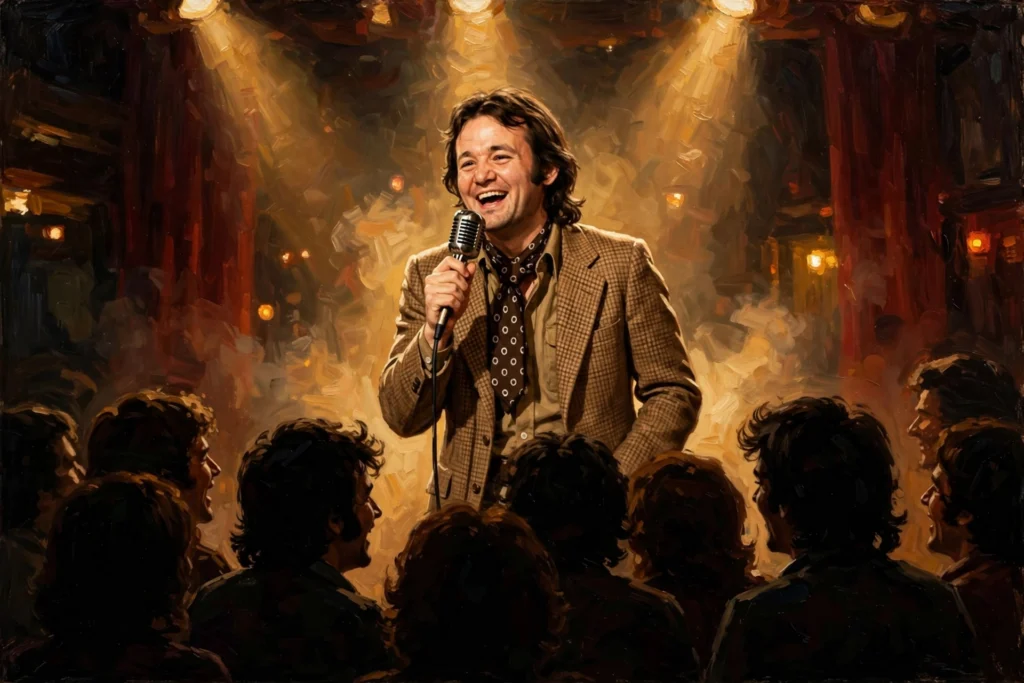
What If?: if Murray had stayed a movie star the conventional way
It is easy to imagine the alternate career: Murray signs the agent, makes Ghostbusters sequels through the 1990s, banks the franchise money, and becomes a beloved but predictable fixture of studio comedy. He would probably have been richer, and certainly more available. He would also, very likely, have been less interesting — to audiences and, by his own account, to himself.
The counterfactual is instructive because it isolates what Murray actually sacrificed. He gave up the safest version of stardom in exchange for control over his time. Research on regret consistently finds that people regret inactions (the chances not taken) more than actions as they age — but Murray’s career suggests the mirror image: the most durable regrets in creative work may come from saying yes too often, from becoming a person whose calendar belongs to other people. His Paris years, his voicemail box, and his refusal of sequels are all versions of the same decision: to keep the calendar his own.
What Most People Lack: tolerance for the unplanned moment
Most of us plan our days to death. We schedule spontaneity out of existence, then wonder why life feels flat. Murray’s public life suggests a different diagnosis: what most people lack is not discipline but tolerance for uncertainty — the ability to sit in a moment that has no agenda and no guaranteed outcome, and to enjoy it anyway.
Psychologists call the opposite pattern intolerance of uncertainty, and it is one of the most reliable predictors of anxiety: the more a person needs every outcome nailed down in advance, the more distressed they feel when life refuses to comply. Improv training is, among other things, a structured way to practise tolerating uncertainty in small, safe doses — a scene with no script, a partner you must trust, an ending you cannot see. Murray spent years in that training, and his public persona is what that training looks like when it leaves the stage and enters a life.
The practical version is modest. You do not need to crash a wedding. You need to leave one afternoon a week unplanned, say yes to one invitation you would normally decline, and take one walk without a destination. The research on novelty and reward suggests that even small doses of the unplanned can lift mood more reliably than another perfectly optimised routine.
What Successful People Do Differently: they protect their attention
Strip away the comedy and Murray’s career looks like a long experiment in attention management. The 1-800 number, the disappearances, the refusal to do press tours he does not want to do — all of it is a system for deciding, in advance, what deserves his focus. Successful people in every field do some version of this: they build fences around the hours that matter, and they treat other people’s urgency as information rather than instruction.
The difference is that most people build those fences around work. Murray built his around life. His fences protect golf games, family gatherings, and afternoons in pubs — the things he seems to value most — and work gets in only when it can fit around them. That ordering is unusual in a culture that treats busyness as virtue, and it may be the single most imitable part of his example: decide what your non-negotiables are, build a system that defends them, and let the rest of the world leave a message.
Success Mindset: play as a serious adult skill
There is a temptation to treat Murray’s playfulness as a lack of seriousness. The research points the other way. Play in adulthood is associated with creativity, stress recovery, and social bonding; studies of adult play find that people who regularly engage in playful, intrinsically motivated activity report higher wellbeing and lower burnout. Murray’s career is, in effect, a fifty-year demonstration that play is not the opposite of work — it is a way of doing work that does not eat the person doing it.
His mindset also includes a particular relationship with ageing. At 76, Murray is not pretending to be young; he is playing the role of the older man who is still curious, still funny, and still willing to be surprised. That is a psychologically potent model. Research on ageing attitudes finds that people who hold positive views of their own ageing live longer and healthier than those who dread it — not because optimism is magic, but because it keeps them engaged with life rather than retreating from it. Murray’s second act is a public argument for curiosity as an ageing strategy.
Failures: the flops, the fallouts, and the years in the wilderness
Murray’s career has not been a straight line. The Razor’s Edge (1984), the serious drama he made as a condition of doing Ghostbusters, was a box-office failure. Scrooged divided critics. His directorial debut, Quick Change (1990), was well reviewed but little seen. And the 2000s brought a run of forgettable comedies — Osmosis Jones, Rock the Kasbah — that suggested, for a time, that the magic had thinned.
The more consequential failure was relational: the long estrangement from Harold Ramis after Groundhog Day. Murray has said little about it in public, and Ramis’s family has said that the two men reconciled before Ramis’s death in 2014, when Murray visited him. The episode belongs in this profile not as gossip but as a reminder that even a career built on connection can include a painful disconnection — and that repair, when it comes, is usually quiet, private, and late. Murray’s public silence about the details is itself consistent with his approach: some things are not material for the stage.
What is striking is how Murray handled failure: he did not explain it, rebrand it, or apologise for it at length. He went quiet, played golf, and came back when there was something worth doing. That is a coping style psychologists would recognise as acceptance rather than avoidance — acknowledging a setback without building a monument to it.
Relationships: brothers, family, and the strangers he collects
Murray’s closest professional relationships have always been familial. His brothers Brian Doyle-Murray, John Murray, and Joel Murray are all actors, and they have appeared alongside him across the decades — Joel and John join him in A Course Called Ireland. His sons have kept mostly out of the spotlight. Murray has been married twice, to Margaret Kelly (1981–1996) and Jennifer Butler (1997–2008), and has six sons across the two marriages. He has spoken rarely and protectively about his family life, and this profile follows that lead: the public record is thin by his design, and thin is where it stays.
The more visible relationship pattern is with strangers. The “Bill Murray stories” are, at bottom, stories about a famous person treating strangers as scene partners rather than fans — equals in a moment of improvisation. Social psychology has a name for the warmth this generates: the mere fact of being treated as a person rather than an audience member is powerfully bonding, because most public encounters with fame are transactional. Murray’s gift, if that is the word, is making a one-minute encounter feel un-transactional. Whether every story is literally true matters less than what the stories reveal about what people crave from public figures: not distance, but a moment of genuine, unscripted attention.
Dark Side: the complaints, and the limits of the legend
No honest profile can skip the other side of the Murray mythology, because it is also on the public record. In 2022, production on the film Being Mortal was suspended after a complaint about Murray’s behaviour towards a female crew member; Murray later said publicly that he had done something he thought was funny but that was not taken that way, and that he was in discussion with the complainant. Separately, Geena Davis wrote in her 2022 memoir Dying of Politeness about uncomfortable on-set encounters with Murray during the filming of Quick Change in 1990. Murray has not publicly addressed Davis’s account in detail.
These reports complicate the spontaneity story in an important way, and the complication is worth stating plainly: spontaneity is only charming when everyone in the scene has consented to the improvisation. A stranger who crashes your wedding has chosen you as a scene partner without asking; most people, in that moment, are delighted — but delight is not consent, and the same impulse that makes a great story can make a bad workplace moment. The research on humour at work makes the same distinction: affiliative humour bonds teams, but humour that targets or embarrasses, even unintentionally, does the opposite. Murray’s public response to the Being Mortal complaint — acknowledging that his intent and the other person’s experience differed — is, whatever else it is, a recognition of that distinction. This profile presents these reports as reported claims, not as findings about anyone’s character, and draws no conclusions about Murray’s private life beyond the public record.
There is a second, quieter shadow: the cost of the disappearing act. A man who is hard to reach is hard to reach for everyone, including collaborators, friends, and family. The voicemail box that protects autonomy can also strand people. Murray’s career suggests he has accepted that trade-off; whether it is a good one is a question each reader will answer differently.
Second Act: Ireland, golf, and going gloriously off course
Which brings us back to Ireland. A Course Called Ireland, premiering 25 October 2026, is not a comeback — Murray never really left — but it is a distillation. Six half-hour episodes, a walk across a country with friends and family, famous guests including Chris O’Dowd, Joanne McNally, and Jason Kelce, and no apparent interest in proving anything. The series is based on Tom Coyne’s bestselling book A Course Called Ireland: A Long Walk in Search of a Country, a Pint, and the Next Tee, and its premise is Murray’s premise: the point of the walk is the walk, not the score.
It is also a neat bookend to the October news cycle. Just weeks earlier, Murray surprised Ghostbusters fans at New York Comic Con by riding through the city in a Rivian Ecto-R1 dressed as Peter Venkman, for a Halloween-themed promotion tied to the same character he created in 1984. The 76-year-old in the jumpsuit and the 76-year-old walking Irish fairways are the same performer: one foot in nostalgia, one foot in whatever is happening right now, and no visible anxiety about which one matters more.
Psychologists who study successful ageing sometimes talk about generativity — the impulse, in later life, to pass something on rather than accumulate more. Murray’s second act looks like generativity in its lightest form: not a foundation or a memoir of lessons, but a willingness to keep showing up, keep playing, and keep letting strangers into the scene. If there is a lesson in it, it is not “be like Bill Murray”. It is smaller and more useful: leave room in the plan for the plan to change.

Fun Facts: ten things you may not know about Bill Murray
- He has no agent and no manager. For decades, directors reached him through a toll-free voicemail number — and he called back only if he liked the sound of the project.
- He studied at the Sorbonne in Paris for four years after Ghostbusters, at the height of his fame, rather than cashing in on a sequel immediately.
- He co-owns minor league baseball teams, including the Charleston RiverDogs, and has been known to work the concession stands and sing during the seventh-inning stretch.
- He played in the Pebble Beach Pro-Am for decades, usually in the most unserious spirit available, and once played a round in a rain suit while joking with the crowd throughout.
- His first big break was not Saturday Night Live but Chicago’s Second City, where his brother Brian Doyle-Murray got him his start in improvisational theatre.
- He won the Golden Globe for Best Actor for Lost in Translation (2003) and was nominated for the Academy Award for the same role, losing to Sean Penn.
- Groundhog Day was selected in 2006 for preservation in the United States National Film Registry as a film of cultural, historical, or aesthetic significance.
- He has played Franklin D. Roosevelt (Hyde Park on Hudson, 2012), a role about as far from Peter Venkman as it is possible to get.
- He once reportedly crashed a wedding in Charleston, gave an impromptu speech, and stayed for photos — one of the most retold of all the “Bill Murray stories”.
- His famous french-fry line — “No one will ever believe you” — has become shorthand for the whole mythology: a moment so strange it only works because it is true, or at least because nobody can prove it is not.
What the Research Says: spontaneity, play, and the ageing mind
Murray’s career is a useful excuse to look at what research actually says about the habits he embodies. First, improvisation: a 2015 study of improvisational theatre training found that it improved participants’ divergent thinking and tolerance for uncertainty, and reduced social anxiety in group settings — the same muscles Murray trained at Second City. Second, play: research on adult play consistently links playful, intrinsically motivated leisure with lower stress and higher life satisfaction, and with better recovery from demanding work. Third, novelty: new experiences are processed by the brain’s reward system, which helps explain why a surprise encounter can feel disproportionately vivid — and why routines, however efficient, can feel flat.
Fourth, psychological flexibility: Acceptance and Commitment Therapy research finds that the ability to adapt behaviour to the present moment, rather than rigidly following rules or plans, predicts better mental health outcomes across anxiety, depression, and chronic stress. Fifth, ageing attitudes: a landmark Yale study led by Becca Levy found that older adults with more positive attitudes towards ageing lived, on average, seven and a half years longer than those with negative attitudes — not because of optimism alone, but because positive attitudes predicted healthier behaviour and greater engagement. Murray’s public second act — walking, playing, joking, working with friends — is a visible model of that engagement.
None of this means spontaneity is a cure for anything, and none of it is an argument for abandoning plans. The research case is narrower and more useful: a life with no room for the unplanned is a life with no room for surprise, and surprise is one of the cheapest sources of joy psychology knows about.
Activity: how spontaneous are you, really?
Answer these five questions honestly, then add up your score. There are no right answers — only a snapshot of how much room you currently leave for the unplanned.
1. A friend invites you to something tonight, out of nowhere. You usually…
2. Your weekend plan falls through at the last minute. You feel…
3. A stranger starts a conversation with you in a queue. You…
4. How much of your week is unscheduled, on purpose?
5. When was the last time you did something purely for fun, with no goal attached?
Pause and ask yourself: When did something unplanned last make your week better — and how much of your week is currently built to prevent exactly that from happening? If the answer is "almost none", try our Name Your Feeling tool to name what a tightly packed week leaves you feeling, then pick one small unplanned hour to reclaim.
Try it on our site
If Murray's way of living sparked something, these free tools can help you practise it:
- Name Your Feeling — label what your week is really leaving you feeling, in under two minutes.
- Thought Reframe — practise the "yes, and" habit on a stuck thought: accept it, then build something better on top of it.
- Relaxation techniques — calm the nervous system so spontaneity feels exciting rather than threatening.
- Brain Games — playful, low-stakes challenges that reward flexible thinking.
Related reading: Tom Skerritt: The Psychology of a Six-Decade Career, Ric Flair: The Psychology of Relentless Comebacks, Psychology of Erling Haaland: Unshakeable Self-Belief.
Key Takeaways
Key Takeaways: Bill Murray, 76, returns on 25 October 2026 in A Course Called Ireland, a series built around unscripted wandering — the perfect distillation of a career founded on spontaneity. From Second City improv to Ghostbusters, Groundhog Day, and Lost in Translation, Murray protected his attention with systems like the famous voicemail box and long disappearances, and reinvented himself without announcing it. Research on improvisation, psychological flexibility, and ageing attitudes supports the habits he embodies: tolerating uncertainty, playing as an adult, and leaving room for surprise. The honest caveat stands too — spontaneity only charms when everyone in the scene has chosen to play along.
Frequently asked questions
What is the psychology of Bill Murray?
At its core, it is spontaneity treated as a discipline: improv-trained tolerance for uncertainty, play as a serious adult skill, and fierce protection of his own attention, which together produced a five-decade career of constant, quiet reinvention.
What is A Course Called Ireland?
A six-part documentary series premiering 25 October 2026 on Paramount+ (BBC in the UK), in which Bill Murray and author Tom Coyne play golf courses across Ireland, meeting locals and friends, based on Coyne's bestselling book of the same name.
Why does Bill Murray not have an agent?
For decades he has used a toll-free voicemail number instead of a conventional agent, calling back only projects that interest him — a system that makes "no" the default and keeps his calendar his own.
Are the "Bill Murray stories" true?
Some are documented, many are embellished in retelling, and Murray has mostly declined to confirm or deny them. As folklore they describe a consistent pattern: a famous man treating strangers as scene partners in unscripted moments.
What does research say about spontaneity?
Improvisation training improves tolerance for uncertainty and divergent thinking, adult play is linked to lower stress and higher life satisfaction, and psychological flexibility — adapting to the present moment rather than rigidly following a plan — predicts better mental health outcomes.
This article is for education only and is not therapy, diagnosis, or medical advice. If you are struggling, please consider speaking to a licensed professional. In the US, call or text 988; in the UK, call Samaritans on 116 123.