

The Psychology of Catherine, Princess of Wales: Composure, Resilience, and Life Under the World’s Gaze
Reviewed by a Psychology Postgraduate (MA)
Catherine princess of wales psychology begins with a single image: on Remembrance Sunday, 8 November 2026, the Princess of Wales stood beside Queen Camilla on the Foreign Office balcony above the Cenotaph in London, wearing Diana’s Collingwood pearl drop earrings, three red poppies and an HMS Glasgow brooch. She did not speak. She did not need to. The short answer to what her public life reveals is this: composure under scrutiny is less a personality trait than a practised skill, built from preparation, routine, self-regulation and a clear sense of purpose, and her story shows how those habits can carry a person through both ceremony and crisis.
This profile is an educational look at public behaviour and published research, not an assessment of Catherine, Princess of Wales as a person.
Composure, in psychological terms, is the ability to keep your behaviour steady and your attention on the task in front of you even when pressure, emotion or an audience are pulling at you. It is not the absence of feeling. It is the management of feeling. That is why “princess of wales” was the third most-searched term in the United States on 9 November 2026, the day after Remembrance Sunday. People were looking at a woman who announced a cancer diagnosis to the world in March 2024, completed chemotherapy that September, announced in January 2025 that she was in remission, and then returned, step by step, to the most visible role in Britain outside the monarch.
Story: From Berkshire to the Palace Gates
Catherine Elizabeth Middleton was born on 9 January 1982 in Reading, Berkshire, England, the eldest of three children of Michael and Carole Middleton. She grew up in the village of Bucklebury, attended Marlborough College, and spent part of a gap year travelling and volunteering abroad before going to the University of St Andrews in Scotland in 2001 to study history of art. It was there, in a student hall of residence, that she met Prince William. They became friends first, then a couple, and graduated together in 2005.
After university she worked briefly in fashion and then for the family business, while her relationship with William played out under a kind of press attention few people ever experience. The couple briefly separated in 2007, before reconciling. Their engagement was announced in November 2010, and they married on 29 April 2011 at Westminster Abbey in a ceremony watched around the world. She wore a dress designed by Sarah Burton for Alexander McQueen, and the sapphire engagement ring that had belonged to Diana, Princess of Wales. The symbolism was unmistakable, and so was the weight of it: she was marrying not only a man, but a role, a family, an institution and a level of scrutiny that has no real parallel in public life.
Three children followed: Prince George, born in July 2013; Princess Charlotte, born in May 2015; and Prince Louis, born in April 2018. Each birth was announced with a photograph on the steps of the Lindo Wing at St Mary’s Hospital in London, hours after delivery, in front of a bank of cameras. It is hard to think of a clearer picture of what her life demands: a private, exhausting, vulnerable moment, performed in public, in heels, smiling, within hours. She has passed that test in public three times.
The years since have been a slow, deliberate construction of a working royal life. She took on patronages in areas that reflect her interests: early childhood development, mental health, addiction, scouting and photography. She launched the Heads Together mental health campaign in 2016 alongside Prince William and Prince Harry. She founded the Royal Foundation Centre for Early Childhood and launched its “Shaping Us” campaign in February 2023, arguing that the first five years of life shape everything that follows. These are not decorative causes. They are the centre of her public identity, and they reveal a consistent instinct: to work on the quiet, foundational parts of life, the parts that happen long before anyone notices.
Turning Point: The Announcement of 22 March 2024
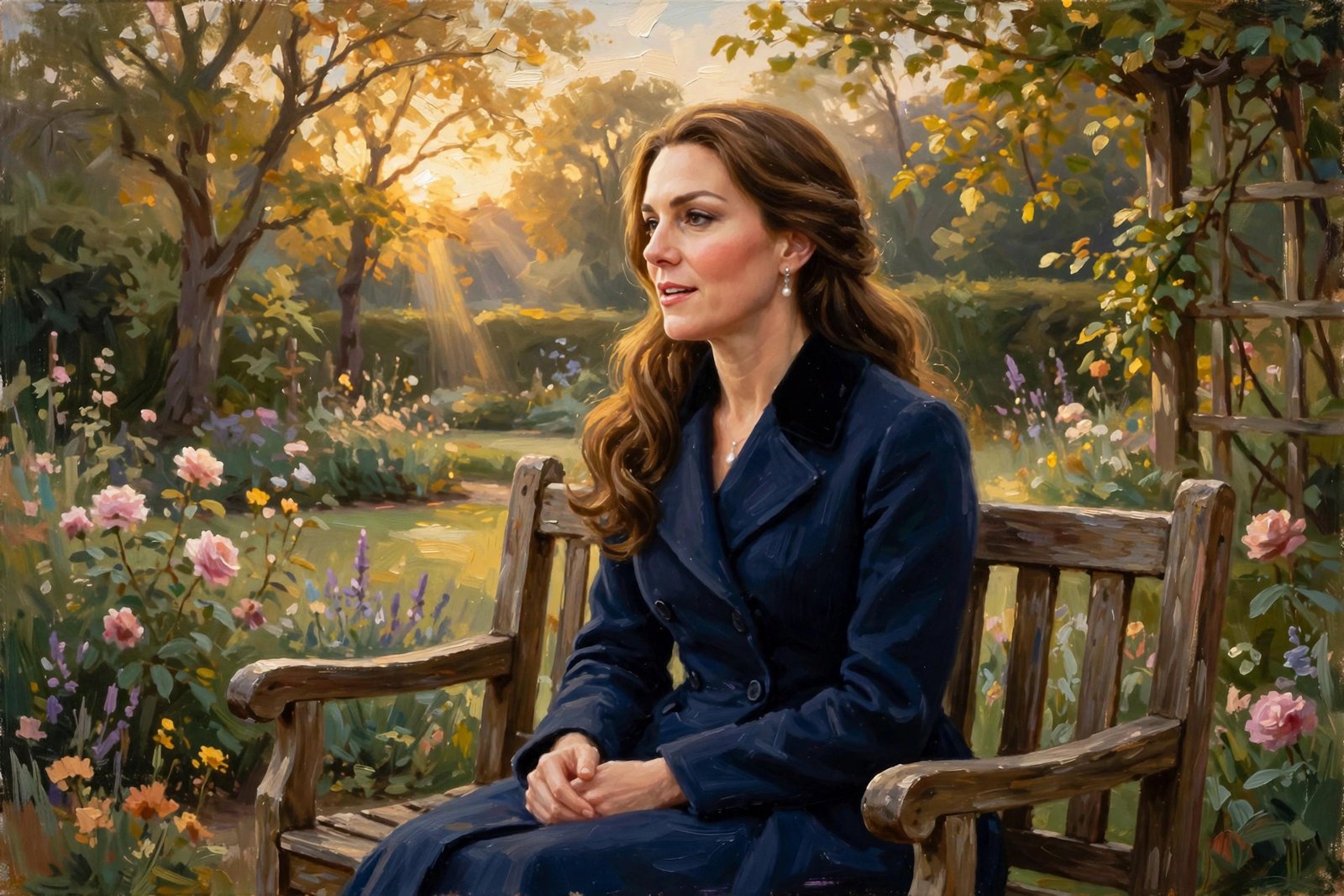
Every public life has a moment that divides the before from the after. For Catherine, it came on 22 March 2024, when she appeared alone, seated on a bench in a garden, and told the world in a video message that she had been diagnosed with cancer.
The context matters. She had undergone abdominal surgery in January 2024, and the palace had said at the time that the surgery was planned and that she would be recovering in private. In the weeks that followed, her absence from public life set off a storm of speculation online, some of it wild, some of it cruel. The video message ended that speculation in the most direct way possible: she spoke plainly, in her own voice, about the shock of the diagnosis, about the chemotherapy she was undergoing, about her family, and about her need for privacy while she recovered. She said she was getting stronger every day by focusing on the things that would help her heal, in her mind, body and spirit.
What followed was a long, careful return. She made her first public appearance after the announcement at Trooping the Colour in June 2024, and attended the Wimbledon men’s final that July. In September 2024 she announced in another video message that she had completed chemotherapy, describing the previous nine months as “incredibly tough” for her family. In January 2025, after a visit to the Royal Marsden Hospital where she had received treatment, she announced that she was in remission. Each step was measured, each appearance chosen, each message delivered in her own words. There was no rush back to a full diary, and no performance of being fully recovered before she was ready.
That is why Remembrance Sunday 2026 carried such weight. She has attended the ceremony every year since marrying in 2011, including in 2024, during her cancer treatment. On 8 November 2026 she stood on the Foreign Office balcony beside Queen Camilla, wearing Diana’s Collingwood pearl earrings, three red poppies believed to honour her great-grandmother Olive Middleton’s three brothers who died in the First World War, and a brooch for HMS Glasgow. She had also attended the Festival of Remembrance at the Royal Albert Hall the night before, on 7 November. The symbolism was layered and deliberate: continuity, remembrance, family history, and a woman who had been through a serious illness standing once again in one of the most solemn ceremonies of the national year.
Mindset: What Keeps Her Steady When Everyone Is Watching?
The short answer is that her public mindset looks like a combination of preparation, emotional regulation and a strong sense of role: she treats public moments as work to be prepared for, not as tests of her personality.
Self-regulation is the psychological term for managing your thoughts, feelings and behaviour in pursuit of a goal, and it is one of the best predictors of how people perform under pressure. The psychologist Roy Baumeister described self-control as operating a little like a muscle: it can be strengthened with practice, and it tires when it is overused. A royal engagement is a long exercise in self-regulation. There are crowds, cameras, unpredictable questions, children to meet, speeches to give, and almost no room for a bad day. Doing that well for years suggests a person who has built strong routines around the basics that support self-control: sleep, preparation, knowing the plan, and knowing what to do when the plan changes.
There is also something psychologists call impression management, from the sociologist Erving Goffman, who described social life as a kind of performance in which people present a version of themselves suited to the setting. That sounds cynical, but it is something everyone does: you speak differently to a job interviewer than to a close friend. Catherine’s public presentation is remarkably consistent: warm, attentive, unhurried, interested in the person in front of her. When the presentation does not change with the mood of the day, it stops being a performance and starts being a professional identity.
Pause and ask yourself: Think of a moment when you had to stay composed while everyone was watching, a presentation, a difficult conversation, a family event. What helped you most: preparation, a routine, or simply slowing down? What would you do differently next time?
Decisions: The Choices That Shaped the Role
What decisions define a public life like hers? The most important ones are the ones nobody applauded at the time: to prepare slowly, to pick a few causes and stay with them, and to protect her children’s privacy while living in public.
The first decision was time. She and William dated for nearly a decade before marrying, and the long courtship was often mocked in the press, which gave her the unkind nickname “Waity Katie”. In hindsight, that long runway looks like a deliberate choice. She had years to learn what the role would demand before she formally accepted it. Research on major life transitions consistently finds that a gradual, well-prepared entry into a demanding role produces better adjustment than a sudden one. She entered the role as an adult who had chosen it, not as a teenager swept into it.
The second decision was focus. Rather than collecting dozens of patronages, she concentrated on a small number of themes and returned to them year after year: early childhood, mental health, addiction, and the outdoors. That is a decision about depth over breadth, and it has a psychological logic. When you return to the same subject repeatedly, you build genuine knowledge, real relationships with the people working in the field, and credibility that a single visit cannot buy. The “Shaping Us” campaign of February 2023 was not a new interest. It was the public expression of years of visits to nurseries, schools, hospitals and family centres.
The third decision was about her children. George, Charlotte and Louis have grown up in public, but their parents have worked hard to give them private space: limited official photographs, school runs kept as ordinary as possible, and a clear line between the moments the children appear in public and the life they live away from cameras. That is a boundary decision, and boundary decisions are among the hardest a public figure makes, because every boundary costs something in goodwill.
Method: How Does She Actually Do It?
What does her method look like in practice? It is built from four habits that show up again and again in the public record, and each one maps neatly onto something the research supports.
First, preparation. Royal engagements are planned in detail, and Catherine is known for doing her homework: reading briefings, learning names, understanding the organisation she is visiting. That matters more than it looks. The psychologist Albert Bandura showed that self-efficacy, the belief that you can handle what is in front of you, grows from preparation and from past experiences of coping. Walking into a room already knowing who you will meet and what they care about removes a whole layer of anxiety, and people can tell when someone has prepared for them.
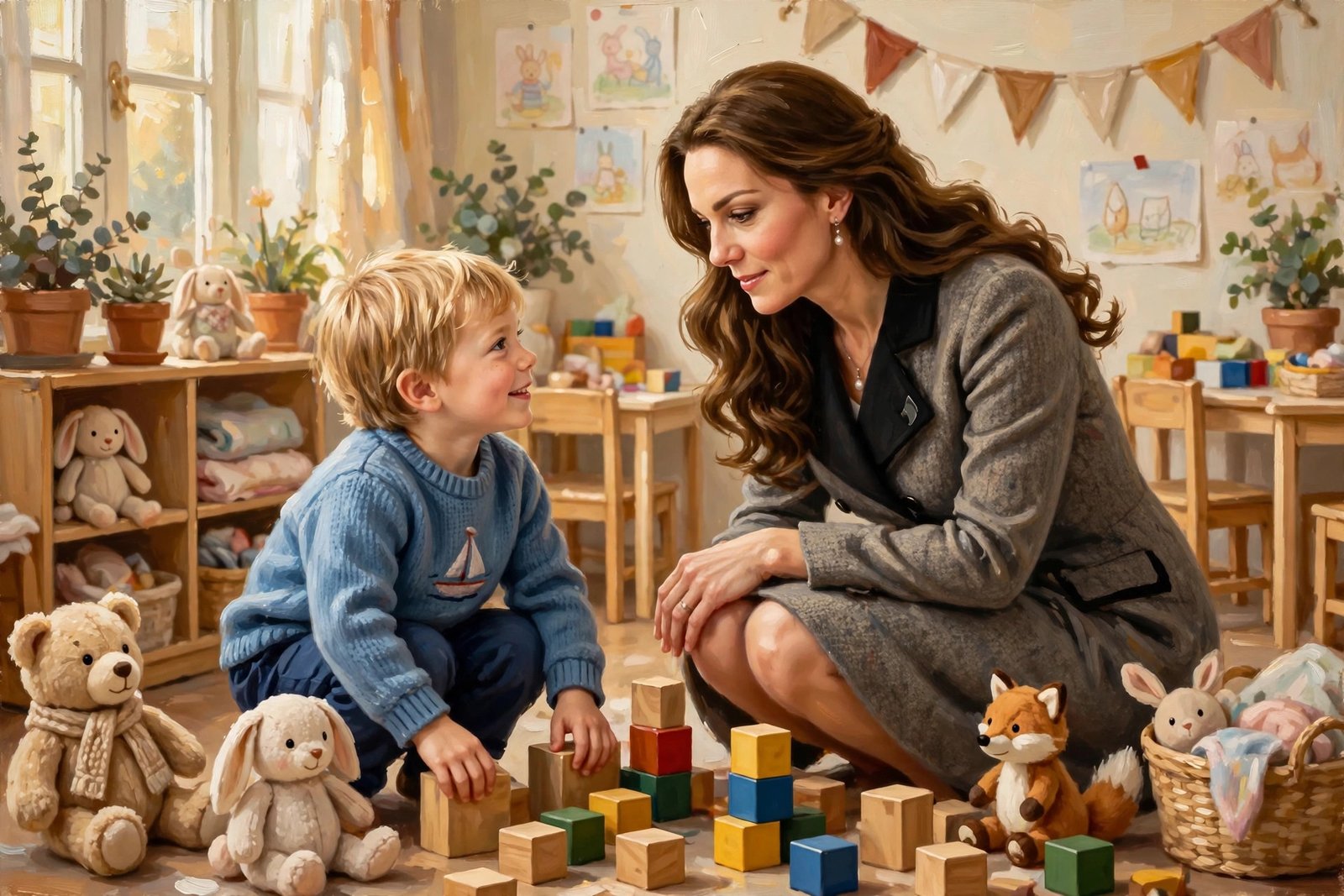
Second, attention to the person in front of her. Watch footage of her on a walkabout or a hospital visit and a pattern emerges: she crouches to a child’s eye level, she listens without rushing, she asks follow-up questions. Focusing your attention outward, on the other person, is one of the most effective ways to manage your own nerves, because it leaves less attention available for self-consciousness. Psychologists call the opposite problem the spotlight effect, the tendency to overestimate how much others are noticing and judging us. The cure for the spotlight effect is to turn the spotlight around: ask the other person a question, and listen to the answer.
Third, the use of ritual. Remembrance Sunday is itself a ritual, and Catherine’s place in it has become one of the most recognisable images of her public life: the balcony, the poppies, the two minutes of silence. Rituals matter psychologically because they give shape to emotions that are hard to put into words. The sociologist Emile Durkheim argued that shared rituals bind a community together by giving everyone the same actions to perform at the same time. Her steadiness in those moments is not only personal composure. It is participation in a shared act of remembering, and that shared purpose carries some of the emotional weight for her.
What If? Roads Not Taken
What if she had never gone to St Andrews? So much of her life turns on that one choice of university. Had she studied elsewhere, she would almost certainly have had a successful private career, perhaps in fashion or art, and a life largely outside public attention. The counterfactual is a reminder that the most consequential decisions are often the ones that look ordinary at the time: a university application, a hall of residence, a friendship formed in a corridor. Psychology calls this the path dependence of life stories: small early choices, amplified over decades, produce lives that look inevitable in hindsight but were anything but.
What if she had announced her diagnosis differently, or not at all? A private person might have said nothing, and the speculation would have continued. A different public figure might have given a press conference, with questions and follow-ups. The video message she chose, direct, brief, and on her own terms, gave the public the facts they needed, gave her family privacy, and gave her control of the moment. In crisis communication, that combination, honesty, brevity and control of the channel, is about as good as it gets.
What Most People Lack: The Patience for Slow Work
What do most people lack that her public life seems to have in abundance? Patience for work that pays off slowly.
Modern public life rewards the fast and the loud: the viral moment, the bold statement, the instant reaction. Catherine’s public work is the opposite. Early childhood development does not produce a headline a week. Mental health campaigns do not change attitudes in a season. Visiting the same kinds of organisations year after year, listening to the same kinds of stories, building knowledge slowly, is work that looks boring from the outside and is anything but. It requires a tolerance for delayed reward that most people find genuinely hard. The psychologist Walter Mischel’s famous marshmallow studies, and the decades of research that followed them, found that the ability to wait for a larger later reward rather than grabbing a smaller immediate one is linked to better outcomes across a lifetime. It is not about willpower alone. It is about having a goal that makes the waiting feel worthwhile.
What Successful People Do Differently: The Quiet Version
What do successful people do differently, in the version of success that her public life represents? They prepare more than they perform, and they choose a few things and stay with them.
Preparation first. The public sees the polished moment: the smile, the conversation, the photograph. What the public does not see is the briefing, the reading, the thinking about who will be in the room and what matters to them. High performers in every field share this pattern: the visible performance is the smallest part of the work, and the invisible preparation is the largest. The psychologist Anders Ericsson, who studied expert performance, found that what separates experts from the rest is not talent alone but deliberate practice: focused, feedback-driven work on specific skills, repeated over years. Catherine’s ease in public is easy to mistake for natural talent. It looks much more like practice.
Second, they narrow their focus. The most effective public figures are not the ones who do everything. They are the ones who pick a lane and go deep. Her lane is clear: the early years of life, mental health, and the outdoors. That clarity makes decisions easier, because every invitation can be judged against the same question: does this serve the work I have chosen? It also makes the work cumulative, because each year adds to the last instead of starting over.
Success Mindset: How Does She Define Success?
What does success look like to a person whose job has no promotion, no salary review and no retirement date? For Catherine, the public record suggests a definition built on usefulness, not applause.
Self-determination theory, developed by psychologists Edward Deci and Richard Ryan, argues that lasting motivation comes from three needs: autonomy, the sense that you are choosing your path; competence, the sense that you are getting better at something that matters; and relatedness, the sense that you are connected to other people. Her public work touches all three. Autonomy: she chose her causes and shaped them, rather than simply accepting a list. Competence: she has spent years learning about early childhood, talking to researchers, visiting settings, and building real expertise. Relatedness: the work is, at its heart, about connecting with people, parents, children, families, and the professionals who support them.
That framing matters, because it explains why her public work has grown more serious over time rather than more glamorous. A person motivated by applause would chase the biggest stage. A person motivated by usefulness would do the opposite: find the problem that matters, learn about it properly, and stay with it. The Centre for Early Childhood, launched in 2021, is the clearest expression of that mindset. It is an institution, not an event. Institutions outlast headlines, and building one is a statement about what kind of success you are aiming for.
Failures: The Setbacks on the Public Record
What failures and setbacks does the public record show? Enough to make the story honest, and each one is instructive.
The first was the long courtship itself, and the press nickname that came with it. Being called “Waity Katie” in newspapers for years, while the whole country speculated about when, or whether, a proposal would come, was a public humiliation dressed up as a joke. It is easy to forget, now that she is the Princess of Wales, how dismissive that coverage was. The lesson is in the response: she did not answer it, she did not perform impatience, and she did not let the press set the timetable for her life. The engagement came when the couple were ready, in November 2010, and the years of waiting turned out to be years of preparation.
The second was the Mother’s Day photograph in March 2024. Kensington Palace released a photograph of Catherine with her three children to mark Mother’s Day, and within hours several major picture agencies withdrew it, saying it appeared to have been digitally altered. Catherine issued a personal apology, saying that like many amateur photographers she occasionally experimented with editing, and apologising for any confusion the photograph had caused. The episode was painful, and it fed the online speculation about her health that was already swirling at the time. But it is also a useful example of how to handle a public mistake: acknowledge it quickly, explain it plainly, apologise without excuses, and move on. Two weeks later, her video message announcing the diagnosis put the whole episode in perspective, and the apology stands as a small, decent example of accountability in public life.
Relationships: The People Around the Princess
Who are the relationships that anchor a life lived in public? The public record gives a clear picture, and it is a deliberately ordinary one.
The first is her marriage. She and Prince William met as students, became friends before they became a couple, and have now been together for more than two decades and married since 2011. Their public appearances together have a relaxed, familiar quality that is hard to fake: the shared jokes, the easy body language, the way they divide the work of an engagement between them. Research on long-term relationships consistently finds that couples who remain close do so because they keep turning toward each other in small, everyday moments, not because of grand gestures. The public record cannot show the private moments, but it can show the result: a partnership that looks, from the outside, like a genuine team.
The second is her family of origin. Her parents, Michael and Carole Middleton, and her siblings Pippa and James, have remained a visible part of her life, and she has spoken about the importance of family in her own upbringing. The psychologist John Bowlby, who founded attachment theory, argued that a secure early base, the sense that home is safe and that someone will be there for you, shapes how a person meets the world for the rest of their life. Catherine’s public emphasis on the early years, on the foundations laid in childhood, reads as consistent with someone who experienced that kind of base and wants other children to have it too.
Dark Side: What Does Life in the World’s Gaze Cost?
What is the dark side of a life like hers? It is the part that the photographs do not show: the loss of privacy, the constant judgment, and the knowledge that a single mistake can become a global story within an hour.
The first cost is privacy. There is almost nowhere she can go without being recognised, photographed or reported on, and that has been true since she was a university student. Most people recharge in private. She has very little private space in which to do it, and the spaces she does have, her home, her family time, her children’s school life, must be guarded fiercely.
The second cost is judgment. Every outfit is reviewed, every facial expression is analysed, every word is weighed. That is not a complaint. It is a description of the job. But it has a psychological effect that is well documented: when you know you are being watched, you monitor yourself more, and self-monitoring is tiring. The researcher Mark Leary, who studies self-presentation, has shown that the fear of negative evaluation is one of the most powerful drivers of social anxiety. Living with that fear as a permanent condition, rather than an occasional one, is a genuine burden, and it is one that no amount of privilege removes.
The third cost is the speculation machine. The weeks before her cancer announcement in March 2024 were a stark example. Her absence from public life, while she recovered from surgery, produced a wave of online speculation, jokes and conspiracy theories that filled the vacuum left by the lack of information. Some of it was cruel, and all of it was public. The episode is a case study in what happens when a public figure’s privacy collides with a public that feels entitled to information: the gap gets filled with invention. Her video message ended it, but it could not undo it, and it is a reminder that the public’s curiosity has a cost, and that the cost is paid by the person, not by the audience.
Second Act: Return, Remission and a New Chapter
What does a second act look like when the first act was already extraordinary? For Catherine, it began in January 2025, when she announced she was in remission, and it has been unfolding in public ever since.
The first part of the second act is a return to public life on her own terms. The appearances since the remission announcement have been chosen carefully: engagements connected to her core work, moments of national significance, and the steady resumption of the ceremonial calendar. Remembrance Sunday 2026, with its balcony appearance beside Queen Camilla and its attendance at the Festival of Remembrance the night before, is the clearest statement of that return. She is not easing back in. She is back, and she is standing in one of the most solemn and visible places in British public life.
The second part is personal, and it is the part that the research on post-traumatic growth describes. Psychologists Richard Tedeschi and Lawrence Calhoun, who developed the concept, are careful to say that growth after trauma is not the same as being glad the trauma happened. It is the finding, reported by many people who have been through serious illness or crisis, that the experience changed their priorities: relationships matter more, small things matter more, time feels more precious. This is a research concept, not a claim about any individual, and it should not be applied to Catherine as a diagnosis. But it is a useful lens for understanding why a public figure returning from serious illness might seem changed: more focused, more selective about where her time goes, and more determined to spend it on the work that matters most to her.
The third part is the simplest, and it is the one that the Remembrance Sunday photographs capture best: continuity. She has attended the ceremony every year since 2011. She attended in 2024, during treatment. She stood on the balcony in 2026, wearing Diana’s earrings and three poppies. The second act is not a reinvention. It is a return to the same commitments, carried forward by a person who has been through something hard and come back to them.
Fun Facts: The Person Behind the Role
What are the lighter facts that fill out the picture? Several come from the public record, and together they show a person with interests that have nothing to do with ceremony.
She studied history of art at the University of St Andrews, graduating in 2005, and her interest in art and photography has stayed with her. She is a keen amateur photographer, and she has taken many of the official photographs of her children released for their birthdays. In 2020 she led “Hold Still”, a community photography project inviting people across the UK to submit images of life during the pandemic, which became a book and an exhibition.
Her wedding dress, designed by Sarah Burton for Alexander McQueen, became one of the most discussed dresses of the decade, and her engagement ring is the sapphire and diamond ring that belonged to Diana, Princess of Wales. The ring is more than jewellery. It is a visible link between two women who married into the same family a generation apart, and it is a reminder that Catherine’s story has always been told alongside Diana’s, whether she chose that or not.
What the Research Says: Catherine Princess of Wales Psychology in Context
What does the research say about the habits this profile has described? The evidence is strong, and it is practical, which is why it is worth setting out plainly.
On self-regulation, the research is clear that it is a skill, not a gift. Roy Baumeister’s work on ego depletion found that self-control can be tired by overuse, but also strengthened by practice, like a muscle. The practical implication is that composure is built in advance, through sleep, preparation and routine, not summoned on the spot. Catherine’s public steadiness is consistent with that finding: the work happens before the event, not during it.
On impression management, Erving Goffman’s work reminds us that everyone presents a version of themselves in public, and that consistency is what makes a presentation credible. The research on authenticity adds a useful nuance: the presentations that work best are the ones that are close to the person’s real values. A presentation built on pretence is exhausting to maintain. A presentation built on genuine interests, in her case early childhood, mental health and the outdoors, is sustainable, because it does not require acting.
On early childhood, the science she has championed is among the most robust in psychology. The Harvard Center on the Developing Child describes “serve and return” interactions, the back-and-forth exchanges between a child and an adult, as the foundation of brain development, and decades of research show that warm, responsive early relationships predict better outcomes in learning, health and relationships across a lifetime. The psychologist Ann Masten, who studies resilience in children, calls this “ordinary magic”: resilience is not built by extraordinary interventions, but by ordinary things done well, by ordinary people, in a child’s everyday life. That is the research behind the “Shaping Us” campaign, and it is why the campaign’s message is about the first five years rather than about any single programme.
On post-traumatic growth, Tedeschi and Calhoun’s research finds that many people who go through serious illness or crisis report positive changes alongside the pain: a greater appreciation of life, closer relationships, a clearer sense of what matters, and a feeling of personal strength. The researchers are careful to say that growth does not mean the experience was good, and that not everyone reports it. Applied to public behaviour only, the concept offers a useful frame for a public return after illness: a person may come back more selective, more focused, and more determined to use their time well, not because the illness was a gift, but because it clarified what mattered.
On staying calm under scrutiny, the research points to three tools that work. The first is cognitive reappraisal, described by the psychologist James Gross: changing how you interpret a situation, from “everyone is judging me” to “this is a moment to do my job well”, reduces the emotional charge. The second is implementation intentions, from Peter Gollwitzer: deciding in advance what you will do when a difficult moment arrives, so you do not have to decide under pressure. The third is attention outward, toward the person in front of you, which reduces the self-focus that fuels anxiety. All three are visible in the public record of how Catherine handles engagements, and all three are skills any person can practise.
Activity: The Composure Quiz
Test what you have learned from this profile. Read each question, pick your answer, then check it below.
1. What is self-regulation, in the sense used in this profile?
A. The ability to hide all emotion in public.
B. The ability to manage your thoughts, feelings and behaviour in pursuit of a goal.
C. The ability to remember names and faces.
Answer: B. Self-regulation is about managing feelings and behaviour, not hiding them. Composure is management, not absence of feeling.
2. What did Catherine announce in her video message on 22 March 2024?
A. That she was stepping back from royal duties permanently.
B. That she had been diagnosed with cancer and was undergoing chemotherapy.
C. That she was launching a new charity.
Answer: B. She announced the diagnosis in her own words, asked for privacy while she recovered, and said she was focusing on healing in mind, body and spirit.
3. What are “serve and return” interactions, according to the Harvard Center on the Developing Child?
A. A type of royal ceremony.
B. Back-and-forth exchanges between a child and an adult that build the foundations of brain development.
C. A method for teaching children to play tennis.
Answer: B. Warm, responsive exchanges in the early years are the foundation of learning, health and relationships across a lifetime.
4. What is the spotlight effect?
A. The tendency to overestimate how much others are noticing and judging us.
B. The glare of camera flashes at public events.
C. A type of stage lighting.
Answer: A. We think people notice us far more than they do. Turning attention outward, toward the other person, is one of the best ways to quiet it.
5. What did Catherine wear on the Foreign Office balcony on Remembrance Sunday, 8 November 2026?
A. Diana’s Collingwood pearl drop earrings, three red poppies and an HMS Glasgow brooch.
B. A new crown and a military uniform.
C. A poppy and a plain black coat with no jewellery.
Answer: A. The earrings, the three poppies believed to honour her great-grandmother’s three brothers who died in the First World War, and the brooch were all noted in coverage of the ceremony.
Frequently asked questions
What is catherine princess of wales psychology?
Catherine princess of wales psychology is the study of what her public life reveals about composure, resilience and self-regulation under scrutiny: preparation, routine, attention to others, and a clear sense of purpose, applied over more than two decades in public.
When did Catherine announce her cancer diagnosis?
She announced it in a video message on 22 March 2024, after abdominal surgery in January 2024. She announced she had completed chemotherapy in September 2024, and announced in January 2025, after a visit to the Royal Marsden Hospital, that she was in remission.
What is the Princess of Wales known for in her public work?
Her public work centres on early childhood development, through the Royal Foundation Centre for Early Childhood and the “Shaping Us” campaign launched in February 2023, and on mental health, including the Heads Together campaign launched in 2016, alongside patronages in addiction, scouting and photography.
What did Catherine wear at Remembrance Sunday 2026?
On 8 November 2026 she stood beside Queen Camilla on the Foreign Office balcony at the Cenotaph wearing Diana’s Collingwood pearl drop earrings, three red poppies believed to honour her great-grandmother Olive Middleton’s three brothers who died in the First World War, and an HMS Glasgow brooch. She had attended the Festival of Remembrance at the Royal Albert Hall the night before.
How can I stay calm under scrutiny?
Research points to three tools: prepare in advance so you are not deciding under pressure, reframe the moment from “everyone is judging me” to “this is a chance to do my job well”, and turn your attention outward toward the person in front of you. Routines, sleep and time outdoors support all three.
Try it on our site
Living under scrutiny, or simply facing a moment when you need to stay steady, is something most of us recognise. These free, no-signup tools can help:
- Challenge the Thought — test a looping thought against the evidence.
- Confidence Builder — build steadiness before a high-pressure moment.
- Name Your Feeling — put a name to what you are feeling.
- Daily Tracker — keep a small daily routine that supports calm and focus.
Related reading: Remembrance Sunday and the Psychology of Collective Memory · Bob Iger and the Psychology of the Comeback · Troy Aikman and the Psychology of Composure
Key Takeaways
- Catherine, Princess of Wales, born 9 January 1982 in Reading, met Prince William at the University of St Andrews in 2001 and married him on 29 April 2011 at Westminster Abbey.
- On Remembrance Sunday, 8 November 2026, she stood beside Queen Camilla on the Foreign Office balcony, wearing Diana’s Collingwood pearl earrings, three poppies and an HMS Glasgow brooch, after attending the Festival of Remembrance the night before.
- She announced a cancer diagnosis on 22 March 2024, completed chemotherapy in September 2024, and announced she was in remission in January 2025 after a visit to the Royal Marsden Hospital.
- Her public composure rests on research-backed habits: preparation, self-regulation, attention to the person in front of her, routine and time outdoors, and the use of ritual.
- Her public work centres on early childhood development, through the Royal Foundation Centre for Early Childhood and the “Shaping Us” campaign, and on mental health through Heads Together.
- Composure is a practised skill, not a personality trait: preparation, reappraisal, implementation intentions and attention outward are tools anyone can use when the pressure is on.
This profile is educational and is not a substitute for professional advice. It is an educational look at public behaviour and published research, not an assessment of Catherine, Princess of Wales as a person. If you are struggling, consider speaking to a licensed professional: in the US, call or text 988; in the UK, call Samaritans on 116 123.