
Canada China Trade Deal Psychology: Why Tariff Relief Feels Like a Deep Breath
Short answer: On 17 November 2026, Canada and China agreed tariff relief worth about C$400 million on pork and seafood exports, starting in 2027. The deal matters psychologically because it breaks months of tariff whiplash for Canadian workers and exporters, offering a rare moment of predictability, though uncertainty over trade with the United States has not gone away.
Canadian Prime Minister Mark Carney met Chinese President Xi Jinping in Shenzhen on Tuesday 17 November 2026, on the eve of the APEC summit. The meeting produced tariff relief that will matter to Canadian farmers, fishers, and food exporters.
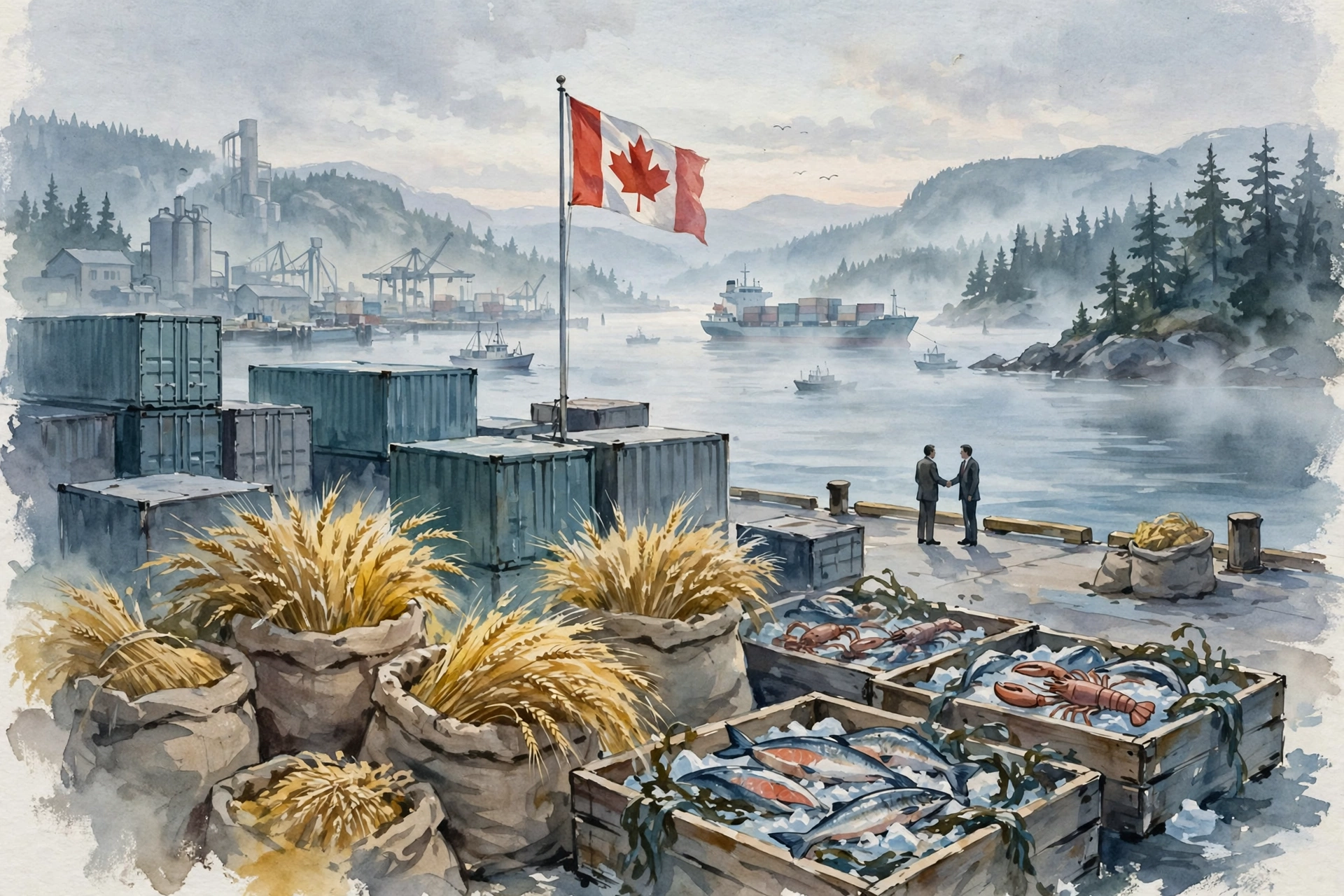
From 2027 through the end of 2028, China will suspend an additional 25 percent tariff on most frozen pork cuts and selected seafood. The relief covers about C$400 million of Canadian exports, based on 2024 export values: frozen pork worth C$116 million and fish and seafood worth C$285 million. For the producers behind those numbers, it is the difference between a shipment that makes money and one that does not.
What did Canada and China actually agree?
Strip away the diplomatic language and the agreement comes down to a swap: China eases tariffs on Canadian food exports, and Canada eases the treatment of steel and aluminum.
In return, Canada agreed to extend its steel and aluminum remission measures by two years and add 32 categories to them. Remission measures decide which imports can enter at reduced rates, so the extension gives Canadian manufacturers two years of known rules, which in trade is a luxury.
The deal sits alongside an earlier November extension: China’s 100 percent tariffs on canola meal and peas remain suspended through 2028, while canola oil still faces the full 100 percent rate. Some doors have opened; the farmers on the wrong side of that line will feel this deal very differently.
Why is Canada looking to Asia now?
Canada’s oldest trading relationship has become its most uncertain one. The Canada US tariffs 2026 shock came in August, when talks with Washington collapsed and the United States imposed 50 percent tariffs on about $20 billion of Canadian goods, shaking a generations-old assumption that the American market would always be there.
On Wednesday 18 November, at the APEC CEO Summit in Shenzhen, Carney said Canada seeks “greater sovereignty” through Asia-Pacific trade diversification, pitching Canada as an energy and critical minerals powerhouse: not a supplier locked into one customer, but a country with choices.
Canadian exports to China surged almost 60 percent year-on-year in the third quarter of 2026, driven mainly by oil, and crude shipments rose 37 percent. Canada says it is “well ahead of schedule” on boosting exports to China by 50 percent by the end of the decade. In January 2026, Canada had already cut tariffs on Chinese electric vehicles from 100 percent to 6.1 percent on a quota of 49,000 a year.
Not everyone in Washington is pleased: White House trade adviser Peter Navarro has criticized Ottawa’s China outreach, though Carney said Canada’s growing China ties are not a top concern for President Trump, whom he planned to meet later on 18 November. For readers following Carney himself, the way he handles this balancing act is a study in leadership under strain, and our profile of Mark Carney’s psychology looks at the decision-making style behind it.
What is economic uncertainty, and why does it wear people down?
Economic uncertainty is the state of not being able to predict the financial conditions that shape your life, your job, your income, your costs, or your country’s trading rules, and having to make decisions anyway.
Research in economic uncertainty psychology agrees: uncertainty is not just uncomfortable, it is exhausting. The brain treats an unpredictable threat differently from a known one. A known loss can be grieved and planned around; an unknown one keeps the threat system switched on. People check the news more often, delay ordinary decisions, and sleep worse.
Psychologists call this intolerance of uncertainty. It varies from person to person, but the distress is not a character flaw: it is what happens when effort and outcome come uncoupled, and you cannot tell whether hard work will pay off.
That is the backdrop to the Canada-China deal and the Canada trade anxiety building all year. The relief matters, but so does what it interrupts: months in which exporters, farmers, and factory workers have lived with the feeling that the ground could shift again at any moment.
Why does the Canada China trade deal psychology matter for ordinary Canadians?
Start with relief, a real psychological event, not just a figure of speech. When a threat lifts, even partly, the body registers it: muscles loosen, breathing deepens, the scanning for bad news eases. For a pork producer who has watched a 25 percent tariff eat into every shipment, the suspension is not only commercial. It is permission to exhale.
But relief after prolonged stress is rarely simple. People coming out of long uncertainty often do not bounce back at once. They stay braced, waiting for the catch, treating good news as provisional. Given how often trade policy reversed in 2026, that caution is rational, not pessimistic.
There is also the question of who feels the relief and who does not. A seafood exporter in Atlantic Canada will feel this deal directly. A canola oil producer still facing a 100 percent tariff will not. An autoworker in Ontario will watch the Trump meeting on 18 November far more closely than the Shenzhen handshake. National mood is never one mood: a single deal can lift one region while leaving another exactly where it was.
How does tariff whiplash affect workers and small exporters?
Tariff whiplash is the repeated, unpredictable raising, lowering, suspending, and reimposing of trade barriers, and it is corrosive because it strikes at the very thing small businesses need most: the ability to plan.
A large corporation can hire trade lawyers and shift supply chains. A small exporter cannot. When a tariff appears, a family-run seafood business must decide, quickly and with incomplete information, whether to absorb the cost, raise prices, find a new buyer, or stop shipping. Each wrong guess costs real money, and faced with repeated unpredictable losses, most people shift toward the safest option available. Caution becomes the default, and spread across thousands of businesses, that looks like a slowdown.
Workers feel a different version of the same pressure, and this is where tariff uncertainty stress hits hardest. A person on a production line does not follow tariff schedules, but they notice when overtime dries up and a supervisor stops talking about next year’s orders. The stress is ambient rather than specific. Financial worry is one of the most common drivers of anxiety and low mood, showing up not as panic but as slow erosion: worse sleep, shorter temper, less patience at home. Our guide to stock market crash anxiety explores a similar pattern: financial shocks that start in the headlines end up living in the body.
Economic pressure does not stay in the workplace. When household budgets tighten, people grow more vulnerable to scams promising quick money, which is why our piece on AI fake ads and holiday shopping scams is worth reading alongside this one: financial stress and deception feed on each other.
What happens next?
The timeline is clear: the tariff suspension begins in 2027 and runs through the end of 2028, as does the canola meal and peas suspension. That gives Canadian exporters roughly two years of certainty. The Carney China deal is a window, not a guarantee.
The bigger question is what happens between Ottawa and Washington. Carney’s planned meeting with President Trump on 18 November will be watched closely on both sides of the border, and if the United States answers Canada’s China outreach with further pressure, the relief from Shenzhen could be overshadowed quickly.
Reflection box: Think of a time when a long period of uncertainty in your own life finally eased. Did you feel relief straight away, or did you stay braced for a while? What helped you trust that the good news was real? Write down one small thing that helped you settle, and keep it for the next uncertain stretch.
Try it on our site
If money worries or trade headlines have been weighing on you, you do not have to carry that alone. Our free Burnout + Money-Stress Check takes a few minutes and shows how financial pressure is affecting your energy, sleep, and mood. Pair it with the Daily Tracker, a simple daily check-in that helps you spot stress patterns early. Both are free and anonymous.
Frequently asked questions
What is the Canada-China trade deal agreed in November 2026? From 2027 through the end of 2028, China will suspend an additional 25 percent tariff on most frozen pork cuts and selected seafood, covering about C$400 million of Canadian exports. Canada extended steel and aluminum remission measures by two years.
Why does tariff uncertainty cause so much stress? Because the brain treats unpredictable threats as ongoing emergencies. When people cannot predict their income, their job, or the rules governing their business, the stress response stays switched on, disrupting sleep, concentration, and decision-making.
How is Canada diversifying its trade away from the United States? Canada is building exports to Asia-Pacific markets: exports to China surged almost 60 percent year-on-year in the third quarter of 2026, and at the APEC CEO Summit on 18 November, Carney framed this as seeking “greater sovereignty.”
Will the deal fix Canada’s trade problems? Not on its own. It helps pork, seafood, canola meal, and pea exporters, but canola oil still faces a 100 percent tariff, and the United States imposed 50 percent tariffs on about $20 billion of Canadian goods in August 2026. The deal buys time; the wider uncertainty remains.
Related reading
- Mark Carney’s Psychology
- Stock Market Crash Anxiety Psychology
- AI Fake Ads and Holiday Shopping Scams Psychology
Reviewed by a Psychology Postgraduate (MA). Educational content only, not financial advice. Readers in Canada in distress can call or text 988 for free, confidential support, 24 hours a day.