
Reviewed by a Psychology Postgraduate (MA)
Right now, as you read this sentence, roughly 86 billion tiny cells in your head are firing messages at each other — and that storm of signals is you. Your memories, your personality, the fact that you understand these words: all of it is neurons talking. Let’s meet them.
What it means in one sentence: Neurons are brain cells that pass electrical and chemical messages to each other — and every thought, feeling, and memory you have is made of those messages.
In short: What are neurons? They are brain cells that pass electrical and chemical messages to each other, and every thought, feeling, and memory you have is made of those messages. Neurons fire, connect, and rewire with practice, which means learning physically changes your brain.
Neurons in Everyday Words
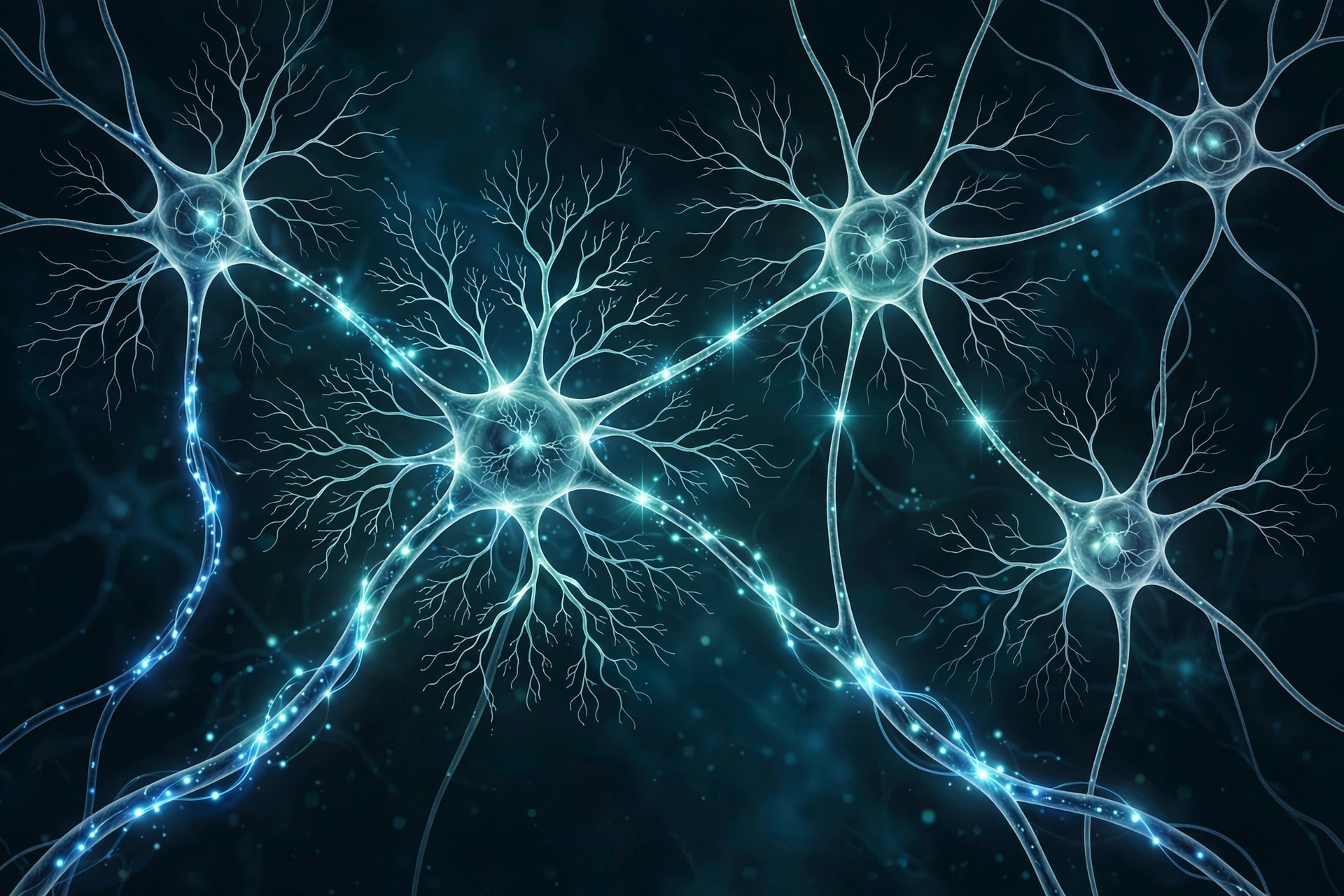
Picture a neuron like a tiny tree with a very long root. It has branch-like arms called dendrites that receive messages from neighboring neurons. Those signals travel into the cell body, and if they’re strong enough, the neuron “fires” — an electrical pulse shoots down its long tail (the axon) at up to 270 miles per hour. At the end of the tail, the neuron releases chemicals called neurotransmitters into a microscopic gap called the synapse. Those chemicals float across and trigger the next neuron. Then the cycle repeats — billions of times per second, all across your brain.
Here’s the part that changes how you see yourself: your brain rewires itself based on what you do. When you practice something, the connections involved get stronger and faster — scientists call this neuroplasticity (“neuro” = brain, “plasticity” = moldable). Every spelling word you drill, every chord you practice, every route you drive repeatedly — you’re paving neural highways. And connections you don’t use? They fade, like an overgrown trail.
The Science Behind It
For most of history, scientists believed the adult brain was fixed — you got your neurons in childhood and that was it. That changed thanks to researchers like Michael Merzenich, whose experiments in the 1980s showed that monkeys’ brains physically reorganized when their experiences changed. Then came the famous London taxi driver studies: cabbies who memorized the city’s 25,000 streets had measurably larger memory centers (hippocampi) than non-drivers. Their brains had grown with use.
We now know neuroplasticity continues throughout life. Stroke patients can relearn lost skills as neighboring brain areas take over. Musicians develop denser auditory regions. The brain isn’t a finished machine — it’s a living garden, and attention is the water.
3 Examples From Real Life
Example 1 — The bike miracle: Remember learning to ride a bike? Day one was wobbly chaos — your neurons had no pathway for “balance on two wheels while pedaling.” By day ten, you were riding no-handed. Nothing about your muscles changed that much. What changed was the wiring: repeated firing built a fast, automatic neural highway. That’s neuroplasticity you can feel.
Example 2 — The fading phone number: You looked up a pizza place’s number yesterday, dialed it once, and it’s already gone. But your childhood home number? Still there after 20 years. The difference isn’t importance — it’s repetition. The childhood number got thousands of firings; yesterday’s got one. Use it or lose it is a literal description of synapses.
Example 3 — The mood chemicals: Ever heard of serotonin? It’s a neurotransmitter linked to mood stability. When serotonin signaling works well, you tend to feel steady and resilient. Many antidepressants work by keeping serotonin active in the synapse a little longer — they’re tuning the messaging system, not changing who you are. It also explains why exercise (which boosts several neurotransmitters) reliably lifts mood.
🧠 Quick check: What happens when a neuron 'fires'?
Why: Firing = electrical pulse down the axon, then chemical neurotransmitters cross the synapse to continue the message.
Try This Today
Pick one small thing to start wiring today: five Spanish words, a 30-second balance stand, juggling two balls. Do it for just five minutes — then do it again tomorrow. You’re not “practicing.” You’re paving a neural road. Notice how day three feels easier than day one. That’s not motivation. That’s plasticity.
What People Get Wrong
Myth: “We only use 10% of our brains.”
Reality: Brain scans show we use virtually all of it — just not all at once (that would be a seizure). Even simple tasks light up widespread networks. The myth probably started as a motivational slogan, but it’s neuroscience fiction. The good news: you don’t need “unlocking.” You need practice.
Why It Matters
Everything else in this series — memory, learning, emotion, habits, mental health — runs on neurons. Once you truly grasp that your brain is a rewiring network, “I’m just bad at math” transforms into “my math pathways aren’t built yet.” That single reframe, backed by real neuroscience, is the difference between giving up and growing. You’re not stuck with the brain you have. You’re building the brain you’ll have.
🧠 Quick check: What is neuroplasticity?
Why: Your brain physically remodels itself with practice — at any age. That's why learning literally changes your brain.
Frequently Asked Questions
What are neurons?
Neurons are brain cells that carry messages. They receive signals through branch-like dendrites, fire an electrical pulse down the axon, and pass chemical messengers called neurotransmitters across a gap called the synapse to the next neuron.
How do neurons communicate?
A neuron fires when incoming signals are strong enough, sending an electrical pulse down its axon at up to 270 miles per hour. At the axon tip it releases neurotransmitters into the synapse, triggering the next neuron. This repeats billions of times per second.
What is neuroplasticity?
Neuroplasticity is the brain rewiring itself based on what you do. Practiced connections get stronger and faster, while unused ones fade. That is why learning a skill feels hard at first and automatic later.
Do we only use 10 percent of our brains?
No. Brain scans show we use virtually all of it, just not all at once, since that would be a seizure. Even simple tasks light up widespread networks. You do not need unlocking. You need practice.
Try It on Our Site
Try it now: Reaction Time game — measure your neurons in action — how fast can your brain respond?. Test your speed →
More tools for this topic:
Related reading: 1. What Is Psychology? · 4. Conscious & Unconscious Mind · 48. Sleep & the Brain
Tap when this one clicks — your progress is saved on this device.