
Reviewed by a Psychology Postgraduate (MA)
In short: Most sleeplessness is not a mysterious disorder — it is an overactive mind, a confused body clock, or habits that trained your brain to associate bed with wakefulness. The good news: insomnia is one of the most treatable sleep problems. CBT-I (cognitive behavioral therapy for insomnia) consistently beats sleeping pills over the long term.
The 3 a.m. Club Nobody Asked to Join
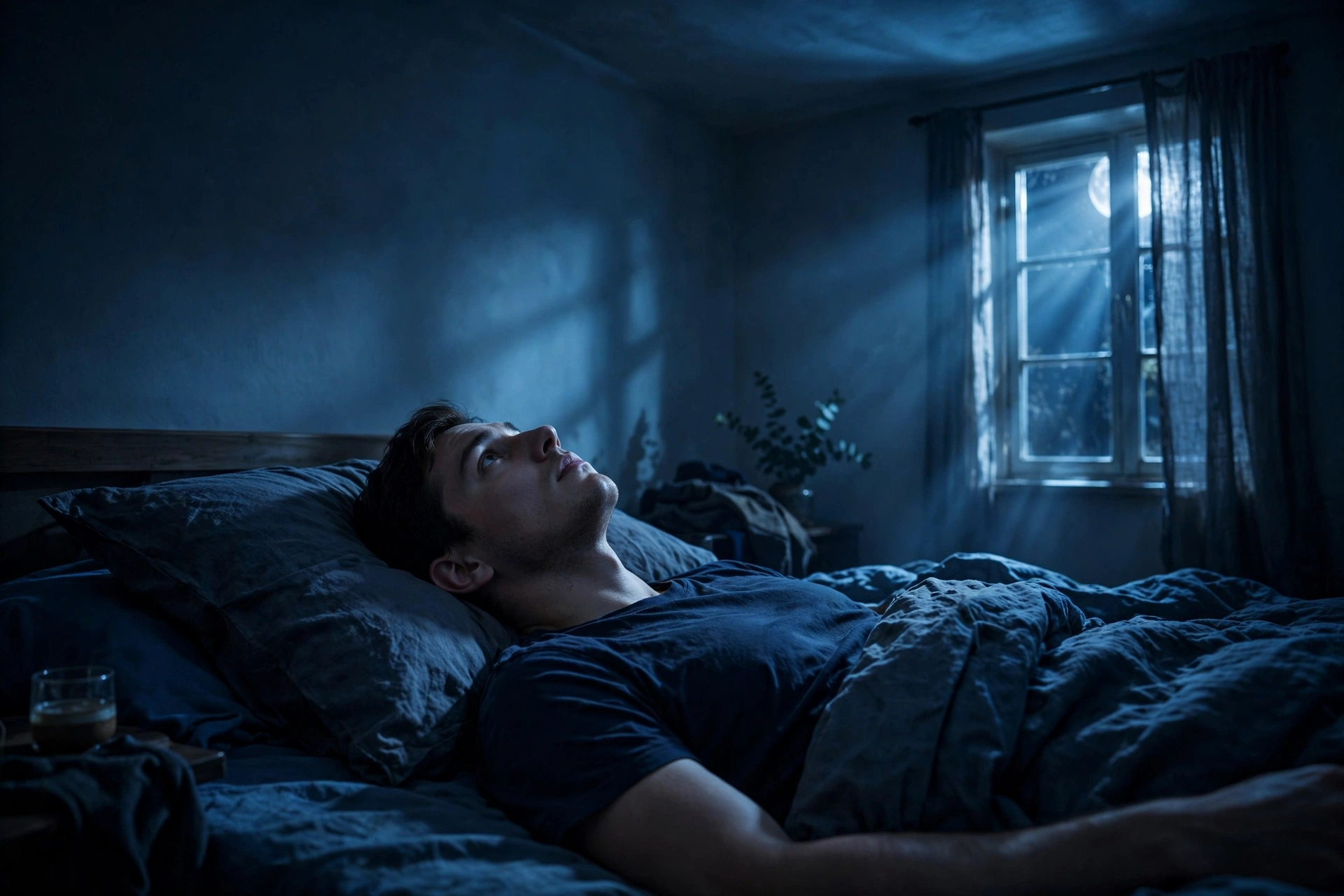
You know the drill. Lights off, phone face-down, eyes closed. And still — nothing. Your brain, which had nothing urgent to say all day, decides that 2:47 a.m. is the perfect time to replay a conversation from 2019.
If that sounds familiar, you’re in enormous company. The question “why can’t I sleep” gets typed into Google roughly 200,000 times a month in the US. And most of those people aren’t dealing with a mysterious disorder. They’re dealing with ordinary, fixable stuff: a racing mind, a warm bedroom, a late coffee, a habit the body learned a little too well.
Here’s the hopeful part. Insomnia is one of the most treatable sleep problems there is: cognitive behavioral therapy for insomnia (CBT-I) consistently outperforms sleep medication over the long term, and many of its core techniques are simple changes you can start tonight.
This article is educational, not medical advice, and it won’t diagnose you. It walks you through the 12 most common reasons people lie awake — mind-related and body-and-habit causes — with what the science says helps each one. Your answer is probably in here somewhere.
Mind-Related Reasons You Can’t Sleep
1. Your brain won’t switch off at bedtime
Racing thoughts are the most reported cause of sleeplessness. Worries about tomorrow’s presentation, replays of today’s awkward moment, mental to-do lists — the moment the lights go out, your mind finally gets the quiet it needs to start chattering.
Psychologists call this hyperarousal: your nervous system is still in daytime alert mode when your body wants rest. The cruel twist is that trying harder to fall asleep backfires. Effort and frustration wake the brain further — like trying to see in the dark by staring harder.
What helps: Give the thoughts somewhere to go before bed. Try a “worry dump”: 15 minutes in the early evening, write every concern and open loop onto paper, then close the notebook. Studies show writing a to-do list before bed helps people fall asleep faster — the list format beats emotional rumination. In bed, if you’re still awake after about 20 minutes, get up, sit somewhere dim, do something boring, and return only when sleepy. That technique is called stimulus control, and it’s a cornerstone of CBT-I.
2. You’re anxious about not sleeping
This is the vicious cycle: you sleep badly, you dread bedtime, the dread makes you alert, and the alertness guarantees another bad night. Sleep researchers call it performance anxiety around sleep — treating rest like a test you can fail.
The moment “I need to fall asleep NOW” enters your head, your body reads it as a threat and releases alerting stress hormones. Your brain can’t tell a tiger in the bushes from a 9 a.m. meeting after no sleep.
What helps: Drop the goal of falling asleep and replace it with the goal of resting comfortably. Paradoxical intention — a real CBT-I technique — asks you to lie there and simply allow yourself to stay awake while resting. People who stop pressuring themselves often drift off faster. Also try labeling the thought — “I’m having the thought that I’ll never sleep” — rather than arguing with it. Naming it shrinks it.
3. Stress is running your evenings
Work emails at 9 p.m., scrolling the news in bed, tense conversations before lights-out — stress and sleep are enemies, and the fight happens on your schedule. Chronic stress keeps cortisol elevated into the evening, exactly when cortisol needs to fall so melatonin can rise.
You might not even feel “stressed.” You might just feel wired — jaw clenched, shoulders up, mind replaying the day. That low-grade background tension is enough to delay sleep.
What helps: Build a buffer zone. Sleep scientists recommend a 30–60 minute wind-down before bed: dim lights, no work, no heated conversations. Think of it like landing a plane, not parking a car. A consistent sequence — shower, stretch, read, breathing exercise — trains your brain to associate those cues with sleepiness. Your brain learns routines fast; give it a good one.
4. Intrusive or looping thoughts
Some nights it’s not general worry — it’s one thought on repeat. A “what if” you can’t resolve. An embarrassing moment stuck on a loop. Repetitive negative thinking is strongly linked to insomnia in the research, and the bedtime quiet gives it a stage.
What helps: Don’t wrestle the thought; contain it. Schedule a specific 15-minute “worry window” earlier in the day — literally put it on your calendar — and promise yourself bedtime is not the venue. In the moment, grounding helps: name five things you can feel (the pillow, the sheet, your breathing). It pulls attention out of the loop and back into the body.
5. Your chronotype is fighting your schedule
Here’s one nobody suspects: you might not have insomnia at all. You might be a night owl forcing a lark’s schedule. Morning-versus-evening preference is partly genetic. If your natural melatonin release starts at midnight but you’re in bed at 10 p.m. staring at the ceiling, that’s not a disorder — it’s a mismatch.
What helps: If your schedule allows flexibility, shifting bedtime later can fix “insomnia” overnight — you fall asleep fast because you’re actually sleepy. If the schedule is fixed, use morning bright light: get outside within an hour of waking to nudge your clock earlier. Consistent wake time matters more than consistent bedtime, because the morning anchor sets the whole rhythm.
6. You’re grieving, or going through something big
Breakups, job loss, a sick parent, a cross-country move — acute life stress disrupts sleep for almost everyone. This isn’t a malfunction; it’s your brain threat-monitoring during a genuinely threatening time. The risk is that the pattern lingers after the crisis passes, turning a rough patch into a learned habit of sleeplessness.
What helps: Protect the basics — same wake time, daylight, movement — even when motivation is gone. And reframe it: “I’m sleeping badly because life is hard right now” is more accurate, and less scary, than “something is wrong with me.” If the sleeplessness outlasts the life event by several weeks, treat it as its own problem worth addressing (see “When to talk to a doctor” below).
Sleep Diary Starter — Try This Tonight
A simple sleep diary is one of the best tools for spotting your personal insomnia pattern. Answer these four prompts each morning for one week:
- What time did I get into bed — and what time did I actually fall asleep? (The gap between those two numbers is your sleep onset delay.)
- How many times did I wake up, and for roughly how long?
- What was in my head during the worst stretch? (One sentence. Worries? A loop? Nothing at all — just wide awake?)
- What did I consume or do in the last 3 hours before bed? (Coffee, alcohol, screens, exercise, tense conversations — be honest.)
After seven days, look for the pattern. Most people discover their sleeplessness isn’t random at all — it’s one or two of the causes on this page, repeating. And once you can see it, you can fix it.
Body and Habit Causes
7. Caffeine is still in your system (yes, really)
Caffeine’s half-life is roughly 5–6 hours — so the 2 p.m. coffee is still at half strength at 8 p.m. What most people miss: caffeine doesn’t just keep you awake; it fragments sleep. You might fall asleep fine and still wake at 3 a.m., never connecting it to the afternoon cold brew.
And it’s not just coffee. Pre-workout powders, energy drinks, many teas, chocolate, and some headache medicines all carry caffeine. Sensitive sleepers can feel a single morning cup; most people are affected by anything after noon.
What helps: Set a caffeine cutoff — noon for sensitive sleepers, 2 p.m. for most — and audit hidden sources for a week. The research is unambiguous: earlier caffeine, better sleep. Switch the afternoon ritual to decaf or herbal tea and keep the ritual itself — the break, the warm cup — which is half the pleasure anyway.
8. Alcohol: the fake sleep aid
A glass of wine feels like it knocks you out — and it does, briefly. Alcohol is a sedative, so sleep onset is fast. The problem is what happens next: as your body metabolizes it, sleep turns shallow and fragmented, with more awakenings in the second half of the night. That classic 3 a.m. wide-awake feeling after drinking? That’s the alcohol wearing off, not insomnia.
What helps: If you drink, keep it earlier and modest — stopping 3–4 hours before bed gives your body time to clear most of it. Cut back evening drinking and the mysterious middle-of-the-night awakenings often vanish.
9. Your bedroom is working against you
Temperature, light, and noise are the big three — and most bedrooms fail at least one. Your core body temperature needs to drop a degree or two for sleep onset, which is why hot rooms are sleep killers. Even small light — a streetlamp through the blinds, a standby LED — suppresses melatonin. And intermittent noise fragments sleep even when it doesn’t fully wake you.
What helps: Aim for cool (around 65–68°F), dark, and quiet. Blackout curtains or a sleep mask, earplugs or white noise, and a fan for airflow cover 90% of bedroom problems. This is the lowest-effort fix on the entire list — and people routinely underestimate how much it matters.
10. Screens and the scroll trap
Two problems here, and only one is blue light. Yes, evening screen light delays melatonin — that’s real. But the bigger thief is engagement: the feed is engineered to keep you scrolling, the group-chat argument spikes your adrenaline, the next episode autoplays. You lose an hour of sleep opportunity and arrive in bed mentally wired.
What helps: The research-backed move isn’t a blue-light filter — it’s a screen curfew. Put the phone to charge outside the bedroom 30–60 minutes before bed. If that feels impossible, start smaller: no social feeds or news after 9 p.m. People who move the charger out of the bedroom report the single biggest sleep improvement of any habit change.
11. Your sleep schedule is chaos
Sleeping in until 10 on weekends after 6:30 a.m. weekdays creates “social jet lag” — your body experiences it almost like flying across time zones twice a week. Add irregular bedtimes and long daytime naps, and your circadian rhythm has no idea when it’s supposed to be sleepy.
What helps: Anchor your wake time — the most underrated advice in sleep science. The same wake-up time every day, weekends included (within about an hour), stabilizes your rhythm within a week or two. Get bright light soon after waking. Keep naps to 20 minutes and before 3 p.m. Your body clock is a metronome: it needs one steady beat, and morning is the beat.
12. Your bed has become a worry zone
The sneakiest one. After months of tossing, worrying, and scrolling in bed, your brain has learned a powerful association: bed = frustration. Now the pillow itself triggers alertness. Sleep researchers call this conditioned arousal — and it explains why some people sleep fine on vacation but lie awake at home.
What helps: Break the association with stimulus control, the most evidence-backed technique in CBT-I: use the bed only for sleep (and intimacy) — no scrolling, no working, no worrying. Awake and restless for ~20 minutes? Get up, go somewhere dim until sleepy, then return. You’re retraining the association: bed means sleep, the couch means everything else. Most people see improvement within one to two weeks.
The CBT-I shortcut, in one paragraph: Cognitive behavioral therapy for insomnia works because it attacks all three pillars — the racing mind (cognitive techniques), the bad habits (stimulus control and a consistent schedule), and the beliefs about sleep itself. Studies consistently find it more effective than sleep medication over the long term, with no side effects. If your insomnia is persistent, asking a doctor about a CBT-I referral — or a validated CBT-I program — is one of the highest-value moves you can make for your sleep.
When to Talk to a Doctor
Everything above covers the common, behavioral causes of sleeplessness — and they genuinely explain most cases. But persistent insomnia can also signal something underneath that self-help can’t fix. Don’t white-knuckle it. Talk to a doctor if:
- Your sleeplessness lasts most nights for three weeks or longer despite better habits
- You snore loudly, gasp, or choke during sleep (possible sleep apnea)
- You have an irresistible urge to move your legs at night (possible restless legs syndrome)
- You feel exhausted all day no matter how much you sleep
- Depression or anxiety is bleeding into every part of the day
- You suspect a medication, thyroid issue, chronic pain, or another health condition is involved
A doctor can screen for medical causes, review your medications, and refer you to a sleep specialist or CBT-I program. That’s not failure — it’s the smartest next step. This article is educational and can’t diagnose anything; only a professional who knows your history can.
Note: this article intentionally doesn’t recommend sleep medications or dosages. Those decisions belong between you and your doctor, who can weigh benefits, side effects, and interactions with your full picture.
Frequently Asked Questions
Why can’t I sleep even when I’m tired?
Usually hyperarousal — your nervous system is still in daytime alert mode at bedtime. Racing thoughts, worry about sleep itself, and habits like scrolling in bed teach your brain that bed means “think,” not “sleep.”
What are the most common causes of insomnia?
Stress and racing thoughts, irregular sleep schedules, late caffeine or alcohol, too much screen light before bed, an uncomfortable sleep environment — and the vicious cycle of dreading bedtime after bad nights.
How can I fall asleep faster tonight?
Get up if you are awake more than about 20 minutes and do something boring in dim light until sleepy (stimulus control). Try a “worry dump” — writing tomorrow’s to-dos on paper — in the early evening, not in bed.
When should I see a doctor about insomnia?
If sleeplessness lasts most nights for three weeks or more despite good habits, or if you snore loudly, gasp awake, or feel dangerously sleepy in the day. Those can signal sleep apnea or another treatable condition.
Try It on Our Site
Reading about sleep is nice. Measuring your own is better. Two free tools on Zentha Psychology can help you put this article into practice tonight:
- Sleep Check-In — a quick questionnaire that scores your current sleep patterns and gives you a personalized read on what’s going on.
- Relaxation Techniques — guided wind-down exercises including the 4-7-8 breathing pattern and a body scan, designed to take you from wired to drowsy.
Key Takeaways
- Most sleeplessness comes from ordinary causes — racing thoughts, stress, caffeine, screens, or a learned bed-worry association — not a mysterious disorder.
- The harder you try to fall asleep, the more awake you get; dropping the effort is itself a technique.
- CBT-I — stimulus control, consistent schedules, and cognitive tools — often outperforms sleep medication in long-term studies and has no side effects.
- Anchor your wake time (even on weekends) and get morning light: it’s the single most powerful rhythm reset.
- Keep caffeine to the morning, alcohol away from bedtime, and the phone charger out of the bedroom.
- If insomnia persists for weeks despite better habits — or you snore, gasp, or feel exhausted all day — see a doctor rather than pushing through.
Related Reading
- What Is Attachment? — how your attachment style shapes nighttime anxiety and the racing thoughts that follow you to bed.
- How to Stop a Panic Attack — grounding techniques for the nights when anxiety spikes into full panic.
- Wellness Check-Ins — quick self-assessments for sleep, stress, anxiety, and more, with instant personalized results.
- Intrusive Thoughts, Explained — why unwanted thoughts loop at night and what the research says about quieting them.
Watch the video version
We covered this topic on the Zentha Psychology YouTube channel — watch it here: