
Reviewed by a Psychology Postgraduate (MA)
In short: What is the psychology of daylight saving time? The clock change disrupts your body clock and your social clock at once, breaking the cues your habits run on and stealing evening light. That is why falling back feels like jet lag and can dim your mood for days.
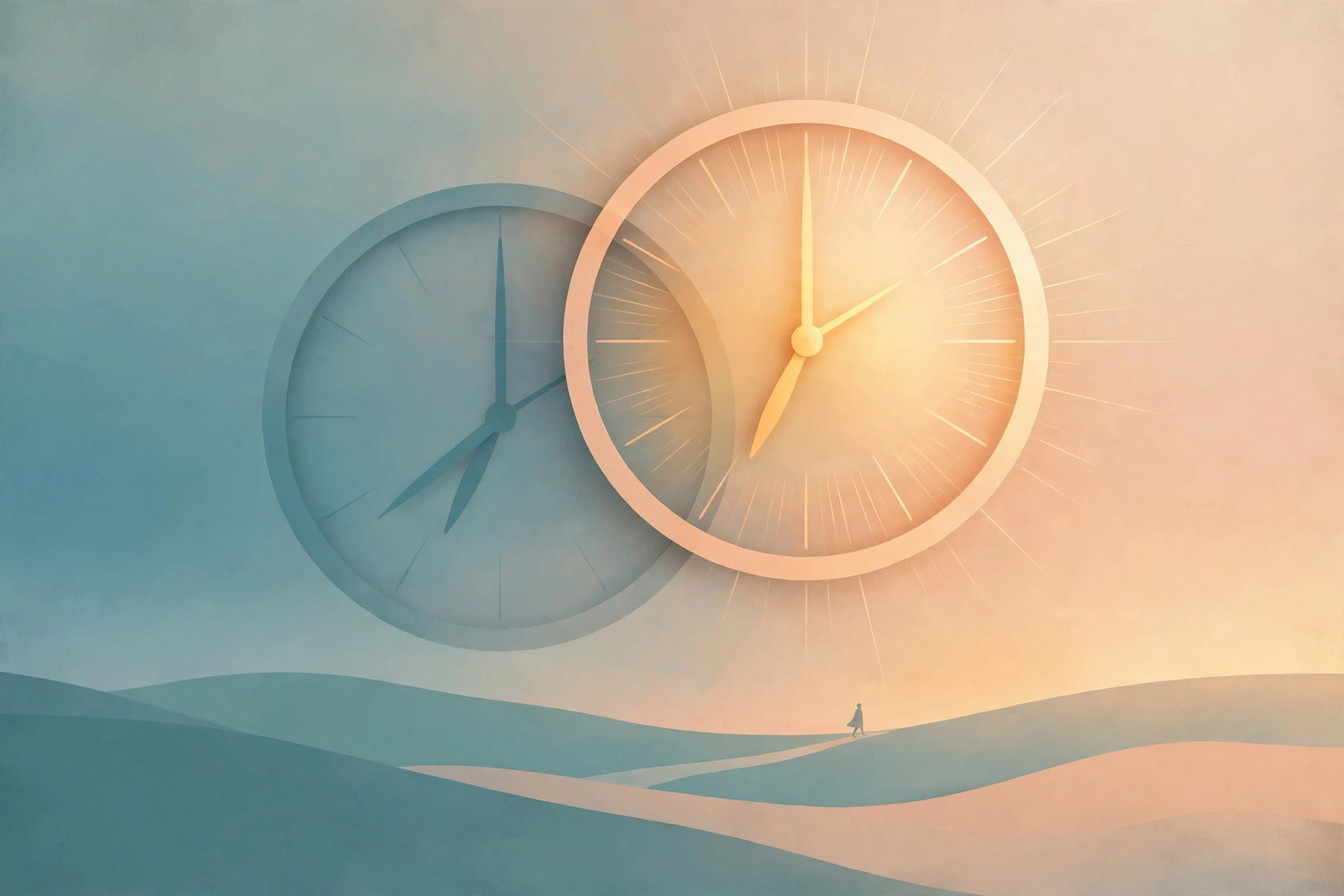
Your brain runs on two clocks, and now they disagree
You don’t have one clock. You have two.
The first is your biological clock: a tiny cluster of cells deep in the brain called the suprachiasmatic nucleus. It runs on a roughly 24-hour cycle and sets the schedule for nearly everything — when melatonin rises to make you sleepy, when cortisol spikes to wake you up, even the daily rhythms of appetite, body temperature, and alertness. Its main time cue is light: brightness in the morning pushes the clock earlier, light in the evening pushes it later.
The second is your social clock: the schedule of the world you live in. Alarms, meetings, school drop-offs, dinner reservations. Everything anchored to the numbers on a dial.
Sleep researcher Till Roenneberg calls the gap between these two clocks “social jet lag” — the mismatch between the time your body wants to live on and the time your life demands. On an ordinary day, the gap is manageable. A time change widens it overnight, by a full hour, with zero travel required. Your biology didn’t go anywhere. The schedule moved around it.
That’s why the grogginess after a clock change feels like jet lag. It is, in a sense — except nobody stamped your passport.
It’s not the lost hour. It’s the broken cues.
Here’s what makes the clock change so disruptive: it doesn’t just move bedtime. It silently rewires every cue your habits hang on.
Think about how much of your life is anchored to clock time rather than body time. You eat lunch at noon not because you’re hungry at noon but because the clock says noon. You leave for work at 8:15, take the walk at 6, start winding down at 10. Each of those is a cue that triggers a routine, and routines run on autopilot — they cost almost no mental energy.
On November 1, every cue fires an hour off from what your body expects. Breakfast comes before your appetite arrives. The evening feels “done” at 5:30 while your brain still expects three hours of light. Your workout suddenly happens in the dark. For a creature of habit, that isn’t one hour of disruption — it’s dozens of tiny disruptions stacked across the day, each one requiring a small decision, a small adjustment, a small expenditure of attention.
Psychologists call habits “context-triggered behaviors” — they fire automatically when the context matches. The clock change breaks the context. Suddenly everything needs conscious management again, and conscious management is exhausting. A big chunk of that “off” feeling is your brain paying the cognitive tax on routines that were supposed to run free.
Try it now: Take the 2-minute Sleep check-in — a guided way to map your current sleep pattern and spot where it’s off-track, no account and no judgment. Start the Sleep check-in →
The darkness does its own work
Then there’s the second blow, and for many people it’s the bigger one: the light itself moves.
When the clocks fall back, sunset in most of the US jumps from around 6:30 or 7 to around 5:30 or 5:45 — seemingly overnight. You don’t experience this as “one hour less of light” (total daylight doesn’t change at all). You experience it as the evening vanishing. The after-work walk is now a before-dinner darkness. The kitchen is dim at 5. The day feels over before it feels finished.
Light is the single strongest signal to your master clock, and evening light in particular does something subtle and important: it tells your brain the active part of the day is still going. Lose it abruptly and the brain reads the message loud and clear — wind down. Melatonin begins its rise earlier. Energy drops. And because the shift happens in days rather than the weeks your clock prefers, there’s no gradual adaptation — just a step change your system wasn’t given time to negotiate.
This is also why the fall clock change lands right on top of the season when mood starts dipping for so many people. Research on seasonal patterns shows October and November are the cruelest months — the brain handles stable short days better than days that keep getting shorter. Falling back doesn’t cause that seasonal slide on its own, but it sharpens it: less evening light, more time indoors under dim lamps, fewer outdoor evenings with people, less movement. Each of those feeds the mood loop, and the mood loop feeds back into sleep, appetite, and energy.
If the weeks after November 1 have always felt heavier to you, this is a large part of why. Not the hour itself — the darkness it ushers in.
Night owls pay a different tax
Not everyone experiences the clock change the same way, and chronotype — your natural tendency toward morningness or eveningness — is the reason.
Morning types, the classic “larks,” tend to adapt to the fall change more easily: their bodies are already inclined to sleep earlier, so the shifted schedule roughly matches their internal preference. Evening types, the “owls,” get the worse deal. The fall change pushes their already-late biology into a schedule that demands earlier everything, and the darker evenings offer them less of the evening light their clocks use as a reference point.
This is worth knowing because people tend to blame themselves. The night owl who can’t seem to “just adjust” like everyone else assumes it’s a discipline problem. It isn’t. It’s a chronotype problem — a genuine biological difference in when your clock wants to run, colliding with a schedule that moved without asking. The American Academy of Sleep Medicine has argued for years that the twice-yearly switches themselves are the problem, which is exactly the argument playing out in the Senate this month. Your struggle to adjust is not a personal failure; it’s your biology accurately reporting that something external just changed.
What actually helps, according to the clock in your head
You can’t vote in the Senate from your kitchen table, and the clock change is coming regardless. But you can work with your biology instead of against it. The trick is to think in cues — the same cues the time change broke.
- 1. Treat morning light like medicine. For the week after the change, get bright light in your eyes within an hour of waking — a walk, the porch, even just sitting near a bright window. Morning light is the strongest signal that resets the master clock, and it’s the fastest way to close the gap between your two clocks. Ten to twenty minutes genuinely matters.
- 2. Shift gradually, starting this weekend. Don’t wait until November 1. Move bedtime and wake time earlier by 15 to 20 minutes a day for three or four days beforehand. Your clock adjusts to gradual shifts far better than step changes — this is the same principle behind managing jet lag, just applied in your own bedroom.
- 3. Keep your wake time sacred. You can flex bedtime, meals, and workouts. But your wake time is the anchor your clock trusts most. Keeping it consistent — even on the weekend after the change — is the single most effective way to lock the new schedule in. Sleeping in “to catch up” just reopens the gap.
- 4. Rebuild your evening on purpose. Since the darkness arrives earlier, don’t let it decide what the evening is. Move one enjoyable outdoor activity to the earlier part of the evening, turn up the indoor lights, keep the things that signal “daytime” to your brain. The brain doesn’t know what time the clock says — it knows what light and activity tell it.
- 5. Name what’s happening when it happens. This is the psychological move that underpins all the rest. When Tuesday hits and you feel dimmed and scrambled, don’t file it under “I’m just like this” or “something’s wrong with me.” Name the mechanism: my clocks are disagreeing. Psychologists call this affect labeling — putting accurate words to a process — and it does something remarkable: it turns a mysterious mood into an explained one. An explained disruption is something you can manage. A mysterious one just sits on you.
And one more thing worth saying: if the post-clock-change weeks reliably bring more than mild fogginess — a persistent low mood, lost interest in things you usually enjoy, sleep changes that don’t resolve — that’s not “the clock change.” That’s a pattern worth taking seriously on its own terms. The clock change reveals vulnerabilities; it doesn’t explain everything away. A dip is a signal, not a verdict.
Frequently Asked Questions
Why does the clock change make you tired?
The clock change creates social jet lag: your biological clock stays put while your social schedule moves an hour. Every cue your habits hang on, from meals to workouts, fires an hour off, and that mismatch feels like jet lag.
Does daylight saving time affect mood?
Yes. Falling back abruptly removes evening light, which is a strong signal to your master clock. Less evening light, more time indoors, and disrupted sleep can sharpen the seasonal mood dip many people feel in late autumn.
Who struggles most with the clock change?
Evening types, or night owls, tend to struggle most with falling back. Their already-late biology is pushed into an earlier schedule, and darker evenings give their clocks less evening light as a reference point.
What actually helps after the clock change?
Work with your cues: get bright morning light, keep meals and sleep times steady, and move your body outdoors while it is light. You cannot vote the change away, but you can re-anchor the routines it broke.
The hour is small. The machinery is not.
There’s something quietly profound about all of this. We act as if time is the numbers on the dial — that moving them moves the day. But your lived day was never in the numbers. It was in the light on your face, the cue at noon, the evening walk, the rhythm your brain spent all year quietly keeping.
That’s why the debate in Washington matters less than it looks, and more. Less, because your biology doesn’t care what the Senate decides — it will adapt to whatever schedule you keep, given light and consistency. More, because the whole argument is proof of the same thing this article is about: we keep discovering, every single October, that an hour isn’t just an hour. It’s a coordinated assault on the two-clock system every one of us runs on.
On November 1, at 2 a.m., most of America will get an hour back. The smart move is to know what else moved with it — and to give your brain the cues it needs to find its footing again. The darkness comes earlier. The schedule shifted. But now you know exactly why you feel the way you do, and knowing is the first step toward adjusting on purpose instead of stumbling by default.
This article is for educational purposes only and is not a substitute for professional advice, diagnosis, or treatment. If low mood, sleep problems, or persistent worry are interfering with your daily life, consider speaking with a licensed mental health professional.
Related reading: Why Do I Overthink at Night? The Psychology of Racing Thoughts at 1 AM (https://zenthapsychology.com/why-do-i-overthink-at-night/) and How to Stop Overthinking: What Psychology Actually Says Works (https://zenthapsychology.com/how-to-stop-overthinking/)