
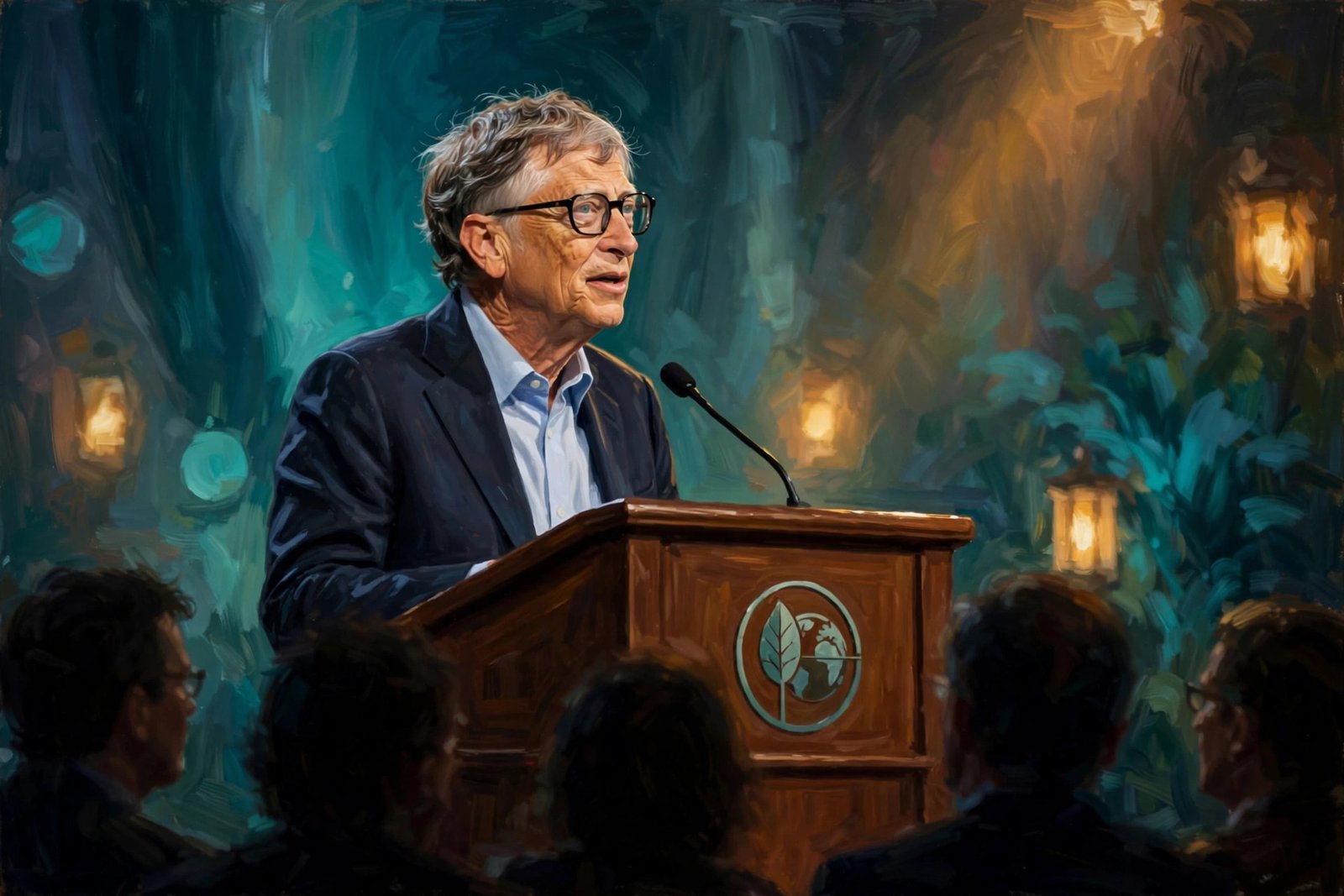
Bill Gates Climate Change Psychology: What Happens When a Famous Mind Changes Its Mind
Reviewed by a Psychology Postgraduate (MA)
Bill Gates published a memo on climate change on the eve of COP30, the United Nations climate summit in Belém, Brazil, from 6 to 21 November 2026. Forbes reported it on 11 November 2026, and it was widely covered on 11 and 12 November. By 13 November, “bill gates” was the number one trending Google search in the United Kingdom (Trendoday, 08:06 UTC).
Bill Gates published a climate memo ahead of COP30 arguing that climate change, while serious, will not end civilisation, and that health and prosperity matter as much as emissions targets. The bill gates climate change psychology angle is less about the science than about how minds react when a prominent person changes position in public.
What did Bill Gates actually say in his climate memo?
In short, he argued that climate change is serious but not civilisation-ending, and that progress should be judged by health and prosperity as well as temperature.
Gates, author of How to Avoid a Climate Disaster (2021) and an investor through Breakthrough Energy, has campaigned on climate for years; commentators called it a strategic pivot. He made three points. First, climate change will not end civilisation. In his words: “Although climate change will have serious consequences, particularly for people in the poorest countries, it will not lead to humanity’s demise” and “People will be able to live and thrive in most places on Earth for the foreseeable future.” Second, limiting temperature alone is not the best measure of progress. Third, health and prosperity are the critical defences against climate change.
He argued for shifting focus toward innovation, cheaper clean technology, better farming and health care, and improving life in a warming world, rather than chasing ever-tighter near-term emissions targets. He also noted net zero would still mean about a 1.9°C rise from 1990 levels, against about 2.9°C with inaction.
Why did the memo cause such a strong reaction?
Because a public change of emphasis from a well-known figure feels personal, even when the subject is policy.
Climate scientists and environmental groups accused Gates of downplaying the danger. Rachel Cleetus of the Union of Concerned Scientists said the memo creates a “false choice” between reducing emissions and improving lives.
The tension is sharpest for younger readers. In Australia, surveys have found widespread worry among teenagers about the climate, as our article on climate anxiety among teenagers describes. In Canada, young people have taken their climate concerns into the courtroom, as our piece on the Canada youth climate trial and eco-anxiety explains. For many, a memo that sounds less urgent can feel like adults have stopped listening.
Why is changing your mind in public so hard?
Because it is rarely just about new facts. In public, it also involves reputation and identity.
Belief updating is the process by which a person revises what they believe when new evidence or reasoning makes the old belief harder to hold.
In practice, the mind resists it. One reason is identity-protective cognition: we accept evidence that fits who we think we are, and resist evidence that threatens that identity. A related idea, motivated reasoning, describes how we reason toward the conclusion we already want.
Think of ordinary life. You have told friends for years that you will never move house, then the evidence changes. Admitting you were wrong feels like a loss of face.
That is why intellectual humility matters, and why it is rare in public life: the willingness to admit that your beliefs could be wrong, and to hold them lightly enough to revise them. Leaders who revise a position in public pay a price, yet can also gain trust.
Our beliefs often harden into limiting beliefs without us noticing, shaping what we try and avoid. A memo like this prompts a useful question: which of your beliefs have been updated lately, and which have simply been defended?
Pause and ask yourself: When did you last change your mind about something important in public, rather than quietly in private? What made it possible, and what did it cost you?
Why do fear-based climate messages often backfire?
Because fear motivates action only when people also believe they can do something useful about the threat. Without that belief, fear turns into avoidance.
Gates has said in interviews that extreme doomsday messaging caused the public to tune out. That fits Witte’s Extended Parallel Process Model: a fear appeal works through two judgements, how serious the threat feels, and how able you feel to deal with it. When both are high, people act. When the threat feels huge but your ability to act feels tiny, people switch off.
Psychologists call that pattern doom fatigue: a worn-down, numb response to repeated warnings of catastrophe. It is not the same as not caring. Many people care deeply and feel powerless at the same time, and the result can look like indifference, when inside it is closer to overload.
Optimism and realism are different tools: optimism sustains effort, realism keeps it honest. A message that leaves you feeling capable and clear about one next step beats one that leaves you terrified or reassured, then inactive.
What does the “false choice” framing do to an argument?
It narrows a complex question into two opposing options, so the argument becomes about picking a side.
Binary framing is powerful because it is simple: emissions cuts or better lives, hope or honesty. Yet most real problems are not either-or. A doctor can treat symptoms and work on the cause at the same time, and a country can cut emissions while investing in health care and farming.
When a debate is framed as a false choice, people who agree with one half feel attacked by the other. The middle ground becomes harder to describe, and the loudest voices set the terms.
None of this means the criticism was unfair. Pointing out a false choice reopens the space that binary framing closed. The lesson is to notice the frame before reacting: is this a choice between two things, or a question about how much of each?
How can you update your own beliefs without losing yourself?
By treating a change of mind as evidence of thinking, not failure, and by making the process slow, specific, and honest.
The difficulty comes when a belief is tied to identity or reputation. Then updating feels like disloyalty. A few habits can make it easier:
- Name the belief precisely. Write it in one sentence, so it can be checked.
- Separate the belief from the person who taught it to you. You can respect someone and still disagree.
- Look for the strongest version of the other side. Arguing only against the weakest version teaches nothing.
- Ask what would change your mind. If the honest answer is nothing, you are holding a loyalty, not a belief.
- Change one part at a time. Revising the emphasis or timing is still a genuine update.
If looping thoughts feel familiar, our guide on how to stop overthinking everything looks at how to break the loop.
Frequently asked questions
Why did Bill Gates publish a climate memo before COP30? He published it on the eve of the summit in Belém, Brazil, in November 2026, arguing that climate change is serious but will not end civilisation, and that health and prosperity should sit alongside emissions targets.
What is doom fatigue? Doom fatigue is the numb, switched-off feeling that follows repeated warnings of catastrophe. It often means a person cares but feels powerless, so the mind tunes out.
Why do people find it so hard to change their minds? Because beliefs are tied to identity and belonging. Updating one can feel like admitting failure, so the mind uses motivated reasoning to defend the old position.
What is intellectual humility? Intellectual humility is the willingness to admit that your beliefs could be wrong and to revise them when the evidence calls for it.
Try it on our site
If this article has left you turning over a belief of your own, try one of these free tools:
- Challenge the Thought — test a belief against the evidence.
- Mind Check-Ins — short check-ins for mood, anxiety, stress, and sleep.
- Wellness Tools hub — the full set of free check-ins and exercises.
Related reading: Climate Anxiety in Teenagers: Why Half of Teens Worry · Canada Youth Climate Trial Eco Anxiety: Courtroom Minds · APA Stress in America 2026 Psychology: Living With Stress
Key Takeaways
- Bill Gates published a climate memo ahead of COP30 in November 2026, arguing that climate change is serious but will not end civilisation, and that health and prosperity matter alongside emissions targets.
- Critics, including Rachel Cleetus of the Union of Concerned Scientists, said the memo creates a “false choice” between emissions cuts and improving lives.
- Changing your mind in public is hard because beliefs are tied to identity and reputation, not only to facts.
- Fear backfires when people feel powerless: Witte’s model shows fear motivates action only when people feel able to act.
- Intellectual humility, the willingness to revise a belief, keeps thinking honest and open to evidence.
This article is for education only and is not therapy, diagnosis, or medical advice. If you are struggling, please speak to a licensed professional, and if you are in crisis, contact your local crisis support service straight away.