
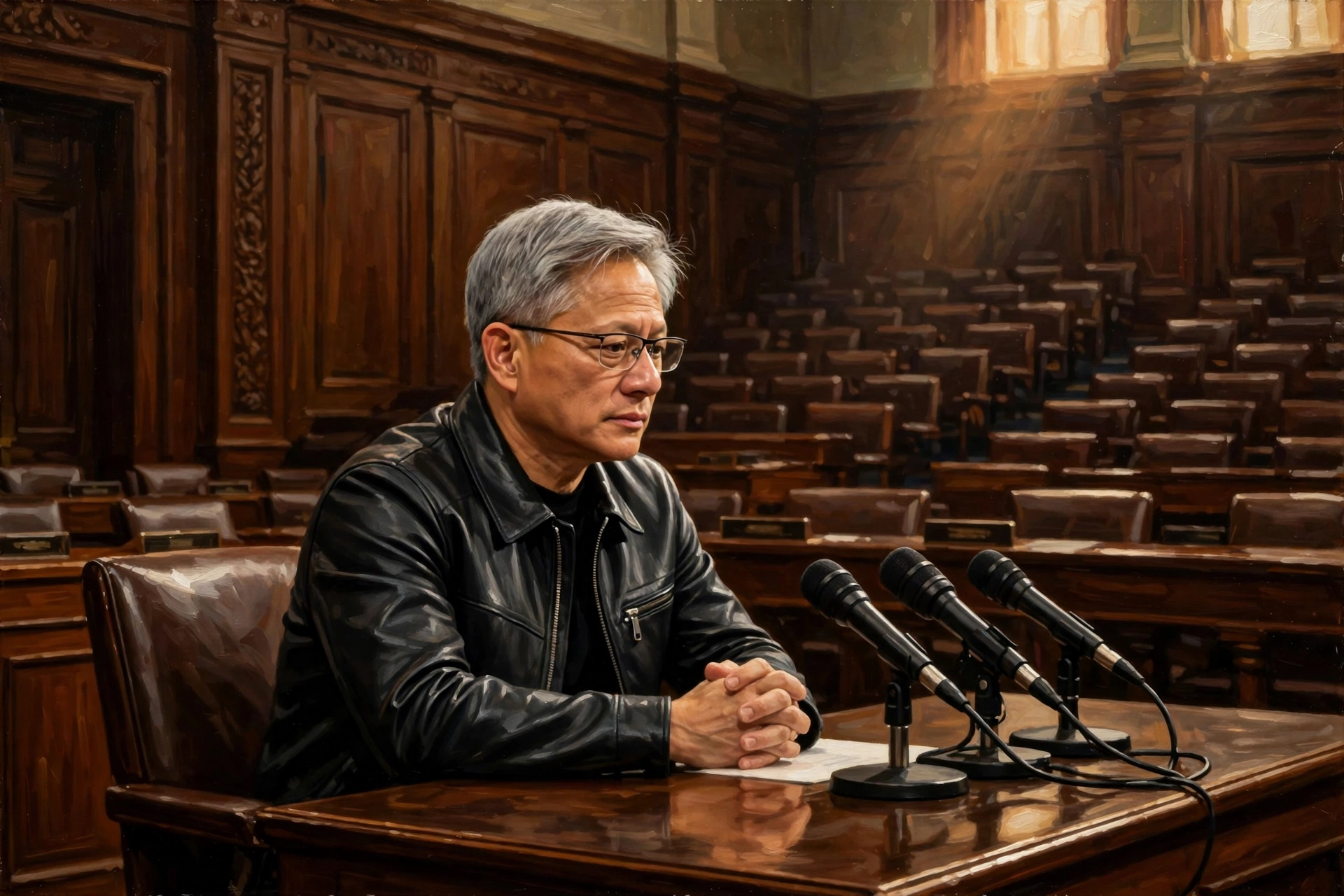
Jensen Huang Summoned to Congress: The Psychology of a Tech Titan’s Public Fall
Reviewed by a Psychology Postgraduate (MA)
Jensen Huang resigned as Nvidia’s chief executive on Thursday 12 November 2026, after 33 years at the company he co-founded. Less than a day later, the Senate came calling – and the jensen huang congress psychology question is now the one millions of people are asking: what does a public summons do to a person, and why can the rest of us not look away?
The short answer: On Thursday evening, 12 November, Senate Banking Committee Chairman Tim Scott asked Huang and Commerce Secretary Howard Lutnick to testify at a public hearing on 3 December, warning of subpoenas if they refuse. The psychology is public accountability – shame, status loss, and moral judgment, played out in front of millions.
What happened with Jensen Huang and Congress?
Senator Tim Scott sent letters on Thursday evening, 12 November, asking Huang and Lutnick to testify at a public hearing on Thursday 3 December. Scott cited “serious concerns about our national security” and warned of a subpoena if Huang refuses to appear. Lutnick was separately asked to testify on Thursday 10 December about Nvidia and the Commerce Department’s role, and Under Secretary of Commerce Jeffrey Kessler was summoned for a 3 December hearing.
Three House chairmen – Brian Mast, John Moolenaar, and Rick Crawford – required Huang and Nvidia general counsel Tim Teter to appear for closed-door interviews on 1 and 2 December, or face subpoenas. According to CNN, Bloomberg, and Fox News, Huang has agreed to testify, with the session expected before Thanksgiving on 26 November.
All of this follows Huang’s resignation on Thursday 12 November, after 33 years at Nvidia. The resignation followed reports of an alleged affair with Alice Huang, a Chinese businesswoman whom US authorities suspect of spying for Beijing. The allegations remain unproven: China has denied she is a spy, and Attorney General Todd Blanche said on 12 November that the Justice Department has not yet reached a conclusion. Huang apologised to staff on 8 November for being “unfaithful to my wife”.
The market reacted fast: Nvidia’s value fell below $4 trillion for the first time since July 2025, and shares closed down 4.3 percent on Thursday after dropping as much as 14 percent during the session. The story is travelling – “Jensen Huang” is trending at 100,000+ searches in Canada, “Kimberly Powell” at 200,000+ – and Forbes’ top US story on Friday morning was Lutnick agreeing to testify.
Why does a public summons hit harder than a private one?
Because a summons is not just a request for information – it is a public ceremony of accountability, and our brains treat public judgment very differently from private criticism.
The first distinction psychologists draw is between guilt and shame. Guilt says “I did something bad”. Shame says “I am bad” – and shame is almost always a social emotion, switched on by being seen and judged by others. As researcher Brene Brown has shown, shame thrives on secrecy – and public exposure is its most powerful trigger. A private conversation with a lawyer can be managed. A public hearing on 3 December, with cameras, senators, and a transcript, cannot. The audience is the point.
The second factor is status. For 33 years, Huang was the leather-jacketed face of the artificial intelligence boom, a founder whose personal brand and company had fused into one thing. Studies of status loss show it activates the same threat systems as physical danger. Losing a job is painful. Losing it in front of the whole world, and then being called to explain yourself to the Senate, is a different order of pain. And the wait hurts too: anticipating a stressful event is often worse than the event itself.
Pause and ask yourself: Think of a time you were called out in front of other people – a classroom, a meeting, a family dinner. Did the public part hurt more than the mistake itself? That gap between the error and the exposure is exactly what a congressional summons weaponises.
Why are millions of us riveted by a billionaire’s fall?
It is tempting to say we are watching for the national security answers. We are also watching because the brain is wired to watch powerful people fall – and to enjoy it more than we admit.
The first mechanism is moral judgment. Humans are compulsive moral accountants, keeping a running ledger of who deserves what, and a story mixing wealth, secrecy, and alleged betrayal has entries on every line. The allegations are unproven, but the moral ledger does not wait for a verdict.
The second is schadenfreude, the quiet pleasure at another’s misfortune. Research finds it spikes when the person falling is high-status and the fall feels deserved – both conditions are met here. It is the brain restoring fairness: when someone has vastly more than we do, watching them lose some of it feels, at a gut level, like the world rebalancing. The Bill Gates climate memo drew the same kind of public accounting this week.
The third is parasocial trust. Millions who never met Huang felt they knew him – the jacket, the keynotes, the founder story. Psychologists call this a parasocial relationship: a one-sided bond that feels real. When a parasocial figure falls, the betrayal feels personal, even though the relationship was never mutual – and the uncertainty over who leads Nvidia next keeps the story alive.
What does the research say about power, secrecy, and accountability?
The research on power is uncomfortable – relevant here not as a diagnosis of any one person, but as a pattern that shows up again and again.
Psychologist Dacher Keltner’s “power paradox” describes it plainly: the skills that help people rise to power – empathy, collaboration, generosity – are often the very skills that power erodes. Studies find powerful people can grow less attuned to others and more impulsive, partly because power weakens the feeling of being constrained by social rules. Huang built a company with roughly 60 executives reporting directly to him and said publicly that he does not believe in succession planning. Centralised power feels efficient, right up until the centre fails.
Secrecy has its own psychology. Research by Michael Slepian at Columbia University shows the burden of a secret comes less from hiding it than from the mind returning to it, over and over, when alone. Secrets also distort trust. Research on digital trust after the Denmark cyberattack showed the same pattern: once people learn information was withheld, they start doubting everything else, too. Trust is not lost in pieces. It collapses all at once, which is why one week of disclosures can undo 33 years of reputation.
Can trust be rebuilt after a fall like this?
Yes – but slowly, and only in a specific order. Trust repair has three stages: stop the bleeding (acknowledge the facts, end the secrecy, accept scrutiny); show consistent behaviour over time – not one good week, but months of it; and give the people hurt a reason to believe the change is real, which usually means structural change, not just words. The psychology of a public apology shows the same pattern: words open the door, but only consistent behaviour walks through it. Nvidia has begun the first stage – the board’s investigation, interim chief executive Colette Kress, the agreement to testify. The 17 November earnings call will be the first public test of whether the company can hold its nerve without its founder. The same question followed Meta’s $25 billion privacy fine: trust returns only when behaviour changes first.
What can the rest of us take from this?
Most of us will never be summoned to Congress – but the psychology shows up in ordinary lives every day.
- Separate the person from the role. When a founder and a company fuse into one identity, the fall of one looks like the fall of both – in families and teams, too. Build systems, not single points of failure.
- Secrets are heavier than they look. The cost of a secret is not hiding it, but the quiet moments your mind returns to it. The longer you carry alone something that would change how people see you, the harder the eventual conversation.
- If your own reputation takes a hit, slow down. The instinct after a public mistake is to explain immediately, to everyone, all at once. The research says the opposite: pause, get the facts straight, and speak once, clearly.
Frequently asked questions
Has Jensen Huang been charged with anything? No. As of 13 November 2026, no charges have been announced. The allegations remain unproven, China has denied the spying claim, and Attorney General Todd Blanche said on 12 November that the Justice Department has not yet reached a conclusion.
When will Jensen Huang testify before Congress? House interviews are set for 1 and 2 December 2026, behind closed doors, and Huang has reportedly agreed to appear before Thanksgiving on 26 November. The Senate has requested his testimony at a public hearing on 3 December, with a subpoena threatened if he refuses.
What happens if Huang refuses to testify? The Senate Banking Committee has said it would consider issuing a subpoena, which would legally compel his appearance.
Try it on our site
- Name Your Feeling – Put a name to what this story stirs in you.
- Challenge the Thought – Catch the all-or-nothing judgments this story invites and test them against the facts.
- Burnout + Money-Stress Check – If market swings are raising your stress, this check-in maps where you stand.
Related reading: Jensen Huang Resigns as Nvidia CEO After 33 Years: The Psychology of a Founder’s Sudden Fall | Bill Gates Climate Change Psychology: What Happens When a Famous Mind Changes Its Mind | Meta Fined $25 Billion: The Psychology of Privacy and Trust
Key Takeaways
- Jensen Huang and Commerce Secretary Howard Lutnick have been summoned to testify before Congress – a public Senate hearing on 3 December, House interviews on 1 and 2 December.
- A public summons hurts because shame is social – and we watch because of moral judgment, schadenfreude, and parasocial trust.
- Trust is lost all at once and rebuilt slowly, through acknowledgment, consistent behaviour, and structural change – never through messaging alone.
This article is for education only and is not therapy, diagnosis, or legal advice. If the news is weighing on you, talk to someone you trust – and if you are in crisis in the US, call or text 988; in the UK and Ireland, Samaritans is free on 116 123.