
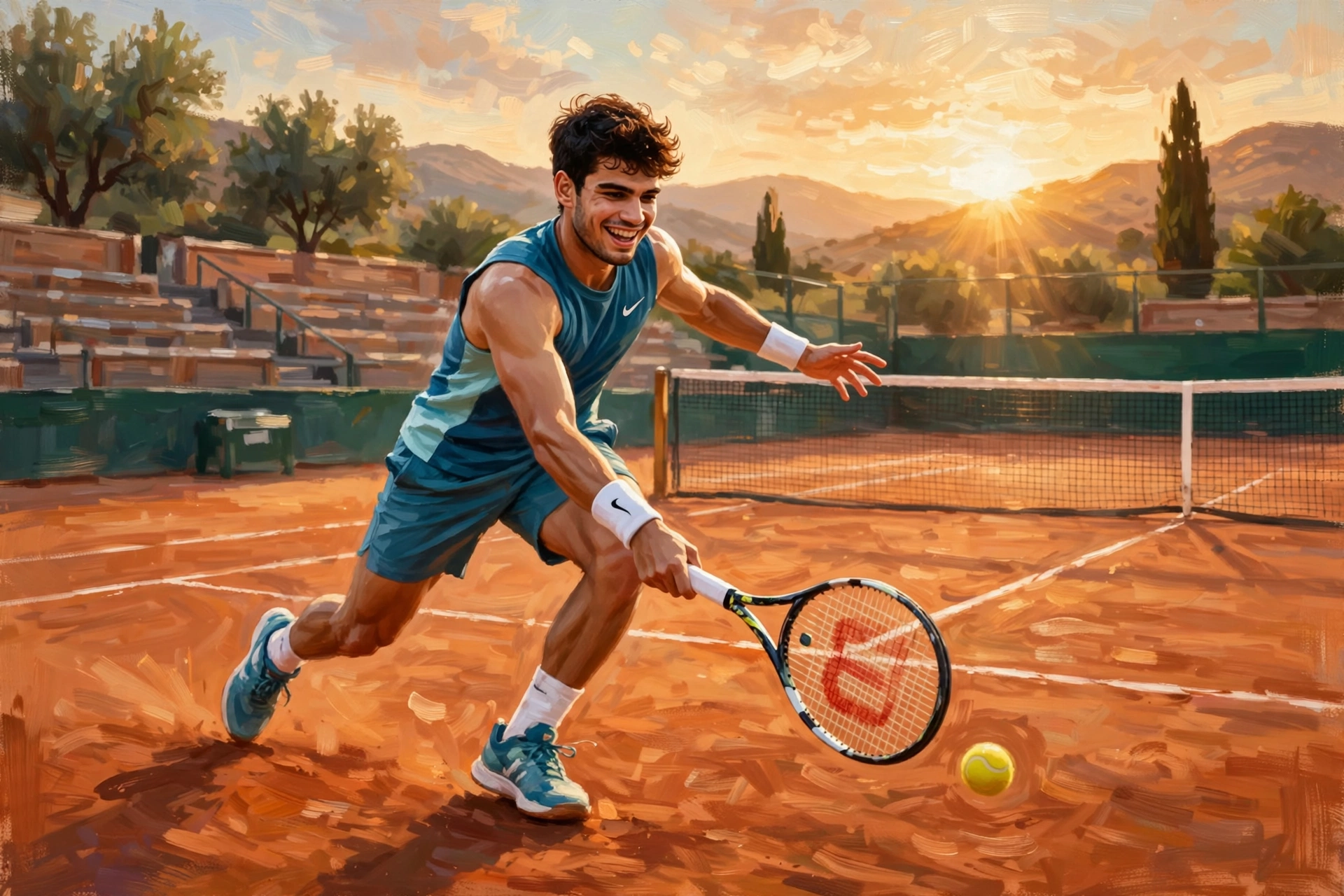
Carlos Alcaraz and the Psychology of Joy: How Tennis’s Youngest No. 1 Turns Pressure Into Play
Reviewed by a Psychology Postgraduate (MA)
Carlos Alcaraz psychology starts with a paradox: the most feared young player in tennis is also the one who looks like he is having the most fun. On Sunday 8 November 2026, the 23-year-old from Murcia beat Ben Shelton to win the Paris Masters, his first title since returning from a wrist injury that kept him off the tour for four and a half months — and he did it smiling, drop-shotting, and sprinting for balls most players would let go. The short answer to what makes him different is this: Alcaraz treats pressure as a playground, not a prison. Where most elite athletes tighten up when the stakes rise, he loosens up — and a growing body of psychology research suggests that is not a quirk of personality. It is a trainable skill, and it may be the most important one he owns.
The timing is no accident. Alcaraz is the most searched tennis player on the planet right now — “carlos alcaraz” trended in 26 countries on 8 November, the day he lifted the Paris trophy — and next week he heads to Turin as the second seed for the ATP Finals, the season-ending championship for the world’s top eight men, running 15–22 November 2026. He arrives there as the youngest man in history to complete the career Grand Slam: in January 2026, aged 22 years and 272 days, he beat Novak Djokovic 2-6, 6-2, 6-3, 7-5 in the Australian Open final, breaking an 88-year-old record held by Don Budge and eclipsing Rafael Nadal’s Open Era mark. Seven Grand Slam titles by 22. A split with the coach who raised him. Four months out injured. And then, somehow, a comeback crowned with a Masters title. This profile is an educational look at his public behaviour and the research behind it — not an assessment of the man himself.
Story
Carlos Alcaraz Garfia was born on 5 May 2003 in El Palmar, a small town outside Murcia in south-east Spain, and he grew up inside a tennis club — literally. His father, Carlos Alcaraz González, ran the Real Sociedad Club de Campo de Murcia, and the boy was hitting balls almost as soon as he could walk, starting at four years old. The family story is often told as a fairy tale, but the psychology of it is more interesting: Alcaraz did not grow up in a tennis academy bubble. He grew up around ordinary club players, weekend hackers, kids messing about on the courts after school. Tennis was play before it was work, and that ordering — play first, pressure later — shows up in everything he does on a court today.
By 15 he was working with Juan Carlos Ferrero, the former world No. 1 and 2003 French Open champion, who took him on in 2018 and built the partnership that would define his teenage years. Ferrero has described the young Alcaraz as a player who needed to be taught not to try to win every point with a winner — a detail that tells you everything about the raw material. The talent was never the question. The question was whether a teenager who played every point like it was match point could learn patience, and whether a boy who loved the spectacular could learn to love the grind. He could. He won his first ATP title at 18, and in September 2022, at 19 years and four months, he beat Casper Ruud to win the US Open and became the youngest men’s world No. 1 in ATP history.
What followed was a run that reads like a highlight reel: Wimbledon 2023, beating Djokovic in a five-set final that many called a changing of the guard; the French Open in 2024, beating Alexander Zverev in five sets; Wimbledon again in 2024, beating Djokovic in straight sets; the French Open again in 2025, beating Jannik Sinner in five sets after saving three championship points in a final that lasted five hours and 29 minutes — the longest French Open final ever played. Then the 2026 Australian Open, the one major missing from his collection, won against Djokovic in four sets with Nadal watching from the stands. Seven Grand Slams, all four majors, before his 23rd birthday. No man in history had done it that young.

Turning Point
Every great career has a hinge moment, and for Alcaraz there are two — one public, one private. The public one came in the 2023 Wimbledon final. He was 20, playing Djokovic, the man who had owned Centre Court for a decade, and he lost the first set 6-1. Most young players would have folded. Alcaraz did something stranger: he started smiling more. He began playing the drop shot — the riskiest, most audacious shot in tennis — on the biggest points. He won in five sets, and the match is now remembered as the day the guard changed. But the psychology matters more than the result. Under the highest pressure of his life, Alcaraz did not retreat into safety. He moved toward the risk. Psychologists call this a challenge response rather than a threat response: the same racing heart, the same adrenaline, interpreted by the brain not as “I am in danger” but as “I am ready.” The body cannot always tell the difference. The mind can, and Alcaraz’s mind told the right story at the right moment.
The private hinge came in December 2025, when he and Ferrero parted ways after seven years, 24 titles and six Grand Slams together. Splits like this are usually framed as drama. The more useful frame is developmental: the coach who raises a prodigy is rarely the coach who finishes the job, because the job changes. A teenager needs structure, boundaries and a plan. A 22-year-old with seven majors needs something else — autonomy, ownership, the feeling that the career is his. In January 2026, in his first tournament since the split, Alcaraz won the Australian Open. That is not a coincidence. It is what self-determination theory predicts: when people feel they are choosing their path rather than following someone else’s, their motivation deepens and their performance follows. He did not win despite losing his coach. He may have won, in part, because he finally had to own the decisions himself.

Mindset
Ask Alcaraz how he plays his best tennis and he gives the same answer in different words: when he is enjoying himself. That sounds like a platitude until you watch what it means in practice. At the 2025 French Open final, three championship points down against Sinner, he hit a drop shot. At match point down in Paris in November 2026, he went for winners. This is not recklessness — it is a deliberate emotional strategy, and it has a name in the research: stress reappraisal. Harvard psychologist Alison Wood Brooks has shown that telling yourself “I am excited” rather than “I need to calm down” measurably improves performance under pressure, because excitement and anxiety share the same physical arousal. You cannot talk your heart rate down in a fifth set. You can relabel what the racing heart means.
Alcaraz’s version of reappraisal is visible: the smile, the bounce, the theatrical shrug after a missed shot. Watch him closely and you will notice something else — he resets fast. A bad point is gone in seconds. That is attentional control, the ability to keep the mind on the next point rather than the last one, and it is one of the most reliable differences between elite performers and everyone else. Research on choking under pressure consistently finds the same pattern: performers fail not because they lack skill but because their attention turns inward — they start monitoring themselves, thinking about their hands, their technique, the crowd. Alcaraz’s play-first mindset is, in effect, an attention strategy. Joy keeps the focus outward, on the ball and the moment, where it belongs.
Decisions
The biggest decision of Alcaraz’s career so far was not a shot. It was the choice, in April 2026, to stop. A wrist injury picked up in Barcelona forced him off the tour, and he stayed away for four and a half months — missing the French Open and Wimbledon, the two tournaments that had defined him. For a 22-year-old defending champion, that is an almost unthinkable call. Athletes at his level are wired to push through pain, and the culture around them rewards it. He did the opposite, and the decision reveals a second, quieter skill: the willingness to choose the long game over the short one.
Psychologists who study elite athletes talk about identity foreclosure — the trap of becoming only the athlete, so that an injury feels like an erasure rather than an interruption. Alcaraz spent his four months away doing something the research says matters enormously: he lived. He travelled with friends, he played golf, he was, by his own account, a normal 22-year-old for the first time in years. When he returned at the US Open in late August, he lost in the quarter-finals to Shelton. Then he won Tokyo. Then Vienna, beating Alex de Minaur 6-1, 6-4 in the final on 1 November. Then Paris, beating the same Shelton who had knocked him out in New York. The arc is a textbook case of what the research calls post-traumatic growth — not that injury is good, but that a forced pause, used well, can return an athlete with a broader identity and a steadier mind. He came back playing freer, because the game was no longer the only thing he had.

Method
Alcaraz’s game is built on a simple idea executed at impossible speed: make the opponent uncomfortable, then make them run. His drop shot is the most famous weapon in tennis — a soft, dying ball hit from positions where everyone else would hit hard — and it works because it breaks the rhythm of the rally. The opponent, braced for pace, is suddenly sprinting forward. It is a physical tactic with a psychological effect: it tells the other player that nothing is safe, that no pattern will hold. Coaches call this unpredictability. Opponents call it exhausting.
But the method that matters most is invisible. Alcaraz plays points in the present tense. He has spoken about his approach in three words — head, heart and courage — and the tattoo on his arm carries the initials in Spanish: cabeza, corazón, cojones. Strip away the colour and the idea is pure sports psychology: think clearly (head), care deeply (heart), and act boldly when it counts (courage). The order matters. Courage without clarity is just recklessness. Alcaraz’s boldness works because it sits on top of extraordinary preparation — the footwork drilled since childhood, the fitness that lets him chase balls other players concede, the point construction learned under Ferrero. Joy is the surface. The method underneath is deliberate practice, thousands of hours of it, done early enough that the hard parts became automatic and the fun parts stayed fun.
What If?
What if Alcaraz had not smiled? It is a strange question, but it is the one his career quietly asks. Imagine the same talent, the same speed, the same drop shot — but with a different emotional strategy. Imagine a player who tightened under pressure, who played safe on break points, who treated every big match as a threat to survive rather than a stage to enjoy. That player would still be very good. He would not be Alcaraz. The difference between the top 50 and the top five in tennis is rarely physical. Everyone at that level can hit the ball. The difference is what happens in the head at 5-5 in the fifth set, and the honest answer is that the players who last are the ones who have found a way to make the hardest moments feel like the best ones.
There is a second what-if, and it is the one that will define the next decade: what if the rivalry with Jannik Sinner becomes the rivalry of the era? The two have already played the longest French Open final in history, and their matches have a quality that even casual fans can feel — two young men pushing each other to a level neither reaches alone. Rivalries do something the research on motivation describes well: they provide a clear, external standard. You do not have to motivate yourself in the abstract. You have a name, a face, a score to settle. The great rivalries in sport — Federer and Nadal, Borg and McEnroe — worked this way, and the early signs are that Alcaraz and Sinner will too. If they do, both will be better for it. Competition, at its best, is not a zero-sum game. It is a shared project, and each man’s ceiling is set by the other.
What Most People Lack
Most people lack what Alcaraz has in plain sight: the ability to enjoy the thing they are best at while they are doing it. That sounds simple. It is not. Most high achievers learn to separate performance from pleasure early — the exam, the interview, the presentation becomes something to survive, and the joy, if it comes at all, comes afterwards, in relief. Alcaraz inverts that. The joy is not the reward for winning. It is the method of winning. And that is a skill most people never practise, because it feels unserious. It feels like not trying hard enough.
There is a deeper lack underneath it: tolerance for looking foolish. The drop shot is a humiliating shot when it fails — it dribbles into the net, the crowd groans, the opponent smirks. Most players stop hitting it after two failures. Alcaraz keeps hitting it, because he has separated his identity from any single point. Psychologists call this a growth mindset, after Carol Dweck’s work: the belief that ability grows through effort and that failure is information, not verdict. A player with a fixed mindset — “I am either good or I am not” — cannot afford to look foolish, because every failure threatens the story. A player with a growth mindset can afford anything, because the story is still being written. Alcaraz’s willingness to miss spectacularly is the visible proof of which mindset he holds.
What Successful People Do Differently
Successful people do not feel less fear. They relate to it differently, and Alcaraz is a case study in how. The research on high performers across fields — surgeons, pilots, musicians, athletes — keeps finding the same pattern: they do not eliminate anxiety. They normalise it. They expect the racing heart before the big moment, they have a plan for it, and they get on with the job. Alcaraz’s plan is visible in his routines: the bounce before the serve, the walk to the towel, the small rituals between points that give the mind something to do while the body recovers. Routines are not superstition. They are attention anchors, and they work because they fill the gap where doubt would otherwise rush in.
The second difference is recovery speed — not physical recovery, but emotional recovery. Studies of elite tennis players show that the best ones return to a neutral emotional state between points faster than their opponents. They do not carry the last point into the next one. Alcaraz is extreme in this: a double fault is followed by a smile and a fresh bounce, as if the scoreboard had been wiped clean. That is not denial. It is discipline. The point is over. The only point that exists is the next one. Most people, in sport and in life, spend their energy replaying the last mistake. Successful people spend theirs on the next move.
Success Mindset
If you had to reduce Alcaraz’s mindset to one sentence, it would be this: the match is a game, and games are for playing. That sounds like a slogan, but it maps precisely onto the psychology of flow — the state Mihaly Csikszentmihalyi described as complete absorption in an activity, where skill and challenge are balanced and self-consciousness disappears. Flow has conditions: clear goals, immediate feedback, a sense that you can meet the challenge. A tennis match provides all three, and Alcaraz’s style — fast, instinctive, playful — is almost designed to keep him in that state. He does not overthink between points. He does not rehearse the consequences. He plays.
There is also a quieter ingredient: intrinsic motivation. Alcaraz has said, in different ways across interviews, that he plays because he loves the game — not because of the rankings, the money or the records. The research is unambiguous here. Extrinsic rewards (money, status, trophies) motivate in the short term, but they can crowd out the deeper drive if they become the whole reason. Intrinsic motivation — doing something because it is satisfying in itself — is what sustains people through the years of grind that elite performance requires. Alcaraz’s four-month injury layoff tested this. He came back, and he came back smiling. That is the test of intrinsic motivation, and he passed it in public.
Failures
The honest version of this profile has to include the failures, because they are the proof that the mindset is real. Alcaraz lost the 2024 Olympic final to Djokovic in Paris, a straight-sets defeat that cost him the gold medal in front of a roaring crowd. He cried afterwards, openly, and then said something revealing: that the pressure of playing for Spain, for something bigger than himself, had weighed on him in a way tour matches did not. That is a useful admission. It shows the limits of his approach. Joy works when the stakes are personal. When the stakes become national, collective, historical — when you are carrying a flag rather than a racket — the same mind can feel the weight differently. He did not hide from that. He named it.
There were smaller failures too, and they matter just as much. The 2023 US Open semi-final loss to Daniil Medvedev, when he arrived as defending champion and left early. The early exits in 2024 and 2025 that fed a narrative — briefly, loudly — that he had lost his way, that the smile was a mask, that the new generation had passed him. The 2026 US Open quarter-final defeat to Shelton on his return from injury. None of these ended his career. All of them were treated, in the moment, as if they might. That is the cycle every public figure lives inside: one bad month and the story flips. Alcaraz’s response has been consistent. He does not argue with the narrative. He goes back to work, and then he wins something, and the narrative flips again. The lesson is not that failure does not hurt him. It is that he refuses to let a single result rewrite the story of who he is.
Relationships
No champion is an island, and Alcaraz’s career is a story of relationships that shaped him. The first is with his father, who ran the club where he grew up and who taught him the game without, by most accounts, ever forcing it. The second is with Ferrero, who took a 15-year-old with raw talent and built a professional around him — and who, by all public accounts, parted from him in December 2025 without rancour, both men acknowledging that the partnership had run its course. The third is with his team, the physios and trainers and hitting partners who kept him going through four months of rehabilitation in 2026, and the fourth is with his family, who have stayed close and largely out of the spotlight — a deliberate choice that has kept his private life private in an era when most athletes live in public.
The relationship that matters most to his tennis, though, is the rivalry with Sinner. The two are close in age, close in the rankings, and opposite in temperament: Sinner cool and metronomic, Alcaraz fiery and improvisational. Their matches have become the sport’s main event, and the dynamic between them illustrates something psychologists call co-regulation — the way two people in a shared high-stakes situation shape each other’s state. Sinner’s calm forces Alcaraz to be patient. Alcaraz’s chaos forces Sinner to adapt. Neither would be as good without the other. It is a reminder that growth rarely happens alone. The people around you — coaches, family, rivals — are not background. They are part of the method.
Dark Side
Every strength has a shadow, and the honest profile names it. Alcaraz’s greatest strength — his emotional, instinctive, joyful style — is also his greatest vulnerability. When the joy is not there, the game can unravel quickly. He has had matches, notably in 2024 and early 2025, where the drop shots missed, the errors piled up, and the smile vanished — and when it vanished, there was not always a plan B. A more mechanical player can grind through a bad day. Alcaraz’s game depends on feeling, and feeling is not a switch you can flip. That is the risk of building your performance on emotion: on the days the emotion is not there, you have to find something else, and he is still learning what that something else is.
There is a second shadow, and it is the one that follows every young superstar: the weight of expectation. At 23 he has already been compared to Nadal, to Federer, to Djokovic — the three greatest players of the modern era — and those comparisons are a trap. They set a standard no one can meet every week, and they turn ordinary losses into crises. The tennis world has a habit of anointing its next great player and then punishing him for being human. Alcaraz has handled it better than most, partly because his team has shielded him and partly because his own temperament resists the narrative. But the pressure is real, and it grows with every record he breaks. The youngest man to complete the career Grand Slam does not get to be ordinary ever again. That is a heavy thing to carry at 23, and the next five years will test whether the joy that powers his game can survive the weight of being the sport’s future.
Second Act
The second act of Alcaraz’s career is already under way, and it looks different from the first. The first act was the prodigy story: the teenager who arrived, conquered and smiled. The second act is the adult story: the 23-year-old who has lost his long-time coach, survived a four-month injury, completed the career Grand Slam, and is now building a career on his own terms. The ATP Finals in Turin, starting 15 November 2026, are the first stage of that second act — a tournament he enters as the second seed, with Sinner absent through injury and Djokovic not qualified, and with the chance to end a disrupted season as its champion.
What comes after Turin is the longer question, and it is the one that will decide how history remembers him. The records are already extraordinary: youngest world No. 1, youngest career Grand Slam, seven majors by 22. But the players he is compared to won 20 or more. The gap between seven and twenty is not talent. It is durability — the ability to stay healthy, stay hungry and stay joyful for another decade. The injury in 2026 was a warning: his game is physical, explosive, hard on the body. The wrist will not be the last thing that breaks. How he manages his body, his schedule and his mind over the next ten years will matter more than any single tournament. The second act is not about becoming great. He already is. It is about staying great, and that is a different skill entirely — one that requires the patience he was never famous for, and the very quality, joy, that got him here in the first place.
Fun Facts
Alcaraz is a devoted Real Madrid fan, and he has said he would love to play at the Santiago Bernabéu — football is his first love after tennis, and golf is a close second. He grew up idolising Rafael Nadal, and the moment he completed the career Grand Slam in Melbourne, Nadal was in the stands watching — the old king witnessing the new one finish the set he had completed at 24. He plays golf to relax, and friends say his competitive streak does not switch off: a casual round becomes a contest within minutes. His favourite shot is the drop shot, the one coaches tell juniors never to hit, and he hits it more than any other top player — because, as he has put it, tennis should be fun, and the drop shot is the most fun shot in the game. He is also, by the accounts of everyone who has worked with him, unfailingly polite off the court: the player who signs every autograph, who thanks the ball kids, who treats the locker room like a shared space rather than a hierarchy. John McEnroe, never an easy man to impress, called him his favourite player to watch in October 2026. And his three-word approach to the game — head, heart and courage — is inked on his arm, a reminder he carries onto every court he plays on.
What the Research Says
The science behind Alcaraz’s approach is stronger than most people realise. Flow, the state of complete absorption Csikszentmihalyi described in the 1970s, has been studied in athletes for decades: it occurs when challenge and skill are balanced, and it is consistently linked to both peak performance and deep enjoyment. Alcaraz’s style — fast, instinctive, playful — is almost a recipe for flow, because it keeps the challenge high and the self-consciousness low. Stress reappraisal, the technique of relabelling anxiety as excitement, has been shown in controlled experiments to improve test scores, public speaking and athletic performance — Brooks’s 2014 study found that participants who said “I am excited” before a stressful task performed significantly better than those who tried to calm down. The mechanism is simple: arousal is arousal, and excitement is easier to use than fear.
Growth mindset research, led by Carol Dweck at Stanford, finds that people who believe ability can be developed persist longer after setbacks and achieve more over time than those who believe talent is fixed. Alcaraz’s willingness to fail in public — the drop shot into the net, the audacious attempt that misses — is growth mindset in action. Self-determination theory, from Deci and Ryan, identifies autonomy, competence and relatedness as the three needs that sustain motivation, and Alcaraz’s post-Ferrero success maps onto it neatly: greater autonomy after the split, competence proven by the Australian Open title, relatedness in the team and family around him. Finally, the research on deliberate practice, from K. Anders Ericsson, reminds us that the joy is not the whole story: Alcaraz’s freedom on court is built on thousands of hours of structured, effortful practice, much of it done before he was old enough to choose it. Talent opens the door. Practice, mindset and joy walk through it together.
Pause and ask yourself: When was the last time you did something hard while genuinely enjoying it — and did the enjoyment make you better at it, or just happier? What would change if you treated your next high-pressure moment as a game to play rather than a test to survive?
Frequently asked questions
How old was Carlos Alcaraz when he completed the career Grand Slam?
He was 22 years and 272 days old when he beat Novak Djokovic to win the 2026 Australian Open, making him the youngest man in history to win all four Grand Slam titles.
Why does Carlos Alcaraz smile so much on court?
Smiling is part of his emotional strategy: it helps him reframe pressure as excitement, keeps his attention on the present point, and stops tension from building up. Research on stress reappraisal supports the idea that treating anxiety as excitement improves performance.
Who coaches Carlos Alcaraz now?
Alcaraz parted ways with his long-time coach Juan Carlos Ferrero in December 2025 after seven years together. He won the 2026 Australian Open in his first tournament since the split.
What happened to Carlos Alcaraz in 2026?
He won the Australian Open and the Qatar Open, then suffered a wrist injury in Barcelona in April that kept him out for four and a half months, missing the French Open and Wimbledon. He returned at the US Open, then won titles in Tokyo, Vienna and the Paris Masters in November 2026.
Is Carlos Alcaraz playing the ATP Finals 2026?
Yes. He qualified as the second seed for the ATP Finals in Turin, running 15–22 November 2026. Jannik Sinner withdrew through injury and Novak Djokovic did not qualify.
Activity: How Do You Handle Pressure? (Quiz)
Alcaraz turns pressure into play. How do you handle it? Answer honestly — there are no wrong answers, only patterns worth noticing.
1. You are about to do something important — a presentation, an exam, a match. What does your body do?
A) My heart races and my stomach knots — I just want it over with.
B) I feel a buzz of energy — nervous, but also a bit excited.
C) I go numb and blank, and I struggle to think clearly.
D) I feel calm and focused, like I have done this a hundred times.
2. Something goes wrong halfway through. What happens next?
A) I keep replaying the mistake and it ruins the rest of my performance.
B) I notice it, take a breath, and reset for the next moment.
C) I panic and rush, trying to fix everything at once.
D) I shrug it off and carry on — it is only one moment.
3. What best describes your attitude to high-pressure moments?
A) I dread them and avoid them when I can.
B) I prepare carefully, then treat them as a challenge to enjoy.
C) I overthink every detail and freeze up.
D) I thrive on them — the bigger the stage, the better I play.
4. After a big setback, what do you usually do?
A) I dwell on it for days and lose confidence.
B) I take time to recover, then look for what I can learn.
C) I throw myself straight back in without thinking.
D) I talk it through with someone I trust, then move on.
Mostly A: You feel pressure as a threat — that is common, and it is changeable. Try relabelling the feeling: before your next big moment, say “I am excited” out loud. It sounds too simple to work, and the research says it does.
Mostly B: You already think like Alcaraz — preparation plus a challenge mindset. Keep building the reset habit: one breath, one next step.
Mostly C: Your mind races ahead of your body. Slow the moment down with a small routine — a breath, a sip of water, a fixed first step — and give your attention one job at a time.
Mostly D: You have a natural performer’s mindset. The thing to watch is the crash after the high — make sure rest and recovery are part of the routine, not an afterthought.
Want to work on your pressure response? Try the Confidence Builder or a Focus Room session — both are free and take just a few minutes.
Try it on our site
Alcaraz’s secret is not talent alone — it is how he meets pressure. Try these free tools to build your own version of it:
- Confidence Builder — practise the self-belief habits that hold up under pressure.
- Focus Room — train your attention to stay on the next point, not the last mistake.
- Thought Reframe — turn “I am anxious” into “I am excited” with a guided reframe.
- Daily Tracker — track your mood, energy and wins, one day at a time.
Related reading: Why We Choke Under Pressure — And How to Stop, Steve Smith’s Comeback After a Broken Neck, Ric Flair and the Psychology of the Comeback.
Key Takeaways
- Carlos Alcaraz is the youngest man in history to complete the career Grand Slam — seven majors by 22, crowned by the 2026 Australian Open win over Djokovic.
- His defining skill is not power or speed. It is his emotional strategy: treating pressure as excitement, not threat, and playing with joy when the stakes are highest.
- Stress reappraisal, flow, growth mindset and intrinsic motivation — the research concepts behind his game — are all trainable, not fixed traits.
- His 2026 injury layoff shows the other half of the story: rest, identity beyond the job, and a patient comeback matter as much as any single win.
- The split with Juan Carlos Ferrero and the Australian Open triumph that followed are a lesson in autonomy: owning your decisions deepens motivation.
- Rivalry helps: his duels with Jannik Sinner push both men higher, and the best rivalries are shared projects, not zero-sum wars.
- Try it yourself: the next time pressure hits, say “I am excited” — and notice what changes.
This profile is an educational look at Carlos Alcaraz’s public career and the psychology research behind it. It is not an assessment of him as a person, and it draws only on the public record — interviews, matches and widely reported events. If you are struggling with pressure, anxiety or low mood, consider speaking to a licensed mental health professional. In the US, call or text 988. In the UK and Ireland, call Samaritans on 116 123. In Spain, call 024.