

France Floods: The Psychology of Disaster Grief
Reviewed by a Psychology Postgraduate (MA)
On October 21 and 22, 2026, violent autumn storms flooded southern France, and France floods grief began as the news spread. At least four people died, authorities said late Wednesday, October 22 (Reuters). In the Bouches-du-Rhône, two women aged 26 and 86 were found drowned in a cellar in Lançon-Provence, and a 75-year-old man swept away by floodwaters was found dead in Istres (prefecture statements via Le Temps). For people across France, the work of coping with natural disaster anxiety has begun — grief for strangers, worry for the missing, and dread as another storm approaches.
In short: France floods grief is the collective mourning that follows a disaster — grief for strangers, neighbors and places, not only loved ones. It is normal to feel shaken by victims you never met, to picture them, and to feel guilty for being safe. Limiting disaster imagery and checking on one neighbor are the first steps toward coping.
Coping with natural disaster anxiety means allowing normal reactions — shock, numbness, intrusive images, disrupted sleep — while your nervous system processes what happened. Limit disaster imagery, keep small routines, check on one neighbor, and give grief a shape. If distress deepens, France’s crisis line 3114 is open 24/7.
In Haute-Corse, a 4×4 was swept away by the Fiumorbo river at Ghisonaccia on Tuesday; one man escaped through the window and another was found dead. Rescuers were searching for a person missing in Roquebrune-sur-Argens in the Var, and at least one person was injured. Dozens of residents moved to emergency shelters in Mouries and Saint-Martin-de-Crau, two small towns between Montpellier and Marseille. “The water has risen to unprecedented levels,” said Prefect Jacques Witkowski (October 22). Roads and rail lines were disrupted, and Transport Minister Philippe Tabarot asked travelers to check before setting out.
Meanwhile Météo France warned Storm Austen would bring heavy winds to the northwest on Thursday into Friday (October 23–24) — as the south counts its losses, the northwest is bracing. As of October 23, 2026, France is living two disasters at once: one that has happened, one on its way. Psychologically, that is a uniquely heavy combination.
What is disaster grief — and why do we grieve people we never met?
Disaster grief is collective mourning after a catastrophe — grief for strangers, neighbors and places, not only loved ones. Reading that a 26-year-old and an 86-year-old died in Lançon-Provence, your brain does not file statistics — it imagines lives.
In one sentence: disaster grief is the collective mourning that follows a catastrophe, directed at strangers, neighbors and places as well as loved ones. It can feel confusing — why am I shaken by people I never met? — but coverage brings victims close enough for empathy to work, and empathy does not check IDs. It is your social brain recognising fellow humans.
What is ambiguous loss?
Ambiguous loss is grief without resolution — mourning someone whose fate is unknown, like the person still missing in Roquebrune-sur-Argens. Its developer, psychologist Pauline Boss, calls it the most stressful kind of loss — the mind cannot complete the story.
Ordinary loss gives grief a shape: a funeral, a goodbye. With ambiguous loss, hope and dread take turns and the nervous system never stands down. If you keep refreshing news about the Var search, that compulsion comes from the open loop. Allow both feelings: hoping for the best and grieving the worst are not contradictions.
Why does my body feel strange after the floods?
Shock, numbness, intrusive images and broken sleep are not signs you are coping badly — they are your nervous system doing its job. After a threat, the body stays on alert until convinced the danger has passed, and “unprecedented” floodwater convinces it slowly.
Picture a resident of Saint-Martin-de-Crau, moved to an emergency shelter: safe, dry, fed — yet unable to sleep, startling at rain on the roof, still seeing the water. Nothing is wrong with her: her threat system is running a background scan, confirming the danger is over. These responses usually ease over days and weeks. They become a concern only if they stay intense, worsen, or harden into avoidance — then seek professional support.
Why do I feel guilty for being safe?
Survivor guilt is the uneasy feeling that your safety is unfair when others were not spared — empathy misfiring, not a moral verdict.
The mind runs a cruel audit — why them, not me — as if survival were a choice. It was not. Treat guilt as information, not instruction: it signals caring, and the healthy outlet is action. Donate, volunteer, check on a neighbor. Guilt that moves you toward others heals; guilt turned inward only festers.
How do I handle anxiety about Storm Austen?
Anticipatory anxiety before Storm Austen is your brain trying to protect you — channel it into preparation, not rumination. Check official Météo France updates, secure what you can, know where you would go if waters rose, then step away from the forecasts.
Imagine a reader in Brittany watching the storm track edge toward her coast. Her worry is functional at first: it gets the garden furniture inside, the emergency numbers saved. Past that point, the tenth forecast check adds only adrenaline. Prepare once, properly, from official sources — then let the preparation do the worrying.
Pause and ask yourself
Who is one person you could check on this week — and what would you say?
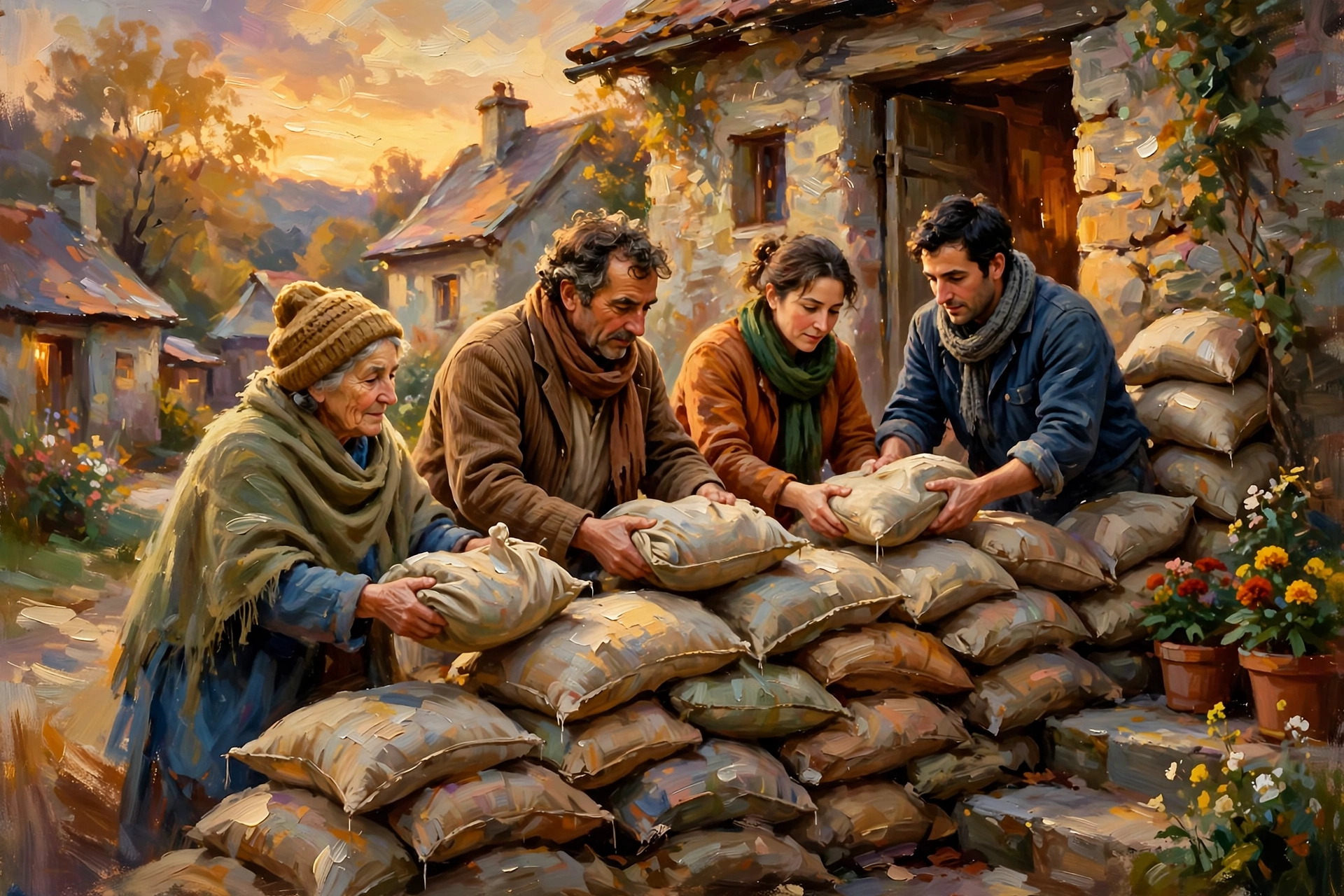
How does community help us heal after a disaster?
Disasters reliably produce a surge of mutual aid — neighbors sheltering neighbors — and that solidarity is itself therapeutic. The writer Rebecca Solnit called it “disaster collectivism”: the discovery that in crisis, people are often at their most generous.
We saw it this week in the shelters of Mouries and Saint-Martin-de-Crau. Research shows perceived social support predicts recovery after disasters better than the severity of the event itself, in many studies. Helping works both ways: receiving restores safety, giving restores agency. If you want to do one useful thing, make it social.
How can I start coping with France floods grief this week?
Grief and anxiety after a disaster are not problems to solve but experiences to move through — these six practices give that moving-through a little more shape:
- Limit disaster imagery intake. Reading the facts once informs you; flood footage on loop re-traumatises you. Get updates from text sources at set times and turn off autoplay.
- Ground the body first. Anxiety lives in the body before it lives in thoughts. Slow breathing (in for four, hold for four, out for six), a short walk, warm food, and protected sleep do more in the first days than any analysis.
- Check on one neighbor. A knock on a door or a short message supports someone else and reminds your own nervous system that you belong to a network, not an island.
- Give grief a shape. Rituals exist because unstructured grief overwhelms. Light a candle, write a few lines, observe a minute of silence. Form does not diminish grief; it makes it bearable.
- Turn worry into preparation. If you are in the northwest, convert anxiety into a checklist: alerts saved, valuables upstairs, a bag packed. Prepared people worry less because the worry has somewhere to go.
- Know when to seek support. If distress stays intense for weeks, you cannot sleep or function, or thoughts turn dark, reach out. In France, the crisis line 3114 is available 24/7 — and speaking with a licensed professional is sense, not weakness.
Frequently asked questions
Is it normal to feel shaken by a disaster I only watched on the news?
Yes. Disaster grief does not require proximity — empathy bridges the distance, and repeated exposure to images and stories produces real stress responses. Feeling affected from afar is humanity, not fragility.
How do I talk to my children about the floods?
Simply, honestly, in small doses: what happened, that helpers are responding, that your family is safe. Let their questions lead, and limit their media exposure more strictly than your own.
What if I cannot stop picturing the victims?
Intrusive images are a normal acute stress response and usually fade as the nervous system settles. Limit imagery intake, ground yourself in the present when they surface, and seek professional support if they stay vivid after several weeks.
Where can I get support in France right now?
The national crisis line 3114 is available 24/7 for anyone in emotional distress. Local mairies coordinate victim support after disasters, and a licensed professional can help longer-term.
How long does disaster grief usually last?
No fixed timeline. Acute distress commonly eases over weeks as routines return; waves of grief — on anniversaries, during later storms — can surface much longer. Both are normal.
Try it on our site
If the floods have left you unsettled, our free tools can help:
- Relaxation techniques — guided breathing exercises
- Wellness check-ins — name your feelings in under a minute
- Challenge the Thought — an interactive CBT tool for spiralling thoughts
Related reading: Hurricane Anxiety and Wildfire Evacuation Anxiety: The Psychology
Key Takeaways
- Disaster grief is collective mourning — grieving strangers, neighbors and places after a catastrophe is a normal human response.
- Ambiguous loss (Pauline Boss) — grief without resolution, as with the missing person in the Var — is the most stressful kind of loss: the mind cannot complete the story.
- Shock, numbness, intrusive images and broken sleep are your nervous system doing its job, not signs you are coping badly.
- Survivor guilt is empathy misfiring; channel it into action — check on a neighbor, donate, volunteer — rather than inward punishment.
- Community is the strongest medicine: “disaster collectivism” (Rebecca Solnit) shows mutual aid heals giver and receiver alike.
Educational content only — not therapy, diagnosis, or professional advice. If you are struggling, consider speaking with a licensed mental health professional. In France, the national crisis line 3114 is available 24/7.