
Last in the West One Year Ago, Grey Cup Champions Now: The Psychology of the Comeback
Reviewed by a Psychology Postgraduate (MA)
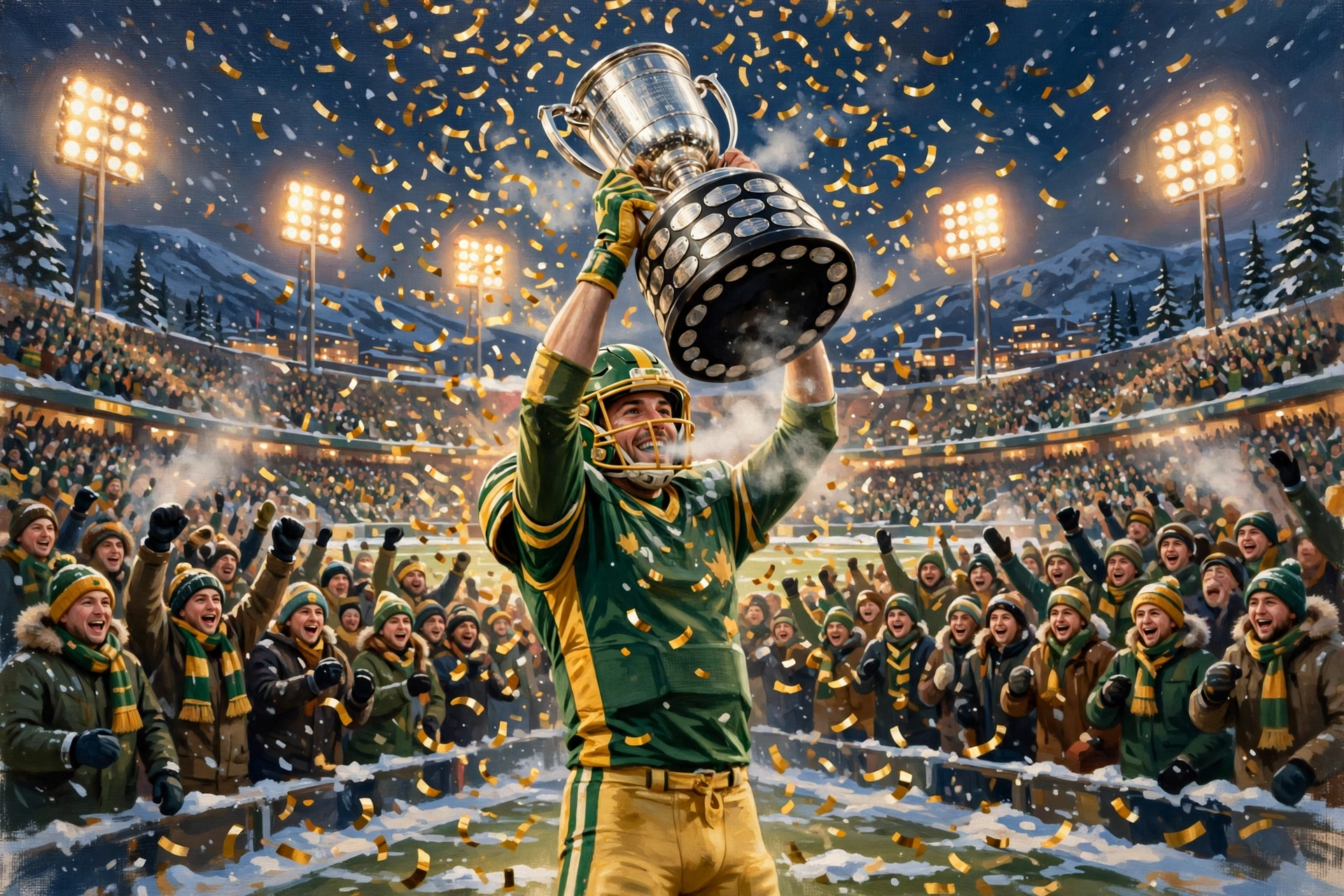
On Sunday 15 November 2026, the Edmonton Elks beat the Montreal Alouettes 37-30 in the 113th Grey Cup at McMahon Stadium in Calgary, in front of 32,419 fans. It was the Elks’ 15th Grey Cup title and their first since 2015, and it completed one of the sharpest turnarounds in Canadian football history: a year ago, Edmonton finished last in the West Division. The game itself was a classic, with six lead changes tying a Grey Cup record and the two teams combining for 763 yards of offence. Quarterback Cody Fajardo, named the game’s Most Valuable Player, threw two touchdown passes and ran for two more, completing 16 of 22 passes for 199 yards, against the very team he had led to the 2023 Grey Cup title before being traded away. Grey Cup psychology is the study of why a comeback like this grips us so hard, and what it reveals about belief, pressure and redemption.
The short answer is that comebacks work on us because they are belief made visible. We spend most of our lives being told that the past predicts the future, that a bad year means a bad team, that a player who was let go was let go for a reason. A comeback is the moment that story breaks, in public, with thousands of people watching. That is why the Elks’ season will be remembered long after the score is forgotten: it was not just a win, it was a correction.
The numbers make the scale of it plain. Montreal came into the game with the CFL’s best regular-season record, 14-4, and had lost only one Grey Cup in the previous three years. Edmonton finished 13-5, but a year earlier they had finished at the bottom of their division and missed the playoffs entirely. Fajardo, 34, won his second Grey Cup MVP award and his third championship ring, two years after the Alouettes moved on from him. The winning margin came from two late field goals by Vincent Blanchard, a 42-yarder with 2:14 to play and a 43-yarder in the final minutes. This was also the last Grey Cup played on the CFL’s historic 110-yard field: from 2027, the field shortens to 100 yards.
What Is the Psychology of a Comeback?
What is the psychology of a comeback? A comeback is a reversal of expectations that is driven by belief, and belief in sport is not a vague feeling. Psychologist Albert Bandura called it self-efficacy: the conviction that you can produce the outcome you want through your own actions. Teams that have it behave differently. They keep playing their game when they fall behind, they trust the plan after a mistake, and they treat a deficit as a problem to solve rather than a verdict.
The Elks’ season is a textbook case. A team that finished last a year ago does not become a champion by accident. It changes what it believes about itself, one game at a time, until the belief becomes evidence. Edmonton won the West Final 28-16 over the B.C. Lions, then beat the best team in the league on the biggest stage. Each win made the next one easier to believe in, which is how self-efficacy compounds: success builds the confidence that produces more success.
There is a quieter version of the same mechanism in ordinary life. A person who has had a bad year at work, a failed relationship, or a health scare faces the same question the Elks faced in January: does last year define this year? The psychology says no, but only if the belief is built on evidence rather than slogans. Small wins, honestly earned, are what change a self-story.
Why Does Cody Fajardo’s Redemption Story Hit So Hard?
Why does Cody Fajardo’s redemption story hit so hard? Because rejection is universal, and public redemption is rare. Fajardo led Montreal to the Grey Cup title in 2023, was named that game’s MVP, and was then traded away the following season. Two years later he stood on the same stage, wearing the other team’s colours, and beat the team that let him go, winning MVP again. That is the narrative arc every person who has been passed over, fired or underestimated has rehearsed in their head a thousand times, except this time it actually happened.
Psychologists call this a redemption narrative: a story in which a bad chapter is not erased but transformed into the reason the good chapter works. Redemption narratives are powerful because they do two things at once. They acknowledge the pain honestly, Fajardo was unwanted, and that stung, and they refuse to let the pain be the ending. Research on life stories by psychologist Dan McAdams finds that people who frame their setbacks as chapters that led somewhere meaningful tend to report higher wellbeing than people who frame them as proof that the world is unfair. The frame does not change the facts. It changes what the facts mean.
It is worth noting what Fajardo did not do. He did not spend the week talking about revenge. He played a controlled, efficient game: 16 of 22, two passing touchdowns, two rushing touchdowns, one interception, and 45 yards on the ground. The overthinking that ruins big performances usually comes from treating the moment as bigger than the task, and Fajardo treated the task as exactly the size it was: the next play.
Why Do Underdogs Capture Our Imagination?
Why do underdogs capture our imagination? Because we see ourselves in them, and because their wins feel earned in a way that favourites’ wins do not. Psychologists have found that people reliably root for the underdog, even when they have no connection to either side, and the effect grows stronger the bigger the gap. Part of it is fairness: we like a world in which effort can beat advantage. Part of it is identification: most of us have been the underdog more often than we have been the favourite.
There is also a cognitive reason. When a favourite wins, the result matches our prediction, and the brain files it away without much fuss. When an underdog wins, the prediction fails, and the brain pays attention. Surprise is a powerful teacher. It makes the memory stick, which is why Grey Cup finals with six lead changes are remembered and one-sided blowouts are not. The Elks-Alouettes game changed leads six times, tying a Grey Cup record, and the first half alone featured 38 points and constant lead changes. Nobody in the stadium could relax, and that is exactly what made it unforgettable.
The Elks’ lesson is the opposite: being the underdog is a starting position, not an identity. The team did not win by embracing underdog status. It won by outgrowing it.
How Do Athletes Handle Championship Pressure?
How do athletes handle championship pressure? By shrinking the moment, not by rising to it. The standard advice in sport psychology is to focus on process, not outcome: the next play, the next throw, the next tackle, rather than the trophy, the crowd or the history. Pressure grows when attention shifts from what you can control to what you cannot, and championship games are engineered to pull attention toward the uncontrollable.
Montreal felt the other side of that coin. The Alouettes had the league’s best record, had won the Grey Cup in 2023, and were playing in their second straight final after losing last year. They led 10-7 after the first quarter and held Edmonton to 13 second-half points, but they could not hold the lead. Favourites carry a different kind of pressure: the expectation that they should win, which turns every mistake into a threat to the story. Psychologists call this the burden of expectation, and it is why favourites sometimes play tight while underdogs play free. The team with less to lose often plays like it.
The same dynamic shows up far from sport. A job interview, a final exam, a first date: the more the outcome matters, the more the mind drifts toward the outcome, and the worse the performance gets. The remedy is the same in every case. Narrow the focus to the next small, controllable action, and let the outcome take care of itself. If the pressure is starting to show up as constant worry, high-functioning anxiety often hides behind exactly this kind of performance, and naming it is the first step to loosening its grip.
Pause and ask yourself: Think of a time you were counted out and proved people wrong, or a time you were the favourite and the pressure got to you. What was different about the two moments: the situation, or what you were paying attention to?
What Does the Elks’ Win Mean Beyond Football?
What does the Elks’ win mean beyond football? For Edmonton, it means the end of an 11-year wait, and for the club’s owner, Deb Thompson, it carries a personal weight. She took over the franchise after her husband, Larry Thompson, died in September 2025, and she called the win surreal, saying he would have loved it. Grief and triumph sitting side by side is not unusual. Psychologists who study meaning-making find that people often hold sorrow and joy together after a loss, and that the two do not cancel each other out. The win does not undo the loss. It gives the loss a different place in the story.
For the rest of us, the win is a reminder that form is not fate. A team that finished last can finish first. A player who was traded away can come back and win the MVP. The psychology of reinvention is the same whether the stage is a football field or an ordinary life: change what you believe about yourself, gather evidence for the new belief one small win at a time, and let the story catch up with the facts.
Frequently Asked Questions
Who won the 2026 Grey Cup?
The Edmonton Elks beat the Montreal Alouettes 37-30 in the 113th Grey Cup on Sunday 15 November 2026 at McMahon Stadium in Calgary. It was Edmonton’s 15th Grey Cup title and its first since 2015.
Who was the Grey Cup MVP?
Edmonton quarterback Cody Fajardo, who threw two touchdown passes and ran for two more, completing 16 of 22 passes for 199 yards. It was his second Grey Cup MVP award; he also won it with Montreal in 2023.
How did the Elks go from last place to champions?
Edmonton finished last in the West Division in 2025, then went 13-5 in 2026, won the West Final 28-16 over the B.C. Lions, and beat the league-best Alouettes in the final. The turnaround was built on belief, consistency and a quarterback with a point to prove.
Why do people love underdog stories?
Because they combine identification, fairness and surprise. We see ourselves in the underdog, we like a world where effort beats advantage, and unexpected wins stick in memory far longer than predictable ones.
What changes for the CFL in 2027?
The 2026 Grey Cup was the last CFL game on the historic 110-yard field. From 2027, the field shortens to 100 yards as part of a package of rule changes.
Try it on our site
These free tools can help you pause, reflect and reset. No signup needed.
- Focus Room — a quiet space to practise staying on the next step, not the outcome.
- Confidence Builder — small, honest steps toward believing your own evidence.
- Thought Reframe — challenge the story that last year defines this one.
- Mind Check-Ins — short questionnaires on mood, anxiety and sleep.
Related reading: Ozzy Osbourne and the Psychology of Reinvention · How to Stop Overthinking Everything · High-Functioning Anxiety Signs
Key Takeaways
- The Edmonton Elks beat the Montreal Alouettes 37-30 in the 113th Grey Cup on 15 November 2026, their first title since 2015 and their 15th overall.
- A year earlier, Edmonton finished last in the West Division. The turnaround was built on self-efficacy: belief earned one win at a time.
- Cody Fajardo won his second Grey Cup MVP against the team that traded him away, a redemption narrative that works because it transforms the setback instead of erasing it.
- Underdogs grip us because of identification, fairness and surprise, and because their wins break our predictions in a way that makes the memory stick.
- Championship pressure is handled by shrinking the moment: focus on the next controllable action, not the trophy.
This article is for education only, not therapy, diagnosis, or medical advice. If you are struggling, consider speaking with a licensed professional. In the US, call or text 988 for the Suicide and Crisis Lifeline, free and 24/7. In Canada, call or text 988 for the Suicide Prevention Helpline, free and 24/7.