
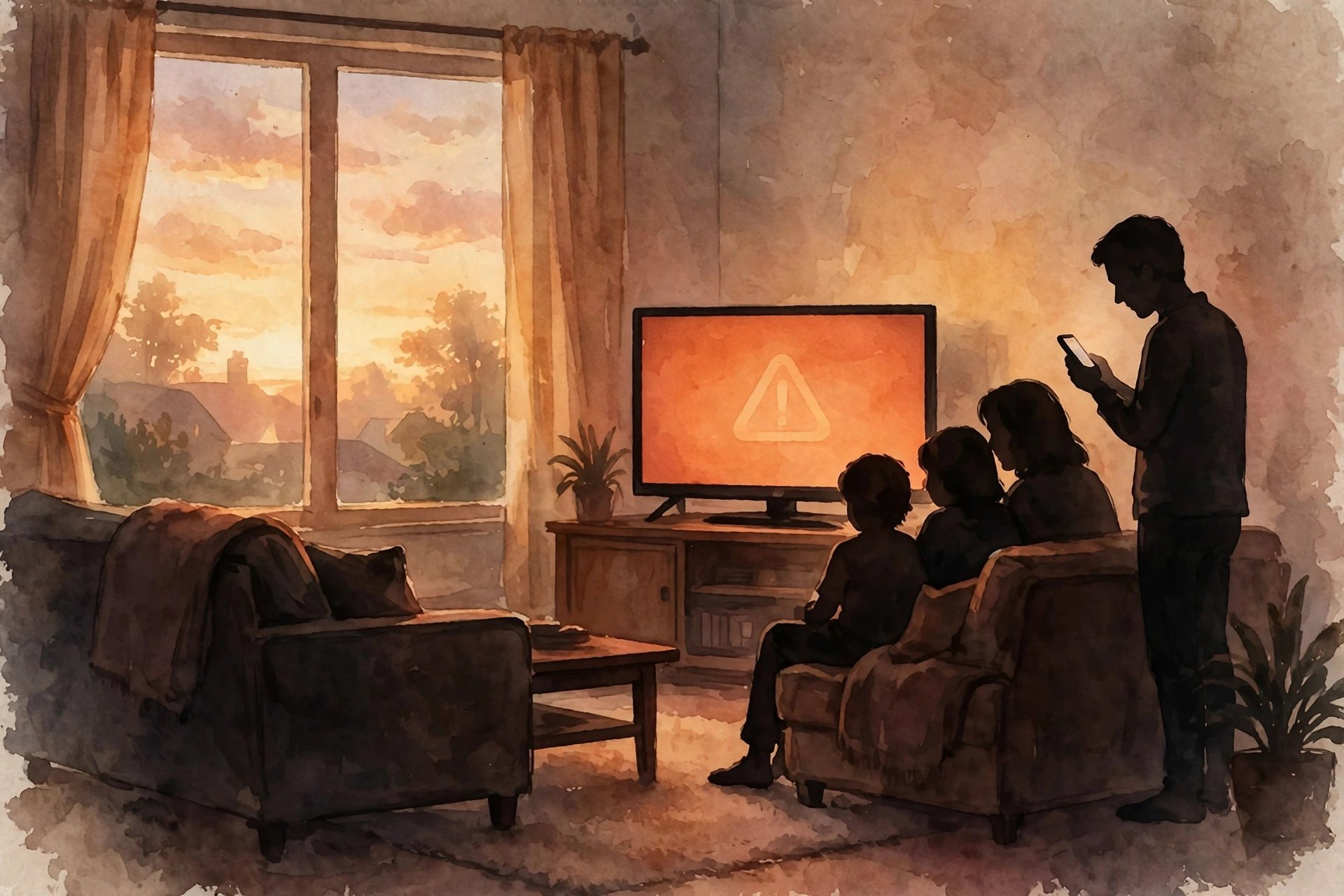
November 17 Blackout Rumour: Why a FEMA Test Caused Panic
Reviewed by a Psychology Postgraduate (MA)
The November 17 blackout rumour claims the United States will go dark for 90 days from Tuesday 17 November 2026. The short answer: it is false. No federal agency has announced a nationwide power shutdown, and the lights will stay on. What is real is a one-minute Emergency Alert System test at about 2:20 p.m. ET. The rumour grew because a cartoon coincidence and two genuine outages that week made a frightening story feel plausible.
What is actually happening on 17 November?
On Tuesday 17 November 2026, the Federal Emergency Management Agency, known as FEMA, and the Federal Communications Commission will test the Emergency Alert System, or EAS, nationwide. It is scheduled for about 2:20 p.m. ET, lasts about one minute, and interrupts radio, television, cable, satellite and wireline broadband providers. The message will say: “This is a nationwide test of the Emergency Alert System, issued by the Federal Emergency Management Agency, covering the United States from 2:20 to 2:50 hours ET. This is only a test. No action is required by the public.”
Unlike the last nationwide test in 2023, this one does not include Wireless Emergency Alerts to mobile phones, so most people will hear nothing on their handset. If a real emergency occurs that day, the test moves to 3 December 2026. FEMA must test the national warning system at least once every three years under the IPAWS Modernization Act of 2015, so this test is routine. Nothing about it touches the electricity grid: the Detroit Free Press reported on 16 November 2026 that the blackout claim is false, and the Economic Times reported on 15 November 2026 that the lights will stay on.
Where did the blackout rumour come from?
A rumour this large rarely has a single source. This one has four ingredients, and each is real on its own, which is exactly why the mixture feels convincing. First, a cartoon: in a Simpsons episode called “It’s a Blunderful Life”, first shown in November 2023, Lisa Simpson’s diary dates a blackout to 17 November. The coincidence is striking, and it is also meaningless, since the episode is fiction and a date in a cartoon diary has no connection to the power grid. But pattern-seeking brains treat two striking things sharing a date as a clue. Psychologists call this apophenia, seeing meaningful connections in unrelated events.
Second, a Pentagon directive dated 30 September 2026 established a programme called “FORTRESS America”, about keeping the United States military supplied with energy and infrastructure during disruptions. It is not a plan to shut down civilian electricity, and it says nothing about a blackout on 17 November. But the dramatic name and a genuine document quoted out of context lend the rumour credibility.
Third, a genuine presidential action. On 26 August 2026, President Trump declared a national emergency concerning the bulk-power system and foreign-produced equipment. It sounds like a warning that the power system is about to fail, but it concerns supply chains and equipment security, not switching anything off. The gap between what it does and what it sounds as if it does is exactly the space a rumour needs.
Fourth, the week itself. On 12 November 2026, Microsoft 365 went down in a major outage that locked people out of email and documents they rely on for work. Then on Friday 13 November 2026, a nationwide FAA ground stop cancelled thousands of flights and stranded passengers across the country. Our piece on the FAA ground stop and the psychology of being stranded looked at the helplessness that follows, and our article on the Microsoft outage and the anxiety of losing your inbox explored the same feeling. When two trusted systems fail in one week, a claim that a third is about to fail starts sounding like a pattern.
Why did the November 17 blackout rumour spread so fast?
Psychologists Gordon Allport and Leo Postman studied rumour during the Second World War and published their findings in 1947. Their basic law still holds: a rumour spreads in proportion to its importance multiplied by the ambiguity of the facts. A nationwide blackout is about as important as a story gets, touching light, heat, food, work and safety at once. And the facts around 17 November were genuinely ambiguous to most people: few had heard of the EAS test, fewer knew it does not involve mobile phones, and almost nobody could say what FORTRESS America actually is. Repetition then did the rest: the illusory truth effect means a claim feels more true each time we hear it.
Anxiety spreads the same way. Psychologists call it anxiety contagion: worry is socially transmissible, and we take our cues about danger from the people around us. A forwarded warning carries two signals: the claim, and the fact that someone you trust passed it on. Our piece on a real Seattle power outage and how people coped in the dark shows the contrast: a genuine outage is local, dated and verifiable. A rumoured one is national and vague, which is why it travels further.
Pause and ask yourself: When you first saw the blackout claim, what made it feel believable — the evidence in the post, or the fact that so many other things had already gone wrong that week?
What is rumour psychology?
Rumour psychology is the study of how unverified stories spread through groups, why people believe and pass them on, and what makes some rumours die quickly while others take hold.
A rumour is rarely one person’s lie. It is a social process, shaped by the needs of those who share it. Allport and Postman found that rumours help people make sense of uncertainty, manage anxiety and signal what matters to their group. This also explains why official denials struggle: a denial is abstract, while the rumour is concrete, with a date, a duration of 90 days, a cartoon that predicted it and a military programme with a dramatic name. The best corrections replace it with a true story just as concrete: a test at 2:20 p.m. ET, lasting about one minute.
What should you do when the alert sounds?
First, expect the sound and know what it means. At about 2:20 p.m. ET on Tuesday 17 November 2026, radio and television broadcasts will be interrupted for about one minute. Your mobile phone will almost certainly stay silent, because this test does not include Wireless Emergency Alerts. If you hear the tones, nothing is wrong and no action is required.
Second, if alert tones make you anxious, plan for the moment rather than dreading it. Turn the volume down, step away from the television for a minute, or listen with someone else in the room. A loud, sudden tone is designed to grab attention, and a nervous system that has spent a week absorbing outage news will grab it hard. Slow breathing helps, as does saying out loud: “This is the scheduled test. It lasts one minute.”
Third, check the source before you share. Before forwarding any dramatic claim, ask three questions. Who is saying this, and do they have a way of knowing? Is the claim dated and specific, or vague and urgent? And does an official source say the same thing? Here the answers are clear: FEMA announced a one-minute test, and no federal agency has announced any shutdown.
Frequently asked questions
Is the power going out on 17 November?
No. No federal agency has announced any nationwide shutdown, and the Detroit Free Press reported on 16 November 2026 that the claim is false. Only a one-minute alert test is scheduled, at about 2:20 p.m. ET.
What time is the test?
About 2:20 p.m. ET on Tuesday 17 November 2026, lasting about one minute. If a real emergency occurs that day, the test moves to 3 December 2026.
Will my phone get the alert?
Almost certainly not. Unlike the test in 2023, this one does not include Wireless Emergency Alerts to mobile phones. It interrupts radio, television, cable, satellite and wireline broadband providers instead.
Why did the Simpsons get mentioned?
A Simpsons episode called “It’s a Blunderful Life”, first shown in November 2023, features a diary entry by Lisa Simpson that dates a blackout to 17 November. It is fiction, but the date coincidence made it a natural hook for the rumour.
Key takeaways
- The November 17 blackout rumour is false: no federal agency has announced a nationwide shutdown, and the lights will stay on.
- What is real is a one-minute test of the Emergency Alert System on Tuesday 17 November 2026 at about 2:20 p.m. ET, with no alert to mobile phones.
- The rumour fed on a Simpsons episode from November 2023, the FORTRESS America programme, a 26 August 2026 emergency declaration, and two real outages that week.
- Allport and Postman’s 1947 finding still explains it: a rumour spreads with its importance times the ambiguity of the facts.
- Repetition makes a claim feel true, anxiety is contagious, and vivid concrete details beat abstract denials.
- When the alert sounds, no action is required. Check the source before you share.
Try it on our site
If the rumour left you feeling on edge, these free tools can help, no signup needed:
- Mind Check-Ins — a quick check-in on how you are feeling right now.
- Challenge the Thought — test a worried thought against the evidence.
- Thought Reframe — turn a spiralling “what if” into a calmer thought.
- Relaxation Techniques — short exercises to settle your nervous system.
This article is for education only and is not a substitute for professional advice. If the rumour has left you distressed, consider speaking to a healthcare professional. In the United States, you can call or text 988 at any time if distress feels overwhelming.
Related reading: the FAA ground stop and the psychology of being stranded, the Microsoft outage and the anxiety of losing your inbox, and a real Seattle power outage and how people coped in the dark.