
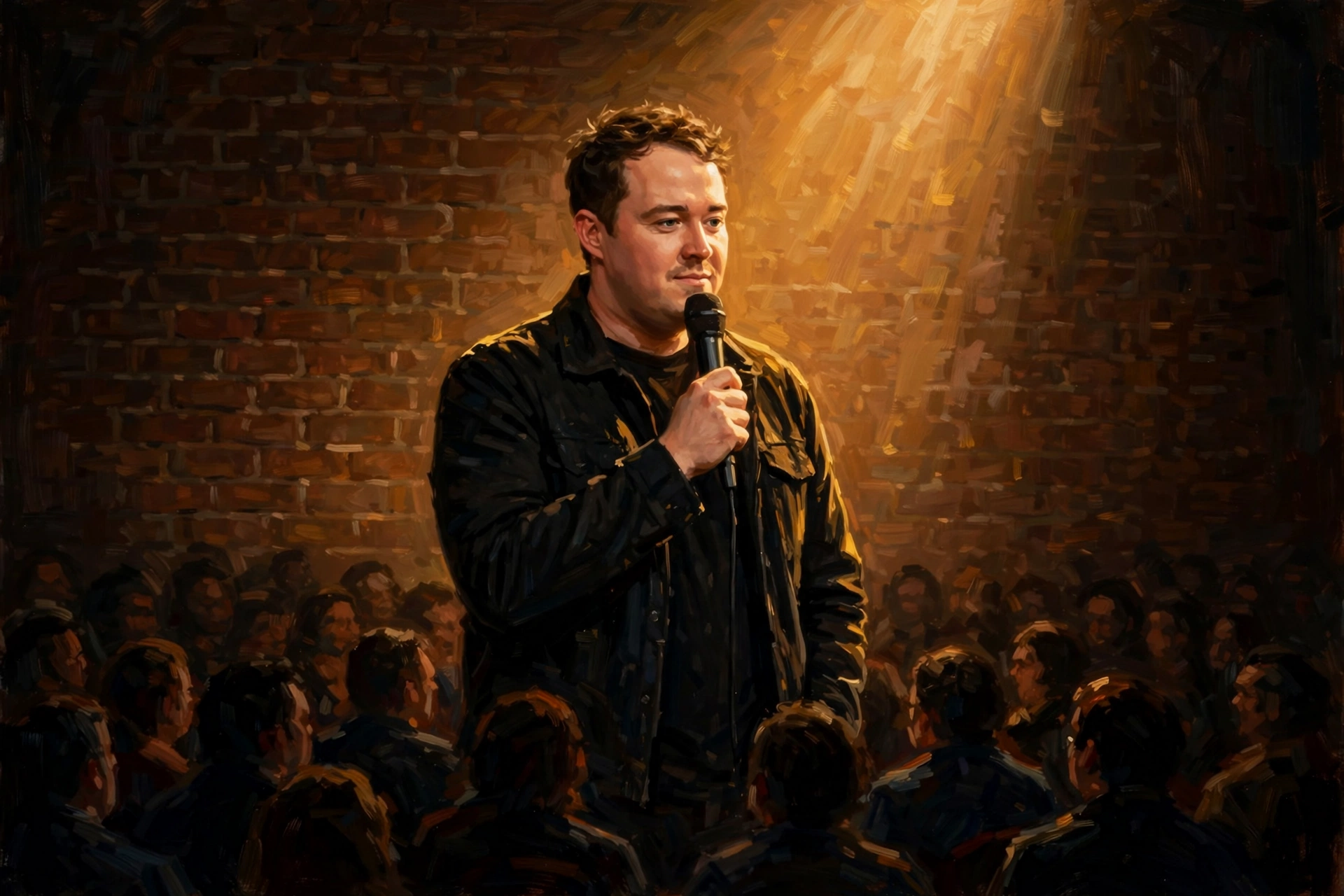
Shane Gillis Psychology: Fired in Five Days, Back on Top – and the Stress That Came With It
Reviewed by a Psychology Postgraduate (MA)
Shane Gillis psychology is a story about what happens when a career collapses in public, and what it takes to rebuild it anyway. On 13 November 2026, Gillis sat down on The Joe Rogan Experience and talked openly about the month he had just lived through. He had hosted Saturday Night Live for a third time on 10 October 2026, and a joke in his opening monologue had set off a wave of backlash. He rated the monologue a “C minus”, said he had deleted social media and spent a month away, and then he said something that stopped the conversation in its tracks: toward the end of a stand-up set during the fallout, he felt severe chest pain, and bloodwork showed what he described as a “severe cortisol spike”. The backlash, he said, felt harder than the 2019 firing that had once ended his SNL dream after five days.
So what does Shane Gillis’s story reveal about resilience? It shows that resilience is rarely a single heroic bounce. It is a slow process of staying in the work, tolerating shame and uncertainty, and rebuilding a reputation one room at a time, while the body keeps its own score of the stress involved.
Resilience is the capacity to adapt well in the face of adversity, trauma, or significant stress, and to keep functioning and growing through it.
This profile is an educational look at public behaviour and research, not an assessment of the person. Everything here comes from the public record: interviews, reported events, and widely covered moments in Gillis’s career. Nothing here diagnoses him or speculates about his private mental health. His own words about stress and the cortisol spike are reported as his own account, framed as stress, never as a diagnosis.
Story: Shane Gillis Psychology Begins in Mechanicsburg
Shane Michael Gillis was born on 11 December 1987 in Mechanicsburg, Pennsylvania. He grew up in an Irish Catholic family, and that background – big family energy, Catholic school discipline, a town where everybody seemed to know everybody – runs through his comedy like a thread. He attended Trinity High School in Camp Hill and graduated in 2006, where he played offensive tackle at 6 ft 4 in and 275 lb. Football gave him a first identity: the big guy on the line, useful, physical, part of a team.
That identity nearly became his life. He was recruited to West Point, the United States Military Academy, but left during his first year. He played one season of football at Elon University, then left there too. After community college, he finished a BA in history at West Chester University, and then spent six months teaching English in Spain. It is a wandering early adulthood: a young person trying on identities – soldier, athlete, student, teacher abroad – and finding that none of them quite fits.
Comedy found him in 2012, when he started performing stand-up. There was no overnight moment. For years he worked the rooms in Philadelphia and New York, building an act out of the world he knew: Catholic school, small-town Pennsylvania, football locker rooms, drinking with friends. In 2016 he started Matt and Shane’s Secret Podcast with Matt McCusker, a long-form conversation show that became a home base for his voice – loose, unfiltered, funny in a way that felt like sitting at a bar with two friends who had known each other forever.
The work accumulated. In 2019 he was selected as a Just for Laughs New Face, one of the clearest signals in comedy that the industry is watching you. That same year, everything changed – twice.
Turning Point
On 12 September 2019, Gillis was announced as a featured cast member on Saturday Night Live for season 45, alongside Chloe Fineman and Bowen Yang. For a stand-up comic, there is no bigger door. SNL is the job that changes a life: national television every week, a writers’ room full of the best in the business, a platform that turns comics into household names.
Five days later, it was gone. On 16 September 2019, clips from a 2018 podcast resurfaced in which Gillis had used racial and homophobic slurs. The clips spread fast, the criticism was fierce, and SNL fired him before he had appeared in a single episode. He apologised, calling himself “a comedian who pushes boundaries”. Five years later, Lorne Michaels said the decision to fire him had been forced on him by NBC executives – a detail that reframes the story slightly, but does not change what Gillis lived through that week: the highest high of his career, followed by the lowest low, inside five days.
Psychologists who study identity talk about what happens when a core identity is threatened in public. Social identity theory, developed by Henri Tajfel, describes how much of our self-worth is tied to the groups we belong to. Gillis had just been welcomed into one of the most prestigious groups in comedy, and then expelled from it in front of the whole country. The shame of that is not abstract. Shame researcher Brene Brown describes shame as the intensely painful feeling of being unworthy of connection and belonging – and public shaming, amplified by social media, delivers that feeling at a scale no previous generation of comedians had to face.
And then, seven years later, the pattern repeated in miniature. On 10 October 2026, Gillis hosted SNL for a third time, with Rosalia as musical guest. His opening monologue included a joke about returning to a gym and women’s gym clothing: “I haven’t been to the gym in so long, I didn’t know women just dress like whores now?” The room gasped. The backlash came quickly, including a public response from actor Dan Levy, who wrote that women wearing short shorts to the gym does not make them whores. A month later, on Rogan’s show, Gillis said this backlash felt harder than the 2019 firing. The first time, he lost a job he had held for five days. The second time, he had everything to lose – a Netflix sitcom, specials, a career he had spent seven years rebuilding.
Mindset
What mindset carries a person through a five-day public firing and back to the same stage four and a half years later? Gillis has never given a tidy answer to that question, and that is probably the honest answer. In interviews he comes across as stubborn rather than strategic, funny rather than philosophical. But his behaviour over seven years reveals a pattern psychologists would recognise: a growth mindset applied to a very specific problem.
Carol Dweck’s research on growth mindset distinguishes between believing abilities are fixed and believing they can be developed through effort. Gillis’s career after 2019 looks like the second kind in action. He did not try to argue his way back into the industry’s good graces, and he did not disappear. He went back to the rooms. He made sketches. He recorded the podcast. He toured. He treated the work itself as the path back, rather than treating reputation repair as the job.
There is also something important about his relationship with the audience. His comedy has always been built on a particular kind of honesty: saying the thing people think but do not say, then dealing with the consequences. That is a risky way to work, and the risk is the point. When a comic’s whole style is built on pushing boundaries – his own words – then a boundary-pushing joke that lands badly is not an accident in the system. It is the system working exactly as designed, with the costs included.
Decisions
Look at the decisions Gillis made after September 2019 and a shape emerges. First, he did not chase the old door. There was no public campaign to get rehired, no apology tour built for television. Instead, in 2020, he and John McKeever launched Gilly and Keeves, a sketch series made on their own terms, outside any network. That decision matters more than it looks. When the biggest platform in comedy closes to you, the natural move is to wait for another big platform. Gillis built a small one instead, and owned it.
Second, he kept the podcast going. Matt and Shane’s Secret Podcast was not just a show; it was a direct line to the audience that had stayed with him, and a place where his voice could exist without a network filter.
Third, he chose the long road of stand-up. In 2021 he released his first special, “Shane Gillis: Live in Austin”, on YouTube – free, direct to the audience, no gatekeeper. On 5 September 2023, his Netflix special “Beautiful Dogs” arrived and reached the Top 10 in five countries. That is a decision about distribution as much as about comedy: if the old gatekeepers will not let you in, build an audience so large that the gates stop mattering.
Fourth, he said yes to the return. On 24 February 2024, nearly four and a half years after the firing, he hosted SNL for the first time. He hosted again in 2025. Walking back into the building that fired you, in front of a live audience, is a decision that takes a particular kind of nerve. Psychologists call this approach behaviour: moving toward the feared situation rather than avoiding it. Avoidance feels safer in the short term and costs more in the long term. Gillis chose approach, twice over, and then a third time in October 2026.
Method
Gillis’s method as a comedian is deceptively simple: he talks like a regular person, about regular life, and finds the absurdity hiding inside it. His best material comes from observation rather than invention – the way people actually behave at a gym, in a bar, at a family dinner – stretched just far enough to become funny. The delivery is relaxed, almost sleepy, which makes the sharp lines land harder. He does not perform effort. He performs ease.
That ease is a craft. Stand-up at his level is built on thousands of hours of small rooms, where a joke either works or it does not, and the audience tells you within seconds. This is deliberate practice in its purest form: immediate feedback, constant revision, no place to hide.
There is also a method to his career choices. He has built his work around collaborators he trusts – McKeever on sketches and on Tires, McCusker on the podcast, Steve Gerben as co-creator on the sitcom. Creative partnerships like these function as what psychologists call a secure base: people who know you, who will tell you the truth, and whose presence makes risk-taking possible. When your public life involves regular controversy, a private circle that is steady matters more than any single career move.
His method also includes a deliberate distance from the machinery of fame. He deleted social media during the October 2026 fallout and spent a month away from it. That is not retreat; it is boundary-setting. Research on attention and wellbeing consistently finds that stepping away from the feed reduces exposure to the exact thing that makes public criticism feel endless: the constant refresh, the new replies, the sense that the judgement is still happening right now. Gillis’s month away was a practical decision, and a psychologically sound one.

What If?
What if the 2018 clips had never resurfaced? It is tempting to imagine a smooth version of the story: Gillis joins the SNL cast in 2019, becomes a regular, builds a career inside the system. But smooth stories are rarely honest ones. A cast member’s life is a particular life – weekly deadlines, ensemble work, a character actor’s career shaped by the show’s needs. The Gillis who exists now – a Netflix special star, the co-creator of a hit sitcom, a podcaster with a direct audience – was built by the firing as much as by the talent. The detour became the road.
What if he had never gone back to host SNL? The 2024 hosting gig was a public reconciliation, a moment the whole comedy world watched. Without it, the story stays unfinished: the guy who got fired and built his own thing, full stop. With it, the story gains a second act of a different kind – not revenge, not apology, but return. The return matters because it shows that institutions and individuals can both change, and that a door closed in 2019 was not locked forever.
What if the October 2026 monologue had landed differently? A joke that gets a laugh instead of a gasp changes the whole month. But the deeper question is what the backlash revealed: that even after a full comeback, the same fault line is still there. Gillis’s comedy pushes boundaries, and boundaries push back.
What Most People Lack
Most people, faced with a public firing like the one in 2019, would do one of two things: disappear, or fight the verdict in public until the fight itself became the story. Gillis did neither, and that is the thing most people lack: the patience to rebuild slowly, in small rooms, without an audience watching the rebuild.
Patience like that is not a personality trait. It is a skill, and it is built the way any skill is built: by doing the boring version of the work, day after day, when nobody is applauding. Self-determination theory, developed by Edward Deci and Richard Ryan, says people stay motivated when three needs are met: autonomy, competence, and relatedness. After 2019, Gillis rebuilt all three on his own terms. Autonomy: his own sketches, his own podcast, his own specials. Competence: rooms that got bigger because the act got better. Relatedness: collaborators and an audience who chose him directly, not through a network.
Most people also lack his tolerance for being disliked. That sounds like a small thing. It is not. The fear of social rejection is one of the strongest forces in human psychology, and social media has turned it into a daily weather system. A comic whose work depends on risking disapproval has to be able to sit with disapproval without either collapsing or lashing out.
What Successful People Do Differently
Successful people in Gillis’s position do something that looks simple and is very hard: they keep producing. After the firing, he did not wait for permission. He made Gilly and Keeves. He toured. He released a special on YouTube. He took a recurring role in Pete Davidson’s Peacock series “Bupkis” in 2023, and a Bud Light partnership that led to a Super Bowl advert in 2024. Each of those is a brick. None of them is the whole building. The difference between people who come back and people who do not is often just the willingness to lay the next brick when the last one felt pointless.
They also diversify without diluting. Gillis’s career now spans stand-up, sketches, podcasting, and scripted television. The Netflix sitcom “Tires”, which premiered on 23 May 2024 and which he co-created with McKeever and Steve Gerben, ran to a second season in June 2025 and a third in August 2026. That is not a side project. It is a second career inside the first one, and it means a bad month in stand-up does not end the story. Psychologists call this identity complexity: when your sense of self rests on more than one pillar, the collapse of one pillar does not bring down the house.
And successful people learn the difference between a setback and a verdict. A firing feels like a verdict: you are done, the industry has spoken. Gillis treated 2019 as a setback, not a verdict, and behaved accordingly. That distinction – setback versus verdict – is the heart of a comeback built on stubborn persistence, and it is the reason the story did not end in September 2019.
Pause and ask yourself: When have you treated a setback as a final verdict, and what changed – or what might change – if you treated it as a setback instead? What is one small, boring, repeatable step you could take this week toward the thing you think is over?
Success Mindset
Gillis’s success mindset is not the polished, motivational-poster kind. There are no morning routines in this story, no five-step plans. What there is, instead, is a workmanlike relationship with the job: show up, write, perform, repeat. That is closer to how success actually works than most success stories admit. Research on expertise, from Anders Ericsson onward, keeps finding the same thing: sustained, focused practice over years matters more than any single breakthrough.
There is also a useful stubbornness in his mindset. Stubbornness gets a bad name in psychology, but in its healthy form it is close to what Angela Duckworth calls grit: passion and perseverance for long-term goals. Gillis’s long-term goal was never complicated. He wanted to be a comedian, on his own terms, in front of rooms that wanted him there.
One more piece of the mindset: he does not seem to perform success for the audience. The persona on stage is not a winner’s persona. It is a regular guy noticing things. That matters, because the moment a comedian starts performing their own success, the comedy often dies.
Failures
The failures in this story are not footnotes. They are the story. The 2019 firing is the biggest: Gillis lost the biggest job in comedy because of words he had said on a podcast a year earlier. He apologised. The apology did not save the job. That is how public failure works: the apology is necessary, and it is not sufficient. What comes after the apology is what matters, and what came after was seven years of work.
The October 2026 monologue is a second failure, different in shape. This time he was not fired. He was hosting, by invitation, on the biggest stage in his field, and a joke misfired in front of a live audience and then in front of the internet. He rated the monologue a “C minus” himself – a strikingly honest grade from a performer who could have blamed the room, the moment, or the critics. Owning the grade is a form of what psychologists call an internal locus of control: the belief that outcomes are shaped by your own actions, not only by forces outside you. People with a stronger internal locus of control tend to recover from setbacks faster, because they can see something to fix.
There are quieter failures too. West Point did not work out. Elon did not work out. Teaching in Spain lasted six months. A career that looks inevitable in hindsight was, at the time, a series of things that did not fit. The psychology of failure is often told as a story about resilience, but it is also a story about information: each thing that did not work told him something about what did. The football player became a teacher, the teacher became a comic, and the comic became, eventually, the person standing on the SNL stage in 2024, 2025, and 2026.
It is worth noting the difference between the two public failures. In 2019, the cost was a job. In 2026, the cost was physical. Gillis said he felt severe chest pain toward the end of a stand-up set during the fallout, and that bloodwork showed a severe cortisol spike. Cortisol is the body’s main stress hormone, released through the HPA axis – the hypothalamic-pituitary-adrenal system – when we face threat. A spike is the body doing its job: mobilising energy to deal with danger. The problem is not the spike itself but what happens when stress stays switched on, day after day, with no real recovery. His account is a reminder that public pressure is not only a reputational event. It is a physiological one, and the body keeps a record even when the headlines move on. Anyone recognising the signs of burnout in their own life should take that record seriously.
Relationships
Gillis keeps his private and family life out of the press, and this profile respects that completely. What the public record does show is the professional relationships that have carried his career: the long collaboration with Matt McCusker on the podcast, the creative partnership with John McKeever on sketches and on Tires, and the working relationship with Steve Gerben. These are not celebrity friendships performed for the cameras. They are working partnerships, built over years, and they function the way good relationships function in any life: they provide honest feedback, shared history, and a place to be ordinary.
There is a psychological point here about the difference between an audience and a community. An audience applauds. A community tells you when a bit is not working, when you need to rest, when you are about to make a mistake. Gillis’s collaborators are his community, and the career he built after 2019 was built inside that community rather than alone. Research on social support is unambiguous on this point: people with strong, stable relationships cope with stress better, recover from setbacks faster, and stay healthier under pressure. The cortisol story from November 2026 makes the point from the other side: when stress spikes, the people around you are not a luxury. They are part of the coping system.
His relationship with the audience is a different thing again. Comedy is an unusually intimate art form: a comic stands alone, with no band and no cast, and asks a room full of strangers to trust him. That trust is also fragile, as October 2026 showed. A joke that breaks trust with part of the room does not only cost laughs. It costs a little of the connection itself, and connection is the whole business.
Dark Side
Every strength in this story has a shadow, and honesty requires naming it. The same boundary-pushing instinct that makes Gillis funny is the instinct that has twice caused him serious public trouble. The 2018 podcast clips contained racial and homophobic slurs, and no amount of context about comedy changes the fact that those words cause real hurt. The 2026 gym joke, whatever its intent, landed as demeaning to women, and the backlash – including Dan Levy’s public response – was a direct consequence of the joke’s content, not a misunderstanding of it.
This is the dark side of a style built on saying the unsayable: sometimes the unsayable is unsaid for a good reason. The psychology here is not mysterious. Humour that punches at a group that already faces judgement can feel, to the people in that group, like one more voice in a chorus they hear every day. A comic in a room cannot control who hears the joke once it leaves the room, and in the age of clips, a joke told to a live audience is a joke told to the world. The risk is structural, not accidental.
There is also a darker question about the cost of the comeback itself. The cortisol spike Gillis described is not a punchline. It is what chronic stress looks like when it shows up in the body – chest pain on stage, bloodwork that alarms a doctor, a month away from social media to recover. A career built on absorbing public criticism and continuing anyway has a price, and the price is paid in the body as surely as in the reputation. The question is not whether the comeback was worth it. Only Gillis can answer that. The question for the rest of us is whether we recognise the cost when we watch someone pay it.
None of this is a diagnosis, and none of it is an excuse. It is a description of a pattern: a talent, a risk, a cost, repeated. The pattern is the interesting thing, because patterns are what psychology studies.
Second Act
The second act of Gillis’s career is already well underway, and it looks very different from the first. The first act was a young comic climbing toward the biggest stage in comedy. The second act is a comic who lost that stage, built his own, and then was invited back to the first one on new terms. On 24 February 2024 he hosted SNL for the first time, nearly four and a half years after being fired from it. He hosted again in 2025, and a third time on 10 October 2026. On 16 July 2025 he hosted the ESPY Awards. The Netflix sitcom Tires, which premiered in May 2024, reached its third season in August 2026. Beautiful Dogs, his 2023 Netflix special, reached the Top 10 in five countries.
A second act after a public fall is one of the oldest stories in entertainment, and it follows a pattern that other famous comebacks share. The pattern has a psychological shape: the fall strips away the parts of the identity that were borrowed from other people’s approval, and what is left – if anything is left – is the part that was yours all along. For Gillis, what was left was the work: the stand-up, the podcast, the sketches, the rooms.
Post-traumatic growth is the term psychologists Richard Tedeschi and Lawrence Calhoun gave to the positive change that can follow struggle: a deeper appreciation of life, closer relationships, new possibilities, personal strength, and spiritual change. Not everyone grows from hardship, and growth is never guaranteed. But the shape of Gillis’s career after 2019 fits the pattern in one respect at least: the work that came after the firing was broader, more independent, and more fully his own than anything that came before it. The firing did not only cost him a job. It forced him to build a career that no single employer could take away, and that is a form of growth, whether or not anyone calls it by that name.

Fun Facts
- He taught English in Spain for six months after university – a long way from the Philadelphia comedy rooms where he started in 2012.
- Matt and Shane’s Secret Podcast, which he started with Matt McCusker in 2016, predates his SNL hiring by three years and outlasted the firing entirely.
- His first special, “Shane Gillis: Live in Austin”, was released on YouTube in 2021 – free to watch, with no network in between him and the audience.
- “Beautiful Dogs”, his 2023 Netflix special, reached the Top 10 in five countries.
- He has hosted Saturday Night Live three times – February 2024, 2025, and October 2026 – after being fired from the cast in 2019 before appearing in a single episode.
- The sitcom “Tires”, which he co-created, reached its third season in August 2026, two years after its premiere.
What the Research Says
Gillis’s story touches several well-studied areas of psychology, and the research helps explain why his experience felt the way it did – and why his recovery worked the way it did.
First, stress and the body. The HPA axis is the system that releases cortisol when we perceive threat, and Hans Selye’s early work on stress established that the body responds to social threat much as it responds to physical threat. Research on social-evaluative threat – situations where we fear being judged negatively by others – shows that it produces some of the largest cortisol responses of any laboratory stressor. Gillis’s account of chest pain and a severe cortisol spike during the October 2026 fallout is consistent with that research: the body was responding to a sustained social-evaluative threat, night after night. The fact that the backlash of 2026 felt harder than the firing of 2019 also fits: in 2019 he lost a job he had barely started, while in 2026 he had a whole career, built over seven years, that felt at risk – and the platforms that carry the criticism are designed to keep us scrolling through it long after the moment has passed.
Second, shame and recovery. Brene Brown’s research on shame resilience finds that the people who recover best from shame are not the people who feel it least, but the people who can name it, share it with trusted others, and separate their actions from their identity: “I did something bad” rather than “I am bad”. Gillis’s public apology in 2019, and his frank “C minus” self-assessment in 2026, both fit that pattern. Naming the failure honestly is not the same as fixing it, but it is the step that makes fixing possible.
Third, post-traumatic growth. Tedeschi and Calhoun’s research finds that growth after adversity is most likely when people can make meaning from what happened, and when they have social support while doing so. Gillis’s meaning-making is visible in the shape of his career: the firing became the reason to build independent work, and the independent work became the foundation for a return on his own terms.
Fourth, mindset and persistence. Dweck’s growth mindset research and Duckworth’s work on grit both point the same way: people who believe they can improve through effort, and who keep going toward long-term goals, outperform people with equal talent who quit earlier. Seven years of small rooms, sketches, podcasts, and touring is what that research looks like in practice.
Finally, identity. Tajfel’s social identity theory helps explain why the 2019 firing stung so deeply and why the 2024 return mattered so much. Being cast out of a group we value threatens our sense of self; being welcomed back, or building a group of our own, restores it. Gillis did both: he built his own group, and then he walked back into the old one – as a host, on his own terms.
Activity
Test what you have picked up from this profile. Choose one answer for each question, then check your answers below.
1. How many days passed between Shane Gillis being announced as an SNL cast member and being fired in 2019?
a) Two days b) Five days c) Twelve days d) Thirty days
2. What did Gillis say he found on his bloodwork during the October 2026 fallout?
a) A vitamin deficiency b) A severe cortisol spike c) Low iron d) High cholesterol
3. What grade did Gillis give his own October 2026 SNL monologue on The Joe Rogan Experience?
a) A plus b) B minus c) C minus d) D plus
4. Which of these did Gillis release on YouTube in 2021?
a) Beautiful Dogs b) Gilly and Keeves c) Shane Gillis: Live in Austin d) Tires
5. According to the research in this profile, what does post-traumatic growth describe?
a) Forgetting a painful event completely b) Positive change that can follow struggle, such as new possibilities and personal strength c) Avoiding all future risks d) Returning to exactly how things were before
Answers: 1 – b, 2 – b, 3 – c, 4 – c, 5 – b.
Frequently Asked Questions
Why was Shane Gillis fired from SNL in 2019?
He was announced as a featured cast member on 12 September 2019 and fired on 16 September 2019, five days later, after clips from a 2018 podcast resurfaced in which he had used racial and homophobic slurs. He apologised at the time, and Lorne Michaels later said the decision had been forced on him by NBC executives.
What happened with his October 2026 SNL monologue?
Hosting for a third time on 10 October 2026, Gillis told a joke about returning to a gym and women’s gym clothing that drew gasps and a wave of backlash, including a public response from Dan Levy. On 13 November 2026 he told Joe Rogan the monologue was a “C minus” and that the backlash felt harder than the 2019 firing.
What did Shane Gillis say about the cortisol spike?
On The Joe Rogan Experience on 13 November 2026, he said he felt severe chest pain toward the end of a stand-up set during the fallout and that bloodwork showed a severe cortisol spike. This is his own account of his stress, reported here as his own words, not as a diagnosis.
Did Shane Gillis host SNL again after being fired?
Yes. He hosted for the first time on 24 February 2024, nearly four and a half years after the firing, then again in 2025, and a third time on 10 October 2026.
What is the psychology of a comeback like Shane Gillis’s?
Research points to several factors: a growth mindset, persistence toward long-term goals, strong social support, the ability to name failure honestly, and building an identity that rests on more than one pillar, so a single setback does not end the story.
Try it on our site
If this profile got you thinking about pressure, stress, or bouncing back, try one of these free tools on our site – no signup needed:
- Mind Check-In – a quick check-in on how you are feeling today.
- Burnout + Money-Stress Check – see where your stress is coming from and what might help.
- Name Your Feeling – put a name to what you are feeling, which is the first step to working with it.
- Social Confidence – practical steps for feeling steadier in social situations.
Related reading: Randy Travis Psychology: The 1% Comeback, Resilience, and Finding Your Voice Again, Michelle Pfeiffer Psychology: 33 Years of Marriage, Reinvention, and the Quiet Mind Behind the Stardom, Signs of Burnout: 12 Signals You Are Not Just Tired.
Key Takeaways
- Shane Gillis was fired from SNL five days after being hired in 2019, then rebuilt his career independently through sketches, podcasting, touring, and specials – and hosted the show three times from 2024 onward.
- His October 2026 monologue backlash felt harder than the 2019 firing, by his own account, and came with real physical stress: chest pain on stage and bloodwork showing a severe cortisol spike.
- Resilience here was not one heroic bounce but seven years of steady work – small rooms, trusted collaborators, and a career built on more than one pillar.
- Research on shame, stress, and post-traumatic growth helps explain both the cost of public failure and the conditions under which people recover from it.
- The same boundary-pushing instinct that makes his comedy work is also what has twice caused him serious public trouble – a pattern worth understanding, not excusing.
This article is for education only and is not a substitute for professional advice, diagnosis, or treatment. If you are struggling, please consider speaking to a licensed professional, or contacting a crisis line in your country, such as 988 in the United States.