
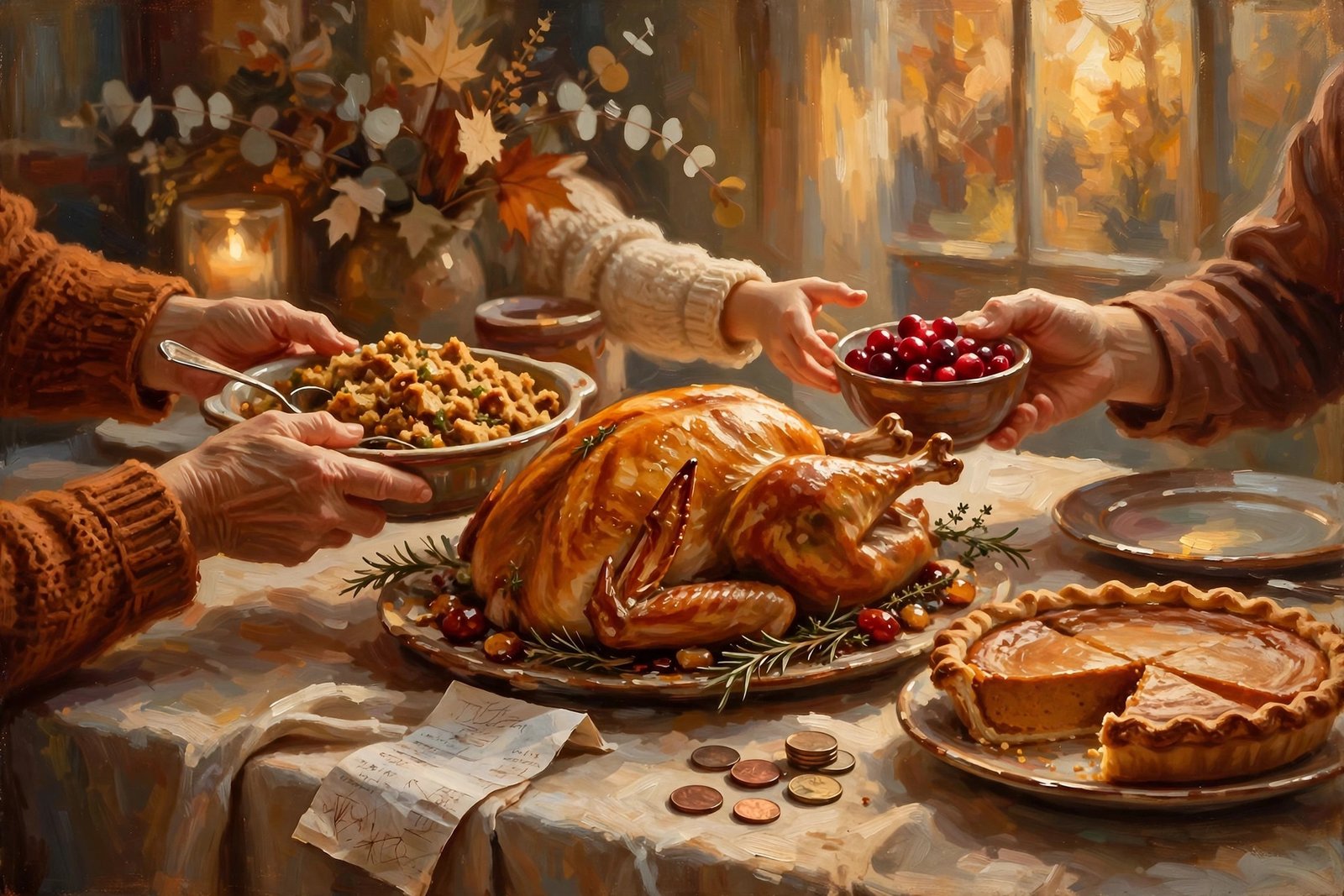
Thanksgiving Dinner Costs 6% More This Year: The Psychology of Holiday Money Stress
Reviewed by a Psychology Postgraduate (MA)
A classic Thanksgiving dinner for ten people costs $58.63 in 2026, about $5.86 per person, up about 6 percent from last year. That is the headline from the American Farm Bureau Federation survey released on 18 November 2026, and it is the first increase since 2022.
The Thanksgiving dinner cost for ten now stands at $58.63, up about 6 percent from 2025, driven mainly by a pricier turkey. The meal is still 8.5 percent below the record high of $64.05 set in 2022. A fuller table, a tighter budget, and a host wondering whether this year will measure up.
What does Thanksgiving dinner cost in 2026?
The survey is the Federation’s 41st annual Thanksgiving dinner cost survey, running since 1986. Volunteer shoppers in all 50 states and Puerto Rico checked prices in the first week of November 2026. Thanksgiving Day 2026 falls on 26 November, so the numbers land as families write their shopping lists.
The turkey is the biggest driver. A 16-pound turkey costs $23.68, or $1.48 per pound, up 10.1 percent from 2025, a rise of $2.38. Milk, one gallon, is $4.05, up 8.6 percent. Fresh cranberries, 12 ounces, are $2.48, up 8.8 percent. Dinner rolls, one dozen, are $3.81, up 7 percent. Sweet potatoes, three pounds, are $4.20, up 5 percent. Cubed stuffing mix, 14 ounces, is $3.91, up 5.4 percent. Pumpkin pie mix, 30 ounces, is $4.24, up 1.9 percent.
Not everything rose. Frozen peas, one pound, are $1.99, down 2 percent, and a vegetable tray, one pound, is $1.31, down 3.7 percent. Eight of the twelve items rose in total. Adding boneless ham, russet potatoes and frozen green beans adds $23.09, bringing the expanded total to $81.72.
Where you live changes the bill. The classic meal averages $54.33 in the South, the cheapest region, then $56.89 in the Midwest, $58.74 in the West, and $61.57 in the Northeast, the most expensive. Faith Parum, deputy chief economist at the Federation, said the increase reflects rising costs of getting food from the farm to the table, including high diesel prices and a shortage of farm labour, and the turkey flock is recovering from bird flu. Aldi offers a feast for ten at $39 this year.
What is holiday money stress, and why does it hit so hard at Thanksgiving?
Holiday money stress is the worry, guilt and mental load that comes from spending on celebrations when money already feels tight. It is not only about affording the turkey. It is about what the turkey stands for: providing, hosting well, and keeping traditions alive.
That is why a six percent rise can feel like twenty. Thanksgiving is one of the few days when spending is public. People see the table and compare it with last year and with other families. A grocery bill is usually private. A Thanksgiving table is not.
Think of Maya, a composite of the stories people tell every November. She is hosting for the first time, in a small apartment, for nine relatives. Then the turkey costs more than she expected, her mother offers to bring a pie, and Maya is not sure whether accepting help feels like relief or failure. The money is real, but the worry is about what the money means.
Why do we notice price rises far more than price falls?
Because the brain is built to notice losses. Psychologists Daniel Kahneman and Amos Tversky described loss aversion: losing something hurts roughly twice as much as gaining the same thing feels good. A turkey that costs $2.38 more stings far more than peas that cost a few cents less soothes.
We also anchor on last year: if the turkey was cheaper in 2025, anything above it feels like a loss, not a new normal. The longer view helps: at $58.63, the meal is still 8.5 percent below the 2022 record of $64.05.
There is a second pattern at work too. When prices rise on the foods that matter most, the turkey, the cranberries, the rolls, we treat them as proof that everything is getting more expensive, even when some items fell. That feeling spreads from the grocery receipt to the whole household budget, which is how a small rise feeds financial stress.
Why does thanksgiving hosting pressure weigh on the host most of all?
Hosting turns a meal into a performance. The host is not only cooking; they are setting the scene, keeping conversation going, and remembering who cannot eat gluten. Psychologists call this the mental load: the invisible planning and anticipating that one person often carries, and at Thanksgiving it lands hardest on whoever offered their home.
Then there is identity. For many hosts, the table is a statement about who they are: generous, capable, someone who keeps the family together. When the cost rises, that identity feels threatened, not just the budget. A smaller turkey can feel like a smaller welcome, even when nobody at the table would think that.
Family dynamics add another layer. Who pays, who cooks, who brings what, and who gets thanked are rarely discussed openly, yet everyone keeps score. An offer to split costs can feel generous to one person and insulting to another. The food is the easy part; the negotiations are where holiday anxiety often starts.
Pause and ask yourself: When you picture this Thanksgiving, what are you actually worried about: the money, or what the money will seem to say about you? Write down what a good day would look like if cost were not part of it. The gap between that picture and your worry is usually where the real pressure lives.
How does comparison make holiday financial stress worse?
Comparison is the quiet engine behind much holiday financial stress. Social media is full of other people’s tables in late November: long tables, matching dishes, a turkey that looks photographed rather than cooked. Psychologist Leon Festinger called this social comparison: we judge ourselves against others, comparing our behind-the-scenes effort with their highlight reel.
The comparison does not stop online. One sibling hosts a bigger gathering, another brings a fancier dessert, a cousin mentions a cheaper turkey, and suddenly a perfectly good meal feels second best. Scarcity mindset sharpens this: when money feels tight, we focus on what is missing.
That feeling can linger after the day itself. For people who are grieving at the holidays, an empty chair or a changed tradition already makes Thanksgiving tender, and money worry adds a second weight on top of the first.
What can actually lower thanksgiving money stress this year?
Start with the number, not the feeling. Write down a real budget before you shop, based on the survey prices rather than last year’s memory, and decide in advance what matters most. If the turkey is the centrepiece, spend there and simplify a side dish.
Second, share the load openly. Asking guests to bring a dish or split the cost is not a failure of hosting; it is how most families have always managed a big meal. Be specific: one person brings rolls, another brings dessert, another brings wine.
Third, shrink the day on purpose if you need to. A smaller guest list, a shorter menu, or a potluck table can still be a real Thanksgiving. People remember who was there, not how many dishes were served.
Finally, watch the thought, not just the spending. If a price rise starts a loop of worry about the whole year ahead, that is overthinking doing its usual work: one uncertain thought, replayed until it feels like a fact. Naming the loop and writing down the actual numbers can break it.
Frequently asked questions
How much does Thanksgiving dinner cost in 2026?
The classic dinner for ten costs $58.63, according to the American Farm Bureau Federation survey released on 18 November 2026. That is about $5.86 per person, up about 6 percent from 2025.
Why is Thanksgiving dinner more expensive this year?
The turkey is the main reason: a 16-pound bird costs $23.68, up 10.1 percent. The Federation points to high diesel prices, a shortage of farm labour, and a turkey flock still recovering from bird flu.
What is the cheapest way to host Thanksgiving?
Keep the menu classic, ask guests to bring specific dishes, and compare store deals. Aldi offers a feast for ten at $39 this year, well below the $58.63 survey average.
Why does holiday spending cause so much anxiety?
Because Thanksgiving spending is public, tied to identity and comparison, and amplified by loss aversion: we notice rises more than falls.
Try it on our site
Holiday money worry is easier to carry when you can see it clearly. Try the Burnout + Money-Stress Check for a quick read on how money pressure is landing right now, and the Mind Check-Ins for a broader check on how you are feeling. If one money worry keeps looping, Challenge the Thought can help you test it, and the Wellness Tools hub has more exercises for the holidays.
Related reading: Holiday Anxiety: Why the Happiest Season Feels So Hard | Grieving at the Holidays | Australia Recession Anxiety: The Psychology of Money Worry
Key Takeaways
- Thanksgiving dinner for ten costs $58.63 in 2026, up about 6 percent from 2025, the first increase since 2022, yet still below the 2022 record of $64.05.
- The turkey drives the rise: $23.68 for a 16-pound bird, up 10.1 percent, with eight of the twelve items rising this year.
- Loss aversion and anchoring on last year make a six percent rise feel far bigger when the table is public.
- Hosting pressure comes from identity, mental load and unspoken negotiations about who pays and cooks, not just the bill.
- A calm budget, shared costs, a smaller menu and naming the worry loop can lower the pressure without lowering what the day is for.
This article is educational and is not a substitute for professional advice. If you are struggling, consider speaking to a licensed mental health professional. In the US, you can call or text 988 for free, confidential support, 24 hours a day.