
A Van Gogh Just Sold for $190.4 Million: The Psychology of Paying a Fortune for Art
Reviewed by a Psychology Postgraduate (MA)
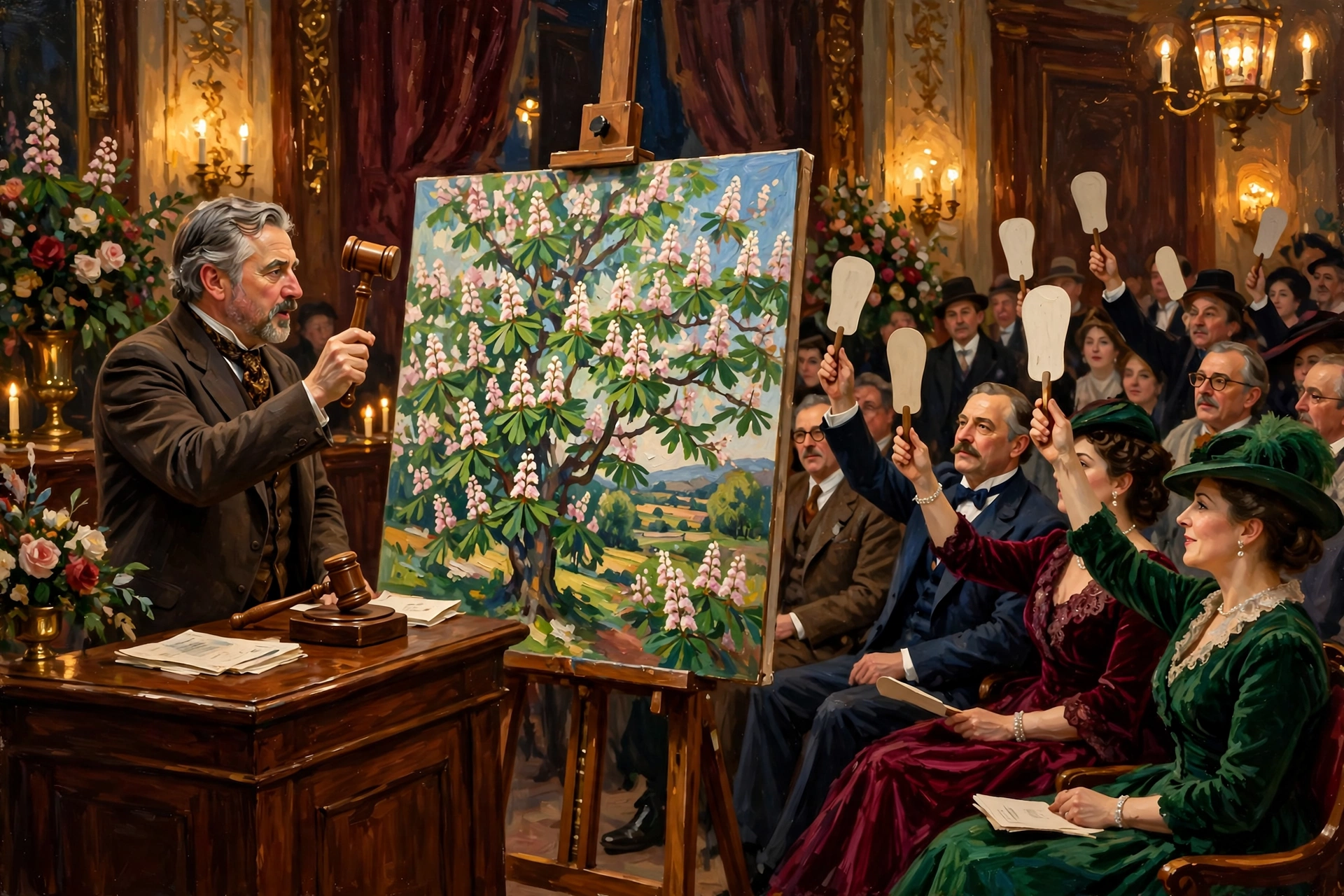
On Wednesday evening in New York, an auctioneer’s gavel fell on $165 million — with fees, a single painting changed hands for $190.4 million. The work was Vincent van Gogh’s Chataigniers en fleurs, or Blossoming Chestnut Trees, painted in 1890 in the final two months of the artist’s life. It is now the most expensive Van Gogh ever sold at auction. The psychology of art prices asks the question everyone outside that saleroom is thinking: how can a canvas be worth more than a skyscraper?
Here is the short answer. A painting’s price is never really about paint. It is about scarcity, story, status and the strange electricity of an auction room, where two determined bidders can turn a number into a contest. Once you see those forces, $190.4 million stops looking random.
What Just Sold for $190.4 Million?
Van Gogh painted Chataigniers en fleurs in Auvers-sur-Oise, France, in 1890, shortly after leaving the asylum at Saint-Remy and only weeks before his death. It shows a village street beneath blossoming chestnut trees. It had not appeared at auction before and had barely been seen in public for five decades.
The sale took place at Sotheby’s in New York on Wednesday 18 November 2026. Bidding opened at $135 million and climbed in $5 million steps, over in roughly three minutes, according to Artnet News. When the gavel fell, the bid stood at $165 million; with fees, the total reached $190.4 million. The buyer was Manhattan dealer Bill Acquavella. The previous Van Gogh record was $117.2 million, paid in November 2022 for the 1888 Orchard with Cypresses.
The sale almost did not happen. The painting had belonged to the family of Samuel Fischer, the German Jewish publisher who bought it in Paris in 1909. The family sold it in 1936, and Fischer’s heirs argued they had parted with it only because of the financial losses suffered under Nazi persecution. On 12 November, their Berlin-based lawyer Gunnar Schnabel challenged the sale; Sotheby’s said its research had “not established that the painting was sold under duress”. On the eve of the sale, the two sides announced an agreement. The painting came from the Blaquier-Arrieta Collection, assembled by Buenos Aires sugar heiress Nelly Arrieta de Blaquier from the 1960s.
Why Did the Price Climb So High in Three Minutes?
Why did the price climb so high in three minutes? Because auctions are social contests, and the room is designed to make bidding feel like winning.
Auction fever is the surge of competitive arousal that makes bidders pay more in a live contest than they planned to pay alone. Every raised paddle is a small public promise, and backing down starts to feel like losing face. Each $5 million step raised the stakes and made the next bid feel like the only way to stay in the game. It is the same pressure that makes ordinary people bid too much on a house; the numbers are bigger here, but the mechanism is identical.
There is also the anchoring effect. Sotheby’s pre-sale estimate of about $180 million told every bidder what “serious” looked like. Research on anchoring, first described by Amos Tversky and Daniel Kahneman, shows that an opening number pulls later judgements toward it. Once $180 million was in the air, $165 million could feel like a relative bargain.
Why Do Paintings Sell for Millions at All?
Why do paintings sell for millions at all? Because a painting is not priced like paint and canvas. It is priced like a story you can hang on a wall.
Scarcity is the first ingredient. Van Gogh painted for about a decade, produced roughly 900 paintings, and will never paint another. This one had never been offered at auction. Scarcity does more than limit supply: research on psychological reactance shows that when something feels hard to get, we want it more.
Status is the second ingredient. A $190.4 million painting is what economists call a Veblen good: part of its appeal is that almost nobody can afford it. Owning it signals wealth, taste and access in a way no bank balance can, because a bank balance is invisible and a Van Gogh is not.
Then there is the story itself. Van Gogh died poor, unrecognised and thirty-seven, two months after painting this canvas. That tragedy is now woven into the price. It is why a print of the same image, identical to the eye, is worth almost nothing by comparison — the value lives in the original and everything it has survived.
Pause and ask yourself: What is the most you have ever paid for something because of what it meant, not what it did?
Does a Painting’s History Change What It Is Worth to Us?
Does a painting’s history change what it is worth to us? Yes — profoundly. We value objects for the lives they have touched, and that invisible history can raise a price or poison it.
Psychologists call this psychological essentialism: the sense that an object carries an essence from its history and its maker. Research by George Newman and Paul Bloom found that people value originals far above identical copies. A Van Gogh is the extreme case — the brushstrokes are the closest thing to touching the man himself. The same logic explains why the Fischer family’s story mattered: for days, the question was whether the painting should be sold at all. The eleventh-hour agreement changed the emotional meaning of the purchase, and the paddles went up.
Why Does Van Gogh’s Story Make His Paintings Feel Priceless?
Why does Van Gogh’s story make his paintings feel priceless? Because his life is the story our brains are built to remember: brilliance, suffering, and recognition that arrived too late. He sold almost nothing in his lifetime and died believing he had failed. Today his sunflowers and starry nights are among the most reproduced images on earth. That arc triggers what psychologists call narrative bias: a tragic hero with a redemptive ending feels true in a way a spreadsheet never will. There is awe too — the quiet, chest-tightening feeling of standing before something far greater than yourself. You cannot buy awe in a poster shop.
How Can You Think More Clearly About Value and Price?
The auction room is an extreme case, but the same psychology runs through everyday shopping. A few habits help.
1. Ask what you would pay if nobody could see it. If the value collapses when the audience disappears, you were buying status, not the thing itself. That should change the price you pay. It is the opposite of the spiral that how to stop overthinking everything describes, where a worry grows simply because it is repeated.
2. Separate the story from the object. A painting’s history is real and moving, but it is not the same as the painting’s quality. Would you love this if it were painted by someone you had never heard of?
3. Notice the room you are in. Competition, countdowns and “only one left” warnings are designed to speed you up. Slowing down — even by a day — is the simplest defence, because urgency is a feeling, not a fact. Under pressure, the mind narrows to the threat of losing out, a pattern choking under pressure research describes.
4. Remember that scarcity is often manufactured. “Almost mythical status” is true of this painting, but the same words sell trainers and concert tickets. Ask who benefits from your urgency.
5. Practise valuing what you already have. The pull of a $190.4 million painting is the pull of wanting what is rare and admired. Gratitude does the opposite work — the habit at the heart of gratitude practice psychology.
Frequently asked questions
How much did the Van Gogh sell for?
Van Gogh’s Chataigniers en fleurs sold for $190.4 million including fees at Sotheby’s in New York on 18 November 2026; the hammer price was $165 million, a new auction record.
Why is a Van Gogh worth $190.4 million?
Scarcity, story and status: Van Gogh produced a finite number of paintings, this one had never been at auction, and its history gives it a narrative no copy can carry.
What was the Nazi-era dispute about the painting?
The heirs of German Jewish publisher Samuel Fischer, who bought the painting in 1909, said the family sold it in 1936 only because of financial losses under Nazi persecution. Sotheby’s said its research had not established duress, and the families settled the day before the sale.
What is the most expensive painting ever sold at auction?
Leonardo da Vinci’s Salvator Mundi holds the record at $450.3 million (2017); the Van Gogh ranks fourth.
Try it on our site
Art makes us feel things, and so does wanting what we cannot have. Try the Thought Reframe to untangle a belief like “I need expensive things to matter”, and use Name Your Feeling to pin down whether what you feel is awe, envy, or longing. The Daily Tracker shows how comparison affects your mood.
Related reading: Gratitude Practice: The Psychology of Wanting What You Already Have · How to Stop Overthinking Everything · Brain Rot and the Psychology of Attention
Key Takeaways
- Van Gogh’s Chataigniers en fleurs sold for $190.4 million at Sotheby’s in New York on 18 November 2026, a new auction record.
- The psychology of art prices is driven by auction fever: competition and time pressure push bidders past their planned price.
- Anchoring on the $180 million estimate shaped the room’s sense of value; scarcity, status and story did the rest.
- Provenance changes value: the Fischer family’s Nazi-era history nearly stopped the sale, and the agreement cleared the way.
- Van Gogh’s tragic story amplifies the painting’s worth through narrative bias, awe, and mortality.
This article is educational only — not therapy, diagnosis, or medical advice. If you are struggling, consider speaking with a licensed professional. In crisis, call or text 988 in the United States, the Suicide and Crisis Lifeline; in the UK and Ireland, Samaritans is available on 116 123.