
Reviewed by a Psychology Postgraduate (MA)
Short answer: Germany supermarket cyberattack psychology is the psychology of trust when the cold chain breaks: Europe’s supermarket fridge-hack wave spread further on 2 November 2026, with four supermarkets in Germany and six in Romania newly reported hit, taking affected countries to at least eleven. The European Union now calls the attacks “not isolated” and is preparing a collective response, while officials stress no state actor is suspected and the motive remains unknown.
UPDATE: what has changed since our Denmark fridge piece?
This is an update to our earlier article, Europe’s Fridges Were Turned Up to 50°C: The Psychology of Trust When the Cold Chain Breaks, published on 3 November 2026. That piece covered the first wave: overnight into 2 November, refrigeration units at more than 100 European supermarkets were remotely manipulated, some set to 50°C. Danish maker Danfoss confirmed its controls were involved.
Since then, the story has materially developed in three ways. First, the geography widened: on Tuesday 3 November, officials and company representatives reported four supermarkets affected in Germany and six in Romania, and the United Kingdom was also hit. Problems had already been reported on Monday in at least nine European Union countries: Belgium, Estonia, Finland, Ireland, Italy, Luxembourg, the Netherlands, Portugal and Sweden. With Germany, Romania and the UK added, at least eleven countries are now affected.
Second, the European Union changed its language. EU spokesperson Thomas Regnier said on 4 November that the bloc’s agencies were talking with national authorities on a joint response: “These are not isolated incidents, and of course, we have to be collectively resilient and prepared for such cyber incidents.” The Commission has convened agencies including ENISA and Europol. Third, attribution narrowed: Romania’s cybersecurity director Dan Cimpean told AFP the attacks seemed “semi-amateurish” and said, “We do not suspect, under any circumstances, that it is a state actor.” No group has claimed responsibility, and the motive remains unknown.
What happened, country by country, in the new reports?
The full picture, combining the first wave with the 3-4 November updates, runs as follows:
- Germany: four supermarkets reported affected on Tuesday 3 November, the newest major economy to join the list.
- Romania: six supermarkets reported affected on Tuesday; officials do not suspect a state actor and say no other infrastructure was compromised.
- Belgium: among the hardest hit on Monday, with dozens of stores reporting refrigeration failures; federal prosecutors have opened an investigation. Carrefour reported 15 Belgian stores attacked, Intermarché 15 of its 153.
- Italy: about 20 supermarkets affected. A Sicily Coop group director said four of its 300 stores were hit, causing thousands of euros in damage: “We had to throw away everything. The shelves are empty.” Italy’s government held talks with intelligence and cybersecurity chiefs on Tuesday; Prime Minister Giorgia Meloni’s office called the impact “limited” while saying institutions remain on high alert.
- Sweden: the Coop chain said refrigerators and freezers at seven stores had been connected to “old 4G networks”. The stores have resumed normal operations, and Coop has accelerated an upgrade, begun after the October attacks, onto 5G networks and modern modems.
- United Kingdom: hackers tried to target small meat-processing firms, but the impact was minimal, according to National Cyber Security Centre chief Richard Horne, who told the BBC the issue affected “the whole food supply chain”.
- Denmark and the wider wave: Danfoss, the Danish maker of refrigeration controls, said its systems were again targeted and it had been in close contact with customers for three weeks, recommending the systems not be directly accessible from the internet. Five Danish food companies were reported hit in the first wave, echoing the October wave in France, where around 700 stores were affected.
Known: temperatures were remotely raised, in some cases to 50°C; food was discarded; stores in at least eleven countries were affected; the EU is coordinating a response. Unconfirmed: who is responsible, why they acted, and whether the waves are linked. No ransom demand has been reported. Treat any online attribution claim as speculation unless it comes from an investigating authority.
What is system trust, in one sentence?
System trust is the quiet confidence that the invisible networks behind daily life, power, payments, refrigeration, transport, will keep working without us having to check them.
Why does the Germany supermarket cyberattack unsettle us more than a data breach?
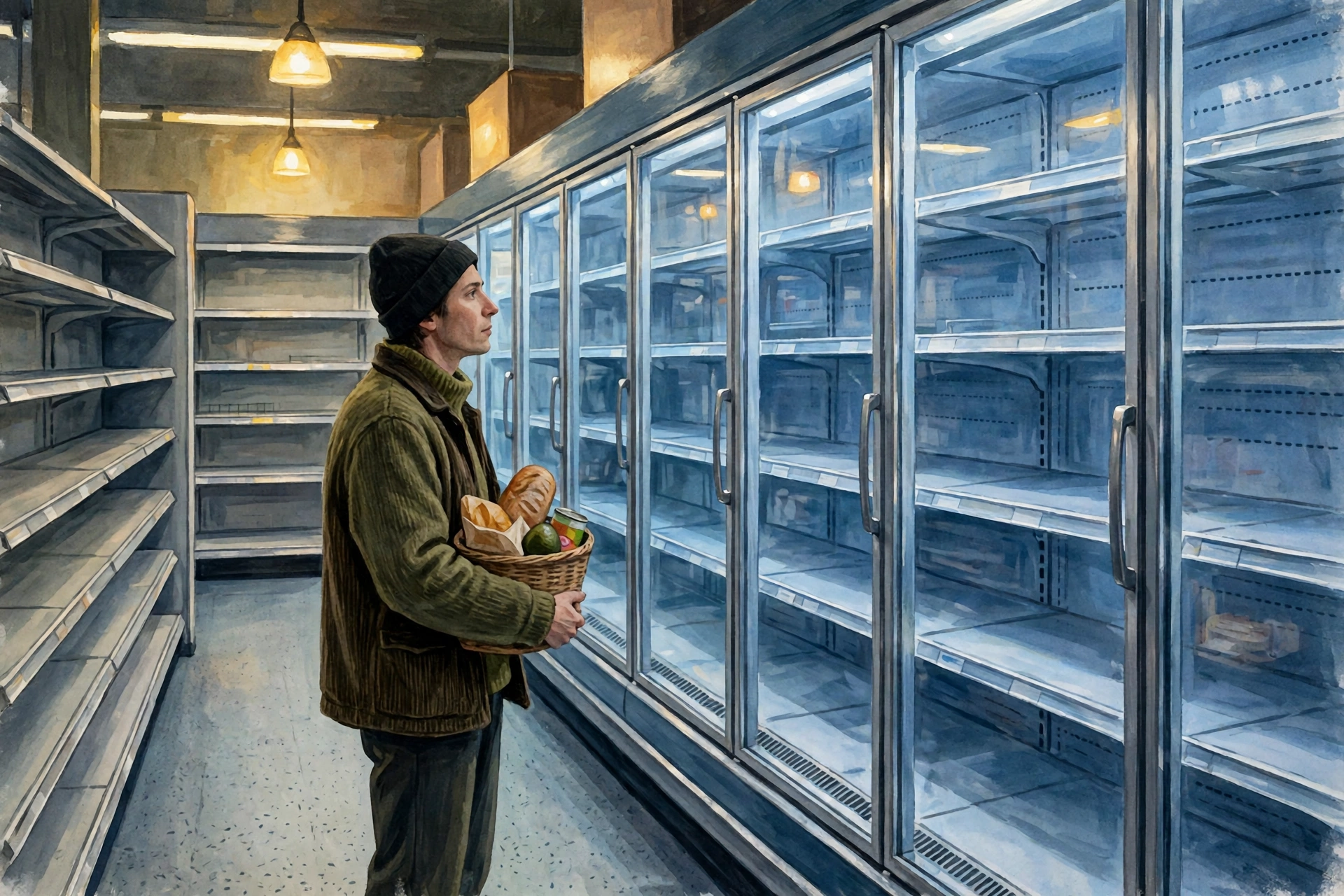
Most cyberattacks steal information, which is abstract. This one changed temperature, which is physical: food spoiled and shelves emptied in front of customers. As one analyst noted, empty refrigerators create a powerful image: people associate empty stores with shortages and crisis, so visibility can matter to attackers as much as financial damage.
The mechanism is the availability heuristic, described by Daniel Kahneman and Amos Tversky: we judge likelihood by how easily examples come to mind. A photograph of an empty fridge is easier to recall than a statistic about supply-chain resilience, so a handful of affected stores can feel like a national shortage. The same mechanism drove panic buying in earlier crises, including the UK’s “Be Ready” campaign coverage, where fear of empty shelves itself became the story.
There is a second mechanism. System trust works because it is unexamined: we do not think about refrigeration when we buy milk. An attack forces the system into consciousness, and once noticed, it is hard to un-notice. Every later shop becomes a small check: are the shelves full, is the milk cold? Psychologists call this hypervigilance after a breach of trust, fading only when the system proves reliable again, day after day.
Why does “not isolated” change the psychology?
The EU’s phrase matters because it reframes the event. A single-store failure is bad luck. Eleven countries is a pattern, and patterns invite a different question: what else is connected? Expert advice reported on 4 November captures the tension. Deloitte cybersecurity expert Frank Groenewegen urged retailers to check whether refrigeration controllers were connected to the internet and updated, adding: “And if they don’t even know, then remove them from the public internet immediately.” Disconnecting does not fix the root cause, but it isolates the system so an attacker cannot reach it.
For shoppers, the pattern cuts two ways. A coordinated EU response, with ENISA and Europol involved, signals the problem is being taken seriously. But the spread, from Sicily to Sweden, from Belgium to Romania, can feed a sense of pervasiveness: if fridges everywhere are vulnerable, what else is? The honest answer is that much infrastructure has similar weak points, old devices, default passwords, forgotten connections, and the fix is unglamorous maintenance. Sweden’s Coop response, accelerating a move from old 4G networks to 5G and modern modems, is exactly that kind of boring, effective repair.
Scale also matters. Four supermarkets in Germany, six in Romania, seven Coop stores in Sweden, about twenty in Italy: real disruptions for those stores, but not a continent-wide food collapse. No authority has reported a general shortage, and several affected stores have resumed normal operations. The gap between stores hit and people worried about food is itself the psychological story.
What should shoppers actually do?
First, check before you worry: if your local store’s shelves look normal and chilled goods feel cold, the system is working where it matters to you. Second, avoid stockpiling in response to photographs from other countries; image-driven bulk buying creates the very shortages people fear. Third, retailers discarded affected stock, and food kept cold and within date is not made unsafe by news from elsewhere. Fourth, small food businesses should check whether refrigeration controls are connected to the internet, update them, and disconnect them from public access if their security cannot be verified.
Longer term, this wave is a reminder that resilience is a habit, not a purchase. The October wave in France prompted warnings that went unheeded in places, with default passwords and end-of-life devices still in use. Systems we depend on need routine care: updates applied, old equipment replaced, connections checked. Trust, once broken, is rebuilt as it was built, by uneventful days stacking up until we stop checking.
Pause and reflect: The next time you see an empty shelf, ask: is this my store, today, or a photograph from somewhere else? That one distinction separates useful caution from borrowed panic. Our Challenge the Thought tool can help you test a worrying headline against what you can actually observe.
Try it on our site
If news-driven worry is spilling into your week, these free tools may help: Challenge the Thought for examining a frightening news thought, the Daily Tracker for news, sleep and mood patterns, and the Burnout and Money-Stress Check for combined strain. All run in your browser, with no signup.
Key takeaways
- UPDATE: Germany (four supermarkets) and Romania (six) were newly reported hit on 3 November 2026, taking the fridge-hack wave to at least eleven countries including the UK.
- The EU now calls the attacks “not isolated” and is coordinating a collective response through national authorities, ENISA and Europol.
- No group has claimed responsibility, the motive is unknown, and Romania’s cybersecurity chief says a state actor is not suspected; the attacks are described as “semi-amateurish”.
- Belgium was among the hardest hit, Italy reported about twenty stores affected, Sweden’s Coop traced its cases to old 4G networks, and the UK impact was minimal.
- Psychologically, the wave works through visibility: empty shelves trigger the availability heuristic, turning a limited disruption into a felt shortage.
- What helps is proportion: check your own store and avoid fear-driven stockpiling.
Frequently asked questions
Is this the same attack as the Denmark fridge incident?
It is the same wave, updated. Our 3 November piece covered the first reports, centred on Denmark, Belgium and other countries. This update adds the German, Romanian and UK reports of 3 November and the EU’s collective-response announcement of 4 November.
Who is behind the attacks?
Unknown. No group has claimed responsibility, no ransom demand has been reported, and Romania’s cybersecurity director says a state actor is not suspected. Any attribution beyond that is speculation.
Is there a food shortage?
No authority has reported a general shortage. Affected stores discarded spoiled stock, and several have resumed normal operations. The disruption is real for the stores involved but limited in scale.
Related reading: Europe’s Fridges Were Turned Up to 50°C: The Psychology of Trust When the Cold Chain Breaks; UK Panic Buying and the Be Ready Campaign; Germany AI Summit Psychology.
Educational disclaimer: This article is for education only and is not cybersecurity, legal or medical advice. If you are in distress in Germany, Telefonseelsorge is available day and night on 0800 111 0 111 or 0800 111 0 222, or on 116 123. In an emergency, call 112.