
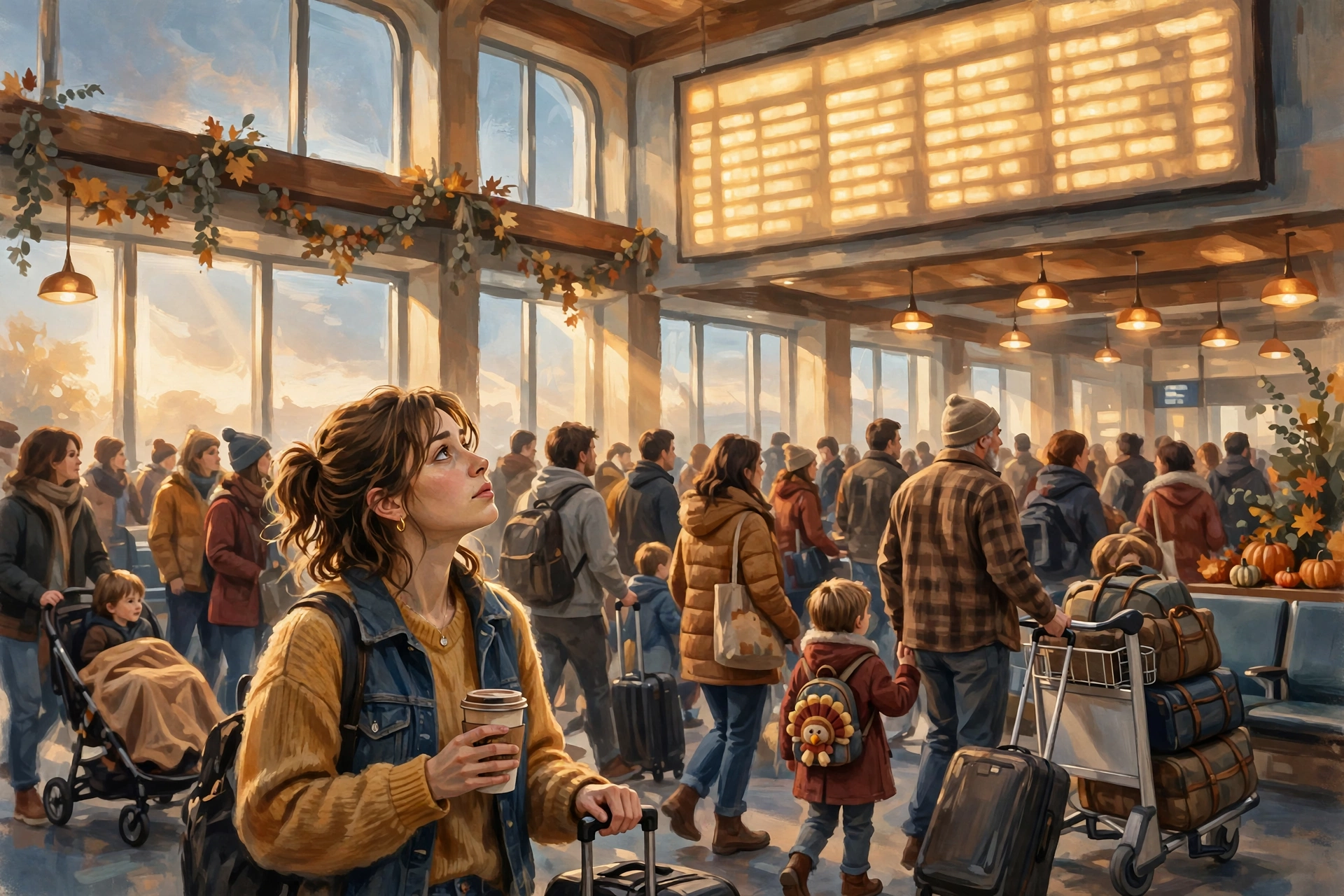
Thanksgiving Travel Anxiety: Why This Year’s Flights Feel Harder — and How to Cope
Reviewed by a Psychology Postgraduate (MA)
Thanksgiving travel anxiety is running high this year, and the numbers explain why. United Airlines expects more than 6.6 million customers over the Thanksgiving period from 19 November to 1 December 2026, according to its newsroom on 12 November 2026. Friday 20 November was expected to be the busiest day, with more than 540,000 customers, while Sunday 29 November is forecast as the peak return day, with around 600,000 flying home for Thanksgiving Day on Thursday 26 November 2026.
In short, Thanksgiving travel anxiety is the dread, worry and physical tension many people feel before and during holiday flights, driven this year by record crowds plus two fresh reminders that air travel can go wrong. It is understandable, common, and manageable.
Those reminders are still fresh. On Friday 13 November 2026, the Federal Aviation Administration ordered a nationwide ground stop that halted United States flights for more than four hours. Three days later, on Monday afternoon 16 November 2026, United suffered a systemwide technology outage: the airline said it lasted around 30 minutes and affected fewer than 150 flights, but FlightAware recorded 811 delayed United flights and 28 cancellations by 9:50pm, according to CNN and FlightAware on 16 and 17 November 2026. United also rewrote its contract of carriage on 11 November 2026 to bar unauthorised third-party AI agents from booking or servicing reservations, while more than half of its daily flights now offer Starlink Wi-Fi (United, 12 Nov 2026).
What is Thanksgiving travel anxiety?
Thanksgiving travel anxiety is the anticipatory worry, physical tension and urge to avoid flying that builds up around holiday travel, fuelled by crowds, delays and uncertainty.
Why does Thanksgiving travel feel more stressful than other trips?
Thanksgiving is the busiest travel week of the American year. Crowded terminals mean longer queues, fewer empty seats and less personal space, which raise arousal in the nervous system before you have even boarded. Add a tight connection, and the journey starts feeling like a test with a deadline.
Then there is the timing. The 13 November ground stop and the 16 November United outage happened within days of the holiday rush. Psychologists call this the availability heuristic: recent, vivid events feel more likely to happen again. Our piece on the FAA flight cuts and the psychology of air travel uncertainty looked at how schedule shocks linger in travelers’ minds.
Why does losing control make flight anxiety worse?
Because flying hands control to other people, and the anxious brain hates that trade.
Once you are in your seat, you cannot drive, you cannot pull over, and you cannot fix a delay by trying harder. That loss of control is one of the strongest drivers of anxiety, amplified by uncertainty intolerance — the difficulty some people have with not knowing what will happen next. An uncertain mind fills every gap with the worst-case version, a habit called catastrophising: one delayed departure becomes a missed Thanksgiving dinner. Research on anxiety has long shown that perceived control matters more than actual danger: flying remains one of the safest ways to travel, yet helplessness in the cabin can make it feel like the riskiest.
Maya, a composite example drawn from the kinds of stories travelers tell, flies home every Thanksgiving, and every year the worry starts on the Monday before she travels: she checks the flight status app a dozen times a day and lies awake picturing herself stuck at the airport. Her flight, most years, leaves on time.
How do recent flight disruptions affect anxious travelers?
They give the worry fresh evidence, and the anxious mind is always collecting evidence. The 13 November ground stop and the 16 November outage confirm a fear rather than create it, and dramatic images of grounded planes stick in memory far longer than the quiet statistic that most flights operated normally. One bad flight can also shape years of travel: a single turbulent landing becomes the reference point for every future trip, a process linked to associative learning. Our article on flight anxiety after the United Flight 1681 incident explored how a single frightening flight can echo for months.
What can you do before you travel?
Prepare the things you can control. Book the earliest flight you can manage — early flights are less likely to be delayed by knock-on disruption. Build in a buffer: a connection of two hours or more, and an arrival the day before the big meal if you can manage it, so a delay costs you an evening rather than the holiday itself. Pack snacks, water, headphones and a charger in your personal item.
Then prepare the mental layer. Write down your worry, in full: what exactly are you afraid will happen? Then write the most likely outcome beside it, and one thing you would do if it happened. This is a simplified version of a technique called decatastrophising: a vague fear — “everything will go wrong” — is terrifying, while a specific one — “my flight might be delayed two hours, and if it is, I will take the later connection” — is a problem with a plan.
How do you cope with anxiety at the airport and on the plane?
Slow your body down first, because the mind follows the body.
When anxiety spikes, breathing becomes fast and shallow, muscles tighten, and attention narrows to the threat. A slow breathing pattern — in for four counts, out for six — directly counters that, activating the parasympathetic nervous system and signalling safety. It is simple enough to do in a security line, which is exactly why it works.
Grounding helps too. The 5-4-3-2-1 technique — five things you can see, four you can touch, three you can hear, two you can smell, one you can taste — pulls attention back to the present terminal. If turbulence frightens you, remember what it actually is: the aircraft moving through uneven air, something pilots train for and aircraft are built to handle.
What if the trip is really about family, not flying?
Then the flight may be carrying feelings that belong to the destination.
Holiday gatherings concentrate family dynamics into a few intense days: old roles resurface, opinions clash, and the pressure to enjoy yourself can make enjoyment harder. For many people, the dread labelled “travel anxiety” is partly arrival anxiety — worry about a difficult relative, an argument at the table, or grief for someone missing this year. Our guide to holiday anxiety and how to handle the season looks at exactly this overlap.
If that rings true, plan for the gathering the way you plan for the flight. Decide in advance how long you will stay, where you can take a walk if things get tense, and what you will say if a topic you would rather avoid comes up. A short phrase — “I would rather not get into that today, let us enjoy the meal” — said calmly and repeated as needed, beats a clever argument. The same loss-of-control feeling surfaces during other sudden disruptions, and our piece on earthquake anxiety and coping when the ground feels uncertain shows how the same grounding strategies apply in the air.
Frequently asked questions
Is Thanksgiving travel anxiety normal? Yes. Holiday travel combines crowds, tight schedules, family pressure and recent disruption news, so even confident flyers feel more on edge.
Why is Thanksgiving 2026 expected to be so busy? United Airlines expects more than 6.6 million customers between 19 November and 1 December 2026, with Friday 20 November the busiest day and Sunday 29 November the peak return.
What is the fastest way to calm flight anxiety at the airport? Slow breathing — in for four counts, out for six — plus a grounding exercise such as 5-4-3-2-1. Both lower physical arousal quickly.
Should I check my flight status constantly before travelling? No. Checking once or twice is sensible, but constant checking is reassurance-seeking and tends to strengthen anxiety.
Try it on our site
- Sleep Reset — wind down the night before an early flight.
- Relaxation Techniques — guided breathing and calming exercises for the gate.
- Thought Reframe — turn a catastrophic travel thought into a balanced one.
- Mind Check-In — check in with how you are feeling before you travel.
Related reading: FAA flight cuts and the psychology of air travel uncertainty · Holiday anxiety: how to handle the season · Flight anxiety after the United Flight 1681 incident
Key Takeaways
- Thanksgiving 2026 is set to be exceptionally busy: United expects 6.6 million-plus customers, with Sunday 29 November the peak return.
- The 13 November ground stop and 16 November outage are fresh in travelers’ minds, making delays feel more likely.
- The anxiety is driven by loss of control, uncertainty intolerance and catastrophising, not by the danger of flying.
- Early flights, long connections, slow breathing, grounding and a written worry plan can lower the stress.
This article is for educational purposes only and is not a substitute for professional advice, diagnosis or treatment. If you are struggling, please speak with a licensed mental health professional. If you are in crisis, call or text 988 in the United States, or contact a crisis line in your country.