
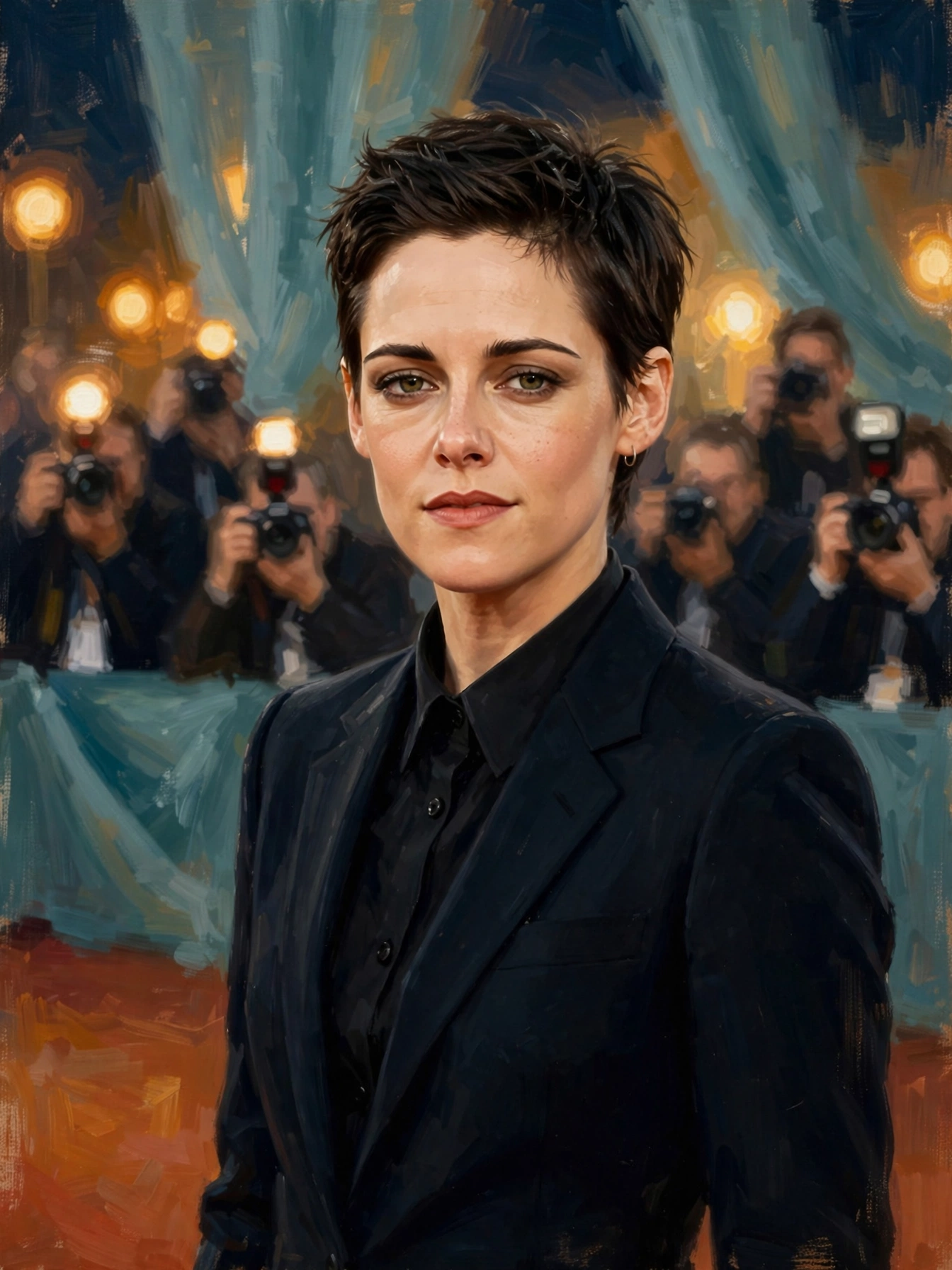
The Psychology of Kristen Stewart: Reinvention, Privacy, and the Art of Being Yourself
Reviewed by a Psychology Postgraduate (MA)
Kristen Stewart was seventeen when the world decided it knew who she was. The year was 2008, the film was Twilight, and within months a teenager from Los Angeles had become one of the most photographed people on the planet. Most people in that position either lean into the machine or let it chew them up. Stewart did something rarer: she walked away from the biggest version of herself and rebuilt a career on her own terms. The psychology of Kristen Stewart is the psychology of reinvention in public, under scrutiny, with everyone watching.
That is why she is trending again in November 2026. Fans are pitching her as the next Bond villain or Bond girl after her former co-star Robert Pattinson was announced as James Bond on 16 November 2026 (Denis Villeneuve directing, Steven Knight writing, Amazon MGM). There is no casting announcement — the Bond talk is fan speculation, full stop — but the fact that audiences are imagining her in that universe says something about how her image has changed. Variety named her one of the 100 best film stars of all time in November 2026, and her English Wikipedia page drew 20,393 views on 19 November, more than three times her usual daily average of about 6,114. This profile is an educational look at public behaviour and research — not an assessment of her as a person.
The core idea of this profile can be stated in one sentence: reinvention is not becoming someone else; it is shedding the identity other people assigned you so the one underneath can breathe.
Story
Kristen Jaymes Stewart was born on 9 April 1990 in Los Angeles, to parents who worked behind the camera — her father a stage manager and television producer, her mother a script supervisor. She grew up on film sets. Her breakout came in 2002, when at eleven she played Jodie Foster’s diabetic daughter in David Fincher’s Panic Room. She followed it with steady work, including Into the Wild (2007), where Sean Penn cast her as Tracy Tatro.
Then, in 2008, she was cast as Bella Swan in Twilight, opposite Robert Pattinson. She was seventeen. The film made over $400 million worldwide, and the five-film saga grossed more than $3.3 billion. Stewart was, almost overnight, famous in a way that has little to do with acting and everything to do with being owned by the public imagination. A brief, heavily covered personal scandal in 2012, when she was photographed with a married director, became a global news cycle that treated a twenty-two-year-old’s private mistake as public property.
From 2014 onward, Stewart turned toward independent and European cinema. She worked with Olivier Assayas on Clouds of Sils Maria (2014), playing the assistant to Juliette Binoche’s ageing actress, and became the first American actress ever to win a César Award, France’s equivalent of the Oscar, taking Best Supporting Actress. She reunited with Assayas for Personal Shopper (2016) and made Certain Women (2016) with Kelly Reichardt — small, brave films that paid a fraction of a blockbuster salary and offered something blockbusters could not: the chance to be taken seriously as an artist.
Then came Spencer (2021), Pablo Larraín’s portrait of Princess Diana over a single Christmas weekend at Sandringham. Stewart played Diana not as an impersonation but as a possession, and it earned her a first Academy Award nomination for Best Actress. In 2025, she made her feature directorial debut with The Chronology of Water, adapted from Lidia Yuknavitch’s memoir, which premiered at Cannes. The same year, she married Dylan Meyer, her long-term partner. The girl famous at seventeen had become, at thirty-five, a director, an Oscar nominee, and an artist on her own terms.

Turning Point
Every reinvention has a hinge. For Stewart, it was not a single day but a stretch of years, roughly 2012 to 2014, when Twilight fame reached its peak and she decided, visibly and deliberately, to step off it.
Researchers call this a turning point narrative: a period of disruption after which a person re-authors the story of who they are. Dan McAdams’ research on narrative identity suggests the healthiest turning points integrate the past rather than deny it — the difficult chapter becomes the reason for the next one. Stewart did not denounce Twilight; she simply stopped chasing the version of fame it offered and started choosing work that asked something real of her.
The Clouds of Sils Maria role was the clearest signal. Playing Valentine, the devoted assistant to a fading star, Stewart was dramatising the question of what an actor is when the spotlight moves on. When she won the César in February 2015, she accepted in French and said she was proud to be part of a cinema that valued her as an actor rather than a celebrity — a public declaration of where she intended to live from now on: in the work, not in the coverage of the work. There was also a quieter turning point: learning to stop performing for the cameras that followed her everywhere, and for the cameras in her own head that told her to smile and be the version of herself that made other people comfortable. She has said letting that go was the most freeing thing she ever did.
Mindset
Watch Stewart in interviews from the last decade and a pattern emerges: she is allergic to the polished answer. She interrupts herself, corrects herself mid-sentence, and says the unvarnished thing. Early in her career, this was read as awkwardness. Later, it was recognised as a refusal to perform a self she does not believe in.
The tension she navigates is authenticity versus impression management. Impression management is the normal human work of presenting ourselves in ways that earn approval — we all do it, every day. Authenticity is the feeling that our outward behaviour matches our inner experience. Research by Michael Kernis suggests people higher in authenticity report greater well-being and less anxiety — but authenticity is costly where conformity is rewarded. Stewart’s environment rewarded conformity at an industrial scale, and she chose authenticity anyway. That cost her easy approval and bought her coherence.
Her mindset also shows psychological flexibility — the ability to stay present with discomfort rather than avoiding it, and to act in line with your values even when it hurts. She has repeatedly chosen projects that were commercially risky and emotionally demanding: a grieving medium in Personal Shopper, a closeted queer icon in Seberg, a woman coming apart in Spencer. Each role required her to sit inside distress rather than resolve it neatly — a skill research on acceptance and commitment therapy (ACT) links to resilience. There is a third strand, and it explains the Bond speculation of November 2026: Stewart has never treated her career as a ladder but as a series of rooms to explore. A ladder has one direction; rooms have doors. When fans imagine her as a Bond villain, they are imagining her in a room she has never entered — and it feels plausible because she has spent a decade proving she can enter any room and make it hers.
Decisions
Stewart’s decisions tell her story better than any biography could.
The first decision was to leave the blockbuster machine. After Breaking Dawn — Part 2 in 2012, she could have signed for any franchise, any superhero role, any nine-figure payday. She did not. She chose Camp X-Ray (2014), a small film about a soldier guarding detainees at Guantanamo Bay, for a fraction of the money, and Clouds of Sils Maria and Personal Shopper with Assayas. Each decision was a bet: that the work would matter more than the opening weekend.
The second decision was about privacy. Stewart has always drawn a hard line between her public work and her private life, and she has defended it with unusual directness. In an era when celebrities are expected to monetise every part of their lives on social media, she has no public presence there at all — a decision, renewed daily. Research on boundary-setting finds that people who protect their private lives from public performance report lower stress and higher life satisfaction. Stewart’s refusal to be constantly available is not aloofness. It is a boundary, and boundaries are how people stay whole.
The third decision was to direct. The Chronology of Water, which premiered at Cannes in 2025, adapts a memoir about trauma, sexuality, addiction, and survival — material that is raw, non-linear, and deeply personal. Choosing it as a first film is itself a statement: she did not ease into directing with something safe. Directing is also a decision about power: actors wait to be chosen; directors choose. After two decades of being cast, Stewart chose to cast. The fourth decision is the one she makes with every role: to be honest rather than likeable, without softening difficult characters for the audience.
Method
Stewart’s acting method is famously physical and unguarded. She does not build a character from the outside in, with accents and mannerisms, but from the inside out, by finding the emotional truth of a scene and letting her body follow it. Olivier Assayas has said she works by instinct and total commitment. Pablo Larraín has described her as an actor who “thinks with her body.”
The idea underneath is embodied cognition: our thoughts and emotions are not separate from our bodies but shaped by them. Stewart’s performances are full of the small physical tells it predicts — Diana’s shoulders rising when she is anxious in Spencer, Valentine’s hands never quite settling in Clouds of Sils Maria.
Her preparation is also famously immersive. For Spencer, she studied Diana’s voice, her walk, her way of holding a cigarette, but she has said the real preparation was emotional — understanding what it feels like to be watched constantly, to be loved by millions of strangers and lonely in a room full of people. That is a feeling she knows from the inside, and she used it. She does not do the polished, media-trained version of acting in which every choice is defensible and every performance is safe — she risks embarrassment, and that willingness is what makes her performances feel alive. Research on vulnerability and social connection, including Brené Brown’s widely cited work, finds that the willingness to be seen imperfectly is what allows genuine connection — on screen and off it.
What If?
It is tempting to ask what would have happened if Stewart had made different choices — and the exercise is genuinely illuminating, because it shows how much of her story depended on decisions that looked, at the time, like career suicide.
What if she had stayed in the franchise lane after Twilight? She would almost certainly have been richer, more famous, and more miserable. Research on hedonic adaptation suggests the happiness boost from wealth and fame fades quickly, while the costs — loss of privacy, loss of autonomy, constant scrutiny — compound. Stewart’s bet was that stepping out was the only way to keep the part of herself that made her good at the work.
What if she had tried to manage her image more carefully — smiled more, said the right things, played the game? She might have been more popular in the short term, and she would have been less herself. Research on self-monitoring finds high self-monitors are often more socially successful but report lower authenticity and lower well-being over time. Stewart is a low self-monitor in a high self-monitoring industry — and that mismatch is precisely what makes her interesting. What if the Bond speculation turns real? There is no casting announcement, and it may never happen. But if it did, it would be the ultimate test of her reinvention: the biggest franchise in the world, taken on by an actor whose adult life has been a study in refusing to be swallowed.
What Most People Lack
Most people lack the thing Stewart has in abundance: the willingness to disappoint other people in order to stay honest with yourself. The fear of disappointing others is one of the most powerful forces in human psychology — it keeps people in jobs they hate, in relationships that have ended, in versions of themselves that stopped fitting years ago. Researchers call this people-pleasing: not kindness, but a strategy for managing anxiety that costs the person who uses it their sense of self. Stewart’s career is, among other things, a sustained refusal to people-please at scale. She disappointed the Twilight fandom by not staying Bella Swan forever, the tabloids by not performing gratitude on demand, and the blockbuster machine by not cashing in — without apology, and without explaining herself to people who had not earned an explanation.
Most people also lack her tolerance for ambiguity. Her films are often unresolved, her characters often unknowable. She does not tidy things up. Research on tolerance for ambiguity links it to creativity, to better decision-making under uncertainty, and to lower anxiety in unpredictable environments. Most of us rush to resolve ambiguity because it feels uncomfortable. Stewart sits inside it. And most people lack her relationship with criticism: mocked, misread, and dismissed in public for most of her adult life, she has kept working, having learned to tell useful criticism from criticism that says more about the critic.
What Successful People Do Differently
Successful people are not simply talented or lucky. They do a small number of things differently, and Stewart’s career illustrates several of them.
First, they play the long game. Stewart’s decisions after Twilight made no sense on a one-year horizon. They made perfect sense on a ten-year one. The César in 2015, the Cannes acclaim for Personal Shopper in 2016, the Oscar nomination for Spencer in 2022 — none of these were available to the actor who stayed in the franchise lane. Angela Duckworth’s research on grit describes exactly this pattern: sustained passion and perseverance for a long-term goal.
Second, they choose their teachers. Stewart did not just choose small films; she chose great directors — Assayas, Reichardt, Larraín, Ang Lee — filmmakers who would demand something of her. The research on deliberate practice shows that improvement comes not from repetition but from working at the edge of your ability with expert feedback.
Third, they protect their energy. Her refusal of social media, her guarding of her private life, her willingness to say no to projects that do not fit — these are not quirks. They are energy management. Roy Baumeister’s work on ego depletion points to the same conclusion: the people who do the best work are the ones most careful about where their attention goes. Fourth, they let the work speak. Stewart rarely explains her choices in interviews. She does not build a personal brand or a motivational philosophy. She makes films. In an attention economy that rewards constant self-promotion, the refusal to self-promote becomes its own kind of signal — a signal that the work is the point.
Success Mindset
Stewart’s idea of success looks nothing like the conventional version, and that is the point. She has said she does not think about success in terms of awards or box office, but in terms of whether she is proud of the work and whether she would do it again. That is a definition of success no bad review, flop, or tabloid cycle can take away, because it does not depend on anyone else’s opinion.
Researchers distinguish between intrinsic and extrinsic motivation. Extrinsic motivation is driven by external rewards: money, fame, status, approval. Intrinsic motivation is driven by the activity itself: the pleasure of doing it well, the meaning it carries, the growth it offers. Decades of research by Edward Deci and Richard Ryan show that intrinsic motivation predicts better performance, greater persistence, and higher well-being than extrinsic motivation — and that extrinsic rewards can undermine it when they become the point. Stewart’s career is a case study in protecting intrinsic motivation from an industry designed to replace it.
Her success mindset also includes a relationship with failure: she has made films that flopped, films that were booed, films that critics hated — and she has kept going, because her definition of success requires every attempt to be honest, not to succeed. That is the mindset researchers call a growth mindset, Carol Dweck’s term for the belief that abilities can be developed through effort and that setbacks are information rather than verdicts. Each film is an experiment, and the learning is the point. There is one more piece, and it is the quietest: she seems to genuinely like the work itself — not the premieres, not the red carpets — and people who like the work, rather than the rewards around it, are the ones who last.
Failures
It would be dishonest to tell Stewart’s story without the failures — and her relationship with them is one of the most instructive parts of the profile.
The most public failure, or what was framed as one, was the 2012 scandal. A twenty-two-year-old was photographed in a compromising situation, the photographs were published worldwide, and the story ran for weeks. She issued a public apology. The coverage was relentless. It would be easy to call this a failure of judgment, and in one sense it was: a mistake, made in private, that became public. But the more useful question is what she did with it. She did not hide, she did not blame, and she did not let it define her. She apologised, went back to work, and let the work become the story again. That is not a failure. That is a recovery.
There were professional failures too. Snow White and the Huntsman (2012) was a commercial success but a critical disappointment, and Stewart’s performance was widely criticised as wooden — a judgment that now reads as a misunderstanding. American Ultra (2015), Charlie’s Angels (2019), and Underwater (2020) all flopped. Each asked her to be something she is not — a conventional action star — and each confirmed that the conventional lane was not hers. The failures were informative: they told her where she did not belong.
And then there were the failures that were not failures at all. Personal Shopper was booed at Cannes in 2016. Stewart has said she was proud of that booing — that it meant the film had done something real enough to provoke a reaction. Spencer divided audiences. In each case, the “failure” was a refusal to be easy, and the refusal was the point. Research on creative success finds that the most original work is the most likely to be rejected at first, and that the creators who persist through that rejection are the ones who change the field. Stewart’s failures, real and imagined, are the receipts for a career spent choosing the hard thing.
Relationships
Stewart’s relationships are the least sensational and most revealing part of her story, because they show what she values when nobody is paying her to perform.
Professionally, her most important relationships have been with directors who trusted her. Olivier Assayas cast her twice and has spoken about her as a collaborator rather than an employee — an actor who brings ideas, who argues, who makes the film better. Pablo Larraín trusted her with Diana. Kelly Reichardt trusted her with silence. These are the relationships of an artist and her peers, not a star and her handlers.
Her most famous professional relationship, with Robert Pattinson, reveals what it means to grow up in public together. Cast as a couple at seventeen and nineteen, they spent four years being treated as a real-life couple by an audience that had decided their fictional romance was true. Both have since built careers defined by the same move: away from the franchise, toward independent and auteur cinema. Robert Pattinson’s own reinvention — from Twilight to Good Time, The Lighthouse, The Batman, and now, in November 2026, to James Bond — runs on a parallel track to Stewart’s, and fans imagining her in his Bond universe is a symmetry neither of them planned.
Personally, Stewart has been private, and that privacy is itself the point. She married Dylan Meyer in 2025, after a long relationship she discussed only in general terms — that she was happy, that she wanted a family. She has been open about her sexuality in the plain way that treats it as a fact rather than a statement. The through-line is the same: her relationships are hers, not the public’s, and she has spent her adult life drawing that line and holding it. That is also the lesson of Macaulay Culkin’s reinvention — another child star who survived early fame by deciding, as an adult, which parts of his life belonged to the audience and which parts belonged to him.
The psychology here is about attachment and boundaries. Research on secure attachment finds that people who can be close to others without losing themselves report the strongest relationships and the highest well-being. Stewart learned that lesson in front of the whole world, and now protects her closest relationships by keeping them out of the spotlight. That is not secrecy. It is care.
Dark Side
Every public life has a dark side, and Stewart’s is not hidden — it is the part of her story that the tabloids built their business on. The dark side here is not a secret scandal. It is the machinery itself: the surveillance, the misrepresentation, the reduction of a person to a character.
The surveillance began when she was a teenager and has never fully stopped: paparazzi followed her everywhere, and photographs of her doing ordinary things were published with captions that invented motives and emotions. The feeling of being watched changes behaviour, and not for the better. Being watched by millions is a form of chronic stress few people ever experience.
The misrepresentation was subtler and more damaging. Stewart was cast, by the media, as sullen, ungrateful, and rude — a character built from photographs of a shy teenager who did not smile on command. The character stuck: for years, every interview began with the premise that she was difficult. Researchers call this a fundamental attribution error: explaining behaviour by character rather than situation, applied at industrial scale. The situation was a teenager photographed by strangers while trying to do her job. The character was a bad person. The gap between the two was the dark side of her fame.
There is also a darker strand: the way young women in the public eye are treated. Stewart has spoken, carefully and without self-pity, about the sexualisation, the moral policing, and the double standards she experienced — a young man’s mistake is a story, a young woman’s is a scandal. Research on gendered scrutiny confirms women in the public eye are judged more harshly than men. Stewart’s career has been lived inside that double standard, and her refusal to perform gratitude for it is one of the bravest things about her.
Second Act
If the first act of Stewart’s career was Twilight — the fame, the scrutiny, the machine — then the second act began in 2014 and is still unfolding. It is the act in which she became the artist she is now: the César winner, the Oscar nominee, the director.
The second act is slower, stranger, and more deliberate: small films and great directors, roles that ask for everything and pay very little, a willingness to be misunderstood by the mass audience to be understood by the right one. It is the act in which she played Princess Diana, directed The Chronology of Water, and married Dylan Meyer.
The psychology of a second act is the psychology of post-traumatic growth: difficult experiences, when processed and integrated rather than denied, can lead to a deeper, more authentic, more purposeful life. Stewart’s second act is not a denial of the first — she does not pretend Twilight did not happen. She treats it as the beginning of the story, not the end of it. That is what integration looks like.
The second act is also a lesson in career design. Stewart did not wait for the industry to offer her the roles she wanted. She built the career she wanted by choosing the people, the stories, and the pace. Most careers are built by default. Stewart’s second act is a career built by design: choose the work that makes you proud, and let the rest take care of itself. That is the same design principle behind Drew Barrymore’s reinvention — another child actor who rebuilt a career and a life on her own terms after fame arrived far too early.
And the second act is not finished. In November 2026, at thirty-six, she is trending again — not because of a scandal, but because audiences are imagining her in new roles and Variety is ranking her among the greats. The Bond speculation may come to nothing, or it may be the beginning of a third act nobody has imagined yet. Either way, the pattern is set: Stewart reinvents herself not by running from her past, but by carrying it forward into whatever comes next.

Fun Facts
- Stewart was cast in Panic Room at eleven after director David Fincher saw her in the 2001 film The Safety of Objects and was struck by her stillness on camera.
- She is the first American actress to win a César Award, taking Best Supporting Actress for Clouds of Sils Maria in 2015 — and she accepted the award in French.
- For Spencer, she studied Princess Diana’s voice so closely that she has said she could still slip into the accent years later — and that the hardest part was not the voice but the breathing.
- Variety named her one of the 100 best film stars of all time in November 2026, the same month fans began pitching her as a Bond villain or Bond girl opposite Robert Pattinson’s James Bond.
What the Research Says
The psychology of reinvention is a research area, and the findings line up with Stewart’s story in ways that are useful far beyond Hollywood.
Identity is a story we tell ourselves, and it can be retold. Dan McAdams’ research on narrative identity finds that the people who report the highest well-being are not the ones with the easiest lives, but the ones who can tell a coherent story — one in which difficult chapters lead to growth rather than defeat. Stewart’s public narrative fits the pattern McAdams calls a “redemption sequence”.
Authenticity predicts well-being. Michael Kernis and Brian Goldman’s research finds that people who behave in line with their values and are willing to be seen as they are, report greater life satisfaction, stronger relationships, and lower anxiety than people who prioritise impression management. Stewart’s refusal to perform is a working model of what the research recommends.
Boundaries protect the self. Research on psychological boundaries finds that people who can separate their public and private selves report lower stress and higher well-being. Stewart’s guarded private life, her absence from social media, and her refusal to monetise her personal relationships are not aloofness. They are boundary-setting, and boundary-setting is a health behaviour.
Growth mindset turns setbacks into information. Carol Dweck’s research finds that people who believe abilities can be developed — a growth mindset — respond to failure by trying harder and learning more. Stewart’s career, with its flops and boos followed by a César, an Oscar nomination, and a directorial debut at Cannes, is a growth mindset in action.
None of this is a diagnosis or an assessment of Kristen Stewart as a person. It is research, applied to a public record, about what reinvention requires: not talent or luck alone, but choices — about honesty, boundaries, and the long game — that anyone can make.
Activity
The quiz below tests the psychology ideas behind Stewart’s story — the concepts that explain it, not trivia about her life.
1. Stewart left blockbuster franchises for small independent films, even though it meant less money and less fame. In self-determination theory, what kind of motivation was she protecting?
a) Extrinsic motivation — the drive for rewards like money and status b) Intrinsic motivation — the drive that comes from the activity itself, from meaning and growth c) Avoidance motivation — the drive to escape something unpleasant d) Social motivation — the drive to be liked by other people
Answer: b. Intrinsic motivation comes from the activity itself — the pleasure of doing it well, the meaning it carries, the growth it offers. Deci and Ryan’s research shows it predicts better performance and well-being than extrinsic motivation.
2. Stewart tells a coherent story about her life — in which the difficult Twilight years led to growth rather than defeat. Dan McAdams calls this:
a) A redemption sequence — a negative experience that leads to a positive outcome b) A contamination sequence — a positive experience spoiled by a negative one c) A fixed narrative — a story that never changes d) A defensive narrative — a story told to avoid blame
Answer: a. A redemption sequence is a life-story pattern in which a negative experience leads, over time, to growth. McAdams’ research finds that people whose life stories contain redemption sequences report higher well-being.
3. Stewart has no public social media and guards her private life closely. In psychological terms, this is:
a) Avoidance — refusing to engage with the world b) Boundary-setting — protecting a private self from public consumption c) Narcissism — believing she is above ordinary interaction d) Social anxiety — fear of being judged by others
Answer: b. Boundary-setting means separating public and private selves and protecting parts of your life from public performance — and research links strong boundaries to lower stress and higher well-being.
4. After films that flopped or were booed at Cannes, Stewart kept choosing difficult, risky roles. In Carol Dweck’s terms, this reflects which mindset?
a) A fixed mindset — believing ability is innate and failure proves its absence b) A performance mindset — believing success means looking good c) A growth mindset — believing abilities develop through effort and setbacks are information d) A defensive mindset — believing the best strategy is to avoid risk
Answer: c. A growth mindset is the belief that abilities can be developed through effort, and that setbacks are information rather than verdicts. People with a growth mindset respond to failure by learning and trying again.
5. The tabloids cast Stewart as “sullen and ungrateful” from photographs of a shy teenager who did not smile on command. The error of explaining her behaviour by her character rather than her situation is called:
a) The halo effect b) The fundamental attribution error c) Confirmation bias d) The spotlight effect
Answer: b. The fundamental attribution error is explaining behaviour by personality or character, while underestimating the power of the situation. Stewart’s situation — a teenager photographed by strangers while trying to do her job — explains far more than any supposed character flaw.
FAQ
Is Kristen Stewart going to be in the next James Bond film?
No casting announcement exists. After Robert Pattinson was announced as James Bond on 16 November 2026, fans began pitching Stewart — his former Twilight co-star — as a Bond villain or Bond girl, and the idea pushed her into Google Trends’ US top 10 on 21 November 2026. It is fan speculation, not a casting decision, and Amazon MGM has announced nothing about her involvement.
What is the psychology of Kristen Stewart’s reinvention?
It is the psychology of choosing intrinsic motivation over extrinsic reward: she left the blockbuster machine after Twilight to protect the part of herself that loved the work, and rebuilt her career on small films and great directors.
Why did Kristen Stewart win a César Award?
She won Best Supporting Actress at the 2015 César Awards for Clouds of Sils Maria (2014), playing the assistant to Juliette Binoche’s ageing actress — the first American actress ever to win a César.
Was Kristen Stewart nominated for an Oscar?
Yes — for Best Actress for Spencer (2021), in which she played Princess Diana over a single Christmas weekend. It was her first Oscar nomination.
Try it on our site
If Stewart’s story has you thinking about your own reinvention, these free tools can help you start. No signup, no account, everything stays in your browser.
- Mind Check-In — a quick, honest check on how you are really doing today.
- Name Your Feeling — put a precise name on what you are feeling.
- Thought Reframe — turn a stuck thought into something truer and kinder.
- Confidence Builder — small, practical steps for rebuilding confidence after a knock.
Key Takeaways
- Reinvention is shedding, not becoming. Stewart did not invent a new self after Twilight; she shed the identity the public had assigned her.
- Intrinsic motivation outlasts fame. She protected her love of the work by walking away from the machine that paid the most and demanded the most.
- Boundaries are a health behaviour. No public social media, a guarded private life, a refusal to monetise her relationships — choices that protect the self, not signs of aloofness.
- Setbacks are information, not verdicts. Flops, boos, and dismissals taught her where she did not belong, and she used that information to build the career she wanted.
- Your story can be retold. The research on narrative identity says the people who thrive are not the ones with the easiest lives, but the ones who can tell a coherent story in which hard chapters lead to growth.
- The second act is yours to design. At thirty-six, trending again in November 2026, Stewart is still writing her story — and the pen is in her own hand.
This article is educational only and is not therapy, diagnosis, or medical advice. If you are struggling, please consider speaking with a licensed professional. In the US, you can call or text the 988 Suicide and Crisis Lifeline by dialling 988. In the UK, Samaritans is available at 116 123, free, 24 hours a day.