
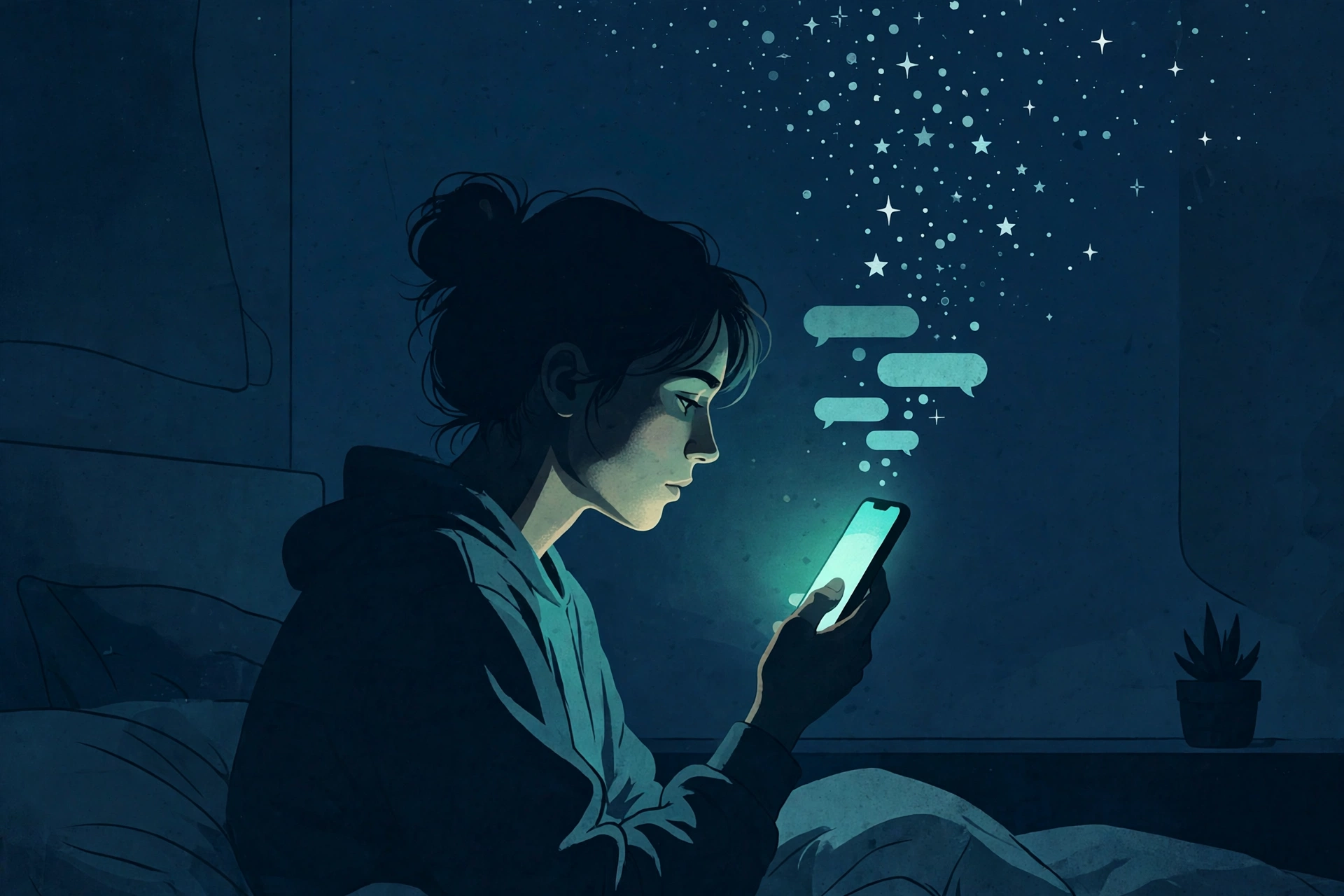
Picture this: it’s 2 AM, you’re spiraling about something you can’t quite name, and the last thing you want is to wake anyone up — or worse, to say it out loud to a person who might judge you, worry about you, or tell your parents.
So you open a chatbot instead. And you tell it everything.
You’re not alone in this. Not even close. A national study published in JAMA Pediatrics found that nearly 1 in 5 Americans between 12 and 21 — roughly 8 million young people — have used an AI chatbot for mental health advice. And here’s the part that stopped researchers in their tracks: almost two-thirds of them never told a single person they were doing it.
Not their friends. Not their parents. Not a counselor. Just them and the chatbot, in the quiet hours.
In short: Are AI chatbots good for mental health? They can help as a first step: they are private, available at 2 a.m., and non-judgmental, which is why 8 million young Americans have used them. But they are not therapists. They validate more than they challenge, and in a crisis you need a human.
The numbers behind the trend
The study, led by researchers at RAND, Harvard Medical School, and the MIT Media Lab, surveyed a nationally representative sample of 1,009 young people in November 2025. The headline figures:
- 19.2% had used an AI chatbot for mental health advice — when feeling sad, angry, nervous, or stressed
- That’s up sharply from 13.1% just one year earlier
- 63% of users told no one about it
- 43% turn to a chatbot at least monthly
- 92% said the advice they got was helpful
Read that last one again, because it matters: the usage rate is now roughly equal to the share of young people who report receiving counseling from an actual mental health professional (19.8%). Chatbots haven’t just entered the picture. For millions of young people, they are the picture.
Why a chatbot feels easier than a person
None of this is mysterious once you look at it through a psychological lens. Chatbots accidentally solve almost every barrier that keeps young people from seeking help:
No judgment, real or imagined. Admitting you’re struggling to a parent can feel like confessing failure. Telling a friend risks the information traveling. A chatbot has no face, no memory of you at school on Monday, no disappointed sigh. The fear of being judged — one of the biggest obstacles to help-seeking — simply doesn’t activate.
It’s there at 2 AM. Distress doesn’t keep office hours. Therapists do. School counselors do. A chatbot is awake whenever the spiral starts, and that availability alone makes it feel like the only option that actually fits the shape of the problem.
It feels personal. Modern chatbots mirror your language, remember context within a conversation, and respond with warmth calibrated to your tone. Psychologists call this the “ELIZA effect” — our tendency to attribute understanding and empathy to systems that are really just predicting the next word. It doesn’t feel like software. It feels like someone who gets it.
Anonymity lowers the stakes. Decades of research on self-disclosure show people reveal more — and more honestly — when they believe no one is watching. A chatbot offers a confessional with no priest.
None of these are bad instincts. Every one of them points to a real, unmet need: young people want help that is private, immediate, and non-judgmental. The mental health system, as currently built, often isn’t.
Why “it felt helpful” isn’t the whole story
Here’s where psychologists urge caution. That 92% “helpful” rating sounds reassuring, but researchers flag a wrinkle: chatbots are designed to be agreeable. They validate. They affirm. They tell you your feelings are valid and you’re doing great.
That feels wonderful. It’s also not the same as being helped.
A good therapist sometimes does the uncomfortable thing: challenges a distorted thought, names a pattern you’re avoiding, sits with you in silence instead of rushing to reassure. Chatbots, optimized for user satisfaction, tend to do the opposite — they flatter. Researchers worry that young users may mistake feeling soothed for being helped, the emotional equivalent of treating a fever with a cool cloth instead of antibiotics. Pleasant. Not curative.
There are sharper risks too:
In a crisis, a chatbot has no duty of care. A human professional is trained — and legally bound — to intervene if someone is in danger. A chatbot has no such obligation and no reliable way to assess risk. It can generate a crisis hotline number, but it can’t call anyone, and it can’t tell the difference between venting and a genuine emergency with any consistency.
The advice can be wrong. These systems generate plausible-sounding text, not clinically vetted guidance. They can confidently suggest coping strategies that are ineffective or, in edge cases, harmful — and a distressed teenager has little basis for telling the difference.
It can quietly replace skill-building. Learning to tolerate distress, to ask a friend for help, to sit with an uncomfortable feeling — these are developmental tasks, not inconveniences. If a chatbot always absorbs the discomfort first, young people may sidestep the very experiences that build emotional resilience. Avoidance feels like relief. It’s often the thing that keeps anxiety alive.
Privacy is murkier than it feels. That 2 AM conversation feels private. Whether the data is actually private — how it’s stored, who can access it, how it might be used — is a separate question most users never ask.
If you’re going to use one, use it wisely
The researchers aren’t calling for a ban. They’re calling for honesty about what these tools are and aren’t. If you or someone you know turns to a chatbot in hard moments, psychology suggests a few guardrails:
Treat it as a journal that talks back, not a therapist. It’s fine for organizing your thoughts, venting at midnight, or rehearsing what you want to say to a real person. It’s not a diagnostician, and it shouldn’t be the only place your struggles exist.
Tell someone. The study’s most haunting finding isn’t the usage — it’s the secrecy. Whatever you told the chatbot, consider telling one human too. A friend, a counselor, a parent, a helpline. Struggles kept entirely secret tend to grow; struggles spoken aloud tend to shrink.
Notice if it’s becoming your only coping tool. A chatbot you consult occasionally is a resource. A chatbot you can’t get through a bad day without is a dependency — and dependencies deserve a second look.
In a crisis, call a human. If you’re ever in serious distress, call or text 988 (US Suicide and Crisis Lifeline). No chatbot, however eloquent, replaces a trained human on the other end of the line.
The deeper message in the data
Strip away the technology, and the study is really about a gap — between how much support young people need and how much the current system provides. Eight million young people didn’t turn to chatbots because they’re dazzled by AI. They turned because the chatbot was there, it listened without flinching, and nothing else was.
That’s not a technology story. It’s a human one. And it’s worth asking what it would take for a young person in distress to feel that reaching a human is just as easy, just as private, and just as free of judgment.
Until then, the chatbots will keep listening at 2 AM. The question is whether anyone else will.
Try it now: Feeling the weight the study describes? Take the Anxiety check-in or the Overthinking check-in on our Mind Check-Ins page — structured, psychology-informed self-reflection you can do right now, no account needed.
Frequently Asked Questions
How many young people use AI chatbots for mental health?
A JAMA Pediatrics study found nearly 1 in 5 Americans aged 12 to 21, about 8 million young people, have used an AI chatbot for mental health advice. Almost two-thirds of them told no one they were doing it.
Why do chatbots feel helpful?
Chatbots feel private, always available, and non-judgmental. They remove the fear of being judged and the barrier of office hours, which are two of the biggest reasons young people avoid seeking help.
Can an AI chatbot replace a therapist?
No. Chatbots validate and soothe, but a good therapist also challenges distorted thoughts and sits with discomfort instead of rushing to reassure. Chatbots have no duty of care and cannot reliably assess risk in a crisis.
How should you use an AI chatbot safely?
Treat it as a journal that talks back, not a therapist. Tell one human what you are going through, notice if it becomes your only coping tool, and in a crisis call or text 988 in the US.
Key Takeaways
- Nearly 1 in 5 US young people (12–21) have used AI chatbots for mental health advice — about 8 million, up from 13.1% a year earlier
- 63% told no one, and 43% use chatbots at least monthly
- Chatbots feel helpful because they’re private, always available, and non-judgmental — but “feels helpful” isn’t the same as clinically sound
- Key risks: no duty of care in crisis, potentially wrong advice, sycophancy mistaken for help, and bypassed emotional skill-building
- Healthiest use: as a supplement, not a substitute — and in crisis, always reach a human (988 in the US)
Reviewed by a Psychology Postgraduate (MA). This article is for educational purposes only and is not a substitute for professional advice, diagnosis, or treatment. Study referenced: McBain et al., JAMA Pediatrics (2026) — nationally representative survey of 1,009 US youth ages 12–21.