
CFB Wainwright Fire Psychology: Fifth Soldier Dies, and a Military Community Grieves All Over Again
Reviewed by a Psychology Postgraduate (MA)
The CFB Wainwright fire psychology story took its hardest turn on Friday, 13 November 2026, when a fifth Canadian soldier died of injuries from a training-ground fire that began almost a month earlier. Private William Douglas Dal Bianco, of the 3rd Battalion, Princess Patricia’s Canadian Light Infantry, died in a hospital in Ontario, the Canadian Armed Forces confirmed on Saturday, 14 November. His death lifts the toll from the 17 October fire at CFB Wainwright to five, with 24 soldiers still in hospital and 14 released.
Short answer: CFB Wainwright fire psychology is about cumulative grief: when a community loses a fifth member weeks after the first four, each new death reopens the earlier losses, and survivors, families and fellow soldiers must grieve again before the first grief has had time to settle.
Cumulative grief is the weight of several losses arriving before any one of them has been fully grieved.
What happened at CFB Wainwright on 17 October 2026?
On 17 October 2026, at about 4 p.m. Mountain Daylight Time, members of 1 Canadian Mechanized Brigade Group, 3rd Battalion, Princess Patricia’s Canadian Light Infantry, were conducting live-fire training at CFB Wainwright as part of Exercise APOLLO SHOOTER, the Canadian Armed Forces said. About 84 soldiers were taking part in attack training when strong winds pushed a grass fire toward the troops at the base southeast of Edmonton.
Four soldiers died that day, and a further 38 members were injured. In its update of 14 November, the military said 24 of the injured were still in hospital and 14 had been released. Three investigations are under way, including a military police investigation and a board of inquiry, and the 14 November release included no new findings about what ignited the fire. Prime Minister Mark Carney has called the blaze one of the worst peacetime tragedies for Canada’s military on Canadian soil.
Who were the five soldiers who died?
Pte William Douglas Dal Bianco, of the 3rd Battalion, Princess Patricia’s Canadian Light Infantry, died on 13 November in an Ontario hospital, the fifth soldier lost to the fire.
The four soldiers killed on 17 October were Sergeant Morgan Wong, 26, of Edmonton; Private Shaun Farrell, 23, of Prince Albert, Saskatchewan; Private Aidan Goulding, 23, of North Vancouver, British Columbia; and Private Hayden Lykkemark, 19, of Langley, British Columbia. A Remembrance Day ceremony took place at Wainwright on 11 November, two days before Dal Bianco died.
CFB Wainwright fire psychology: why does a fifth death hit differently from the first four?
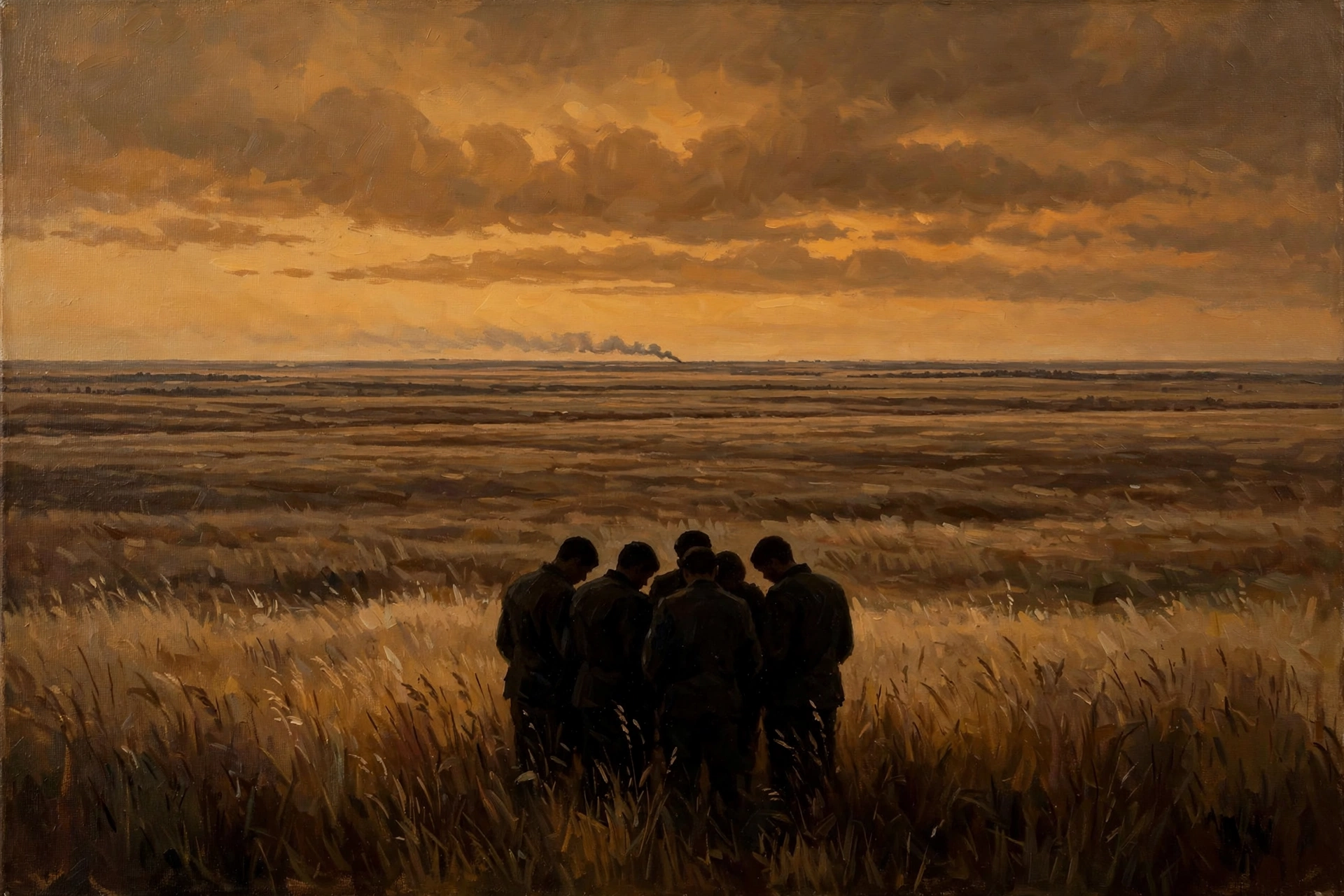
Because grief does not reset between losses. When the first four soldiers died on 17 October, their families, friends and fellow soldiers began grieving. Four weeks later, before that work was finished, a fifth death arrived and asked the same community to start again. This is cumulative grief, and it sits at the heart of military community grief psychology: each new loss interrupts the processing of the ones before it, so people carry several griefs at once.
Timing makes it harder still. In the first days, a community is held together by shock, ritual and practical help. By week four, much of that support has quietly faded, so a new death can feel lonelier than the first. Research on resilience by George Bonanno has shown that most people do recover after loss, but recovery is rarely a straight line, and repeated losses in a short period make the line much harder to hold.
What is survivor guilt, and why does it surface after a training accident?
Survivor guilt is the painful feeling that you did something wrong by living when others did not, even when nothing you did caused their deaths. It is a normal human response, not a sign of weakness, and it is especially common after accidents where survival came down to a few steps or a gust of wind.
Survivor guilt after a training accident can be sharper than after combat, because training is supposed to be controlled. Soldiers expect danger on deployment, not on a range at home. When danger comes from an ordinary training day, the mind replays its ordinary choices: where I stood, when I moved, what I did first. The replays feel like evidence of fault, but they are usually just the brain searching for a reason it could not control. Picture a composite scene: a young soldier who was on the range that day is back at the base, eating in the mess with an empty seat across the table, asking himself every night why them and not me.
Pause and ask yourself: If you have ever survived something others did not, what thought keeps returning? Is it something you actually did, or something you wish you had done? Most survivor guilt is built from the imagined version, and naming which kind it is can loosen its grip.
How does a military community grieve together?
A military unit is not just a workplace: soldiers train, eat and deploy together, and know each other’s families. When five members of one battalion die, the loss runs through the whole community at once. Researchers call that shared loss collective trauma: an event that wounds a whole group, not just those closest to the dead.
Collective trauma has a strange double edge: everyone is hurting, so nobody has to explain why they are upset, but the usual helpers are wounded too. The sergeant who would normally steady a young private is grieving a soldier he trained. Communities in this position need outside support, not just inner strength.
The Remembrance Day ceremony at Wainwright on 11 November gave the base a shared moment to name the loss together, and funerals did the same for each family. Rituals do not fix grief, but they give it a shape and a time, as shared mourning did after the FAMU homecoming shooting.
What helps families and friends in the weeks after repeated loss?
There is no timetable for grief, and no advice can take the pain away. But a few things genuinely help:
- Name each loss separately. Say each person’s name. Five deaths in one event can blur into a single number, but families need their person remembered as a person.
- Expect grief to come in waves. It eases for a day, then returns with a headline, a song, or a date on the calendar. That is normal, not a setback.
- Make practical help specific. “Let me know if you need anything” puts the work on the grieving person. “I am bringing dinner on Tuesday” is help they can accept.
- Test guilty thoughts gently. If you think “I should have done more,” ask what you knew at the time, not what you know now. Hindsight makes every choice look clearer than it was.
- Keep one small routine. A morning walk, a regular meal, a fixed bedtime. Routines give the day a shape when everything else feels shapeless, as in burnout after long strain.
- Reach out early, not only in crisis. A short message or a visit this week matters more than a perfect message next month.
For the wider public, the lesson is simpler. Counting the dead is necessary for the news, but the numbers are not the story. The story is five young lives, 38 injured people, and a community that will live with this for years. The same long tail of worry follows any sudden disaster: people who lived through the hurricane evacuations earlier this season described the same pattern after the headlines moved on. Attention fades, but grief does not run on a news cycle.
Frequently asked questions
How many soldiers died in the CFB Wainwright fire?
Five. Four died on 17 October 2026, and Pte William Douglas Dal Bianco died on 13 November from injuries in the fire, confirmed on 14 November.
How many soldiers are still in hospital?
As of 14 November, 24 of the 38 injured were still in hospital, and 14 had been released.
What caused the fire at CFB Wainwright?
The cause remains under investigation. Three investigations are under way, and the 14 November release included no new findings.
What is survivor guilt after a training accident?
It is the feeling that you did something wrong by living when others died, even when nothing you did caused their deaths. It is common after accidents where survival came down to chance.
Where can military families in Canada get support?
In Canada, call or text 988 any time, or call 1-833-456-4566 toll-free. Military families can also contact their base family resource centre.
Try it on our site
If this news has left you heavy, or you are supporting someone who is grieving, these free tools can help:
- Mind Check-Ins – quick, private check-ins for anxiety and mood.
- Daily Tracker – track your mood day by day.
- Relaxation Techniques – breathing and calming exercises for a racing mind.
- Burnout and Money-Stress Check – a check-in for exhaustion and strain.
Related reading: FAMU Homecoming Shooting and Collective Trauma | Storm Boelo Deaths and the Psychology of Grief | Grieving a Childhood Hero: The Psychology of Public Loss
Key Takeaways
- Pte William Douglas Dal Bianco died on 13 November 2026 from injuries in the 17 October fire at CFB Wainwright, the fifth soldier lost, with 24 still in hospital.
- Repeated loss in a short period creates cumulative grief, where each new death reopens earlier losses before they have been processed.
- Survivor guilt is a normal response after a training accident, built from replaying ordinary choices that felt like they should have changed the outcome.
- Shared rituals, named memories and specific practical help support a grieving community more than general reassurance.
- If you or someone you love is struggling, reach out early: in Canada, call or text 988.
This article is for education only and is not therapy, diagnosis, or medical advice. If you are struggling, consider speaking with a licensed professional. In Canada, call or text 988 any time, or call 1-833-456-4566. In the United States, call or text 988.