
Reviewed by a Psychology Postgraduate (MA)
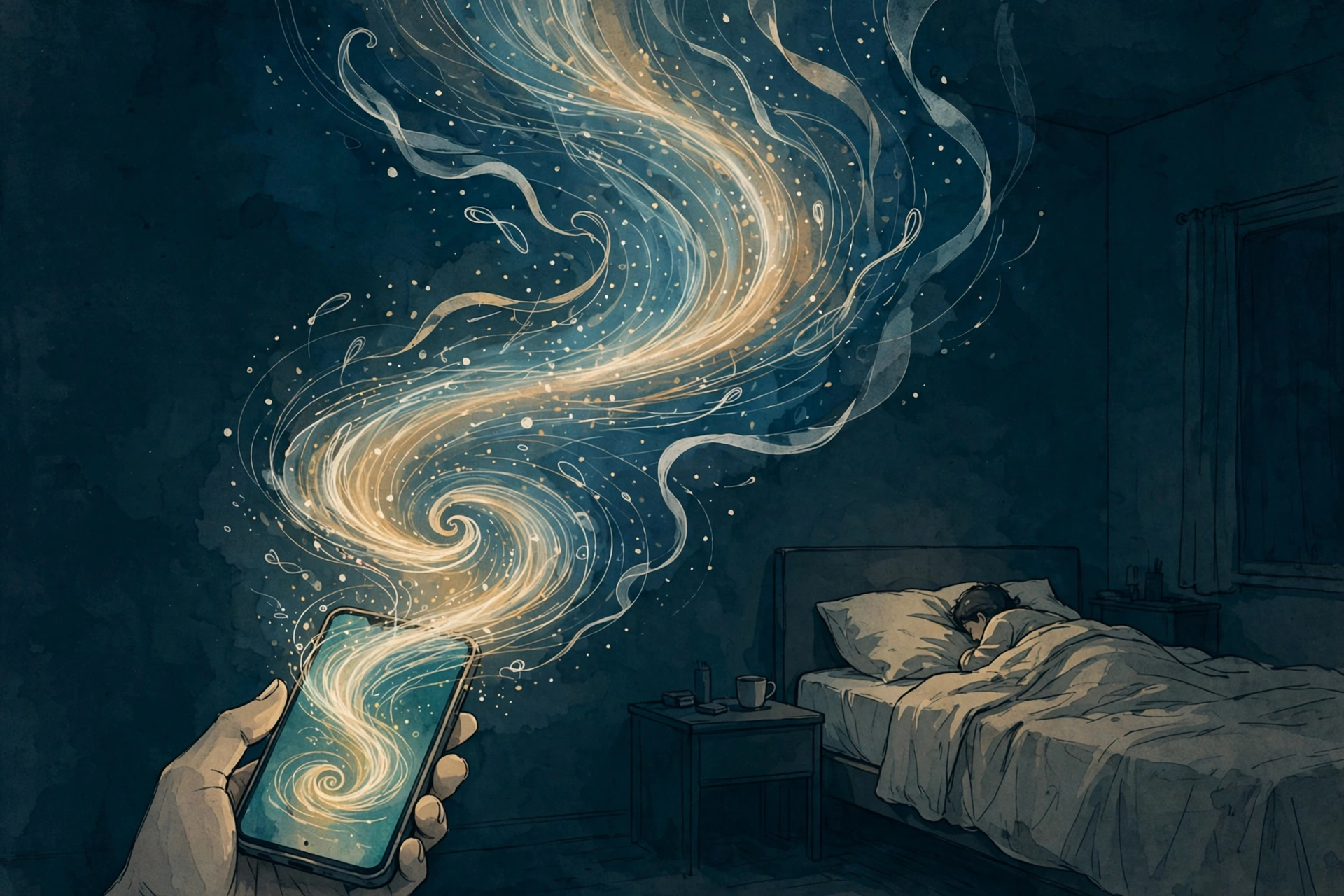
It’s 12:40 a.m. You opened your phone to check tomorrow’s weather. Somehow you’re now forty-seven comments deep in an argument between strangers about a news story that made your stomach drop. Your eyes sting. You’re exhausted. And your thumb — your traitor thumb — keeps pulling down to refresh.
Welcome to doomscrolling: the compulsive consumption of bad news, long past the point where it’s informing you and deep into the territory where it’s just hurting you. You know it’s making you feel worse. You do it anyway. Here’s why — and how to stop.
In short: How do you stop doomscrolling? By breaking the loop, not by willing it away: add friction, set a news window, use a three-scroll rule, and replace the ritual. Bad news glues you because your brain treats it as survival information, even when it only raises stress.
Why Bad News Glues You to the Screen
It feels irrational: why would your brain crave the stuff that upsets it? Because underneath, it’s running very old software.
Your brain thinks it’s gathering survival intel
For most of human history, knowing about threats kept you alive. The rustle in the grass might be a predator; the neighbor’s warning about a bad harvest meant you should store food. Your brain is wired to treat alarming information as urgent and important — it literally cannot tell the difference between “a tiger is near the village” and “a alarming headline about the economy.” So it keeps demanding more data, convinced that one more article will finally make you feel prepared. It never does. The threat file is infinite now.
Negativity is stickier than positivity
Psychologists call this the negativity bias: bad news grabs about five times more attention than good news. A headline about a disaster will always outperform a headline about a community garden. Your feed’s algorithm knows this cold — it learned long ago that outrage and fear keep you scrolling longer than joy ever could. You’re not weak for clicking. You’re responding exactly as predicted.
The loop feeds itself
Here’s the cruel part: doomscrolling creates the anxiety it promises to soothe. You scroll because you feel uneasy → you read three terrible stories → you feel worse → the unease says “keep looking, maybe there’s a solution” → you scroll more. It’s a perfect closed loop, and “just put the phone down” doesn’t break it, because the anxiety is still there humming when the screen goes dark.
The Real Cost of the Scroll Hole
Your sleep is paying for it
Doomscrolling is overwhelmingly a nighttime activity, and that’s the worst possible slot for it. The blue light suppresses melatonin, but the bigger problem is cognitive: you’re loading your brain with threats and outrage right before asking it to power down. No wonder you lie there with your mind racing. If your nights have become a scroll-then-stare-at-the-ceiling routine, our guide on why we overthink at night maps the whole cycle.
Your stress baseline creeps up
Each alarming story triggers a small stress response — a little cortisol, a little adrenaline. One story is nothing. Forty stories is a low-grade fight-or-flight state sustained for an hour. Do that nightly and your “normal” starts to feel like a low hum of dread. People often don’t connect their free-floating anxiety to the scroll hole, but the timing usually tells the story: worst in the evening, better on days they somehow skipped it.
Your worldview warps
The news is not a representative sample of reality — it’s a highlight reel of the worst things happening anywhere, selected for maximum engagement. Spend an hour a night marinating in it and your mental model of the world quietly shifts: everything is getting worse, nobody can be trusted, catastrophe is around the corner. That’s not information. That’s a mood disorder with a newsfeed.
How to Break the Loop: Tactics That Actually Stick
1. Add friction between you and the feed
Doomscrolling thrives on zero-effort access. So make it effortful: delete news and social apps from your phone (the mobile websites are deliberately clunkier — use that). Log out of everything. Turn off all news notifications, especially breaking-news alerts, which are basically a slot machine that pays out in anxiety. If getting to the feed takes four annoying steps instead of one thumb-tap, the 12:40 a.m. version of you will usually give up. That’s not laziness. That’s the system working.
2. Set a “news window” — and defend it
You’re allowed to stay informed. You’re just not allowed to do it at midnight in bed. Pick one or two windows — say, fifteen minutes with morning coffee and ten after lunch — and get your news then, from actual sources, sitting upright. Outside those windows, the news doesn’t exist. This works because it separates information (useful, bounded) from compulsion (endless, miserable). Most people discover that twenty-five deliberate minutes tells them everything the two-hour scroll hole did.
3. Build a replacement ritual for the witching hour
The scroll hole fills a specific slot: tired, in bed, brain still buzzing, needing something. You can’t just remove it — you have to install a substitute. A physical book (not an e-reader with a browser). A short journaling dump: three lines about the day. A boring podcast with a sleep timer. The replacement doesn’t need to be virtuous; it needs to be available and slightly more appealing than staring at the ceiling. Put the book on the pillow every morning so it’s waiting at night.
4. Use the “three-scroll rule”
When you catch yourself in the hole, don’t try to quit cold — negotiate. Give yourself three more scrolls, then the phone goes face-down across the room. It sounds almost too simple, but it works because it gives the compulsive part of your brain an endpoint it can accept. “Stop now” triggers rebellion. “Three more, then done” triggers compliance. Over time, shrink it to two, then one.
5. Curate ruthlessly, mute generously
Go through your follows and ask one question about each: does this account make me feel informed, or just alarmed? Unfollow or mute the alarmists — the ones whose entire brand is outrage. Keep the explainers, the local news, the one friend who posts genuinely useful stuff. Your feed is an environment, and you’re allowed to landscape it. This single cleanup, done once, pays off every night for months.
6. Name what you’re actually feeling
Underneath every doomscroll is a feeling wearing a news-shaped costume: helplessness, usually, or grief, or a free-floating dread you can’t place. When you catch yourself refreshing, pause and try: “I’m scrolling because I feel ___.” You don’t have to solve the feeling. Naming it breaks the trance, because now you’re a person with an emotion instead of a thumb with a feed. If the late-night anxiety runs deeper than the news, our guide on how to stop overthinking has techniques built for exactly that hour.
7. Make the phone itself less appealing at night
Here’s a weirdly effective trick: turn on grayscale mode after 10 p.m. (it’s in accessibility settings on both iPhone and Android). Without color, the feed goes from candy to cardboard — videos lose their pop, photos look flat, and your brain’s reward system quietly loses interest. Pair that with physical distance: when the scrolling window closes, the phone goes face-down on the dresser across the room, not on the nightstand. Every doomscroll starts with a phone within arm’s reach. Move the starting line and most nights the race never begins.
What About Staying Informed?
The objection everyone raises: “But I need to know what’s going on.” Fair. So here’s the reframe: doomscrolling doesn’t make you informed, it makes you anxious. Informed is reading one solid article about an issue. Anxious is reading forty takes about it from strangers at 1 a.m. The news window approach above keeps the information and drops the compulsion. You will miss nothing important — genuinely important news has a way of finding you by breakfast.
Frequently Asked Questions
What is doomscrolling?
Doomscrolling is the compulsive consumption of bad news, long past the point where it informs you. It usually happens late at night, when one more headline turns into an hour of scrolling.
Why does bad news glue you to the screen?
Your brain treats bad news as survival information, so it keeps gathering it. Negativity is stickier than positivity, and each alarming headline raises the urge to check for the next one, which feeds the loop.
What does doomscrolling cost you?
Sleep, first: late scrolling delays rest and raises arousal. Then your stress baseline creeps up, and your worldview warps, since a feed of worst cases feels like the whole world.
How do you break the doomscrolling loop?
Add friction by charging your phone outside the bedroom, set a daily news window, use a three-scroll rule, and replace the ritual with something absorbing. Staying informed needs minutes, not hours.
The Bottom Line
Doomscrolling isn’t a character flaw. It’s your ancient threat-detection system colliding with an infinite feed designed to exploit it. You don’t beat it with willpower — you beat it with friction, scheduled windows, and a better thing waiting on the pillow.
Tonight, try just one: delete one news app, or set the three-scroll rule, or put a book on your pillow. The loop breaks one small friction at a time.
Key Takeaways
- Doomscrolling hijacks your brain’s ancient threat-detection system — it treats alarming headlines like survival intel, so “one more article” never feels like enough.
- Negativity bias means bad news grabs far more attention than good, and algorithms are built to exploit exactly that.
- The loop is self-feeding: anxiety drives scrolling, scrolling creates more anxiety. The cost shows up as wrecked sleep, a higher stress baseline, and a warped view of the world.
- Break it with friction, not willpower: delete news apps, kill breaking-news alerts, and log out of everything.
- Contain the news to one or two scheduled windows — twenty-five deliberate minutes informs you better than a two-hour scroll hole.
- Install a replacement ritual for the late-night slot (book on the pillow, sleep-timer podcast) and use the three-scroll rule to negotiate your way out mid-hole.
TRY IT NOW
How Hooked Are You, Really?
A 2-minute interactive check-in that scores your screen habits and gives you a clear, honest picture — no judgment, just a starting point.
Take the check-in →
6 thoughts on “Doomscrolling: Why You Can’t Stop Scrolling and How to Break the Loop”