
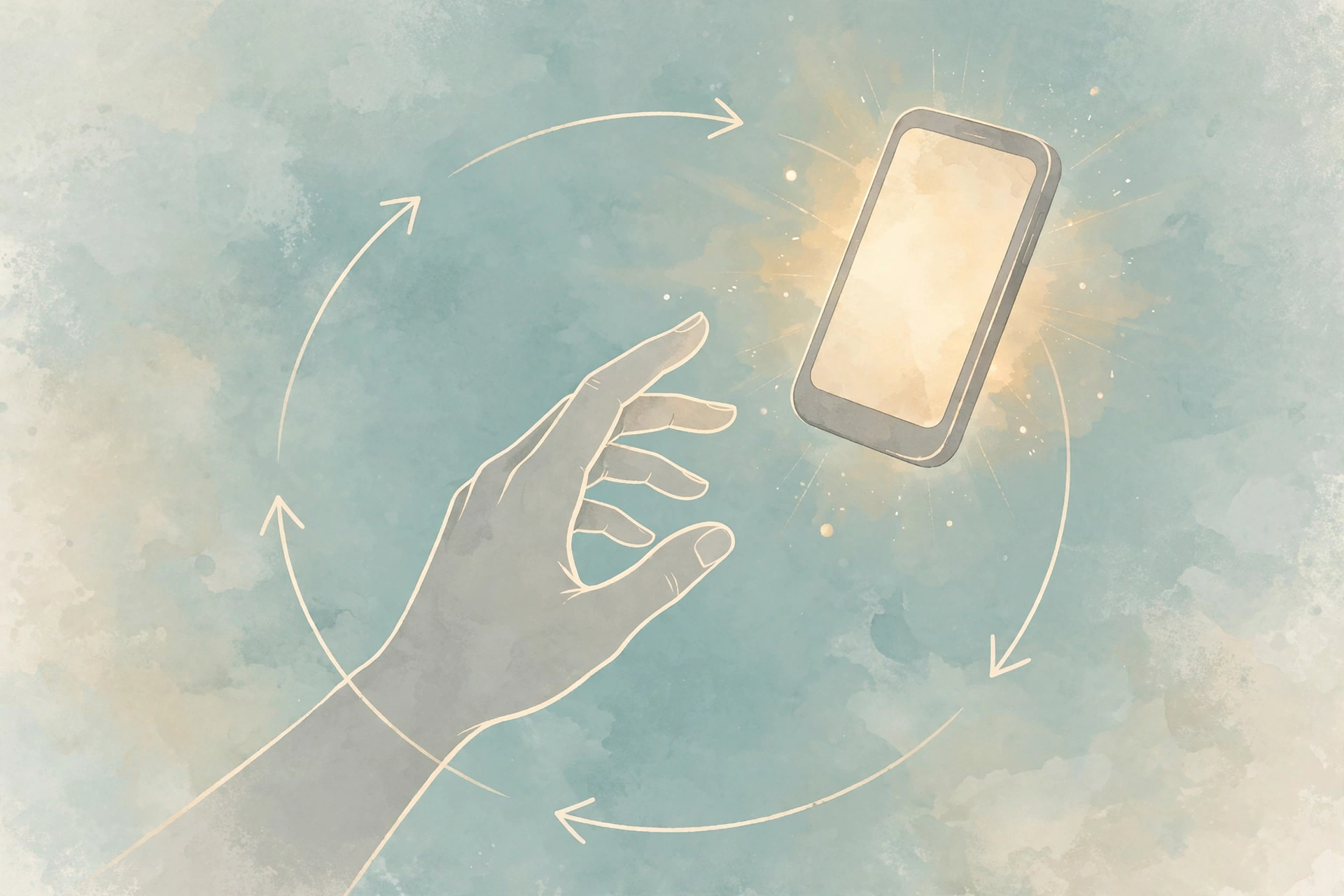
You unlock your phone. You stare at it for a few seconds. You lock it again. And then — the strangest part — you realize you have no idea why you picked it up in the first place.
No notification. No message you were waiting for. Nothing. Just a reflex, executed by your thumb before your brain was even consulted.
If that sounds familiar, you’re in enormous company. The average smartphone user checks their phone over 100 times a day and touches it more than 2,500 times. Most of those checks aren’t purposeful. They’re something closer to a tic — and there’s a precise psychological reason your brain does it.
In short: Why do I keep checking my phone? Because your brain treats it like a slot machine: variable rewards, red dots, and phantom buzzes train a checking reflex that fires before you decide. Most checks are not purposeful. They are habits built by design, and they can be redesigned.
Your brain thinks your phone is a slot machine
In the 1950s, psychologist B.F. Skinner discovered something that would one day make trillion-dollar companies: rewards delivered on an unpredictable schedule are far more addictive than rewards delivered every time.
Press a lever, get a treat every time — the rat gets bored. Press a lever and get a treat sometimes — the rat will press it compulsively, for hours, ignoring food and rest.
Your phone is that lever. Sometimes you unlock it and there’s a funny message from a friend. Sometimes a like, a news alert, a photo that makes you laugh. Sometimes — nothing. That sometimes is the whole trick. Your brain learned long ago that checking might pay off, so it keeps pulling the lever just in case.
This is called a variable reward schedule, and it is the single most powerful habit-forming mechanism psychology has ever identified. Social media companies didn’t stumble onto it. They hired the psychologists who understand it.
Phantom vibrations are real (and they prove the point)
Most phone users have felt their phone buzz in their pocket when nothing happened. Researchers call it phantom vibration syndrome, and studies suggest up to 90% of people have experienced it.
Think about what that means. Your brain is so primed to expect a notification — so hungry for that little dopamine hit — that it hallucinates one. Your nervous system has been rewired to treat the phone as a source of potential reward worth monitoring at all times.
Boredom has become unbearable — by design
There is a deeper reason beneath the slot machine mechanics: we have lost the ability to tolerate even tiny moments of boredom or discomfort.
Waiting for the elevator. Standing in line. A pause in conversation. Every micro-gap used to be filled with nothing. Now every gap gets filled with the phone, instantly. And the more you fill those gaps, the lower your tolerance for emptiness becomes. Boredom starts to feel like an emergency.
Researchers call this “experiential avoidance” — the unwillingness to sit with even mild discomfort. The phone became the perfect tool for it: the fastest escape from any feeling, available in 0.8 seconds from your pocket.
The red dots are not an accident
Nothing on your phone looks the way it does by chance. The red notification badges, the infinite scroll, the autoplay, the streaks, the “pull to refresh” gesture (designed to mimic a slot machine lever — the designer who invented it has said so publicly): these are the products of thousands of A/B tests run by some of the smartest behavioral scientists alive, all optimizing for one metric — your time.
You’re not weak for falling for it. You’re up against an industry.
What it’s actually costing you
Your attention is fragmenting. Researcher Gloria Mark at UC Irvine found it takes an average of 23 minutes to fully refocus after an interruption. If you check your phone 100 times a day, you may never reach deep focus at all. Writer Linda Stone calls it “continuous partial attention” — always scanning, never landing.
Your sleep is suffering. Blue light suppresses melatonin, but the bigger issue is psychological: one “quick check” becomes 40 minutes of scrolling. There’s a name for it — revenge bedtime procrastination, the feeling that the only free time you own is time stolen from sleep.
Your relationships are thinning. There’s a word for choosing your phone over the person in front of you: phubbing (phone + snubbing). Studies show even the presence of a phone on the table — face down, untouched — reduces conversation quality and connection.
Your anxiety is feeding on it. The constant stream of notifications keeps your nervous system in low-grade alert. Many people report baseline anxiety dropping within days of reducing phone use — which tells you how much the phone was manufacturing.
Your memory is outsourcing itself. Psychologists call it the “Google effect”: when information is stored externally, our brains don’t encode it deeply. We’re practicing remembering less, navigating less, tolerating uncertainty less.
What actually works (not “just use less”)
- Kill the slot machine’s bells. Turn off all notifications except calls, texts from real humans, and genuinely urgent apps. The single highest-leverage change — every silenced notification prevents dozens of future pickups.
- Make the phone boring. Switch to grayscale mode (Settings → Accessibility on iPhone and Android). Without color, the screen loses its reward sparkle. It sounds silly. It works remarkably well.
- Create phone-free zones. The bedroom is the big one: charge your phone outside it, buy a $10 alarm clock. Meals and the first morning hour next. Remove the decision entirely.
- Add friction to the worst apps. Delete social media apps from your phone. Log out after each session. Move addictive apps off your home screen. Every second of friction gives your prefrontal cortex time to ask: “did I actually want this?”
- Batch your checks. Check messages at set times — every two hours, say. Tell people. The world will not end, and you’ll discover how little was urgent.
- Build a boredom menu. Write a literal list of alternatives and keep it visible: stretch, step outside, text a friend something real, doodle, do nothing for two minutes. Tolerating boredom is a skill, and it rebuilds fast.
- Audit honestly for one week. Use Screen Time (iPhone) or Digital Wellbeing (Android). Don’t judge — just look. Most people underestimate usage by half. Awareness alone changes behavior.
Try it now: Take the Phone Checking check-in — 6 quick questions that show you exactly which patterns are running your thumb. Take the check-in →
Frequently Asked Questions
Why do I keep checking my phone for no reason?
Because checking has become a reflex, not a decision. Variable rewards, like unpredictable notifications, train your brain the way a slot machine trains a gambler: you check because the next check might pay off.
What are phantom vibrations?
Phantom vibrations are the false sensation that your phone buzzed when it did not. They show how sensitized your brain has become to phone cues: it now detects signals that are not there.
Is phone checking an addiction?
For most people it is a compulsive habit rather than a clinical addiction, but the mechanism is the same: cue, routine, reward. The label matters less than the cost: lost time, fractured attention, and boredom intolerance.
What actually stops compulsive phone checking?
Redesign beats willpower: remove red dots, add friction with grayscale or app limits, and replace the reflex with a waiting ritual. You cannot out-discipline a habit that was engineered against you.
Try it on our site
A few more tools that help with exactly this:
- Screen Time check-in — the broader audit of your digital habits. → Start the check-in
- The Waiting Game — trains delayed gratification, the core skill behind resisting “just one more scroll.” → Play the game
- Urge Surfing — guided exercise for riding out the itch to check without acting on it. → Try urge surfing
Related reading: Internet Addiction: 7 Signs You’re Hooked · How to Stop Doomscrolling
Key Takeaways
- Compulsive phone checking runs on a variable reward schedule — the same mechanism as slot machines. It’s engineered, not a character flaw.
- Phantom vibrations show how deeply your nervous system has been rewired to expect notifications.
- The deeper driver is boredom intolerance: the phone became the instant escape from any micro-moment of discomfort.
- Costs are real: fragmented attention (23 minutes to refocus), worse sleep, thinner relationships (phubbing), manufactured anxiety, outsourced memory.
- What works isn’t willpower — it’s environment design: kill notifications, grayscale mode, phone-free zones, friction on addictive apps, batched checks, a boredom menu.
- A one-week honest audit (Screen Time / Digital Wellbeing) is the best first step.
Reviewed by a Psychology Postgraduate (MA). This article is for educational purposes only and is not a substitute for professional advice, diagnosis, or treatment.
2 thoughts on “Why You Keep Checking Your Phone for No Reason”