
Reviewed by a Psychology Postgraduate (MA)
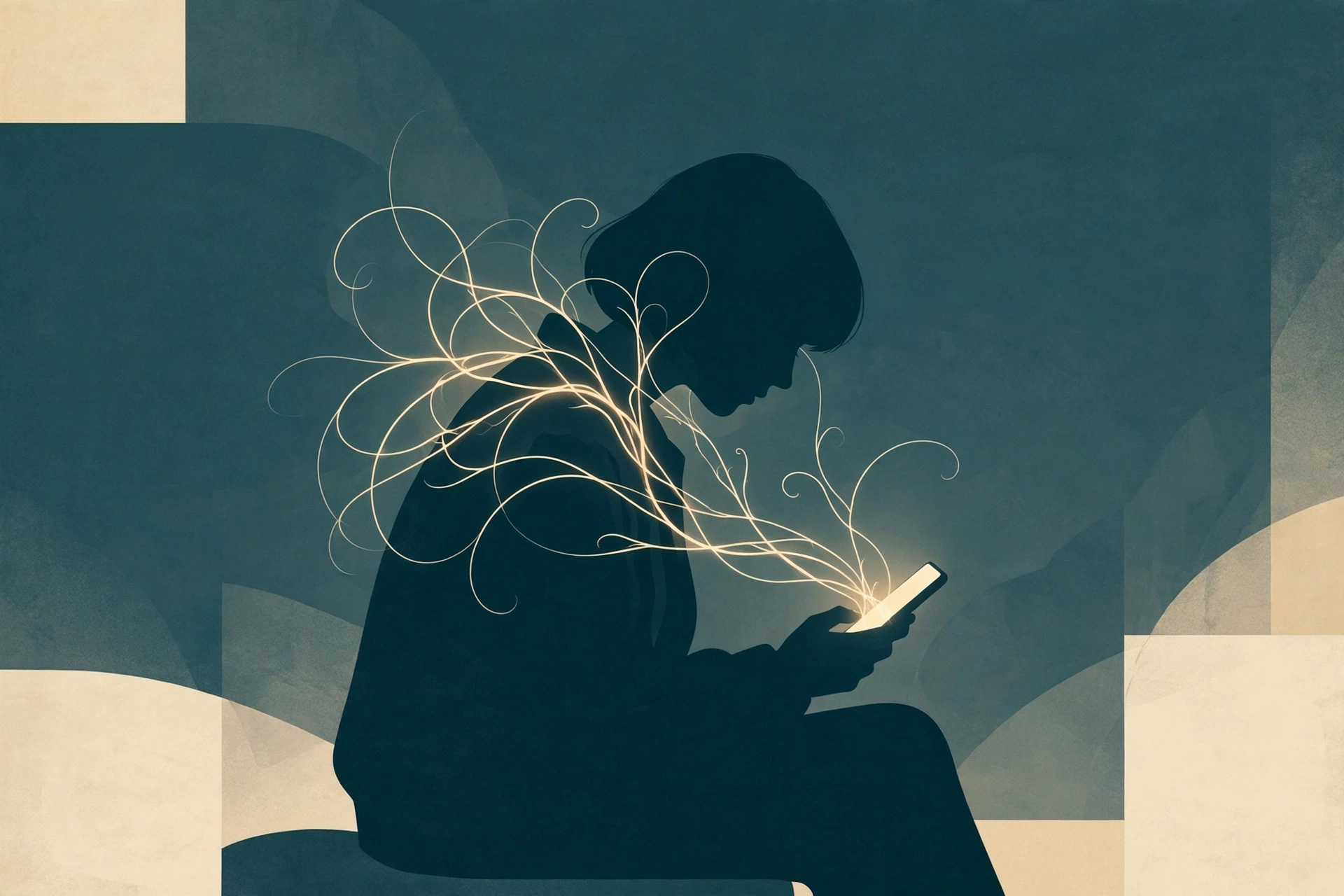
It’s 1:47 a.m. and the blue glow is the only light in the room. You told yourself “five more minutes” about forty minutes ago. Your thumb keeps moving on its own — one more video, one more thread, one more refresh of a group chat that hasn’t said anything new in an hour. Part of you is tired. The rest of you can’t seem to put the thing down.
If that scene feels a little too familiar, you’re not broken, and you’re definitely not alone. Most of us have a complicated relationship with the internet. The question isn’t whether you use it a lot — it’s whether it’s starting to use you.
In short: What is internet addiction? It is compulsive online use that crowds out sleep, work, relationships, and real life: reaching for a device in every empty moment, losing track of time, and failing to cut back. The hook is variable rewards and infinite scroll, and friction plus replacement habits break it.
What “Internet Addiction” Actually Looks Like Day to Day
Let’s skip the clinical language. Nobody’s diagnosing you here — this article is for general education, not a diagnosis, and if your internet use ever feels genuinely out of control, a licensed professional can help you sort it out. What we’re talking about is a pattern: the internet quietly moving from tool to compulsion.
It rarely looks dramatic. It looks like this:
- You pick up your phone without deciding to. You don’t remember reaching for it — your hand just went there during a pause in conversation, a red light, a boring line at the store.
- You open an app “just to check one thing” and surface twenty minutes later with no memory of what you were checking.
- You’ve started taking your phone into the bathroom, to meals, to bed — places it didn’t used to go.
- Time online feels slippery. An hour vanishes and you can’t account for it, the way money vanishes at a casino.
That’s the shape of it. Not a dramatic rock-bottom story — just a slow leak of attention, sleep, and presence.
Why Your Brain Can’t Resist the Hook
This isn’t a willpower problem. The internet is engineered — by thousands of very smart people — to keep you scrolling. A few of the tricks your brain is up against:
Variable rewards: the slot machine in your pocket
A slot machine doesn’t pay out every time. That’s the whole point — the unpredictability is what keeps people pulling the lever. Your feed works the same way. Sometimes you refresh and there’s nothing. Sometimes there’s a message from someone you like, a hilarious video, a piece of news that changes your day. Your brain learns fast: maybe this time. That “maybe” is one of the most powerful motivators in behavioral psychology.
Infinite scroll: no stopping cues
Books have chapters. TV episodes end. Even a bag of chips eventually runs out. But a feed? It never ends, which means your brain never gets the natural signal that says “okay, we’re done here.” Without a stopping cue, the default decision is always keep going.
FOMO: the fear that everyone else knows something you don’t
The group chat is moving fast. Someone posted “did you SEE this??” and you have no idea what “this” is. That itch — the feeling that life is happening somewhere you’re not looking — is enormously uncomfortable, and the internet sells the cure: just check. Just one quick look. The check rarely ends the itch; it usually feeds it.
7 Signs the Internet Has Its Hooks in You
Run through these honestly. A couple of “yeah, that’s me” answers is normal modern life. But if most of them land, it’s worth paying attention.
1. You reach for your phone in every empty moment
Waiting for the elevator. The microwave’s running. A conversation pauses for three seconds. If stillness feels intolerable and your hand is already moving toward your pocket, the reflex has gone automatic. Try this tonight: leave your phone in another room during dinner and notice how many times you feel the phantom urge. That urge is the sign.
2. You’ve lost track of time online — repeatedly
Once in a while, everybody falls down a rabbit hole. But if “I was only going to be a minute” has become a running joke you tell yourself daily, your sense of time is being hijacked. The fix isn’t shame; it’s measurement. Check your screen time report this week — not to punish yourself, just to see the real number. Most people underestimate by half.
3. You feel restless or irritable when you can’t get online
Dead battery. No signal on a road trip. Phone left at home. If those situations make you genuinely edgy — snapping at people, unable to settle — your nervous system has started treating connectivity like a need. That’s a big tell, and it’s also very fixable with gradual practice (more on that below).
4. You’ve tried to cut back and couldn’t stick with it
Deleted the app on Monday, reinstalled it by Wednesday. Set a screen time limit and typed in the passcode to override it without a second thought. Failed cutbacks aren’t evidence that you’re weak — they’re evidence that the habit is stronger than intention alone. Which means you need systems, not resolutions.
5. Sleep is taking the hit
The phone is the last thing you touch at night and the first thing you grab in the morning. You’re scrolling in bed, telling yourself it’s relaxing, while your brain gets blasted with novelty and blue light. If you’re tired all day and wired all night, the bedtime scroll is suspect number one. (Our guide on why we overthink at night digs into the whole racing-mind-at-1-a.m. cycle.)
6. Real-life stuff is getting crowded out
Hobbies you used to love are gathering dust. You’re half-present with people you actually like because part of your attention is on the phone face-down on the table. Work or school is slipping — not catastrophically, just enough that you notice. The internet isn’t adding to your life at this point; it’s replacing parts of it.
7. You use the internet to dodge feelings
Bored? Scroll. Anxious? Scroll. Lonely at 11 p.m.? Scroll. Sad about something you don’t want to think about? Definitely scroll. When the internet becomes your go-to emotional regulation strategy — the thing you do instead of feeling things — it’s serving a job it was never meant to do. If the scrolling is really about what’s underneath, our piece on how to stop overthinking everything might hit home.
How to Break Free: Practical Steps That Actually Work
Forget “just use less willpower.” Here’s what works, grounded in how habits actually change:
Make the bad habit harder, not the good habit stronger
Willpower is a terrible plan. Friction is a great one. Delete the apps from your phone (you can still use the clunky mobile websites — that’s the point). Log out of accounts so every session starts with a password. Move your phone charger out of the bedroom. Turn off every notification that isn’t from an actual human. Each tiny barrier gives your prefrontal cortex a few seconds to catch up with your thumb.
Give the urge somewhere else to go
A habit is a loop: cue, routine, reward. You can’t just delete the routine — you have to replace it. When the itch to check hits, have a specific alternative ready: a book on the nightstand, a two-minute stretch, stepping outside. It feels silly at first. It works anyway, because the brain cares more about doing something than about doing the specific thing.
Schedule your scrolling instead of banning it
Total bans fail because they turn the internet into forbidden fruit. Try scheduled windows instead: twenty minutes after lunch, thirty after dinner. Outside those windows, the phone stays put. Paradoxically, planned scrolling is less compulsive than “forbidden” scrolling — you enjoy it more and stop sooner, because the scarcity isn’t artificial anymore.
Reclaim your mornings and nights first
Don’t try to fix the whole day. Start with the bookends: no phone for the first hour after waking, and the phone charges outside the bedroom at night. Buy a ten-dollar alarm clock if you have to. These two windows have an outsized effect because they protect your sleep and your freshest attention — and once those improve, everything else gets easier.
Notice the feeling underneath
Next time you catch yourself mid-scroll, pause and ask: what was I feeling right before I picked this up? Boredom, loneliness, anxiety, restlessness — the answer is usually one of those. You don’t have to fix the feeling. Just naming it loosens the loop a little, because now you’re choosing rather than reacting. For the late-night variant of this loop, read our guide on how to stop doomscrolling.
Frequently Asked Questions
What is internet addiction?
Internet addiction is compulsive online use that crowds out sleep, work, relationships, and real life. The question is not whether you use it a lot, but whether it is starting to use you.
What are the signs of internet addiction?
Reaching for a device in every empty moment, losing track of time online, feeling restless offline, failing to cut back, losing sleep, crowding out real life, and using the internet to dodge feelings.
Why is the internet so hard to resist?
Variable rewards, infinite scroll, and FOMO combine into a hook with no natural stopping point. There is always one more video, thread, or refresh, so the loop never closes on its own.
How do you break free from internet addiction?
Make the bad habit harder with friction and app limits, give the urge somewhere else to go, schedule your scrolling, and reclaim mornings and nights first. Notice the feeling underneath the urge, since that is what the scrolling is dodging.
The Bottom Line
The internet isn’t the enemy — it’s the greatest tool humans ever built, and it’s also a slot machine that lives in your pocket. Noticing the hooks is the whole game. You don’t need to throw your phone in a river. You just need to stop letting an algorithm decide what your attention is worth.
Start small tonight: charger out of the bedroom, one app deleted, one scheduled scroll window. That’s it. Small frictions beat big resolutions every single time.
Key Takeaways
- Internet addiction rarely looks dramatic — it looks like reaching for your phone in every empty moment and losing track of time online.
- Your brain is up against engineered hooks: variable rewards (the slot-machine effect), infinite scroll with no stopping cues, and FOMO.
- Watch for the big tells: failed cutbacks, irritability when offline, sleep taking the hit, and using scrolling to dodge feelings.
- Don’t rely on willpower — add friction instead: delete apps, log out, move the charger out of the bedroom, kill non-human notifications.
- Replace the habit loop rather than just banning it, and protect your mornings and nights first — the bookends matter most.
- When you catch yourself mid-scroll, pause and name what you were feeling right before. Awareness loosens the loop.
TRY IT NOW
How Hooked Are You, Really?
A 2-minute interactive check-in that scores your screen habits and gives you a clear, honest picture — no judgment, just a starting point.
Take the check-in →
2 thoughts on “Internet Addiction: 7 Signs You’re Hooked and How to Break Free”