
Reviewed by a Psychology Postgraduate (MA)
The short answer: Voyager 1 psychology is the study of what a 49-year journey into the dark does to the human mind. On Wednesday 18 November 2026, Voyager 1 becomes the first human-made object ever to sit one light-day from Earth, about 16 billion miles away, and the milestone matters because awe and long-term thinking change how we feel about our own lives.
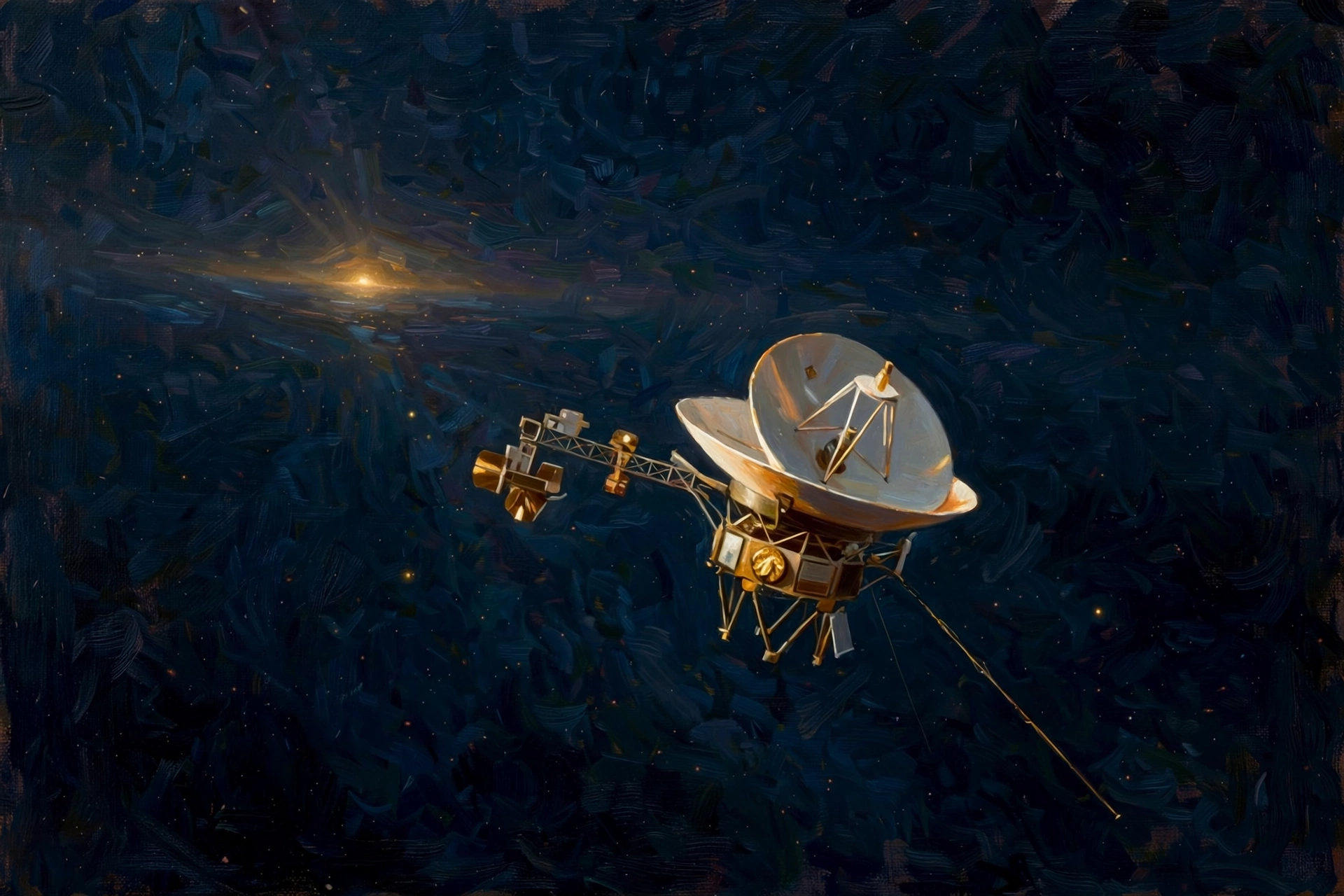
Here is what is actually happening. Voyager 1 launched from Cape Canaveral on 5 September 1977 on a five-year mission to Jupiter and Saturn. Forty-nine years later it is still flying, still talking to Earth, and still moving outward at about 61,000 kilometres per hour. At 5:16:07 a.m. Eastern time on Wednesday 18 November 2026, it crosses a line no human-made object has ever crossed: one light-day from Earth, the distance light travels in 24 hours, about 25.9 billion kilometres, or 16.09 billion miles. NASA confirmed the timing on its mission page, updated 12 November 2026, and is marking it with “Shine Bright for Voyager’s Light-Day”, inviting people to flash the probe’s call sign, V-G-R, in Morse code with a torch after sunset on Tuesday 17 November.
The crossing itself will change nothing on the spacecraft. NASA is clear about that: it is a mile marker, not an event. But the numbers are hard to hold in the mind all at once. A radio signal from Earth will take a full day to reach Voyager 1, and its reply will take another full day to come back, so the fastest possible conversation now takes 48 hours. Its computers hold about 69 kilobytes of memory, less than a single photo on a modern phone. It left the Sun’s protective bubble, the heliosphere, on 25 August 2012. Its twin, Voyager 2, will not reach one light-day until November 2035.
What is awe?
Awe is the emotion we feel when we encounter something vast that challenges our understanding of the world, and makes us feel small in a good way.
Psychologist Dacher Keltner, who has spent two decades studying awe at the University of California, Berkeley, describes it as having two ingredients: vastness, something that dwarfs our normal scale, and accommodation, the need to stretch our mental models to fit what we are seeing. Voyager 1 has both. Keltner’s research finds that awe quiets the brain’s default mode network, the circuitry behind self-focused chatter, which is why people describe awe as the self going quiet.
Voyager 1 psychology: why does a distant spacecraft move us?
Because it gives us the overview effect without leaving the ground.
Astronauts who have seen Earth from space describe a consistent shift: the planet looks fragile and borderless, everyday conflicts shrink, and a sense of connection takes their place. The writer Frank White called this the overview effect in 1987. Voyager 1 produced its most famous version on 14 February 1990, when it photographed Earth as a single pale blue dot, an image Carl Sagan later made famous. The milestone works the same way in reverse: instead of seeing Earth from far away, we imagine how far we have reached. Space launches grip us for the same reason: a rocket caught by robot arms on 14 November gave millions the same sudden sense of scale, and the brain answers scale with awe before it answers with words.
There is also the simple power of a long story ending well. Voyager 1 was built to last five years. It has lasted 49. Human beings are drawn to endurance, because endurance is a promise that effort can outlive its maker. The engineers who launched it are mostly retired or gone, and the machine they built is still working in the dark on less memory than a phone photo.
Why does thinking in decades feel so hard?
Because the human brain is built for the next meal, not the next half-century, and the future always feels further away than it is.
Psychologists call this temporal discounting: we value rewards now far more than rewards later, even when the later reward is bigger. It is why saving for retirement feels harder than buying something today, and why climate news feels abstract even when the numbers are alarming. Voyager 1 is a counter-example the brain can actually hold: a 49-year project with a payoff measured in light-days, still delivering. Research finds that people who regularly imagine their future selves make steadier decisions in the present. A milestone like this one does some of that imagining for us.
Erik Erikson, writing in the 1950s, described generativity, the adult concern with leaving something useful behind for the next generation, as one of the central tasks of a meaningful life. Voyager 1 carries a literal version of that idea: the Golden Record, a gold-plated disc with greetings in 55 languages, music, and sounds of Earth, bolted to the spacecraft in case anyone ever finds it. Weather news can make the future feel heavy, and the El Niño forecasts this month did exactly that, but Voyager 1 shows the other side: the future can be built toward, not only dreaded.
What does awe do for the mind?
Awe is not just a nice feeling. Research links it to lower stress, greater generosity and a stronger sense of connection. In a 2015 study in the Journal of Personality and Social Psychology, Paul Piff and colleagues found that people who had just experienced awe were more generous and more willing to help strangers. The proposed mechanism is the “small self”: awe shrinks our sense of self-importance, and with it our selfishness.
That is why space milestones punch above their weight in the news cycle: a probe crossing one light-day delivers awe to millions at once, for free. In a week of flight cancellations and political deadlock, a 49-year-old spacecraft still answering its phone offers a different headline: some things we build actually last. Stress in America research keeps finding that people feel overwhelmed by problems that seem unsolvable, and awe is one of the few emotions that directly counters that feeling.
How can you use awe in everyday life?
You do not need a spacecraft. Awe is available at much smaller scales, and frequency matters more than intensity.
- Look up on purpose. Spend two minutes looking at the night sky or a tall tree. On Tuesday 17 November, NASA’s invitation is literal: point a torch at the sky and flash V-G-R in Morse code after sunset.
- Follow a long story. Pick one thing that unfolds slowly, a garden, a skill, a savings goal, and check in monthly.
- Imagine your future self. Picture yourself ten years from now, in detail: research links this exercise to steadier decisions today.
- Watch something done brilliantly. A great performance, a craftsman at work: mastery triggers awe, and awe triggers the small self.
Pause and ask yourself: What is one thing you started years ago and are still glad you started? That is your own Voyager 1: something small that kept going long after the excitement faded.
If your mind feels crowded with short-term noise, try the Focus Room for a short stretch of single-task calm.
What happens to Voyager 1 next?
It keeps going, getting quieter, until one day it does not answer at all. NASA expects the probe’s instruments to shut down one by one as its plutonium power source fades, probably in the early 2030s, and at some point the signal will simply stop.
That is part of why the milestone is being marked now: it may be the last clean, countable line the mission crosses. Voyager 2 follows nine years behind, reaching one light-day in November 2035. We built a machine to outlive us, pointed it at the dark, and spent half a century listening. The listening, as much as the machine, is the achievement.
Frequently asked questions
What is one light-day?
The distance light travels in 24 hours: about 25.9 billion kilometres, or 16.09 billion miles.
When does Voyager 1 reach one light-day from Earth?
Wednesday 18 November 2026 at 5:16:07 a.m. Eastern time, according to NASA.
Can we still communicate with Voyager 1?
Yes. A signal takes 24 hours to reach it and 24 hours to return, so the fastest round trip is 48 hours.
What is the overview effect?
The shift in perspective astronauts report after seeing Earth from space: the planet looks fragile and borderless, and everyday conflicts feel smaller.
Why does awe matter for mental health?
Research links awe to lower stress, greater generosity and a stronger sense of connection. It is not a treatment, but regular small awe experiences are linked to better mood.
Try it on our site
If this story stirred something in you, give it somewhere to land.
- Focus Room — a quiet space for single-task attention when the news feels loud.
- Daily Tracker — log one small thing you are building for the long term.
- Relaxation Techniques — slow breathing and grounding for evenings when big news makes your mind race.
- Brain Games — short puzzles that reward patience and attention.
Related reading: SpaceX Caught Starship With Giant Robot Arms: The Psychology of Awe, Risk, and Why We Cannot Look Away · Google Just Launched Gemini 4 for AI Agents: The Psychology of Letting AI Do Your Thinking · El Nino Weather Psychology: The Strongest on Record — and Why the Forecast Feels So Heavy
Key Takeaways
- Voyager 1 reaches one light-day from Earth, about 16 billion miles, on Wednesday 18 November 2026, after 49 years in flight.
- Awe needs vastness and a stretched mental model, and Voyager 1 supplies both at a scale no everyday experience matches.
- The milestone works like the overview effect in reverse: instead of seeing Earth from far away, we feel how far we have reached.
- Long-term thinking is a skill: imagining your future self is linked to steadier decisions.
This article is educational and is not a substitute for professional advice. If you are struggling, please consider speaking to a licensed mental health professional. In the US, you can call or text 988.