
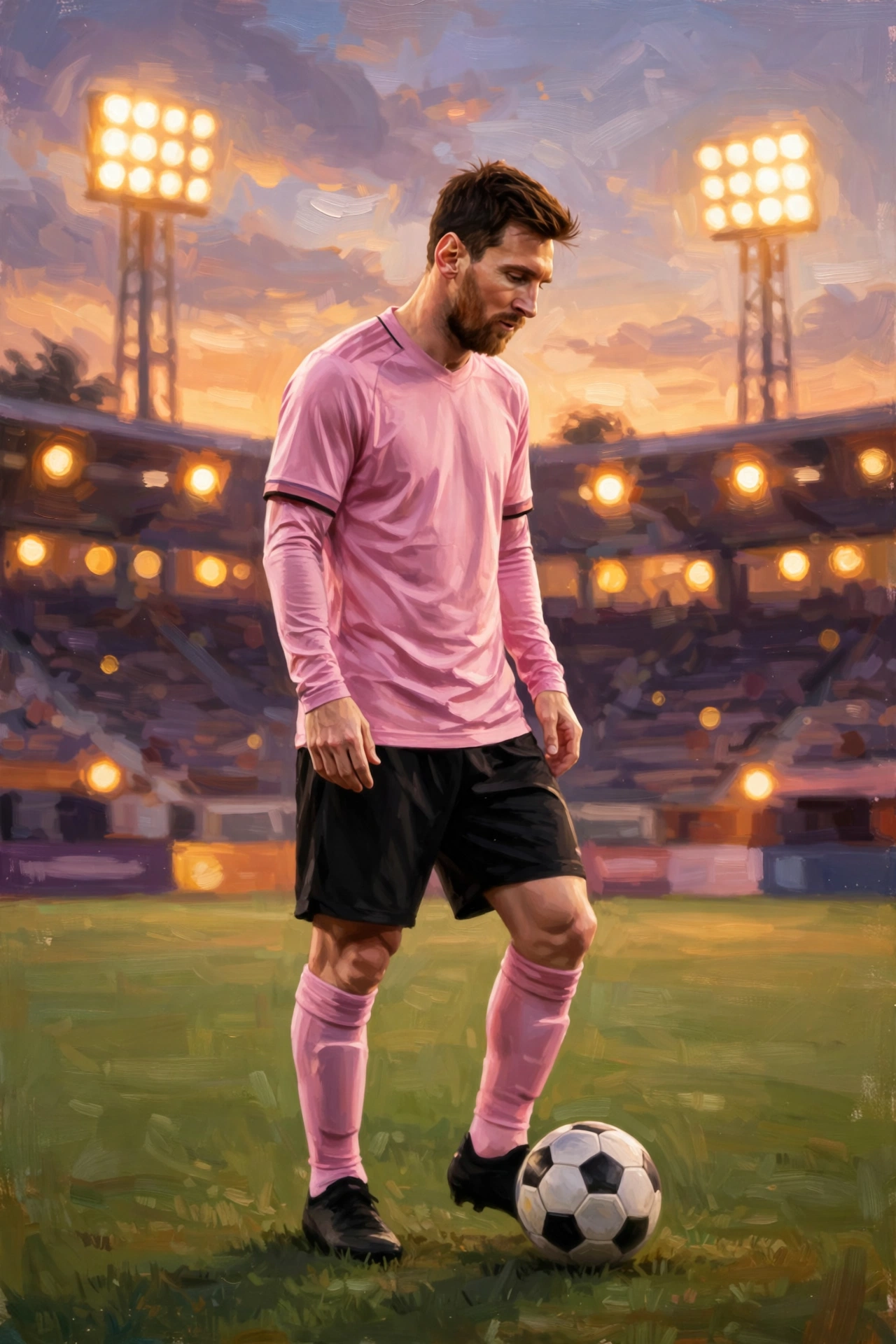
Lionel Messi and the Psychology of Longevity: Why the Greatest Keeps Going When Winning Stops Being Easy
Reviewed by a Psychology Postgraduate (MA)
This profile is an educational look at public behavior and research, not an assessment of the person.
On Friday 23 October 2026, Lionel Messi accepted the Princess of Asturias Award for Sport in Spain, another milestone in the Lionel Messi psychology of longevity. Within a day he had flown back across the Atlantic, and on Saturday 24 October 2026 he came off the bench in the 56th minute for Inter Miami against the New York Red Bulls at Sports Illustrated Stadium in Harrison, New Jersey. The Red Bulls won 2-0, through a Casemiro own goal in the 7th minute and a stoppage-time goal from Emil Forsberg. Messi, who arrived at kickoff leading Major League Soccer with 25 goals this season and tied with Son Heung-min on 15 assists, could not turn this one around. Miami stayed on 55 points.
The short answer: What Messi’s longevity can teach us is that staying great is a different skill from becoming great. It depends less on talent than on routine, humility, recovery, and the ability to keep enjoying the work after the applause fades. Messi has lasted because he protected the small habits that made him, adapted his game as his body changed, and never let one bad night rewrite his story.
Longevity in elite sport is the capacity to perform at a high level over many years by adapting training, role, and motivation as age, injuries, and circumstances change.
That is the question this profile follows, from a small boy in Rosario who needed medical treatment to grow, to a 39-year-old still deciding matches in a fourth decade of professional football. It is not a story about never losing. Messi lost finals, left Barcelona in tears, and was booed in Paris. On 24 October 2026 he lost again, in an ordinary league match, after coming on as a substitute. Longevity is not immunity from defeat. It is what a person does the morning after defeat, and the season after that, and the decade after that.
Story: How does a small boy from Rosario become the player every defender fears?
Lionel Andres Messi was born on 24 June 1987 in Rosario, Argentina, the third of four children. His father worked in a steel factory and coached a local youth team, and his mother worked in a magnet manufacturing workshop. Football was not a hobby imposed from above. It was the language of the neighborhood, played on dusty pitches, in the street, and wherever a ball could be kicked without breaking something valuable.
By the time he was a small child, Messi was playing for local club Grandoli, coached by his father, and then for Newell’s Old Boys in Rosario, where his talent was obvious even to adults who had watched hundreds of promising boys come and go. He was small, quick, and unusually balanced, able to keep the ball close to his feet while changing direction at full speed. Coaches and teammates from those years have described, in public interviews, a boy who seemed to see space a fraction of a second before everyone else did.
Then came the obstacle that shapes the whole story. At around the age of 10, Messi was diagnosed with a growth hormone deficiency. The treatment was expensive, and his family could not easily afford it. In 2000, at the age of 13, he moved to Spain to join Barcelona, after the club agreed to support his treatment and development. The widely reported detail matters here: a child left home, crossed an ocean, and started again in a new country, a new language, and a new academy, all while receiving regular medical treatment. Whatever talent he carried with him, the move demanded patience, homesickness, and trust from a family making an enormous gamble on a teenager.
At La Masia, Barcelona’s academy, Messi kept growing. He rose through the youth teams, and on 16 October 2004, at 17 years old, he made his first-team debut against Espanyol. His first senior goal followed in May 2005 against Albacete. He was a teenager, slight, quiet in interviews, but on the pitch he was already doing things that made experienced professionals stop and watch.

Turning Point: When did Messi stop being a prodigy and become a leader?
There are several candidates for Messi’s turning point, and each reveals a different part of his longevity. The first was the 2008-09 season under Pep Guardiola, when Messi moved from a brilliant winger into the center of Barcelona’s attack. He scored 38 goals that season as Barcelona won the treble of La Liga, the Copa del Rey, and the UEFA Champions League. He was no longer the exciting teenager alongside Ronaldinho and Samuel Eto’o. He was the player the whole system was built around.
The third turning point, and arguably the most important for this profile, was the 2022 World Cup in Qatar. Argentina beat France in the final on penalties after a 3-3 draw, and Messi, who had lost finals in 2014, 2015, and 2016, finally lifted the trophy that had defined his international career. He scored seven goals in the tournament and was named its best player. For many players, that would have been the natural ending: the story complete, the pressure gone, retirement announced on a high. Messi kept playing.
That choice, to continue after the ultimate prize, is where longevity becomes a psychological question rather than a physical one. When the biggest external goal is achieved, what keeps a person going? In Messi’s public remarks since then, the recurring theme has been enjoyment of football itself, and of time with his family and teammates, rather than a new record to chase. The turning point was not a single match. It was the moment when the motivation shifted from proving himself to enjoying the work, and that shift is what makes a long career sustainable.
Mindset: What is Messi’s mindset, really, behind the quiet public image?
Messi’s public image is famously quiet. He rarely gives long, revealing interviews. He does not perform outrage, does not trade insults with opponents in public, and does not build a personal brand around controversy. In public appearances he has often spoken simply about loving football, enjoying training and matches, and valuing time with his family. That restraint is sometimes mistaken for a lack of competitiveness. Anyone who has watched him chase a lost ball in the 90th minute of a match his team is already winning knows better.
The mindset that best fits the public record is a task focus: attention fixed on the next pass, the next run, the next decision, rather than on the noise around the match. Sports psychology research consistently finds that athletes who focus on controllable actions, rather than on outcomes, reputations, or crowd reactions, cope better with pressure and sustain performance longer. A player focused on the next action can survive a missed chance, a hostile crowd, or a bad refereeing decision, because none of those things is the next action.
There is a second part to that mindset: humility as a practical tool, not just a virtue. Messi has repeatedly, in public, credited teammates, coaches, and family for his success, and deflected individual praise toward the team. Humility of that kind protects longevity in a very concrete way. A player who believes his own legend stops listening to coaches, stops adapting, and stops doing the recovery work that nobody applauds. A player who still sees himself as a member of a team keeps learning, even at 39.
Decisions: Which choices made a 20-year career possible?
Longevity is built from decisions, and Messi’s public career offers several clear ones. The first was staying at Barcelona for so long. From his debut in 2004 until his departure in 2021, he played his entire European club career at one club, through multiple managers, teammates, and tactical systems. Stability of that kind has a cost, familiarity can become comfort, but it also has a benefit that matters for longevity: deep knowledge of a system, trust with teammates, and a daily routine that does not need to be rebuilt every summer.
The second decision was adapting his position. The teenage winger who beat defenders on the outside became, over time, a central playmaker, a false nine, and eventually a deeper creator who dictates tempo rather than sprinting past everyone. Each adaptation extended his career, because it asked less of his legs and more of his vision, timing, and decision-making. Players who insist on playing exactly as they did at 21 rarely last. Players who let their game evolve can last into their late thirties.
The third decision was leaving Europe for Inter Miami in 2023. After two seasons at Paris Saint-Germain, Messi chose Major League Soccer over a return to Barcelona, which was not financially possible at the time, and over far more lucrative offers elsewhere that were widely reported. He spoke publicly about wanting a different pace of life and more time with his family, while still competing. The move was criticized by some who saw it as a step down. It also, in practical terms, gave him a schedule, a climate, and a role that allowed him to keep playing at a high level, win the Leagues Cup in his first weeks there, and later help Miami to the Supporters’ Shield in 2024, without the relentless intensity of European football week after week.
The fourth decision is the one on display on 24 October 2026: accepting a substitute role when needed. Coming off the bench in the 56th minute is not the role Messi occupied for most of his career, when he started almost every important match. Accepting it, without public complaint, is a decision about ego. Many great players damage their final years by refusing to accept a smaller role. Messi’s willingness to take the role the team needs on a given night is one reason he is still useful to a team at all.
Method: How does Messi actually train, recover, and prepare?
Messi’s method is not a secret program sold online, and this profile will not invent one. What is publicly known is more ordinary, and more useful. Throughout his career, his preparation has centered on consistent training, careful management of injuries, and a playing style that conserves energy: short bursts of explosive movement, followed by walking, watching, and choosing the exact moment to act. Coaches have often noted that Messi covers less total distance than many midfielders, but covers the decisive distance, the few meters that create a goal, better than anyone.
That economy of movement is a longevity strategy in itself. A player who sprints everywhere burns out. A player who saves his energy for the moments that matter can still decide a match in his late thirties. It also reflects a cognitive skill: reading the game well enough to know when to move and when to wait. As physical speed declines with age, game intelligence becomes more valuable, not less, and Messi’s game was always built on intelligence as much as speed.
Recovery and injury management have been part of the story too. Messi has had hamstring and muscle injuries at various points, particularly in his late twenties, and his training load has been managed more carefully since then, with rest periods, individualized work, and time away from the pitch when needed. None of this is glamorous. It is the unglamorous middle of longevity: sleep, treatment, sensible training, and the discipline to stop when stopping is wise.
Pause and ask yourself: Where in your week are you sprinting everywhere, and where could you walk, watch, and save your energy for the moment that actually matters? If you are tired all the time, try our Sleep Reset tool before you add more effort to an already full schedule.
What If?: What if Messi had never left Rosario?
It is tempting to imagine a version of Messi who stayed at Newell’s Old Boys, became a beloved local hero, and never faced the pressure of Barcelona, the Champions League, or the World Cup. He might have been happier, in some simple sense, and he might have avoided the tax case, the tears of 2021, and the booing in Paris. He would also have been a different player, and arguably a smaller one, because growth often requires leaving the place where you are already comfortable.
The counterfactual also runs the other way. What if Barcelona had not agreed to support his treatment in 2000? What if his family had decided the move to Spain was too great a risk for a 13-year-old? The honest answer is that we do not know, and this profile will not pretend otherwise. Many talented children never get the support, the timing, or the luck they need. Messi’s story includes talent, but it also includes a family willing to move, a club willing to invest, and a medical treatment that worked. Longevity is never purely a matter of character. Circumstances matter, and acknowledging that makes the story more honest, not less inspiring.
What Most People Lack: Why do most people burn out where Messi keeps going?
Most people do not lack talent. They lack a sustainable relationship with effort. They work in bursts, driven by deadlines, praise, or fear, then collapse, then start again. Over years, that cycle produces burnout: exhaustion, cynicism about the work, and a feeling that effort no longer leads anywhere. Messi’s public career shows the opposite pattern: steady effort, spread across decades, with peaks and troughs but no long collapse.
Psychology research on burnout points to several protectors, and Messi’s career displays them in public form. The first is autonomy: a sense of control over how the work is done. The second is social support: teammates, family, and coaches who share the load. The third is a sense of meaning that goes beyond external rewards. Messi has spoken publicly about playing because he enjoys football, not only because of trophies or money, and enjoyment is a far more durable fuel than applause, which always fades.
Most people also lack what might be called recovery literacy: the knowledge that rest is part of training, not a reward for finishing it. A reader who works late every night, skips sleep, and treats weekends as catch-up time is not building longevity. She is spending it. Messi’s later career, with its managed minutes, substitute appearances, and time in Miami, is a public example of a different deal: less intensity, sustained over more years, beats maximum intensity that ends early.
Picture a reader who loves her job but dreads Mondays because she perfects every task at weekends. She does not need a new career. She needs a smaller, sustainable standard for the tasks that matter least.
What Successful People Do Differently: How do the greats handle pressure that breaks others?
Successful people in high-pressure fields do not feel less pressure. They handle it differently. The public record of Messi’s career shows several habits that research also supports. First, they narrow their focus under pressure. In the 2022 World Cup final, with Argentina’s lead gone twice, Messi kept taking penalties, kept demanding the ball, and kept making decisions, rather than hiding from the moment. That is not fearlessness. It is a trained habit of returning attention to the next action.
Second, they separate identity from outcome. A player who believes he is only as good as his last match will be destroyed by a bad night. A player who sees a match as one performance among hundreds can survive it. Messi has lost Champions League finals, Copa America finals, and, on 24 October 2026, a league match in New Jersey after coming on as a substitute. None of those results erased the career that preceded them, and his public response to defeat has consistently been to return to training and the next match, rather than to public explanation or blame.
Success Mindset: Is Messi’s success mindset about winning, or about something quieter?
It would be easy to describe Messi’s mindset as a desire to win. He has won eight Ballon d’Or awards, four Champions League titles with Barcelona, ten La Liga titles, the Copa America in 2021, and the World Cup in 2022, among many other honors. But a mindset built only on winning has a flaw: winning eventually stops, or becomes harder, or moves to a different league, a different team, a different stage of life. On 24 October 2026, Messi did not win. He came on in the 56th minute, with Miami already behind, and the match ended 2-0 to the Red Bulls. If winning were the whole mindset, that night would be a crisis.
A quieter description fits better: a mindset built on mastery, on getting the details right, on enjoying the craft itself. Mastery mindsets last longer than outcome mindsets, because mastery can be pursued on a bad night, in a substitute appearance, or in training, while winning cannot be guaranteed on any given night. A player focused on mastery can play well in a losing team. A player focused only on trophies cannot.

Failures: What did Messi lose, and what did losing teach him?
Any honest profile of Messi must include failure, because his career contains a great deal of it. With Argentina, he lost the 2014 World Cup final to Germany, and lost Copa America finals in 2015 and 2016. After the 2016 defeat, he briefly announced his retirement from international football, then reversed the decision weeks later and returned. That episode is often retold as a moment of despair, but it is better understood as a moment of exhaustion: a player who had carried enormous national expectation, lost three finals in three years, and needed time to decide whether he could carry it again. He decided he could, and six years later he won the World Cup.
At club level, there were painful Champions League exits with Barcelona, including heavy defeats to Roma in 2018 and Liverpool in 2019, when Barcelona surrendered large first-leg leads. There were seasons when the team around him declined, when managers changed, and when the club’s finances deteriorated. Messi did not solve those problems alone, and he did not pretend otherwise. He kept playing, kept scoring, and kept adapting, while the context around him changed.
The lesson of those failures is not that failure builds character in some automatic way. Failure alone builds nothing. What builds is the response: rest, reflection, a change of approach, and a return. Messi’s return after 2016, and his persistence through Barcelona’s difficult final years, show a pattern that research on resilience supports. Resilient people do not bounce back instantly. They recover slowly, they accept help, they change something about their approach, and they try again. The trying again is the part that matters, and it is the part that cannot be faked.
Relationships: Who has kept Messi grounded for more than 20 years?
Messi’s most visible long-term relationship is with his wife, Antonela Roccuzzo, whom he has known since childhood in Rosario. They married in 2017 and have three sons, Thiago, Mateo, and Ciro, who have often been seen celebrating with him after major victories, including the 2022 World Cup. In public interviews and celebrations, Messi has consistently placed family at the center of his life after football, and his move to Miami was widely reported as a choice shaped, in part, by family life.
His football relationships are equally long-lived. At Barcelona, his partnership with Xavi Hernandez and Andres Iniesta defined an era, and his later partnership with Luis Suarez and Neymar, known as MSN, produced one of the most prolific attacking trios in modern football. At Inter Miami, he was reunited with former Barcelona teammates including Suarez, Sergio Busquets, and Jordi Alba, a reunion that speaks to the durability of trust built over years of shared work. Players who trust each other do not need to explain everything on the pitch. They already know where the other will be.
Dark Side: What are the difficult chapters in Messi’s public record?
This section is brief, neutral, and limited to the public record. In August 2021, Messi left Barcelona after 21 years at the club, because the club could not register his new contract under La Liga’s financial rules. At his farewell press conference he cried as he said goodbye, a moment broadcast around the world. It was not a scandal. It was a painful, public ending to a relationship that had defined his adult life, and it is included here because longevity includes endings that are not chosen.
In 2016, a Spanish court found Messi and his father guilty of tax fraud relating to image rights income, imposing suspended prison sentences of 21 months, which were later replaced by fines. Messi has said publicly that he trusted others with his finances and did not intend to defraud anyone. The case was resolved in court, and it is reported here as a matter of public record, without moral judgement, and without speculation about his private intentions beyond what he has stated publicly.
During his two seasons at Paris Saint-Germain, from 2021 to 2023, Messi faced criticism from some supporters and commentators, particularly after Champions League exits, and was booed by sections of the crowd at times. In 2023 he was briefly suspended by the club after an unauthorized trip. He left Paris that summer for Miami. These episodes do not erase his achievements, and they do not define his character. They show that even the most celebrated career includes periods of friction, criticism, and imperfect fit, and that longevity sometimes means leaving a situation that is not working, rather than forcing it to work.
Second Act: Is Inter Miami a retirement, or a reinvention?
When Messi joined Inter Miami in July 2023, many observers described it as the beginning of the end: a great player winding down in a less demanding league, in a warm climate, with his family nearby. The early evidence complicated that story. He scored ten goals in his first seven matches, won the Leagues Cup in August 2023, the club’s first trophy, and lifted the profile of Major League Soccer around the world, with sold-out stadiums, new television audiences, and a wave of interest in the league that commentators called the Messi effect. His Argentina farewell on 6 October 2026 closed his international chapter only.
Miami’s subsequent seasons, including the Supporters’ Shield in 2024 for the best regular-season record, showed that the move was not only a commercial event. It was a competitive project, built around former Barcelona teammates, a growing club, and a player still capable of leading a league in goals. At kickoff on 24 October 2026, Messi led MLS with 25 goals and was tied for the assist lead with 15, numbers that do not describe a player merely going through the motions.
And yet the 24 October match also shows the limits of any second act. Messi accepted the Princess of Asturias Award for Sport in Spain on 23 October, flew back, came on in the 56th minute on 24 October, and still could not change a 2-0 defeat. A second act is not a guarantee of victory. It is a new context, with new teammates, new travel, new expectations, and new defeats. What makes it a reinvention rather than a retirement is not that Messi always wins in Miami. It is that he is still competing, still adapting, still accepting a role that is sometimes a substitute’s role, and still finding reasons to play that go beyond the record books.
Fun Facts: What are ten things you may not know about Lionel Messi?
- Messi made his Barcelona first-team debut on 16 October 2004 against Espanyol, at the age of 17.
- He has won the Ballon d’Or eight times, more than any other player in history.
- In 2012 he scored 91 goals in a calendar year for club and country, a world record.
- He is Argentina’s all-time leading scorer, and captained Argentina to victory at the 2022 World Cup in Qatar.
- His first senior goal for Barcelona came against Albacete in May 2005, from a pass by Ronaldinho.
- He spent most of his youth career at La Masia, Barcelona’s academy, after moving from Rosario at 13.
- He won his first Copa America with Argentina in 2021, ending a long wait for a senior international trophy.
- He joined Inter Miami in July 2023 and won the Leagues Cup within weeks of arriving.
- He accepted the Princess of Asturias Award for Sport in Spain on 23 October 2026.
- At kickoff on 24 October 2026, he led Major League Soccer with 25 goals and was tied on 15 assists.
What the Research Says: What does science say about longevity, pressure, and mastery?
How does research explain a career like Messi’s? Start with deliberate practice. Psychologist Anders Ericsson’s research found that expertise is built not by simply repeating a skill for years, but by practicing with feedback, focusing on weaknesses, and gradually increasing difficulty. Messi’s career fits that pattern: a player who did not just play for twenty years, but kept changing his game, adding passing range, free-kick skill, and playmaking vision as his physical strengths changed.
Next, consider intrinsic motivation. Self-determination theory, developed by Edward Deci and Richard Ryan, finds that people sustain effort longest when they feel autonomy, competence, and relatedness: control over their work, a sense of getting better, and connection to others. Messi’s public account of enjoying football, valuing teammates, and choosing a move that suited his family life maps closely onto those three needs. External rewards, including trophies and money, matter, but research consistently finds that they sustain effort less reliably than enjoyment and meaning.
Third, look at stress and recovery. Research on athletes and high performers finds that chronic stress without recovery leads to burnout and injury, while stress followed by genuine recovery leads to adaptation and growth. Messi’s managed minutes, substitute appearances, and move to a less congested schedule can be read as recovery management: protecting the body and mind so that high performance remains possible, rather than spending both in a single season.
Fourth, consider the psychology of aging in sport. Studies of veteran athletes find that those who last longest tend to compensate for declining speed with improved anticipation, positioning, and decision-making. They also tend to accept role changes, from star to mentor, from starter to substitute, without seeing the change as a defeat. Messi’s shift from winger to playmaker, and his acceptance of a bench role on 24 October 2026, are public examples of exactly that compensation.
None of this research claims that anyone can become Messi by following a formula. Genetics, opportunity, coaching, and luck all matter, and this profile does not pretend otherwise. What the research does offer is a set of habits that make any long pursuit more sustainable: practice with feedback, protect enjoyment, recover properly, adapt your role as you change, and keep your identity larger than your last result.
Activity: How long is your fuse? A longevity quiz
Answer these six questions honestly, choosing the option closest to your usual pattern. There is no JavaScript here, so simply note your answers, add up the points, and read your result in the scoring key below. There are no right answers, only a snapshot of how sustainable your current approach is.
1. When a project gets hard, you usually…
A (1 point): Keep going at full speed until it is done, even if you are exhausted.
B (2 points): Slow down, break it into smaller steps, and keep going steadily.
C (3 points): Stop, rest, rethink the approach, and return with a better plan.
2. After a bad day at work, you…
A (1 point): Replay it all evening and dread the next day.
B (2 points): Talk it over with someone, then let it go.
C (3 points): Note one thing to change, then switch off properly.
3. How do you handle a role that gets smaller, for example fewer responsibilities?
A (1 point): See it as a defeat and resist it.
B (2 points): Accept it grudgingly and do the job.
C (3 points): Ask how you can still contribute well in the new role.
4. What keeps you going in a long project?
A (1 point): Praise, promotion, or a reward at the end.
B (2 points): A mix of rewards and personal interest.
C (3 points): Genuine enjoyment of the work itself.
5. How do you recover after a busy week?
A (1 point): You do not really recover; the next week starts immediately.
B (2 points): You rest a little, but feel guilty about it.
C (3 points): You protect real rest time, without guilt.
6. When you fail at something important, you…
A (1 point): Decide you are simply not good enough.
B (2 points): Feel low for a while, then try again.
C (3 points): Change one part of your approach and try again.
Scoring key:
6 to 9 points: The burnout zone. You are spending energy faster than you restore it. Pick one Messi-like change this week: protect your sleep, accept a smaller role gracefully, or focus on the next action instead of the last result.
10 to 14 points: Steady but stretched. You have good habits, but they slip under pressure. Choose one recovery habit and defend it like a training session, not a luxury.
15 to 18 points: The longevity zone. You pace yourself, recover well, and adapt when roles change. Your challenge is to keep those habits when life gets busy, because that is exactly when they matter most.
Frequently asked questions
What is the psychology of Lionel Messi?
It is a longevity mindset built on task focus, humility, steady routine, and adaptation. Messi has lasted more than twenty years at the top by changing his game as his body changed, protecting enjoyment of football, and accepting new roles, including substitute appearances, rather than clinging to an old version of himself.
What happened in Messi’s match on 24 October 2026?
Messi accepted the Princess of Asturias Award for Sport in Spain on 23 October 2026, flew back, and came off the bench in the 56th minute for Inter Miami on 24 October 2026. The New York Red Bulls won 2-0 at Sports Illustrated Stadium in Harrison, New Jersey, through a Casemiro own goal in the 7th minute and a stoppage-time goal from Emil Forsberg. Miami stayed on 55 points.
How many Ballon d’Or awards has Messi won?
Eight, more than any other player. He also won the 2022 World Cup with Argentina, the Copa America in 2021, four Champions League titles with Barcelona, and ten La Liga titles.
Why did Messi leave Barcelona?
In August 2021, Barcelona could not register his new contract under La Liga’s financial rules, so he left after 21 years at the club. He joined Paris Saint-Germain, then moved to Inter Miami in July 2023.
What can ordinary readers learn from Messi’s longevity?
Pace yourself, protect recovery, focus on the next action rather than the last result, adapt your role as you change, and build an identity larger than any single outcome. Longevity is less about never losing and more about returning well after you do.
Try it on our site
If Messi’s longevity sparked something, these free tools can help you practice it:
- Confidence Builder — rebuild self-belief after a setback, one small step at a time.
- Focus Room — practice task focus, the skill behind Messi’s calm under pressure.
- Daily Tracker — track the small daily habits that make a long pursuit sustainable.
- Sleep Reset — protect the recovery that makes longevity possible.
Explore more free tools at the Wellness Tools hub.
Related reading: Psychology of Erling Haaland: Unshakeable Self-Belief, Ric Flair: The Psychology of Relentless Comebacks, The Psychology of Bill Murray: Spontaneity, Second Acts, and the Joy of Going Off Course, Messi Retired From Argentina: The Psychology of Losing Who You Are.
Key Takeaways
Key Takeaways: Lionel Messi accepted the Princess of Asturias Award for Sport on 23 October 2026, then came off the bench in the 56th minute for Inter Miami on 24 October 2026 as the New York Red Bulls won 2-0. Even the greatest cannot win every night, and that is the point. Messi’s longevity, from Rosario and growth-hormone treatment to Barcelona, the 2022 World Cup, Paris, and Miami, rests on steady routine, task focus, humility, recovery, and a willingness to adapt his game and accept new roles. Research on deliberate practice, intrinsic motivation, stress and recovery, and aging athletes supports those habits. For readers, the lesson is practical: pace your effort, protect rest, focus on mastery over trophies, and return well after defeat.
This article is for education only and is not therapy, diagnosis, or medical advice. If you are struggling, please consider speaking to a licensed professional. In the US, call or text 988.