

Reviewed by a Psychology Postgraduate (MA)
Updated: October 24, 2026. This update on the France protests October 24 is developing; marches were just starting at midday Paris time, so outcomes are not yet confirmed.
France protests October 24: what is happening?
Short answer: On Saturday, October 24, 2026, France faces its second major protest Saturday in eight days, with an authorized Paris march from Bastille to Nation, strict security nationwide, and bans in several cities. About 70,000 security personnel are deployed after sideline looting on October 17, while Paris museums, shops, and metro stations are shut or restricted as the day unfolds.
Earlier coverage: Macron’s bans and the court reversal, the October 17 looting, and the France night curfews.
What happened on October 17, and why does October 24 matter?
October 24 is the second major protest Saturday after October 17, when between 500,000 and 800,000 people marched across France, according to figures reported on October 23 and 24. On the sidelines, rioting and looting erupted. More than 2,500 people were detained. Justice Minister Gérald Darmanin said 217 people had been jailed through fast-track procedures, with about half described as first-time offenders. That contrast shapes October 24.
How large is the security operation on October 24?
Interior Minister Laurent Nuñez mobilized about 70,000 security personnel nationwide for October 24, according to Reuters on October 24. That is about 10,000 more than on October 17. Nuñez told police to be, in his words, “hyper-reactive” and “ultra, ultra responsive” against troublemakers and looters. The scale aims to deter disorder and reassure the public.
What is happening in Paris?
In Paris, a march from Bastille to Nation was authorized from 1pm to 7pm local time under a prefectural decree. Around it, central Paris was restricted or closed:
- 24 metro stations closed from 9am on Saturday at police request, according to RATP, the Paris transport operator.
- The Louvre, the Musée d’Orsay, and the Picasso Museum were shut for the day.
- Shops along sensitive routes boarded up in advance.
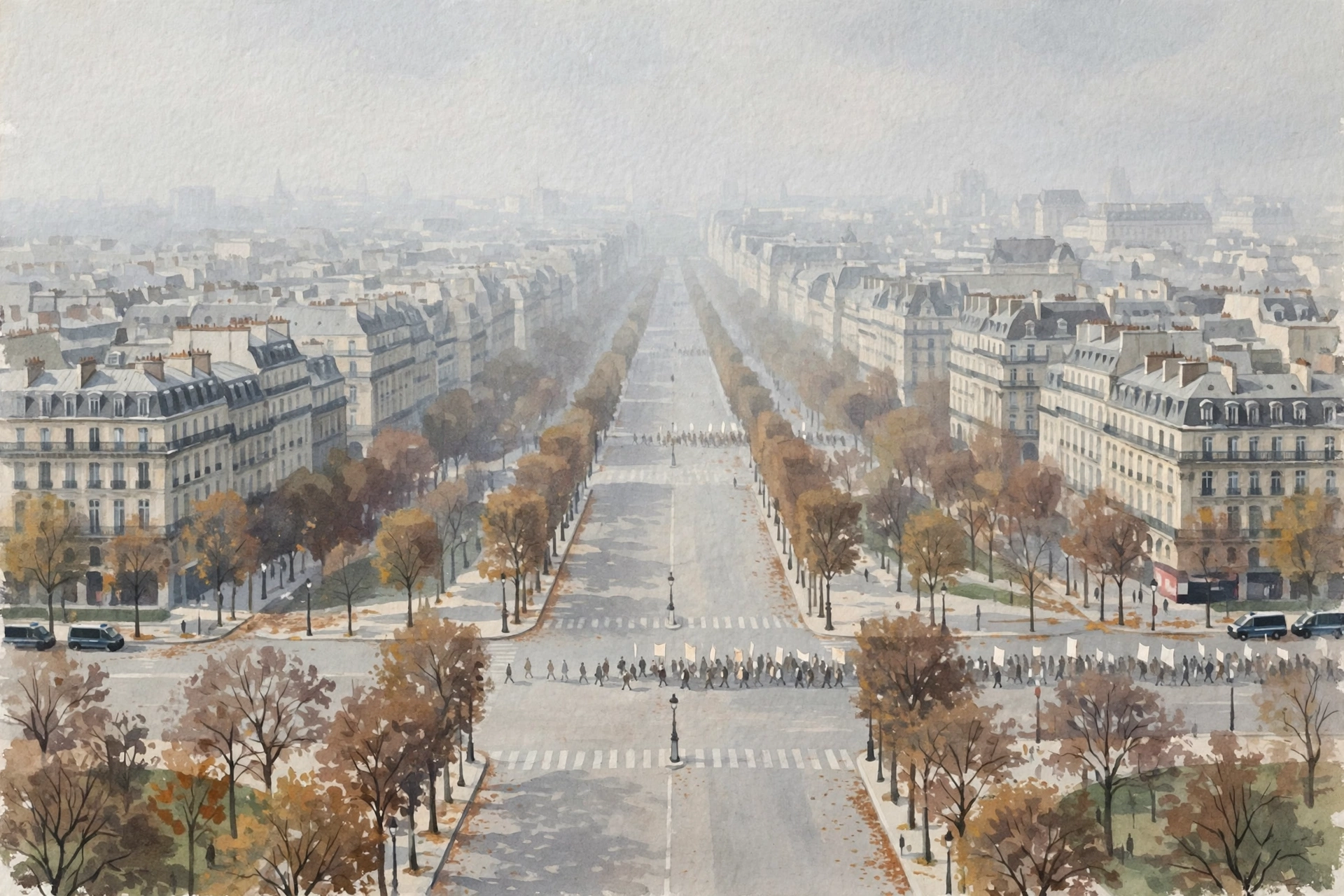
- Soldiers from the Sentinelle anti-terrorism unit patrolled the Champs-Élysées, and police vans circled the Arc de Triomphe.
A Paris curfew from 11pm to 6am continues through Monday morning in the République and Les Halles perimeters.
Which cities banned demonstrations, and which authorized them?
- Lyon: all Saturday demonstrations were banned by the prefecture.
- Marseille and Bouches-du-Rhône: demonstrations were banned across the department on Saturday. Marseille public transport was regulated, and an adult curfew from 11pm on Saturday applied in some central zones, including Vieux-Port.
- Paris, Lille, Strasbourg, Mulhouse, Grenoble, Toulouse, Amiens, Bordeaux, and Nice: marches were authorized under strict security conditions.
Lyon and Marseille residents thus faced a day of prohibition, while Paris and Bordeaux residents faced a controlled march.
What are the protests about?
The protests began as high-school student protests over learning conditions and have spread into a nationwide cost-of-living movement, with unions involved. On Friday, October 23, President Emmanuel Macron met representatives of secondary-school pupils. After the meeting, those representatives urged students to keep protesting until concrete proposals are made. On Thursday, Macron had called for “the utmost severity” against what he called “acts of delinquency.” Those statements capture the gap: firm action against disorder versus continued protest until proposals change.
What else is happening this weekend?
In Orléans, the National Rally (RN) congress hosted by Marine Le Pen takes place this weekend, with counter-protesters heading there. A new poll underlines Le Pen as frontrunner six months ahead of elections to replace Macron. The United States Embassy in Paris issued a security alert on October 22 advising citizens to avoid large crowds and police activity over the weekend.
What is confirmed, and what is still unconfirmed?
- Confirmed: the deployment size, Paris march route and hours, metro and museum closures, city bans, curfews above, October 17 estimates and detentions, and official statements quoted here.
- Unconfirmed: the size of the October 24 crowds, any arrest counts for October 24, and whether clashes or looting occurred on October 24. Those figures need official sources and reputable reporting before they can be stated as fact, so early social media claims should be treated with caution.
Why does the day before a protest feel so tense?
The first theme is anticipatory anxiety, defined here in one sentence: worry that builds before a feared or uncertain event, driven less by what has happened than by what might happen.
In small doses, it helps people plan. It becomes harder when the threat is vague. On October 24, residents faced possibilities, not one clear danger: a peaceful march, transport disruption, a closed museum, a banned gathering, a curfew, or sideline disorder. The mind fills each gap with a worst case, and the body stays alert as if all were happening at once.
Does a visible show of force reassure people, or raise fear?
This is the question at the heart of security theatre, the visible display of security measures meant to signal safety, whether or not each measure directly prevents harm. Security theatre can reassure: a patrol can tell a shopkeeper help is near, and a closed station can tell a parent a risky area is sealed off. It can also raise fear: 70,000 personnel, boarded shops, and soldiers on a famous avenue can make a normal Saturday look like an emergency. Both reactions can be true at once, in different people, on the same street.
Why do bans in some cities and marches in others feel so different?
Procedural justice, the sense that a process is fair, transparent, and applied consistently, shapes how people judge a decision even when they disagree with the outcome. Psychologist Tom Tyler has shown people accept authority decisions more readily when they feel heard, respected, and given a clear reason, even if it goes against them. A ban in Lyon and a march in Paris can each have a local reason, but without a clear public explanation, people fill the gap with their own explanation, often reflecting prior beliefs about authorities.
How do protesters and police affect each other?
Crowd research corrects the old idea of a mindless mob. Psychologists Stephen Reicher and John Drury have argued crowd behavior is shaped by shared identity, by how groups see each other, and by interaction over time. People act on what they believe the situation means, and that meaning can shift quickly. If police treat a crowd as a threat from the start, some marchers may harden. If marchers treat police as an enemy, some officers may respond in kind. Clear routes and predictable policing can break that spiral.
What happens to a city mood when museums, shops, and transport shut?
A shutdown removes normal signs of city life. A shut museum tells a visitor today is not normal. A boarded shop tells a passerby trouble is expected. A closed station tells a commuter the city has been rearranged around risk. The result is collective vigilance: a group stays alert, scans for signals, and shares warnings. That vigilance can protect, but also exhaust, because every closed door starts to look like danger. When neutral ground like museums and cafes closes, conversation narrows to the march route and the police line.
Pause and reflect: Think about a day when your city felt tense before anything happened. What told you to be alert: the news, a closed street, or your memory of a previous event? Notice how much tension came from what you saw, and how much from what you imagined.
What can help on a tense news day?
Limit live scrolling to set times. Separate confirmed facts from early claims, especially about crowd size. Keep normal routines where possible. Feeling anxious on a tense day does not mean you are overreacting; it means you are responding to real signals. If distress feels overwhelming, reach out for support. In France, the national crisis line is 3114.
Key Takeaways
- October 24, 2026 is France’s second major protest Saturday after October 17, when 500,000 to 800,000 marched and sideline looting led to over 2,500 detentions.
- About 70,000 security personnel are deployed, about 10,000 more than on October 17.
- Paris authorized a Bastille to Nation march from 1pm to 7pm, while 24 metro stations closed and major museums shut.
- Lyon and Marseille and Bouches-du-Rhône banned Saturday demonstrations, while other major cities authorized marches under strict security.
- October 24 was still unfolding at midday Paris time, so crowd size, arrests, and incidents remain unconfirmed.
- Anticipatory anxiety, security theatre, procedural justice, and crowd interaction explain pre-protest tension.
Try it on our site
If today’s news has left you on edge, our free, anonymous tools can help. Try the Anxiety check-in or the Stress check-in, or use Name Your Feeling at Zentha Wellness Tools. No signup needed.
Frequently Asked Questions
Is Paris safe to visit on October 24, 2026?
Paris authorized a march from Bastille to Nation from 1pm to 7pm, with metro closures and museum shutdowns around it. Visitors should avoid large crowds and police activity and check transport updates before traveling.
Why are 70,000 police deployed in France on October 24?
Interior Minister Laurent Nuñez deployed about 70,000 security personnel, about 10,000 more than on October 17, after sideline rioting and looting on October 17, according to Reuters on October 24.
Which French cities banned protests on October 24?
Lyon banned all Saturday demonstrations, and demonstrations were banned across Bouches-du-Rhône, including Marseille. Paris, Lille, Strasbourg, Mulhouse, Grenoble, Toulouse, Amiens, Bordeaux, and Nice authorized marches under strict security.
Is there a curfew in France in October 2026?
Yes, in specific areas. Paris has an 11pm to 6am curfew through Monday morning in the République and Les Halles perimeters. Marseille has an adult curfew from 11pm on Saturday in some central zones, including Vieux-Port. These are local, not nationwide.
Educational disclaimer: This article is for general education only. It reports news and explains psychological ideas. It is not medical, legal, or safety advice, and it does not diagnose or treat any person or group. For urgent safety concerns, follow local authority guidance and emergency services. For distress in France, call 3114.