

The Psychology of Patrick Stewart: Dignity, Reinvention, and a Lifetime of Becoming
Reviewed by a Psychology Postgraduate (MA)
On 29 October 2026, the world learned that Sir Patrick Stewart had died — and Patrick Stewart psychology starts with the life behind the tributes, not just the loss. He was 86, and he had died the day before, 28 October, at his home in Los Angeles, in the care of his wife Sunny, after what his family’s statement called a “brief and poignant journey” with Alzheimer’s disease and Lewy body dementia. Within hours, tributes were pouring in from across the acting world: William Shatner called him “a friend, a colleague, and a magnificent actor”; Jonathan Frakes wrote simply, “Rest in peace my friend”; Wil Wheaton posted, “Godspeed, captain.” The Star Trek account’s tribute read: “A voice. A presence. A captain unlike any other.” This profile is an educational look at public behavior and widely reported career choices, not an assessment of Patrick Stewart as a person.
The short answer: Patrick Stewart psychology is the psychology of dignity under pressure: a boy from a working-class Yorkshire home marked by his father’s wartime trauma who turned discipline, language and decency into a 60-year career, reinvented himself at 47 when most actors settle, and kept growing into his eighties. He survived early baldness, class prejudice and typecasting by treating craft as a daily practice, choosing roles that demanded more of him rather than less, and by turning private pain into public advocacy. His life suggests that a long career is less about talent than about what you do with the hand you are dealt, and that dignity is a habit, not a gift.
Dignity, in psychological terms, is the steady sense that you matter and that others matter too, expressed in behavior even when circumstances are humiliating, frightening or unfair.
Story
Patrick Stewart was born on 13 July 1940 in Mirfield, a mill town in the West Riding of Yorkshire, England. He was the youngest of three sons of Gladys, a weaver and textile worker, and Alfred Stewart, a regimental sergeant major in the King’s Own Yorkshire Light Infantry who had served in the Second World War. The family home was poor, and Stewart has spoken publicly, including in his 2023 memoir Making It So, about his father’s violence at home after the war and about growing up frightened of the man he also loved. It is a part of his story he did not hide as an adult; he became a patron of the domestic-abuse charity Refuge and spoke openly about how his father’s untreated trauma shaped his childhood.
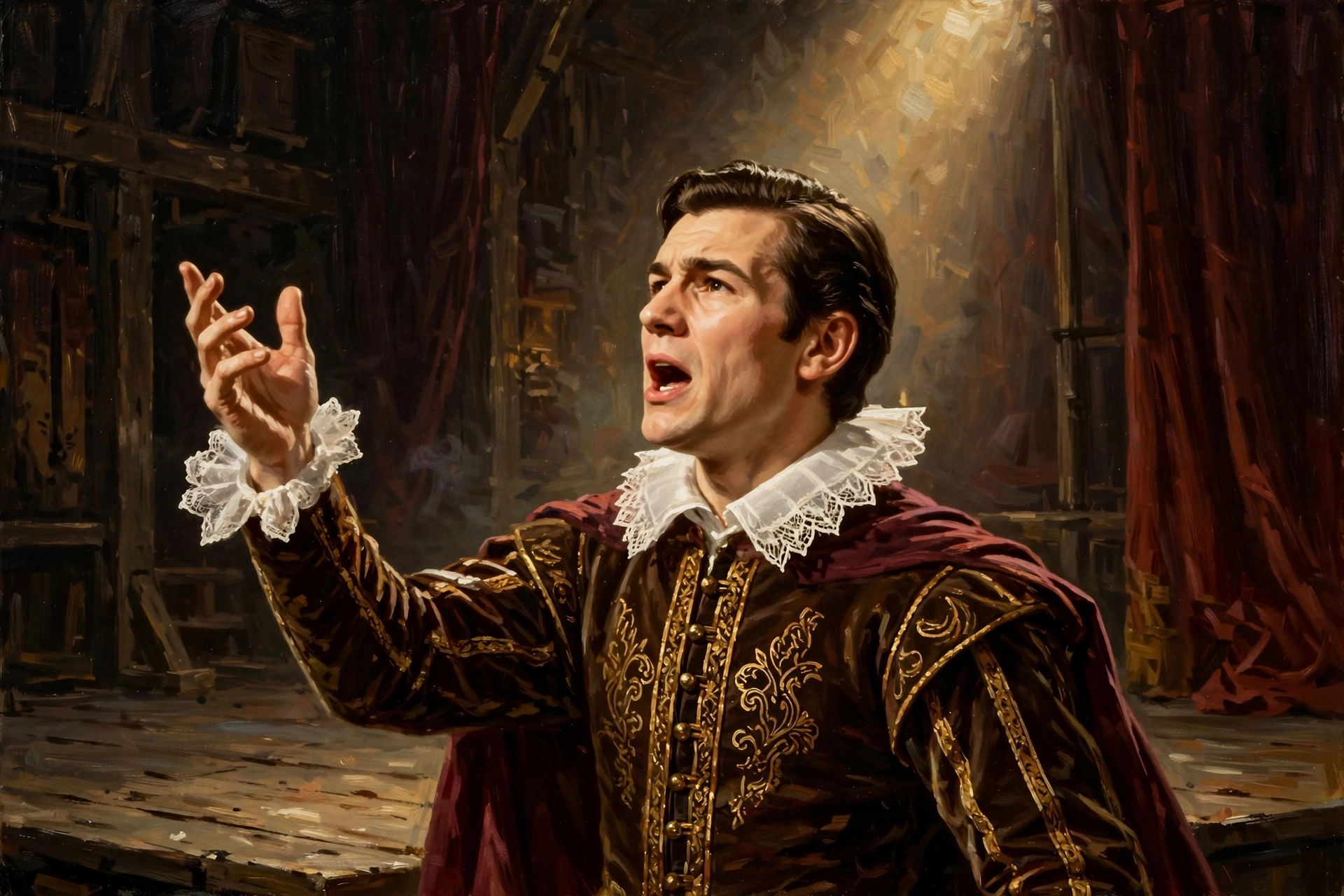
School did not hold him. He left at 15, worked briefly as a junior reporter on a local newspaper, and then, after joining an amateur drama group at 12 and discovering that he could memorize Shakespeare for fun, pursued acting with a single-mindedness that never left him. He trained at the Bristol Old Vic Theatre School, joined the Royal Shakespeare Company in 1966, and spent nearly two decades as a classical stage actor, playing Shakespeare’s kings, villains and fools. He was losing his hair by 19, and for years wore a toupee on stage, a small daily humiliation he later treated as a joke rather than a secret. In 1987, at 47, an age when most stage actors have settled into their lane, he took a job that changed everything: Captain Jean-Luc Picard on Star Trek: The Next Generation. He had never watched Star Trek, he expected the show to fail within a year, and he kept his flat in London just in case. It ran for seven seasons, 178 episodes, and made him famous around the world.
What followed was a second and third career most actors never get. He played Professor Charles Xavier in the X-Men films from 2000, returning to the role across two decades and into the Marvel Cinematic Universe. He returned to the stage repeatedly, including acclaimed productions of Macbeth, Hamlet and Waiting for Godot opposite Ian McKellen. He was knighted by Queen Elizabeth II in 2010 for services to drama. He married Sunny Ozell, a singer-songwriter, in 2013. He returned to Picard for Star Trek: Picard (2020–2023), a series that let an 80-year-old hero face aging, regret and mortality on screen. He wrote his memoir at 82. His final completed film role, Professor X in Marvel’s Avengers: Doomsday, is due in cinemas on 18 December 2026.
His memoir deserves a closer look, because it shows how Stewart thought about his own story. Making It So (2023) is unusually candid for a celebrity autobiography: it opens not with fame but with the small house in Mirfield, the fear, and the father he loved and feared in equal measure. It describes the years of stage work in detail — the dressing rooms, the touring, the roles that taught him his trade — and it treats Star Trek not as a triumph but as a gamble he nearly did not take, because he was afraid of being away from the theater for too long. Memoirs usually polish; this one interrogates. Stewart writes about mistakes in his personal life without self-pity and without blaming others, and about the therapy that helped him understand his father’s behavior as trauma rather than villainy. That distinction — understanding without excusing — is psychologically sophisticated, and it is the same distinction that made Picard such a compelling leader: a man who could hold two truths at once, who could condemn an action and still understand the person who took it.
His advocacy followed the same logic. As a patron of Refuge, he did not simply lend his name; he spoke, repeatedly and specifically, about growing up watching his mother being hurt, about the shame that kept families silent, and about the responsibility of men to name domestic abuse as a men’s issue too. He spoke in Parliament-adjacent settings, in interviews, and in a widely shared 2009 video in which he described witnessing violence as a child. For a man of his generation and background — Yorkshire, military family, classical theater — that openness was a genuine break with the culture that raised him, and it may be the part of his legacy that matters most outside entertainment. Fame gave him a platform; he used it for something that cost him comfort and gained him nothing commercially, which is one reasonable definition of character.
Turning Point
Stewart’s first turning point was not Picard; it was the decision, as a teenager, to believe that a working-class boy from Mirfield could speak Shakespeare for a living. Class in British theater in the 1960s was a wall, not a hurdle: regional accents were coached out, and actors from mill towns were expected to play servants, not kings. Stewart’s voice — that deep, precise, musical instrument — became his passport, but he earned it through years of stage work, not through connections.
The second turning point was Picard itself, and the psychology of it is worth pausing on. He took the role expecting failure. That low expectation was protective: it freed him to play the part seriously, without the anxiety of carrying a franchise. When the show succeeded beyond anyone’s imagining, he faced the opposite problem — the fear of being trapped in one role forever. Many actors in his position either reject the role angrily or surrender to it. Stewart did neither. He used the fame and the money to fund the stage work he loved, negotiated returns to the theater between filming, and, decades later, came back to Picard on his own terms, insisting that the new series be about something more than nostalgia. The turning point, repeated across his life, was refusing to let any single success define him.
Mindset
Three habits run through Stewart’s public record. First, preparation as respect. Directors and co-stars consistently describe him as the most prepared person in the room: lines learned, text understood, choices made before rehearsal began. That is not fussiness; it is a mindset psychologists call conscientiousness applied to craft, and it is the trait that most reliably predicts long-term success in any field. Second, curiosity over comfort. He kept taking roles that frightened him — a silent clown, a villain, a Shakespearean king at 70, a broken old admiral at 80 — because comfort, for him, was a form of decline. Third, decency as discipline. Co-stars from every era describe the same man: punctual, kind to crews, funny without cruelty, and serious about the work without taking himself too seriously. That reputation, built over six decades, is why the tributes of October 2026 sound so personal: people were not just mourning a famous actor, they were mourning a colleague.
There is also a quieter mindset at work: the refusal to be embarrassed by his own history. He spoke about his father’s violence, about his childhood fear, about baldness, about the toupee, about the years when he was not famous and not rich. Shame thrives in secrecy; Stewart’s approach was the opposite — name it, learn from it, and use it. That is the core of what psychologists call post-traumatic growth: not the claim that suffering is good, but the observation that some people, with support and reflection, build meaning and purpose out of painful experience rather than being defined by it.
Decisions
Look at the decisions, not just the roles. Staying with the Royal Shakespeare Company for nearly twenty years when film money was available, because the craft mattered more than the fame. Saying yes to an American science-fiction series he had never watched, because the part was well written and the risk was bounded. Saying yes to X-Men at 60, when many actors would have guarded their serious reputation against a comic-book film, and then playing Professor X with the same gravity he brought to Prospero. Saying yes to Star Trek: Picard at 79, on the condition that it would not simply repeat the old show but would ask what a hero looks like when he is old, tired and uncertain. Writing a memoir at 82 that was honest about his family, his failures and his fears, rather than a polished victory lap.
Each decision shares a shape: a stretch beyond comfort, a text worth serving, and a refusal to protect the image at the expense of the work. That is a learnable pattern. The careers that last are not the ones that avoid risk; they are the ones that take risks in the service of something larger than reputation.
Method
Stewart’s method, as visible from the outside, was classical training made invisible. Years of Shakespeare gave him breath control, textual clarity and an understanding of rhetoric — how a speech persuades, how a pause lands, how stillness commands attention. As Picard, he turned those skills into leadership: the captain who thinks before he speaks, who listens, who leads by reason rather than by shouting. It is no accident that Picard became a cultural shorthand for a certain kind of leader — calm, principled, humane — because Stewart played him that way from the first episode, against the expectations of an action-hero franchise.
His voice work deserves its own note. Stewart’s voice was his signature, and he treated it as an instrument: warm in narration, steely in command, tender in the quiet scenes of Picard where an old man confronts his past. In later years, as his body slowed, the voice carried more of the performance, and he used it with increasing economy — fewer words, longer pauses, more meaning per sentence. For anyone whose work depends on communication, that evolution is instructive: the instrument does not have to get louder with age; it can get more precise.
What If?
What if Stewart had stayed safely in Stratford-upon-Avon, never taking the Star Trek job? He would have had a distinguished stage career and remained largely unknown outside theater circles. What if he had taken Picard and then refused ever to return to the stage, chasing Hollywood money instead? He would have been richer, and probably less respected, and certainly less happy — he has said repeatedly that the stage was where he felt most alive. What if he had let the early fame of Star Trek harden into bitterness about typecasting, as it did for some of his peers? The counterfactual that matters most is the family one: what if he had never spoken about his father’s violence and his own childhood fear? The silence would have protected his privacy, but it would also have silenced the advocacy work — the Refuge patronage, the speeches about domestic abuse — that he considered among the most important things he ever did. The life he actually lived chose openness over comfort, again and again.
What Most People Lack
Most people lack not talent but patience with obscurity. Stewart spent twenty years as a respected but largely unknown stage actor before the world knew his name. The modern economy, and especially the modern attention economy, tells young people that if they are not famous by 25 they have failed. Stewart’s career is a long rebuttal: the work you do in obscurity is the work that makes you ready when the opportunity finally arrives. He could play Picard at 47 because he had spent two decades learning how to carry a stage, how to speak complex text, how to lead an ensemble. The fame was fast; the preparation was slow. Most people want the first without the second, and that is why most careers built on sudden fame do not last.
What Successful People Do Differently
Successful long-career people do three things differently, and Stewart illustrates all three. They diversify before they must: stage, television, film, voice work, advocacy, writing — so no single failure or fashion change can end them. They invest in relationships, not just roles: the decades-long friendship and stage partnership with Ian McKellen, the Star Trek ensemble he treated as family, the marriage to Sunny Ozell that grounded his later years. And they treat reputation as a long game: one punctual arrival, one kind word to a junior actor, one refusal to badmouth a colleague, repeated for sixty years, compounds into trust. That is why, in October 2026, the tributes sounded like they were for a friend, not a brand.
Success Mindset
A success mindset is often described as believing you can grow. Stewart’s version looks more specific: believing you can grow at any age. He took his most famous role at 47, his biggest film franchise at 60, his knighthood at 70, his memoir at 82, and his final television series about aging itself at 79. Psychologists who study aging distinguish between a fixed view of later life — decline, withdrawal, irrelevance — and a growth view, in which new challenges remain possible. Stewart embodied the second view publicly, and that is part of why his death hit so many people who had grown old alongside him: he had shown them a version of aging that included work, love, humor and purpose.
There is a related idea worth naming: generativity, psychologist Erik Erikson’s term for the adult concern with guiding the next generation and leaving something useful behind. Stewart’s later career was deeply generative — mentoring younger actors, advocating for abuse survivors, writing a memoir designed to be useful to others, and playing an old Picard who passes the torch rather than clutching it. Generativity is one of the strongest predictors of wellbeing in later life, and Stewart’s final decade reads like a case study in it.
Failures
No 60-year career is unblemished. Stewart has spoken candidly about a first marriage that ended, about years when work was scarce, about roles that did not work, and about the strain that fame put on his family life. His stage debut in America and some early film choices drew mixed notices. The instructive part is not the failures but the response: no public bitterness, no blaming, no retreat into nostalgia. He kept working, chose better material, apologised where apology was due, and let the next good role do the talking. Psychologists call this self-compassion plus persistence: treating a setback as information rather than identity, and returning to the work rather than to the grievance.
Relationships
Stewart’s closest professional relationships are long ones. Ian McKellen, his friend of decades and co-star in Waiting for Godot and the X-Men films, officiated at his wedding to Sunny Ozell in 2013. The Next Generation cast — Frakes, Marina Sirtis, Brent Spiner, LeVar Burton, Gates McFadden, Michael Dorn, Wil Wheaton — remained a family across 35 years, reuniting for Picard‘s final season in 2023. His marriage to Ozell, 38 years his junior, was the subject of tabloid comment, and he answered it with the same dignity he brought to everything else: by living the marriage visibly and happily, and by refusing to perform outrage for the press. Friends describe him as loyal, funny, and fiercely protective of the people he loved — including his beloved pit bulls, whom he fostered and championed, and Huddersfield Town, the football club he supported all his life.
Dark Side
Every honest profile has a shadow, and Stewart’s is the one he named himself: a childhood lived in fear of a violent, traumatised father, and the long work of making sure that fear did not become his own adult pattern. He has spoken about the anger he carried, about therapy, and about the conscious decision to be a different kind of man from the one who frightened him as a boy. There is also the shadow side of fame itself: the years when Picard threatened to swallow the actor, when fans wanted the captain and not the man, when the toupee years and the class snobbery of early British theater left their marks. And there is the final shadow, the one his family named in October 2026: that a man whose instrument was language and memory spent his last months on a “brief and poignant journey” with Alzheimer’s disease and Lewy body dementia, conditions that attack exactly those gifts. The family’s statement asked for privacy and gratitude rather than speculation, and that request deserves respect: what matters publicly is the life and the work, not the details of the illness.
Second Act
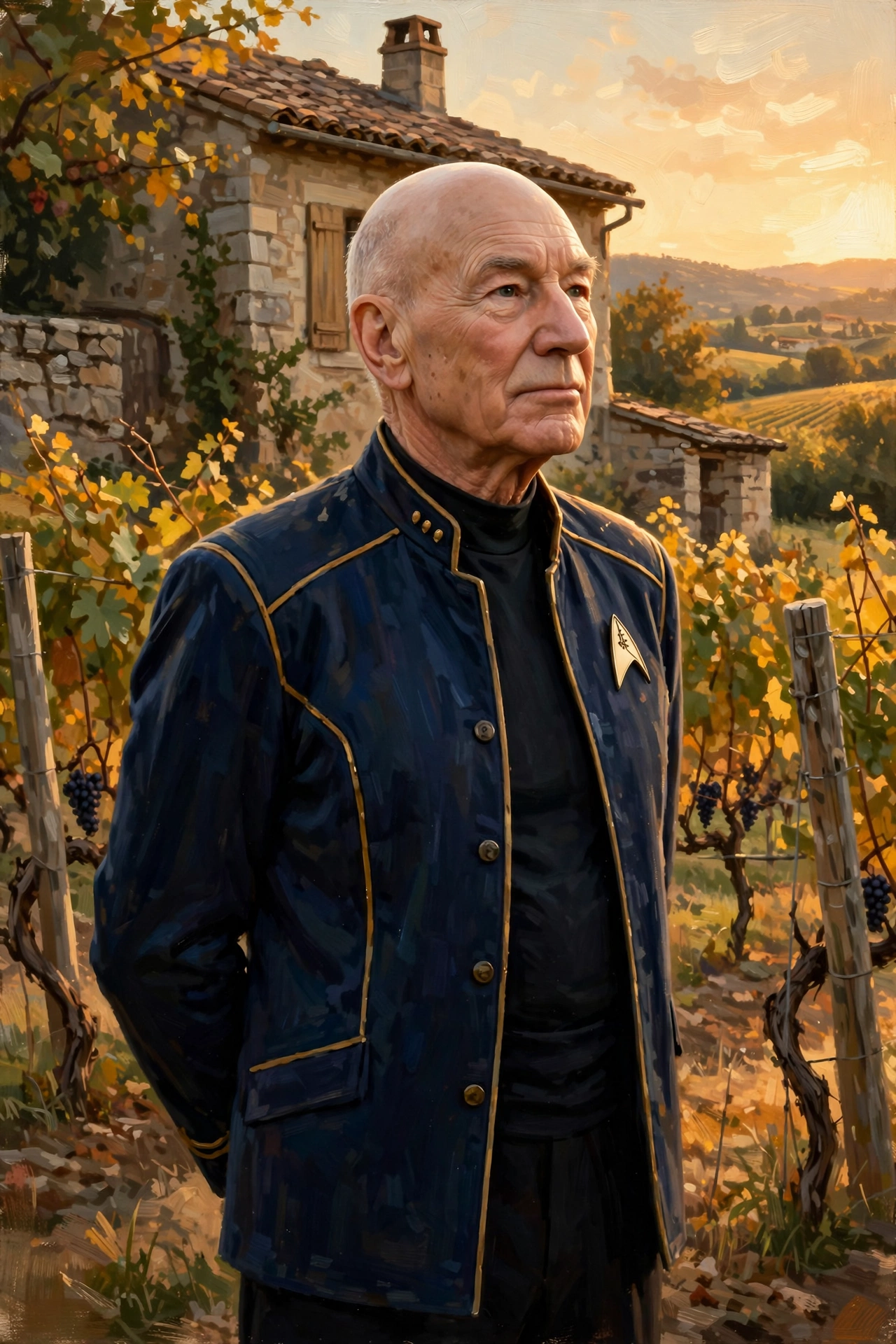
Stewart had not one second act but several, and the last of them may be the most instructive. Star Trek: Picard (2020–2023) was a deliberate second act, not a nostalgia exercise: it showed an old hero retired to a vineyard, grieving, uncertain, and then choosing to act again. It was, in effect, Stewart playing his own situation — an aging man deciding whether he still had something to offer — and audiences responded precisely because it was honest. Then came the memoir at 82, Making It So, which confronted his childhood, his father’s violence and his own mistakes with unusual candor for a celebrity autobiography. And then, in his mid-eighties, a final film role as Professor X, closing a circle that began in 2000. The pattern is unmistakable: each act was chosen, not drifted into, and each was harder and more honest than the last.
Fun Facts
Stewart memorized Shakespeare for fun as a schoolboy and could recite long passages before he ever acted professionally. He was a lifelong Huddersfield Town supporter and a motor-sport enthusiast. He became an unexpected social-media star in his seventies, posting cheerful videos with Sunny Ozell and his dogs that charmed a new generation. He was Chancellor of the University of Huddersfield from 2004 to 2015. He voiced characters in American Dad!, Family Guy and The Prince of Egypt, and narrated everything from documentaries to video games. And he once said that the proudest title he ever held was not “Sir” or “Captain” but “Dad” — a line that, coming from a man who grew up frightened of his own father, carries more weight than any award.
What the Research Says
What does psychology research say about a life like Stewart’s? Several findings fit. First, conscientiousness — the tendency to be disciplined, prepared and reliable — is the personality trait most consistently linked to career longevity and life satisfaction across decades of longitudinal research. Second, purpose in life, the sense that one’s daily activities serve something larger than oneself, predicts better health and cognitive aging in older adults; Stewart’s advocacy and mentoring are textbook examples. Third, social connection is among the strongest predictors of wellbeing in later life, and Stewart’s long friendships and marriage are the human infrastructure behind the public career. Fourth, research on post-traumatic growth finds that people who construct meaning from adversity — through storytelling, advocacy or helping others — often report deeper purpose than before, though growth is never guaranteed and never erases the original pain. Finally, studies of “successful aging” emphasize selection, optimization and compensation: choosing fewer, more meaningful goals, investing deeply in them, and finding new ways to do what matters when old ways close. Stewart’s later career — fewer roles, deeper ones, a voice used more precisely as the body slowed — is that model in action.
Activity
The Picard Pause — a 2-minute quiz. Think of a decision you are facing right now, then answer honestly:
- When you picture the decision, do you feel rushed, or do you feel clear? (Rushed = pressure is deciding for you; clear = you have room to think.)
- What would you choose if nobody would ever know what you chose?
- What is the smallest next step, not the grand gesture?
- Who is one person whose counsel you trust, and what would they ask you — not tell you — about this?
- If you imagined yourself at 86 looking back, which choice would you be glad you made?
If most answers point the same way, that is your Picard answer: the choice made with dignity, not with noise. If they conflict, the conflict itself is the information — sit with it a day longer before deciding.
Frequently Asked Questions
How did Patrick Stewart die? Patrick Stewart died on 28 October 2026 at his home in Los Angeles at age 86, after a brief illness involving Alzheimer’s disease and Lewy body dementia, according to a statement from his family published on 29 October 2026.
What was Patrick Stewart best known for? He was best known as Captain Jean-Luc Picard in Star Trek: The Next Generation (1987–1994) and Star Trek: Picard (2020–2023), and as Professor Charles Xavier in the X-Men films, alongside a six-decade Shakespearean stage career.
Was Patrick Stewart knighted? Yes. He was knighted by Queen Elizabeth II in 2010 for services to drama.
What did Patrick Stewart advocate for? He was a patron of the domestic-abuse charity Refuge and spoke publicly about his childhood experience of his father’s violence, campaigning against domestic abuse and for support for survivors.
Try it on our site
Stewart’s life was a study in pausing before reacting — the Picard pause. Try it for yourself:
- Challenge the Thought — examine a pressured thought the way Picard would examine a problem: slowly, and with evidence.
- Mind Check-Ins — a quick check-in on how you are really doing today.
- Name Your Feeling — put a precise name on what you feel before you decide what to do about it.
Related reading: Julia Roberts and the Psychology of Longevity, Bill Murray and the Psychology of Spontaneity, Ric Flair and the Psychology of the Comeback.
Key Takeaways
- Dignity is a daily habit — preparation, punctuality, kindness to colleagues — not a trait you are born with.
- Long careers are built in obscurity: the twenty unglamorous years made the famous twenty possible.
- Reinvention works best as a step sideways into something adjacent, with people you trust, not a leap into the unknown.
- Pain named openly can become purpose; pain hidden tends to become pattern.
- Aging well means choosing fewer, deeper goals and using your instruments more precisely, not more loudly.
- The Picard pause — think before you speak, listen before you lead — is a leadership skill anyone can practice today.
This article is for education only and is not therapy, diagnosis, or medical advice. If you are struggling, consider speaking to a licensed professional. In the US, you can call or text 988 for the Suicide and Crisis Lifeline; in the UK, Samaritans is available at 116 123.