
Reviewed by a Psychology Postgraduate (MA)
Everyone agrees the plan is great. You think it’s terrible. Speak up? Probably not. That silence: conformity. Not weakness — one of the most powerful forces in behavior, proven with lines on cards.
What it means in one sentence: Conformity is adjusting behavior/opinions to match a group — even when obviously wrong.
In short: Conformity psychology studies why we adjust our behavior and opinions to match a group, even when the group is obviously wrong. In Asch's line experiment, about 75 percent of participants conformed at least once. Two engines drive it: normative conformity, wanting to be liked, and informational conformity, treating the group as data. One ally cuts conformity dramatically.
Conformity in Everyday Words
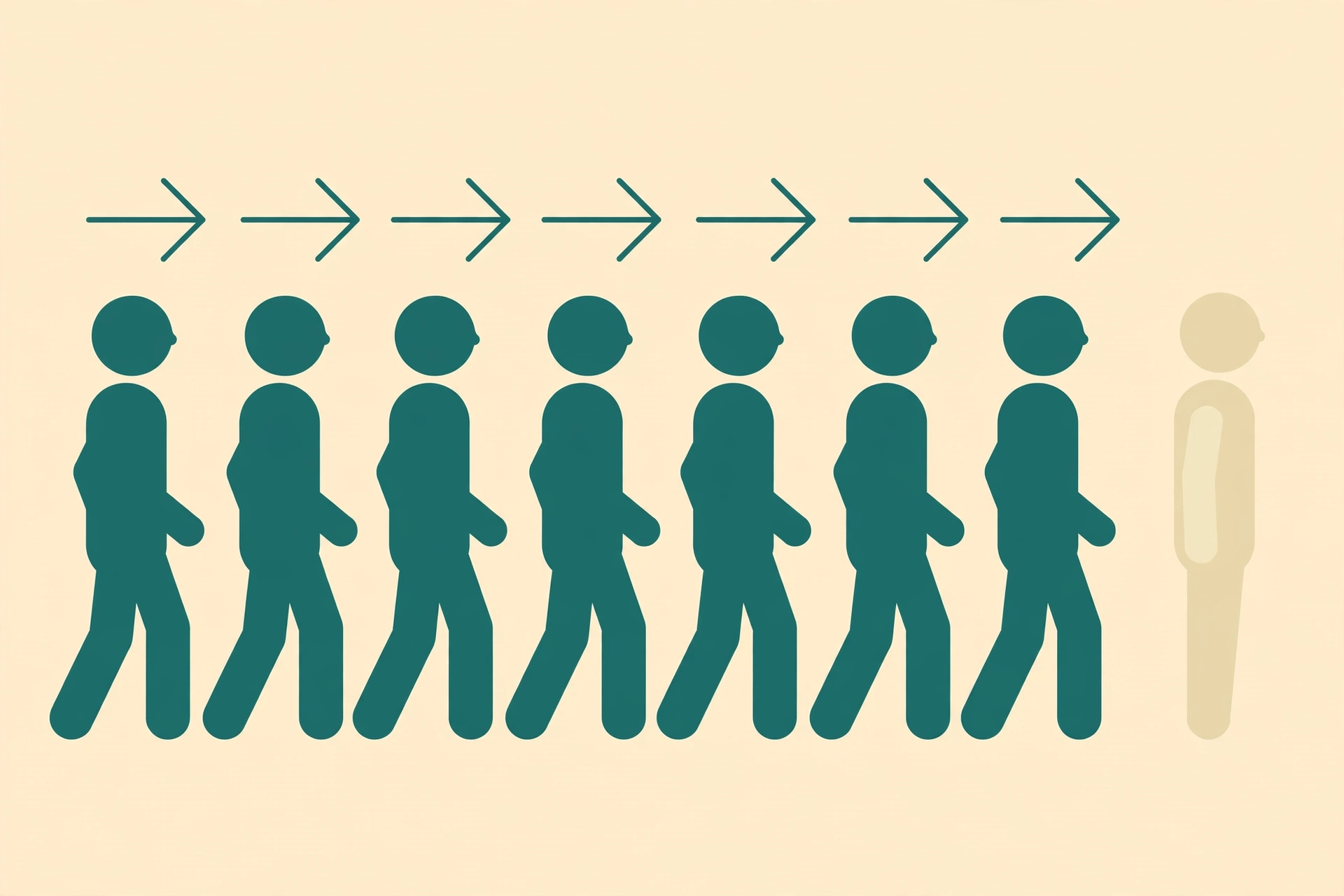
Asch (1951): obvious line-matching. Seven actors gave wrong answers first. Real participant last: ~75% conformed at least once. Over lines.
Two engines: Normative (“want to be liked” — knew right answer, wouldn’t say it). Informational (“they must know” — group as data). Conformity = culture’s glue (traffic rules, manners). Question: when does group deserve agreement vs. dissent?
The Science Behind It
Unanimity matters most: one ally → conformity collapsed 80%. Group size: plateaued at 3-4. Anonymity: private answers slashed it — social cost, not belief. Collectivist cultures conform more; all conform plenty.
3 Examples From Real Life
Example 1 — Meeting silence: Boss’s flawed plan. You see problems. Silent. So does everyone. Later: everyone saw them. Pluralistic ignorance — each thinks only doubter. One voice would’ve broken it. Unanimity is lock; dissenter is key.
Example 2 — Fashion wave: Skinny → baggy → skinny. Nobody decided — group moved, individuals followed. Normative (don’t stand out) + informational (must know cool). We adopt from observation, not evaluation.
Example 3 — Elevator: Actors face back. Newcomer turns too. No pressure, just unanimous behavior. “They must know something.” (They didn’t.) We conform to elevator direction.
🧠 Quick check: Why did Asch participants give wrong answers?
Why: ~75% conformed over obvious lines. Not perception — social cost. Saw correctly; spoke incorrectly.
Try This Today
Pre-commit dissent: write honest view before meetings. Harder to silently slide with a record. Find your ally beforehand. Asch: one partner cuts conformity 80%. Dissent = team sport.
What People Get Wrong
Myth: “Conformists weak; independents strong.”
Reality: Everyone conforms — neural, not moral. Group opposition activates pain; agreement activates reward. “Independents” conform to different groups. Skill = selective nonconformity.
Why It Matters
Shapes opinions, purchases, ethics, silence. Unanimous groups don’t just pressure dissent — prevent it forming. Antidotes: speak/write first, find one ally, reward dissent (as leader). Groups need honest disagreement.
🧠 Quick check: What most reduces conformity (Asch)?
Why: Unanimity is lock. One partner collapses pressure. Dissent easier together.
Frequently Asked Questions
What is conformity in psychology?
Conformity is adjusting your behavior or opinions to match a group — even when the group is obviously wrong. It is not weakness; it is one of the most powerful forces in human behavior, proven with lines on cards.
What was the Asch conformity experiment?
In 1951, Solomon Asch had seven actors give obviously wrong answers on a simple line-matching task, with the real participant answering last. About 75 percent conformed at least once — over lines, with nothing at stake.
What is normative vs. informational conformity?
Normative conformity is wanting to be liked: you know the right answer but will not say it. Informational conformity is treating the group as data: you assume they must know something you do not. Both run at once in most group pressure.
How do you resist conformity?
Pre-commit dissent by writing your honest view before meetings, find one ally beforehand (Asch showed a single partner cuts conformity by about 80 percent), and speak or write first. Dissent is a team sport.
Try It on Our Site
Try it now: Social Anxiety check-in — how much does the group steer you?. Start the check-in →
More tools for this topic:
Related reading: 30. Obedience (Milgram) · 31. Social Proof · 32. The Bystander Effect
Tap when this one clicks — your progress is saved on this device.
Why are teenagers more likely to conform than adults?
Because in adolescence the social reward system is turned up while the braking system is still under construction. Fitting in is not vanity at 14 — peers are a teenager’s main route to status, safety, and identity, so the brain treats group approval as a genuinely high-value reward.
Developmental research has tracked this curve for decades. Thomas Berndt’s classic 1979 study found that conformity to peers peaks around the ninth grade, at roughly age 14 to 15, and then gradually declines. More recent brain-imaging work explains why. In a well-known experiment by Jason Chein and colleagues (2011), teenagers took far more risks in a driving game when friends were watching than when alone — and scans showed their brains’ reward regions responding more strongly in the presence of peers. Adults in the same setup barely changed. The audience itself was changing how rewarding the risky choice felt.
Laurence Steinberg’s research on adolescent development adds the timing mismatch: the socioemotional system that craves peer reward becomes highly sensitive at puberty, while the prefrontal systems that weigh long-term consequences mature well into the twenties. So a teenager who goes along with the group is usually not being foolish or weak. They are running newer social hardware with older brakes, in the life stage when belonging matters most.
Picture a school corridor at lunch. A group chat joke at another student’s expense is flying around, and Maya, 14, adds a laughing emoji even though it sits badly with her. She is not cruel, and she privately messages the target afterwards to check she is okay. In the moment, though, the visible cost of not reacting — being the one who killed the joke, being quietly dropped from the chat — felt immediate, while the harm felt abstract. That lopsided maths, not bad character, is what adolescent conformity runs on.
Two quick questions
Is conformity the same as obedience?
No. Conformity is adjusting to a group’s norms, usually among equals, without being directly ordered. Obedience is following an instruction from an authority figure. The pressure in conformity is belonging; the pressure in obedience is hierarchy.
Does conformity disappear when answers are private?
Partly. Asch found that private responses sharply reduced conformity, which shows much of it is public compliance — saying the thing while privately disagreeing. But informational conformity can survive privacy, because the group genuinely changed what the person believes is true.