
Reviewed by a Psychology Postgraduate (MA)
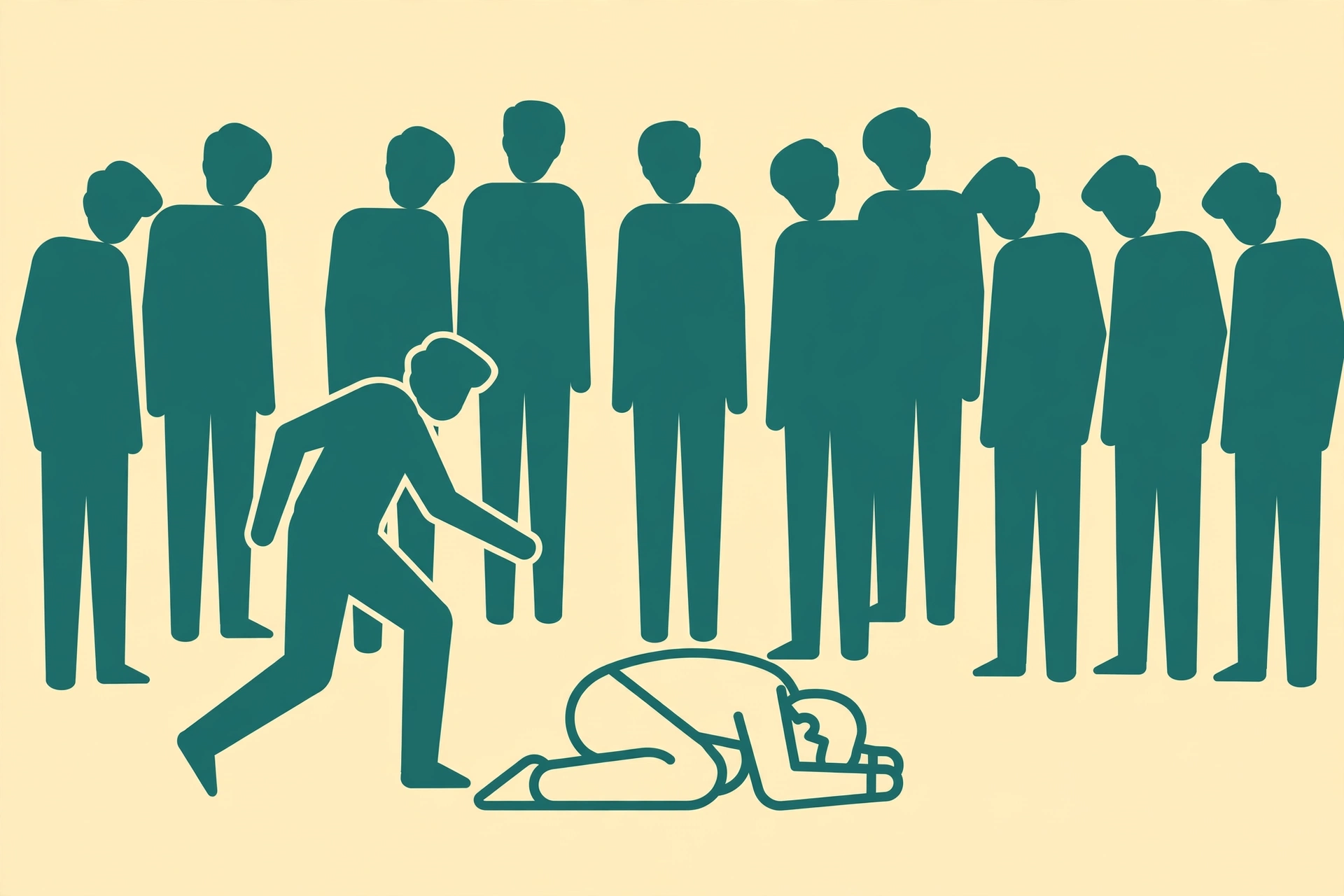
A woman is attacked. Thirty-eight witnesses watch from windows. Nobody calls police. Nobody helps. This is the story — possibly exaggerated, but psychologically true — that launched 50 years of research into the bystander effect: the chilling paradox that the more people present, the less likely anyone helps.
What it means in one sentence: The bystander effect is the finding that individuals are less likely to help in an emergency when other people are present — responsibility diffuses across the crowd.
In short: The bystander effect is the finding that individuals are less likely to help in an emergency when other people are present. Three mechanisms paralyze crowds: diffusion of responsibility, pluralistic ignorance, and evaluation apprehension. The antidote is specificity: point at one person and give one clear task, and the paralysis collapses.
The Bystander Effect in Everyday Words
Three mechanisms paralyze crowds. Diffusion of responsibility: “Someone else will do it.” With 38 witnesses, each feels 1/38th responsible — which feels like zero. Alone, you’d feel 100% — and act. Pluralistic ignorance: everyone looks calm (nobody wants to overreact), so each concludes “must not be serious.” The crowd’s calm is performed; the interpretation is wrong. Evaluation apprehension: fear of looking foolish — “what if it’s not an emergency and I embarrass myself?” Social cost blocks moral action.
The result: a crowd of concerned individuals producing collective indifference. Everyone would help alone. Together, no one does. It’s not apathy — it’s social psychology.
The Science Behind It
John Darley and Bibb Latané (1968) proved it experimentally. Participants heard a seizure over intercom — believing 0, 1, or 4 others also heard. With no others: 85% helped. With four others: 31%. Same emergency, same person — crowd size was the variable. Later studies confirmed: help decreases as witnesses increase, across emergencies, cultures, decades.
The antidote is specificity. In one study, when a victim pointed at one bystander — “You! Call 911!” — help skyrocketed. Why? It broke diffusion (responsibility assigned), broke pluralistic ignorance (this is serious), and removed evaluation fear (you were asked). The bystander effect isn’t about character — it’s about structure. Change the structure, change the behavior.
Modern twist: the effect reverses when helping is visible and rewarded (social media era) — people now sometimes help for the audience. The mechanism didn’t vanish; the incentives flipped.
3 Examples From Real Life
Example 1 — The subway: A man collapses. The car is packed — nobody moves. Each thinks: “Someone closer will help.” “Is he just sleeping?” “I don’t want to make a scene.” Then one woman kneels, checks his pulse, yells “Call 911!” — and suddenly five people help. She didn’t just help — she broke the three mechanisms for everyone. Leadership in emergencies isn’t heroism. It’s specificity.
Example 2 — The office: In a meeting, the boss’s plan has an obvious flaw. Everyone sees it. Nobody speaks — diffusion (“someone else will raise it”), pluralistic ignorance (“no one else looks worried”), evaluation fear (“don’t embarrass yourself”). The plan fails. Later: “Why didn’t anyone say anything?” Everyone thought it. No one said it. The bystander effect isn’t just for streets — it’s for conference rooms.
Example 3 — The internet: A cruel comment thread. Hundreds watch. Nobody defends the target — each assumes someone else will, each fears becoming the next target. Then one person posts “This isn’t okay” — and the tide turns. Online, the effect is stronger (anonymity + distance) — but the antidote is identical: one specific voice breaks the paralysis.
🧠 Quick check: What is the bystander effect?
Why: Darley & Latané: 85% helped alone, 31% with four others. Not apathy — diffusion, pluralistic ignorance, evaluation fear.
Try This Today
Be the pointer. In your next group situation needing action (messy kitchen, stalled project, someone struggling), don’t wait for “someone.” Assign specifically: “Alex, can you handle X? I’ll do Y.” Watch how fast paralysis breaks. You’re not just getting things done — you’re vaccinating the group against the effect. Specificity is the cure.
What People Get Wrong
Myth: “People who don’t help are cold and uncaring.”
Reality: They’re psychologically paralyzed, not morally bankrupt. The same person helps alone and freezes in crowds. Judging character misses the mechanism — and the fix. Don’t ask “why are people so heartless?” Ask “how do we structure situations so helping is easy?” The answer is always specificity: name a person, name an action.
Why It Matters
The bystander effect kills — literally (delayed emergency response) and socially (toxic cultures where “everyone saw, no one acted”). But it’s defeatable: point at someone, give a specific task, and the effect collapses. The most moral thing you can do in a crowd isn’t feel responsible — it’s make responsibility specific. Be the one who points. The crowd is waiting for you.
🧠 Quick check: What breaks the bystander effect most effectively?
Why: Specific assignment breaks diffusion (you're responsible), pluralistic ignorance (it's serious), and evaluation fear (you were asked). Structure beats character.
Frequently Asked Questions
What is the bystander effect?
The finding that individuals are less likely to help in an emergency when other people are present. The more witnesses, the less likely any one person acts — a crowd of concerned individuals producing collective indifference.
Why don't people help in a crowd?
Three mechanisms: diffusion of responsibility (“someone else will do it”); pluralistic ignorance (everyone looks calm, so each concludes it must not be serious); and evaluation apprehension (fear of looking foolish if it turns out not to be an emergency).
What did the Darley and Latane experiment show?
Participants who believed they alone heard a seizure over an intercom helped 85 percent of the time; when they believed four others also heard, only 31 percent helped. Same emergency, same person — crowd size was the variable.
How do you break the bystander effect?
Be specific: point at one person and give one task — “You! Call 911!” That breaks diffusion (responsibility assigned), breaks pluralistic ignorance (this is serious), and removes evaluation fear (you were asked). Specificity is the cure.
Try It on Our Site
Try it now: Boundaries check-in — would you be the one who acts? Find your pattern. Start the check-in →
More tools for this topic:
Related reading: 29. Conformity · 30. Obedience (Milgram) · 31. Social Proof
Tap when this one clicks — your progress is saved on this device.