
Reviewed by a Psychology Postgraduate (MA)
You hear the ice cream truck’s jingle from three blocks away — and your mouth waters. You haven’t seen the truck. You haven’t tasted anything. A sound made you salivate. That’s not a decision. That’s classical conditioning: your brain’s ancient system for learning by association. And it’s running your life more than you think.
What it means in one sentence: Classical conditioning is learning through association — when your brain links two things that occur together, so that one starts triggering a response to the other.
In short: What is classical conditioning? It is learning through association: when your brain links two things that occur together, so one starts triggering a response to the other. Pavlov rang a bell, then gave food, until the bell alone made dogs salivate. The same system runs your life: a phone ding that makes you grab it, a song that resurrects an old feeling, a smell that triggers dread before you think.
Classical Conditioning in Everyday Words
Around 1900, Russian scientist Ivan Pavlov was studying digestion in dogs. He noticed something odd: the dogs started salivating at the sight of the lab assistant who fed them — before any food appeared.
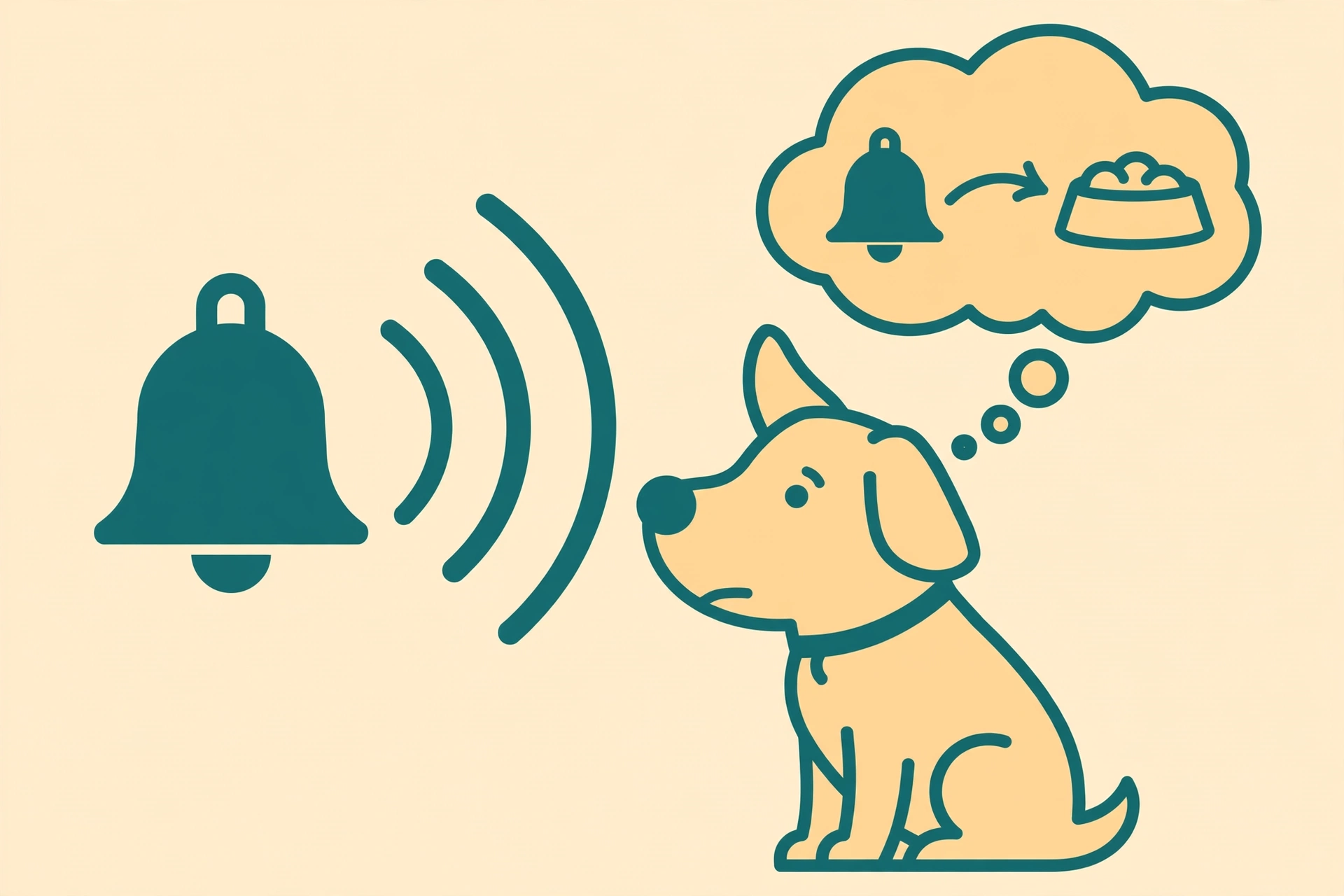
He tested it deliberately: ring a bell, then give food. Bell, then food. Soon, the bell alone made the dogs salivate. The dogs had formed an association.
Psychologists named the pieces. The food is the unconditioned stimulus — it naturally triggers drooling. The bell starts as a neutral stimulus. After pairing, the bell becomes a conditioned stimulus that triggers the conditioned response (drooling to the bell).
The Science Behind It
Pavlov’s work (1927) launched the behaviorist movement. John Watson then showed it works in humans: in the “Little Albert” experiment (1920), Watson paired a loud bang with a white rat until a baby feared the rat — and then all furry things.
Pavlov also discovered nuances. Extinction: ring the bell many times without food, and drooling fades. Generalization: dogs also drooled to similar bells — why one bad dog experience makes you nervous around all dogs.
3 Examples From Real Life
Example 1 — The dentist’s waiting room: Your heart pounds at the antiseptic smell — before seeing any instrument. The smell (neutral) got paired with pain. Now the smell alone triggers dread. You’re conditioned, not dramatic.
Example 2 — The phone buzz phantom: You feel your phone vibrate. You check — nothing. That notification ding has been paired with social rewards so many times your brain hallucinates the cue. Tech companies engineer these associations deliberately.
Example 3 — The song that wrecks you: A song comes on and you’re instantly back in your ex’s car. Music got paired with intense emotion. Now the song alone resurrects the feeling. Advertisers pay millions to pair products with catchy music — they’re Pavlov, you’re the dog.
🧠 Quick check: In Pavlov's experiment, what was the conditioned stimulus?
Why: The bell started neutral and became meaningful only through association with food.
Try This Today
Spot one conditioned response in your life. The ping that makes you grab your phone? Sunday-evening dread? Write down: cue → response. Was this useful learning or hijacked learning? Naming it is the first step.
What People Get Wrong
Myth: “Conditioning is just for animals.”
Reality: Advertising, political messaging, and app design are applied classical conditioning on humans at scale. The jingle, the logo with happy people — all Pavlovian. Humans aren’t exempt; we’re the target market.
Why It Matters
Classical conditioning explains phobias, cravings, prejudices, and brand loyalty. But the same system that built unwanted associations can dismantle them — therapies for phobias use extinction deliberately. You can’t delete conditioning. But you can recondition.
🧠 Quick check: What is extinction in classical conditioning?
Why: Bell with no food, over and over → drooling fades. Associations weaken without reinforcement.
Frequently Asked Questions
What is classical conditioning?
Classical conditioning is learning through association. When two things repeatedly occur together, your brain links them, so one starts triggering a response to the other, like a bell triggering salivation after being paired with food.
What was Pavlov's experiment?
Pavlov noticed dogs salivating at the sight of the lab assistant who fed them. He tested it deliberately: bell, then food, repeated until the bell alone made dogs salivate. The food is the unconditioned stimulus, the bell becomes the conditioned stimulus, and drooling to the bell is the conditioned response.
What is extinction in classical conditioning?
Ringing the bell many times without food makes the drooling fade. Extinction is how unwanted associations are dismantled: therapies for phobias use it deliberately, pairing the feared thing with safety until the response weakens.
What is the difference between classical and operant conditioning?
Classical conditioning is passive association: a stimulus triggers an involuntary response. Operant conditioning is active: behavior is shaped by its consequences. Classical conditioning explains cravings and phobias; operant conditioning explains habits and choices.
Try It on Our Site
Try it now: Phone Checking check-in — see classical conditioning running your own thumb — cue, craving, check. Start the check-in →
More tools for this topic:
Related reading: 10. Operant Conditioning · 45. How Habits Form · Why You Keep Checking Your Phone
Tap when this one clicks — your progress is saved on this device.