
Reviewed by a Psychology Postgraduate (MA)
You don’t decide to check your phone 100 times a day. You don’t decide to bite your nails. You just… do. That’s a habit: behavior on autopilot. Habits run ~40% of your daily actions — your life is largely automatic. Understanding the loop that builds them means you can reprogram it. Here’s the science.
What it means in one sentence: Habits are automatic behaviors formed by repeating a cue → routine → reward loop — until the brain outsources them to autopilot.
In short: How do habits form? Through the cue-routine-reward loop: a trigger sparks a behavior, and the reward teaches your brain to automate it. Repeated enough, the behavior runs on autopilot — habits drive roughly 40% of daily actions. To change one, keep the cue and reward but swap the routine.
How Habits Form in Everyday Words
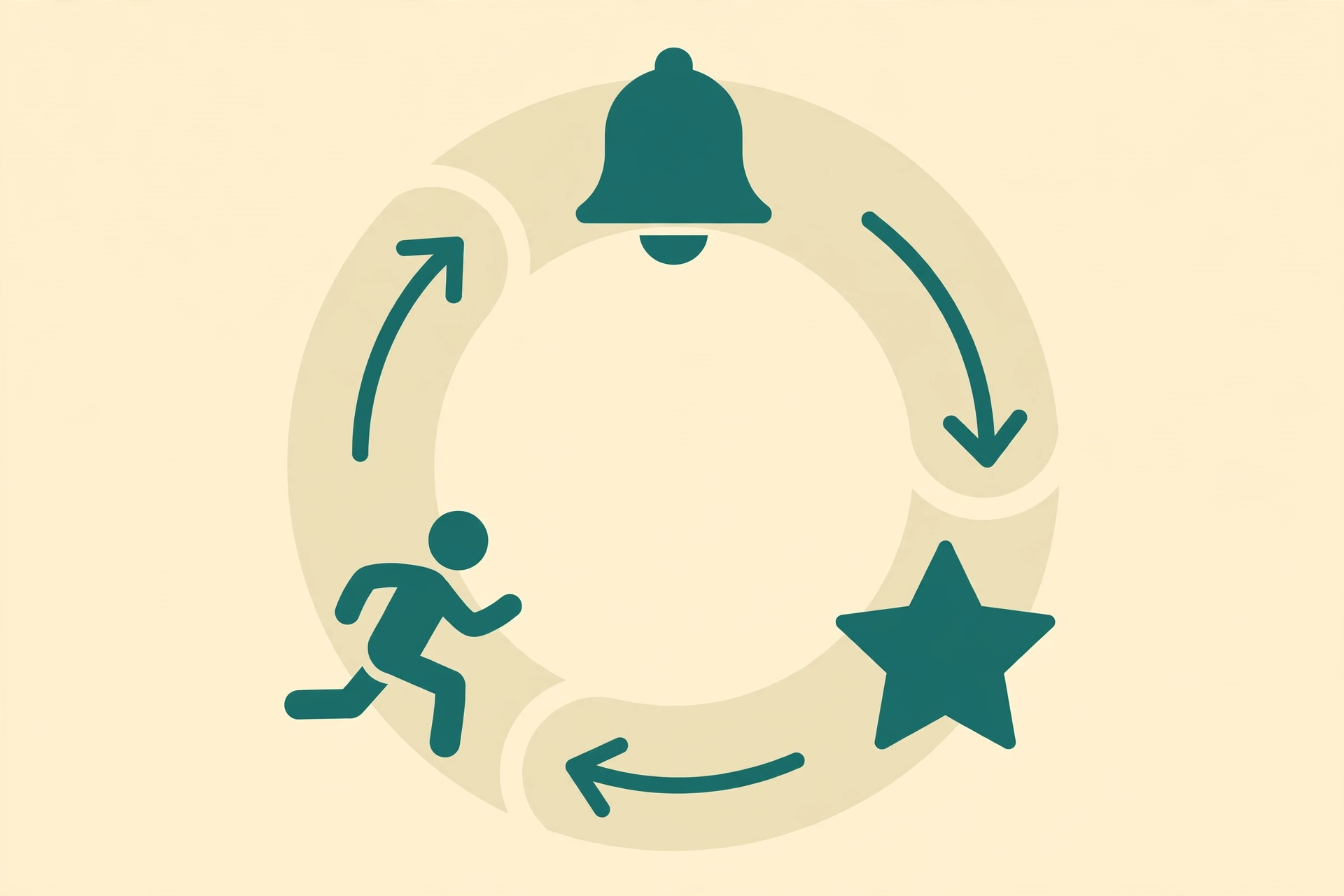
The loop (Duhigg): Cue (trigger: time, place, emotion, preceding action) → Routine (the behavior) → Reward (the payoff: dopamine, relief, satisfaction). Repeat → the brain chunks it (basal ganglia takes over from prefrontal — less effort). Eventually: cue alone triggers routine — no decision needed.
Why habits stick: They’re efficient. The brain loves autopilot — it saves energy. But autopilot doesn’t evaluate — it just runs. Good habits (exercise) and bad (smoking) use the same machinery.
Breaking: You can’t erase a habit — but you can replace it. Keep the cue and reward, swap the routine: stressed (cue) → walk (not smoke) → relief (reward). The loop remains; the behavior changes. Willpower fights the loop; redesign rewires it.
The Science Behind It
Basal ganglia: As habits form, brain activity shifts from prefrontal (decision) to basal ganglia (autopilot). fMRI shows less brain activity for habitual vs. novel behaviors — that’s the efficiency. But it also means habits are insensitive to outcomes — you keep doing them even when they stop rewarding (the definition of addiction-adjacent).
Time: Not 21 days (myth). Lally (2010): average 66 days, range 18-254 — depending on complexity and consistency. Missing a day doesn’t reset — it’s total repetitions that matter.
Context: Habits are context-dependent. Change environment → habits weaken (that’s why moving breaks routines). Design beats discipline: make good habits easy (gym bag packed) and bad hard (phone in another room).
3 Examples From Real Life
Example 1 — The phone: Cue: boredom (emotion) or notification (external). Routine: check phone. Reward: novelty (dopamine). Repeat 100x/day → autopilot. You don’t decide — the cue triggers. Break: keep cue/reward, swap routine — bored → stretch (not scroll) → relief. Or remove cue: phone in drawer. Design, not willpower.
Example 2 — The runner: Cue: 6am alarm + shoes by bed. Routine: run. Reward: endorphins + pride. Month 1: effortful (prefrontal). Month 3: automatic (basal ganglia) — missing it feels wrong. Same loop as the phone — but programmed deliberately. Habits don’t care what they automate. You choose the program.
Example 3 — The smoker: Cue: coffee (preceding action). Routine: cigarette. Reward: nicotine + break. Quit attempts fail because they fight the loop (willpower vs. autopilot — autopilot wins). Success: replace — coffee → walk outside → break + fresh air. Same cue, same reward (break), different routine. The loop is preserved; the habit is transformed.
🧠 Quick check: What is the habit loop?
Why: Duhigg: the loop chunks behavior into autopilot. Breaking = keep cue/reward, swap routine. Design beats discipline.
Try This Today
Design one habit. Pick a tiny behavior (2 pushups, 1 page). Cue: attach to existing habit (“after coffee, I…”). Routine: make it ridiculously easy. Reward: mark it done (checklist, app). Repeat daily. Don’t optimize — automate. Small + consistent beats big + sporadic. The loop builds with reps.
What People Get Wrong
Myth: “21 days to form a habit — just use willpower.”
Reality: Average 66 days (range 18-254, Lally). And willpower loses to autopilot — that’s why habits exist (to bypass decision). The pros don’t rely on willpower — they design environment (cues visible for good, hidden for bad). You’re not weak — you’re fighting neuroscience. Stop fighting. Start designing.
Why It Matters
Habits are 40% of your life — on autopilot. That means 40% of your outcomes are programmed, not chosen. The good news: you can reprogram. Understand the loop, design the cues, swap the routines, protect the rewards. You’re not stuck with your habits. You’re the programmer. Code wisely.
🧠 Quick check: Why is 'just use willpower' bad advice for breaking habits?
Why: Autopilot beats effort. Pros design environment, not rely on discipline. Keep cue/reward, swap routine — rewire, don't fight.
Frequently Asked Questions
How do habits form?
Through the cue-routine-reward loop: a trigger sparks a behavior, and the reward teaches your brain to automate it. Repetition in a stable context moves the behavior to autopilot.
How long does it take to form a habit?
Longer than the mythic 21 days — research averages around two months, varying with complexity. Consistency in the same context matters more than perfection.
What is the habit loop?
Cue (the trigger, like morning coffee), routine (the behavior), reward (the payoff your brain learns to crave). Every habit, good or bad, runs this loop.
How do I break a bad habit?
Don’t fight the cue — redesign the routine. Keep the trigger and find a new reward: stressed at 3 PM? Walk instead of snack. Make the good choice the easy choice.
Try It on Our Site
Try it now: Screen Time check-in — audit the habit loop running your digital life. Start the check-in →
More tools for this topic:
Related reading: 10. Operant Conditioning · What Are Habits? · Why You Keep Checking Your Phone
Tap when this one clicks — your progress is saved on this device.